Spice Substitutes · Substitutes
Herbes de Provence Substitutes: Make Your Own or Swap a Blend
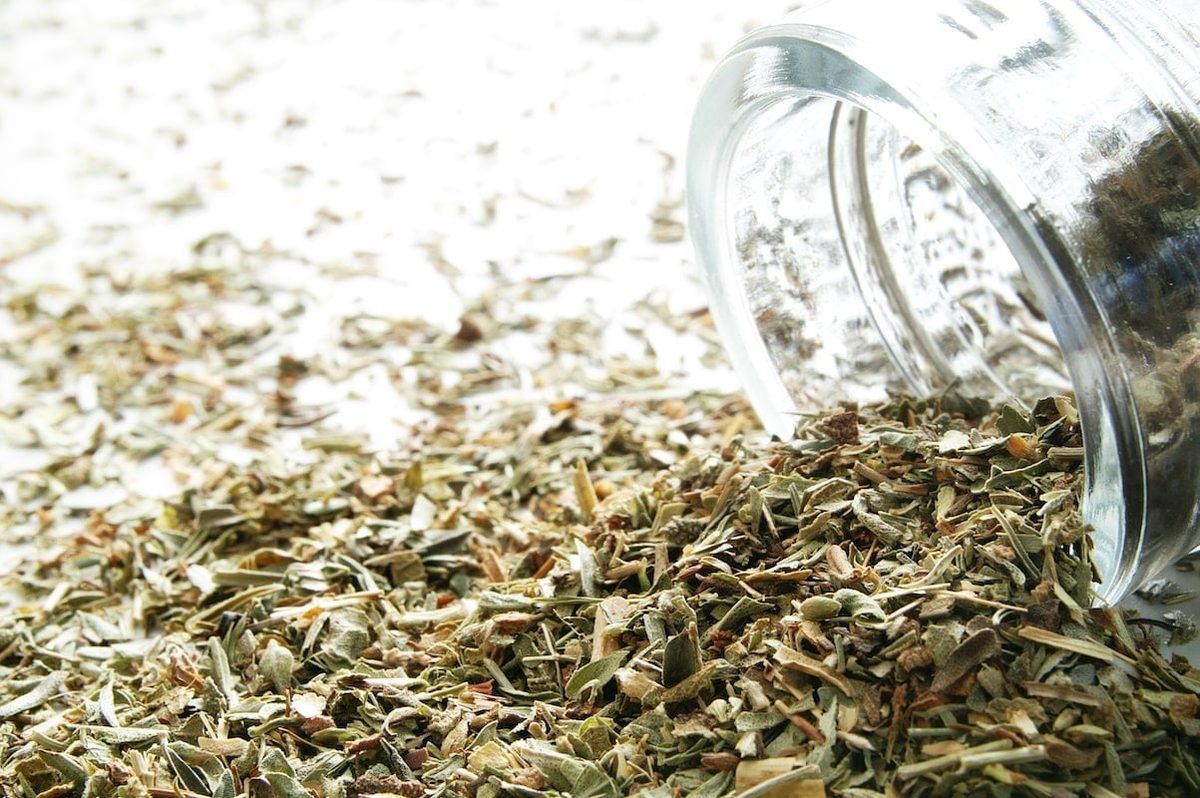
Herbes de Provence is a blend of dried herbs named for Provence in southeastern France. In France, one version carries the Label Rouge quality mark, and its specification fixes the herbs: thyme, rosemary, savory and oregano, with basil in the original version and no lavender.1 Outside that label there is no fixed recipe, and commercial blends may add marjoram, fennel seed, mint, tarragon or culinary lavender.2 Because the blend is just dried herbs, the best substitute is usually one you mix yourself. If you can’t, another blend will get you close.
Quick answer
| What you need | Best substitute | Starting amount, per 1 tsp herbes de Provence | Treatment |
|---|---|---|---|
| The full blend, with the herbs on hand | Homemade blend (thyme, savory, rosemary, oregano) | 1 tsp | Attributed (recipes) |
| A quick swap from the pantry | Italian seasoning | 1 tsp | Attributed |
| Only two or three herbs on hand | Thyme with savory or oregano | 1 tsp in total | Method |
| Fresh herbs instead of dried | Fresh thyme, rosemary, oregano | 1 Tbsp | Computed |
How the ratios on this page are labeled
- Computed: based on a measurable physical relationship, with the source named.
- Attributed: a named source publishes this ratio. We quote it as theirs.
- Disputed: named sources give different answers to the same swap. We show each one and do not average them.
- Method: we found no published ratio. We give a direction and a cautious starting point, and say so.
Why the herbs can stand in for each other
The main herbs in the blend get much of their aroma from related compounds. In one 2023 sample of common thyme, thymol made up 42.44 percent of the oil.3 In oregano, carvacrol and thymol together make up about 78 to 85 percent of the oil, according to a 2020 review.4 A 2018 review of summer savory gives carvacrol at 11 to 67 percent and thymol at 0.3 to 28.2 percent across studies.5 That overlap is why thyme and oregano can cover for a missing savory, and the reverse. This is our reading of the chemistry, not the result of a taste test. Rosemary is different: in one set of samples its oil was led by α-pinene and 1,8-cineole,6 and in our judgment it tastes quite unlike the other three. See the herbes de Provence profile for the full table.
If you have the herbs: make your own
1. The Label Rouge proportions
The certified French blend is the one version with published proportions. Ducros’s 2025 specification for its Label Rouge blend lists rosemary, savory and oregano at 27 percent each and thyme at 19 percent.7 The 2014 specification text on the website of France’s INAO, the agency that oversees the label, shows 19 percent thyme, 26 or 27 percent each of rosemary, savory and oregano, and 3 percent basil.1
Ratio (Attributed): By the Ducros figures, a teaspoon of blend is roughly 1/4 teaspoon each of rosemary, savory and oregano plus a scant 1/4 teaspoon of thyme. The percentages are the specification’s. The conversion to spoons is ours, and it is approximate, because the specification does not say the percentages are by volume and cut herbs differ in density.
2. The Spice House’s version, with lavender
The Spice House gives this mix: 2 teaspoons dried thyme, 2 teaspoons dried savory, 1 teaspoon dried marjoram, 1 teaspoon dried lavender, 1/2 teaspoon dried rosemary, 1/2 teaspoon fennel seeds and 1 crushed bay leaf.8 It is much lighter on rosemary than the Label Rouge recipe and adds lavender, marjoram, fennel and bay.
Ratio (Attributed): Use the mix in place of the same amount of store-bought blend. The Spice House suggests starting with about 1 to 2 teaspoons of the dried blend per pound of meat.8
What about lavender?
Lavender is not part of the Label Rouge recipe.1 The Takeout’s Leah Kaplan writes that it was added to the blend to appeal to tourists, which is her account rather than a documented history.2 You can leave it out. The Spice House suggests skipping it or using a very small pinch of lemon zest for brightness instead.8
Other recipes
Kaplan reports that Julia Child’s version called for only dried thyme or savory, dried basil and ground fennel seed.2 She also suggests grinding the rosemary and fennel before mixing in the other herbs.2
If you need a quick swap: Italian seasoning
The USDA’s purchase specification describes Italian seasoning as a blend of thyme, rosemary, sage, oregano and basil.9 That covers three of the four Label Rouge herbs. It has no savory, and it adds sage. The Spice House says Italian seasoning works in a pinch but lacks lavender and savory, so the flavor will be different.8
Ratio (Attributed): The Takeout says the two blends can typically be swapped one for one in everyday cooking.2 The Spice House names Italian seasoning without giving an amount.8
If you have thyme or savory, adding a pinch to the Italian seasoning moves it closer to herbes de Provence. That is our judgment, based on the chemistry above.
If you have only a few of the herbs
Ratio (Method): No published ratio. Thyme is the most useful herb to build on, because its main compound, thymol, also turns up in savory and oregano.534 A starting point: two parts thyme to one part savory or oregano, plus a little crumbled rosemary if you have it, used in the same total amount as the blend. Adjust the next time you make the dish.
If you have fresh herbs instead of dried
Ratio (Computed): Penn State Extension’s conversion is 1 tablespoon fresh herbs to 1 teaspoon dried herbs to 1/4 teaspoon powdered herb.10 America’s Test Kitchen found that 1 part dried to 3 parts fresh came closest to equal flavor, for hardy herbs in dishes with a fairly long cooking time (more than 20 minutes) and a good amount of liquid.11 The Spice House gives the same rough three-to-one rule.8 Thyme, rosemary, oregano and savory are all hardy herbs that suit this, in our judgment. Chop them finely and add them early so they have time to soften.
Other blends
Herbes de la Garrigue. World Spice Merchants describes its Herbes de la Garrigue as similar to herbes de Provence, with the additions of rosemary, fennel, mint and Turkish bay leaf.12 Recipes vary by maker. Ratio (Method): no published ratio; start one for one and taste for mint.
Fines herbes is not a good swap. Britannica lists its common ingredients as parsley, chives, tarragon and chervil.13 Those are delicate herbs, used fresh, with none of the main herbes de Provence herbs. In our judgment they belong in a different kind of dish.
What isn’t known
- No published taste test compares herbes de Provence with Italian seasoning or with any homemade mix. The Takeout’s one-for-one swap is a writer’s guidance.
- Commercial herbes de Provence has no fixed recipe outside the Label Rouge, so a store-bought jar may differ from both recipes above.
- We could not open the final approved text of the current Label Rouge specification; the 2014 text and the 2025 Ducros sheet differ slightly on rosemary, savory, oregano and basil.17
Related
- Herbes de Provence, herbes de Provence uses, cooking with herbes de Provence
- Herbes de Provence vs. Italian seasoning, Italian seasoning, Italian seasoning substitutes
- Thyme, summer savory, winter savory, rosemary, oregano, marjoram, lavender, fennel seed, bay leaves
- Thyme substitutes, summer savory substitutes, lavender substitutes
- Fines herbes, bouquet garni
Footnotes
-
Cahier des charges du Label Rouge LA 02/03 « Herbes de Provence », modification request, INAO, 2014. extranet.inao.gouv.fr · Regulator ↩ ↩2 ↩3 ↩4
-
Leah Kaplan, “What Is Herbs De Provence, Really?”, The Takeout, 2025. thetakeout.com · Publication ↩ ↩2 ↩3 ↩4 ↩5
-
Dong et al., “Chemical Compositions of Essential Oil Extracted from Eight Thyme Species”, Plants, 2023. mdpi.com · Peer-reviewed ↩ ↩2
-
Lombrea et al., “A Recent Insight Regarding the Phytochemistry and Bioactivity of Origanum vulgare L. Essential Oil”, International Journal of Molecular Sciences, 2020. mdpi.com · Peer-reviewed ↩ ↩2
-
Fierascu et al., “Phytochemical Profile and Biological Activities of Satureja hortensis L.”, Molecules, 2018. mdpi.com · Peer-reviewed ↩ ↩2
-
Satyal et al., “Chemotypic Characterization and Biological Activity of Rosmarinus officinalis”, Foods, 2017. mdpi.com · Peer-reviewed ↩
-
“Provencal herbs red label 78g”, product specification, McCormick for Chefs (Ducros), 2025. mccormickforchefs.com · Merchant ↩ ↩2
-
“Herbes De Provence Substitute”, The Spice House, 2017. thespicehouse.com · Merchant ↩ ↩2 ↩3 ↩4 ↩5 ↩6
-
Commercial Item Description A-A-20001C, Spices and Spice Blends, USDA Agricultural Marketing Service, 2023. ams.usda.gov · Regulator ↩
-
Stacy Reed, “Preserving Herbs by Drying”, Penn State Extension, 2024. extension.psu.edu · Reference work ↩
-
“Science: Substituting Dried Herbs for Fresh”, America’s Test Kitchen. americastestkitchen.com · Publication ↩
-
“Herbes de la Garrigue”, World Spice Merchants. worldspice.com · Merchant ↩
-
“Fines herbes”, Encyclopaedia Britannica. britannica.com · Reference work ↩