Spice Comparisons · Comparison
Dried Coriander Seed vs. Fresh Green Coriander: Two Stages of One Fruit
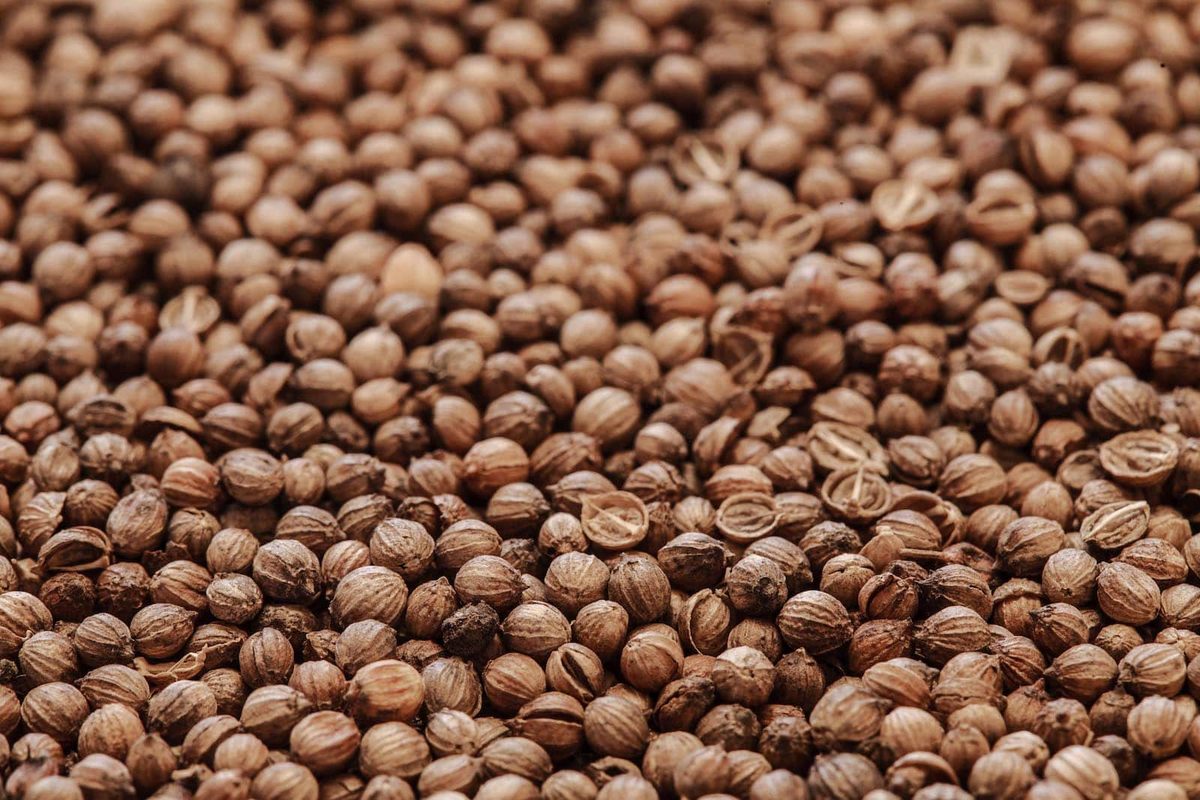
“Dried coriander” and “fresh coriander” mean different things depending on where you are. In North American English, the leaves of the plant are cilantro, and coriander is usually the seed; Oxford’s learner’s dictionary labels “cilantro” as North American and defines coriander as a plant whose leaves are used as an herb and whose seeds are used as a spice.12 If you are looking for dried versus fresh leaves, see dried vs. fresh cilantro. This page compares the seed in its two forms: the familiar dried, ripe seed, and fresh green coriander, the unripe seed picked before it dries.
The short answer: they are the same fruit at two stages, and the stage changes the chemistry. As the fruit ripens, the sharp aldehydes it shares with the leaf disappear from its oil, and the ripe seed is led by linalool instead.3 That is why chef Alan Bergo describes green coriander as a bit like a cross between dried coriander seed and cilantro.4
Side by side
| Dried coriander seed | Fresh green coriander | |
|---|---|---|
| Plant | Coriandrum sativum, family Apiaceae56 | Same |
| Part used | The ripe, dried fruit (a schizocarp), sold as “seed”3 | The unripe fruit, harvested green before it matures and dries4 |
| Looks | Ovoid to round, up to 5 mm across, yellow-brown, with ten lengthwise ribs3 | Green; the aroma sits largely in the green husk around the seed4 |
| Key compounds | Linalool, usually more than 60% of the oil (PROSEA); 60 to 80% (2023 review)37 | Not analyzed in any source we found; PROSEA says the aldehydes of the oil disappear during ripening3 |
| Flavor | Mild, sweet, warm and aromatic (2023 review);7 sweetly aromatic, nutty and spicy (Wisconsin Master Gardeners)8 | Intense, “almost electric” (Bergo);4 part leaf, part seed |
| Forms | Whole, ground, essential oil | Fresh from the plant; brined or frozen to keep4 |
| Typical uses | Curry powder, spice blends, baked goods, sausages, pickles38 | Raw: salsa, sauces, dressings, raw fish; pickles and brines4 |
| Keeps | Whole dried seed keeps its oil for years; once crushed, the oil quickly goes3 | Weeks in the refrigerator, per Bergo; he recommends freezing4 |
| Where to get it | Any grocery | Not a standard grocery item (editorial); mostly from gardens, where cilantro bolts to seed in hot weather8 |
The difference is ripeness
PROSEA, the Southeast Asian plant reference, places volatile compounds with a smell it calls bug-like in the roots, stems and leaves.3 During ripening, it says, the aldehydic components of the fruit’s oil disappear and its odor changes notably.3 What remains in the ripe seed is dominated by linalool: PROSEA’s composition table gives 63.8%, with camphor and p-cymene as minor components.3 The leaf’s aldehydes, for comparison, make up more than 80% of its volatile oil.3
So green coriander is not a “fresh” version of the spice in the way fresh ginger is a fresh version of dried ginger. It is the fruit at an earlier stage, before its chemistry has switched over. We found no published analysis of green coriander’s oil composition, so the claim that it sits between leaf and seed rests on PROSEA’s description of ripening3 and on cooks’ descriptions,4 not on a measurement.
Using dried coriander seed
PROSEA calls the fruit a spice in a large number of dishes and notes that curry powder can contain up to 40% coriander,3 and USDA’s purchasing specification lists coriander among the ingredients of curry powder.9 The Wisconsin Master Gardener program lists cookies and other baked goods, soups, casseroles and sausages, and notes that Arabic cooking uses both leaves and seeds in pickles, curries and chutneys.8 Garam masala is a common home for it too, but not every version includes it: Bong Eats describes the most basic Bengali garam masala as cardamom, cinnamon and cloves, while Healthline lists coriander as a garam masala ingredient.1011
For whole to ground, McCormick gives 1 teaspoon of seeds as equal to 1 1/4 teaspoons ground.12 That is a volume conversion (ground spice takes up more room), not a strength figure. Because PROSEA says crushed coriander loses its oil quickly while whole seed keeps it for years,3 buying whole and grinding as needed keeps more flavor.
Using fresh green coriander
Bergo’s suggestions are to chop it into salsa for extra punch, add it to sauces and dressings, use it with raw fish, tartare and sushi, and crush it into pickles and brines.4 He calls fermenting the seeds in brine a useful way to preserve them, and in reply to a reader recommends a 3 to 5% brine for caper-style seeds.4 He says fresh green seeds can last for weeks in the refrigerator and suggests freezing them in a jar.4
Green coriander is mostly a gardener’s ingredient. Cilantro is a cool-season crop that bolts, or runs to seed, in hot weather,8 so a summer patch that has gone to flower is where most people will find it.
Can one stand in for the other?
Only partly, and no source gives a ratio either way.
- Green coriander in place of dried, in pickles and brines (Method). This is the best fit, since Bergo already uses crushed green seeds in pickles.4 Expect a greener, more cilantro-like result. We found no published ratio. Start with roughly the same volume, crushed, and taste the brine after a day or two.
- Green coriander in place of dried, in spice blends or rubs. In our judgment this doesn’t work: the fresh seed is moist and won’t grind to a powder or keep in a dry blend.
- Dried coriander in place of green, raw (Method). The flavor is different, and in our judgment whole dried seed is too hard to eat raw. If a recipe wants green coriander’s leafy note, a little chopped fresh cilantro plus a pinch of freshly ground coriander seed covers both sides. That pairing is a kitchen suggestion, not a tested substitute; start small and taste.
For other stand-ins for the dried seed (cumin, caraway, curry powder), see coriander substitutes. For the leaf, see cilantro substitutes.
What isn’t known
- No published analysis of green (unripe) coriander’s oil composition was found; its chemistry is inferred from PROSEA’s description of ripening.
- No source gives a size comparison between green and dried seeds.
- No published ratio exists for swapping green and dried coriander.
- How long brined or frozen green coriander keeps its flavor: not measured in any source reviewed.
Related
- Coriander: the full seed profile, including production and storage
- Cilantro: the leaf profile
- Coriander substitutes and cilantro substitutes
- Coriander vs. cilantro and dried vs. fresh cilantro
- Dried herbs vs. fresh: the general rules for leafy herbs
- Cooking with coriander, how to store coriander and too much coriander
- Coriander vs. cumin, curry powder and garam masala
Footnotes
-
“cilantro”, Oxford Learner’s Dictionaries. oxfordlearnersdictionaries.com · Reference work ↩
-
“coriander”, Oxford Learner’s Dictionaries. oxfordlearnersdictionaries.com · Reference work ↩
-
Coriandrum sativum, Plant Resources of South-East Asia (PROSEA). uses.plantnet-project.org · Reference work ↩ ↩2 ↩3 ↩4 ↩5 ↩6 ↩7 ↩8 ↩9 ↩10 ↩11 ↩12 ↩13 ↩14
-
Alan Bergo, “Green Coriander or Unripe Cilantro Seeds”, Forager | Chef, 2021, updated 2026. foragerchef.com · Publication ↩ ↩2 ↩3 ↩4 ↩5 ↩6 ↩7 ↩8 ↩9 ↩10 ↩11 ↩12
-
Coriandrum sativum L., Plants of the World Online, Royal Botanic Gardens, Kew. powo.science.kew.org · Reference work ↩
-
“Coriander”, Encyclopaedia Britannica. britannica.com · Reference work ↩
-
Al-Khayri et al., “Essential Oil from Coriandrum sativum: A Review on Its Phytochemistry and Biological Activity”, Molecules, 2023. mdpi.com · Peer-reviewed ↩ ↩2
-
Susan Mahr, “Cilantro”, Wisconsin Master Gardener Program, University of Wisconsin-Madison, 2017. mastergardener.extension.wisc.edu · Reference work ↩ ↩2 ↩3 ↩4 ↩5
-
Commercial Item Description A-A-20001C: Spices and Spice Blends, USDA Agricultural Marketing Service, 2023. ams.usda.gov · Regulator ↩
-
“Bengali Garam Masala”, Bong Eats, 2016. bongeats.com · Publication ↩
-
Jillian Kubala, “The 7 Best Substitutes for Coriander and Cilantro”, Healthline, 2018. healthline.com · Publication ↩
-
“How to Grind Your Own Spices, Plus Spice Conversions”, McCormick, 2025. mccormick.com · Merchant ↩