Spice Substitutes · Substitutes
Coriander Substitutes, Ranked by the Job Coriander Is Doing
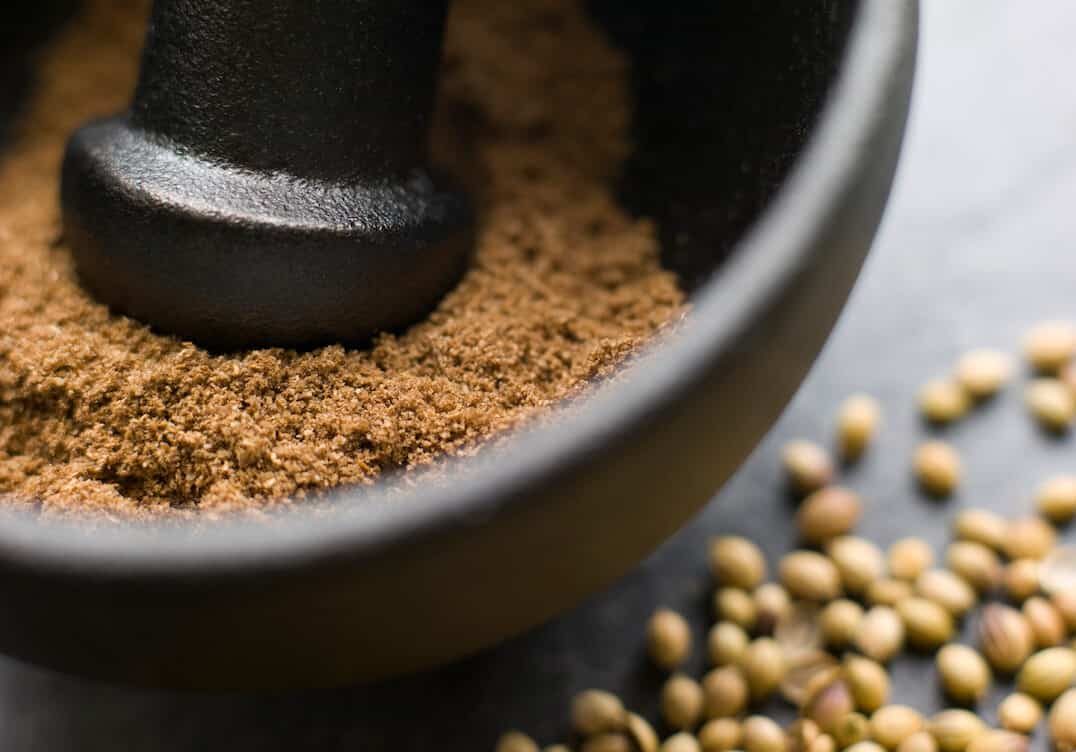
Coriander is the dried fruit of Coriandrum sativum, an annual of the parsley family (Apiaceae) whose young leaves are sold as cilantro.1 The main compound in the seed’s oil is always linalool, usually more than 60 percent of it,2 and a 2023 review puts linalool at 60 to 80 percent and describes the flavor as mild, sweet and warm.3 No common spice shares that linalool-led profile, so every swap below changes the dish a little. Which one changes it least depends on what the coriander is there to do.
Quick answer
| What coriander is doing | Best substitute | Starting amount, per 1 part coriander | Treatment |
|---|---|---|---|
| Warm, earthy base note (rubs, chili, stews, spice mixes) | Ground cumin | 3/4 to 1 part | Attributed |
| A seed note in breads, sausages, pickles | Caraway | 3/4 part, up to 1 part | Attributed |
| One spice among many in a curry | Curry powder | 1/2 part, up to 3/4 part | Attributed |
| Same, where yellow color is unwanted | Garam masala | 1/2 to 3/4 part | Attributed |
| You have whole seeds and the recipe says ground | Whole coriander, ground at home | 1 tsp seed for 1 1/4 tsp ground | Computed |
Cilantro is not on the list. The leaf and the seed come from the same plant but taste different, for reasons explained below.
How the ratios on this page are labeled
Every ratio carries one of four labels.
- Computed: based on a measurable physical relationship, with the source named.
- Attributed: a named source publishes this ratio. We quote it as theirs.
- Disputed: named sources give different answers to the same swap. We show each one and do not average them.
- Method: we found no published ratio. We give a direction and a cautious starting point, and say so.
The published ratios below come from a spice merchant and a food writer. Neither says how the figures were arrived at, so treat them as rules of thumb, not measurements of flavor strength.
If coriander is a warm, earthy base note
In rubs, chili, bean dishes and many spice mixes, coriander rounds out stronger spices rather than standing out. The Spice House recommends cumin for warm, earthy depth.4
1. Ground cumin
Cumin is the most practical swap because most kitchens have it. It is also much louder than coriander. Its oil is led by cuminaldehyde, which PROSEA puts at 20 to 72 percent of the oil depending on the sample,5 while coriander’s is led by linalool.3 The two do not share a main compound, so cumin brings its own earthy, savory character rather than coriander’s sweet, citrusy one. Use it where coriander plays a supporting role; it is a poor choice in a sweet bake or a delicate sauce.
Ratio (Attributed): The Spice House says to replace 1 teaspoon of ground coriander with 3/4 to 1 teaspoon of ground cumin, then adjust to taste.4 Healthline says cumin can be used one to one.6 The two agree at the top of the range. If the dish already contains cumin, start at the low end.
If coriander is a seed note in breads, sausages or pickles
Here coriander’s own aroma matters more, and you want another parsley-family seed with a sweet, warm side.
1. Caraway
Caraway is also in the parsley family.7 Britannica describes its aroma as reminiscent of anise, with a warm, slightly sharp taste, and gives d-carvone and d-limonene as the principal components of its oil.7 That is a different chemistry from coriander’s linalool,3 so expect a rye-bread note in place of coriander’s citrus. Caraway works best where that note fits, such as breads, sausages, cabbage and pickles; in our judgment it is a weaker fit in curries.
Ratio (Attributed): The Spice House says caraway can be used at 3/4 to 1 teaspoon per teaspoon of coriander, but to watch for its stronger profile.4 Healthline says caraway can be substituted equally but suggests starting with a small amount, because its flavor notes differ.6 Both sources point the same way: start at 3/4 and add more only after tasting.
If coriander is one spice among many in a curry
When coriander is one of six or eight spices, a blend that already contains it can stand in, as long as you account for everything else it brings.
1. Curry powder
PROSEA notes that curry powder can contain up to 40 percent coriander,2 and the USDA’s purchasing specification lists coriander among the ingredients curry powder should include, along with turmeric, fenugreek, cinnamon, cumin, black pepper, ginger and cardamom.8 Turmeric is regulated in the US as a color additive,9 so expect the dish to turn yellower. If the recipe already uses several of those spices, reduce them a little.
Ratio (Attributed): The Spice House suggests 1/2 to 3/4 teaspoon of curry powder per teaspoon of coriander.4 Healthline says to start with half the amount.6 Start at half.
2. Garam masala
Garam masala varies by region and cook. Bong Eats describes its most basic form as cardamom, cinnamon and cloves,10 which contains no coriander at all, while Healthline describes coriander as one of its ingredients.6 Check the label. A blend without coriander will add warmth but not replace it.
Ratio (Attributed): The Spice House suggests 1/2 to 3/4 teaspoon of garam masala per teaspoon of coriander.4 Healthline gives no figure and says to add it in small amounts until the dish tastes right.6 Start at half.
If you have whole coriander and the recipe calls for ground
This is the best fix of all, because it is still coriander. Toast the seeds lightly if you like, then grind them.
Ratio (Computed): McCormick’s conversion is 1 teaspoon of coriander seeds to 1 1/4 teaspoons of ground coriander.11 That is a volume figure: ground spice takes up more room than the seed it came from. It says nothing about strength.
Why cilantro is not a substitute
The leaf and the seed are the same plant at different stages, but their chemistry changes as the fruit ripens. PROSEA says the aldehydes in the oil disappear during ripening and the smell of the fruit changes notably,2 which leaves the ripe seed dominated by linalool. The Spice House says fresh cilantro and dried coriander seeds have very different flavors and are not interchangeable.4 If a recipe says “coriander” but means the fresh leaf, see cilantro substitutes instead.
What isn’t known
- No published study compares the flavor strength of coriander with cumin, caraway or any blend. Every Attributed ratio above is a rule of thumb.
- No published figure was found for how much coriander a typical garam masala or a given brand of curry powder contains. PROSEA’s 40 percent is a maximum, not a typical value.
- It is sometimes said that black cumin smells sweeter and closer to coriander than ordinary cumin, or that cumin mixed with fennel seed comes closest to coriander. No source reviewed here supports either claim.
Related
- Coriander, cooking with coriander and how to store coriander
- Coriander vs. cumin, coriander vs. cilantro and dried vs. fresh coriander
- Cumin, caraway seeds, curry powder and garam masala
- Too much coriander? How to fix the dish
Footnotes
-
Coriander, Encyclopaedia Britannica. britannica.com · Reference work ↩
-
Coriandrum sativum, Plant Resources of South-East Asia (PROSEA). uses.plantnet-project.org · Reference work ↩ ↩2 ↩3
-
Al-Khayri et al., Essential Oil from Coriandrum sativum, Molecules, 2023. mdpi.com · Peer-reviewed ↩ ↩2 ↩3
-
Coriander Substitute, The Spice House, 2018. thespicehouse.com · Merchant ↩ ↩2 ↩3 ↩4 ↩5 ↩6
-
P.C.M. Jansen, Cuminum cyminum, Plant Resources of South-East Asia (PROSEA). uses.plantnet-project.org · Reference work ↩
-
Jillian Kubala, The 7 Best Substitutes for Coriander and Cilantro, Healthline, 2018. healthline.com · Publication ↩ ↩2 ↩3 ↩4 ↩5
-
Caraway, Encyclopaedia Britannica. britannica.com · Reference work ↩ ↩2
-
Commercial Item Description A-A-20001C, Spices and Spice Blends, USDA Agricultural Marketing Service, 2023. ams.usda.gov · Regulator ↩
-
21 CFR 73.600, Turmeric, US Code of Federal Regulations. ecfr.gov · Regulator ↩
-
Bengali Garam Masala, Bong Eats, 2016. bongeats.com · Publication ↩
-
How to Grind Your Own Spices, McCormick, 2025. mccormick.com · Merchant ↩