Spice Comparisons · Comparison
Coriander vs. Cilantro: One Plant, Two Ingredients, Two Chemistries
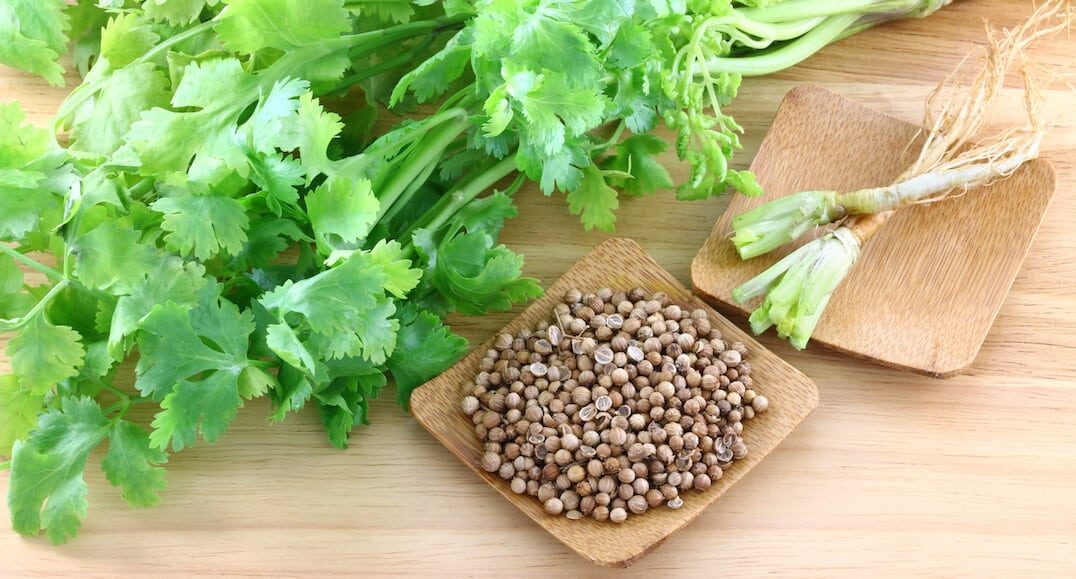
Cilantro and coriander come from the same plant, Coriandrum sativum, but they are different ingredients. Cilantro is the fresh leaf; coriander, in American usage, is the dried fruit sold as “seed”.12 As the fruit ripens, the sharp aldehydes that dominate the leaf disappear from its oil,3 its smell changes notably, and the ripe seed oil is led instead by linalool.34 That change is why one tastes bright and green, to some people soapy, and the other warm and mild, and why neither can stand in for the other.
What the names mean
Oxford’s learner’s dictionary labels “cilantro” as North American English for the leaves of the coriander plant, and defines “coriander” as a plant whose leaves are used as an herb and whose seeds are used as a spice.25 So in the US, “cilantro” means the leaf and “coriander” usually means the seed. Where “cilantro” is not used, “coriander” can mean either part, so check whether a recipe means leaf or seed before you shop.
“Cilantro” is the Spanish word. It came into English by 1907 from Spanish cilantro, a variant of culantro, from Latin coriandrum.6 (Culantro is now also the common name of a different plant; see culantro vs. cilantro.)
Side by side
| Cilantro | Coriander | |
|---|---|---|
| Plant | Coriandrum sativum, Apiaceae (parsley family)71 | Same plant71 |
| Native range | Eastern Mediterranean to western Pakistan (Kew)7 | Same plant |
| Part used | Fresh leaves and stems1 | Dried fruit (a schizocarp), sold as seed3 |
| Looks | Bright green, feathery leaves, sold in bunches1 | Ovoid to round fruit up to 5 mm across, yellow-brown, with ten lengthwise ribs3 |
| Essential oil | About 4 mg per gram of fresh leaf (PROSEA)3 | Almost zero to 2% of the seed (PROSEA); 0.18–1.40% (2023 review)34 |
| Main aroma compounds | Aldehydes, more than 80% of the leaf’s volatile oil, led by (E)-2-dodecenal at 15.6%3 | Linalool, usually more than 60% of the seed oil (PROSEA); 60–80% (2023 review)34 |
| Flavor (editorial, with sources) | Descriptions run from citrusy with a biting tang to soapy8 | Mild, sweet, warm and aromatic (2023 review); sweetly aromatic, nutty and spicy (Wisconsin extension)48 |
| Heat | A delicate herb, best added in the last minute or two9 | Usually toasted or bloomed, then cooked into the dish (common practice) |
| Keeps | Cut leaves about a week in the refrigerator8 | Whole dried seed keeps its oil for several years; once crushed, the oil quickly disappears3 |
| Forms | Fresh bunches; dried leaf | Whole seed, ground, essential oil |
The oil figures for the two parts come from the same PROSEA entry, but they are measured differently (milligrams per gram of fresh leaf against a percentage of dry seed), so read them as a description of each part rather than a ratio between them.
Why they taste so different
PROSEA puts the volatile oil of the fresh leaf at about 4 mg per gram and says aldehydes make up more than 80% of it, with (E)-2-dodecenal, (E)-2-tetradecenal and (E)-2-decenal the largest components.3 Eriksson and colleagues describe those (E)-2-alkenals as soapy, fatty, “like cilantro” or pungent.10
During ripening, PROSEA says, the aldehydic components of the oil disappear and the smell of the fruit changes notably.3 The main component of the ripe seed oil is always linalool, usually more than 60%,3 and a 2023 review puts it at 60 to 80%.4
The soapy taste is a leaf problem
In a 2012 genetic study of 14,604 people of European ancestry, Eriksson and colleagues linked reports that cilantro tastes soapy to a variant near a cluster of smell-receptor genes. One of those genes, OR6A2, codes for a receptor that binds several of cilantro’s aldehydes.10 The genetic effect was small: common variants explained only about 0.087 of the heritability of the soapy-taste trait.10 Because the aldehydes disappear as the fruit ripens,3 the study’s findings concern the leaf. We found no study that asks whether people who taste soap in cilantro also dislike coriander seed.
How each one is used
Cilantro. Britannica says the young leaves are widely used in Latin American, Indian and Chinese dishes.1 The Wisconsin Master Gardener program notes cilantro in Mexican salsas and meat dishes, and says Arabic cooking uses both the leaves and the seeds in pickles, curries and chutneys.8 PROSEA adds that the aromatic taproots are eaten as a vegetable in China and Thailand.3 By common practice it is folded into guacamole and scattered over tacos and curries at the end.
Coriander. PROSEA describes the seed as a spice in a large number of dishes and an ingredient of curry powder, which can contain up to 40% coriander,3 and USDA’s purchasing specification for curry powder lists coriander among its ingredients.11 The Wisconsin program lists cookies and other baked goods, soups, casseroles and sausages, and notes that in England the seeds flavor liqueurs.8 Coriander is also a signature spice of Belgian witbier: Clemson Extension traces the style to Flanders and says the coriander brings the orange and citrus aromas, alongside bitter orange peel.12
Nutrition: what a realistic serving supplies
Both are often credited with impressive nutrient numbers. The numbers are real per 100 grams, but nobody eats 100 grams of either.
| Per serving (USDA FoodData Central) | Cilantro, 1/4 cup (4 g)13 | Coriander seed, 1 tsp (1.8 g)14 |
|---|---|---|
| Vitamin K | 12.4 µg, about 10% of the Daily Value | No value listed |
| Vitamin A (RAE) | 13.5 µg, about 1.5% DV | 0 |
| Vitamin C | 1.1 mg, about 1% DV | 0.4 mg, under 1% DV |
| Dietary fiber | 0.1 g | 0.75 g, about 3% DV |
These are our calculations from USDA’s per-100 g values (cilantro: vitamin K 310 µg, vitamin A 337 µg, vitamin C 27.0 mg, fiber 2.8 g; coriander seed: fiber 41.9 g, vitamin C 21.0 mg) and USDA’s own portion weights, against FDA Daily Values of 120 µg vitamin K, 900 µg vitamin A, 90 mg vitamin C and 28 g fiber.131415 Cilantro is a meaningful vitamin K source only in large handfuls. This page makes no claim that either treats or prevents any condition.
Can one stand in for the other?
No. The Spice House says fresh cilantro and dried coriander seeds have very different flavors and are not interchangeable,16 and the chemistry above explains why. What to use instead depends on which one you are missing:
- Out of coriander seed: see coriander substitutes. Ground cumin and caraway are the attributed swaps there. If you have whole seed and the recipe calls for ground, McCormick’s conversion is 1 teaspoon of seed to 1 1/4 teaspoons ground (Computed, a volume figure).17
- Out of cilantro, or you taste soap: see cilantro substitutes, which covers culantro, flat-leaf parsley and Thai basil.
- Dried forms: see dried vs. fresh coriander and dried vs. fresh cilantro.
Safety
The FDA links recurring outbreaks of cyclosporiasis in the US in 2012 through 2015 to fresh cilantro from the state of Puebla, Mexico, and under Import Alert 24-23 it can detain fresh cilantro from Puebla offered for entry between April 1 and August 31 each year, unless it comes from a firm on its “Green List”.18 The alert concerns fresh cilantro, not dried coriander seed.
What isn’t known
- No study we found compares how people who dislike cilantro react to coriander seed.
- USDA’s coriander seed record lists no vitamin K value, so the two cannot be compared on that nutrient.
- Widely repeated uses of coriander seed in Danish pastries, butter cookies, posole, enchiladas and barbecue rubs could not be traced to a source.
- No source we found explains how “cilantro” came to dominate American usage.
Related
- Coriander, cooking with coriander, how to store coriander, too much coriander
- Cilantro, cooking with cilantro, how to store cilantro, too much cilantro
- Coriander vs. cumin, coriander vs. parsley, cilantro vs. parsley
Footnotes
-
“Coriander”, Encyclopaedia Britannica. britannica.com · Reference work ↩ ↩2 ↩3 ↩4 ↩5 ↩6
-
“cilantro”, Oxford Learner’s Dictionaries. oxfordlearnersdictionaries.com · Reference work ↩ ↩2
-
Coriandrum sativum, Plant Resources of South-East Asia (PROSEA). uses.plantnet-project.org · Reference work ↩ ↩2 ↩3 ↩4 ↩5 ↩6 ↩7 ↩8 ↩9 ↩10 ↩11 ↩12 ↩13 ↩14 ↩15
-
Al-Khayri et al., “Essential Oil from Coriandrum sativum: A Review on Its Phytochemistry and Biological Activity”, Molecules, 2023. mdpi.com · Peer-reviewed ↩ ↩2 ↩3 ↩4 ↩5
-
“coriander”, Oxford Learner’s Dictionaries. oxfordlearnersdictionaries.com · Reference work ↩
-
“cilantro”, Online Etymology Dictionary. etymonline.com · Reference work ↩
-
Coriandrum sativum L., Plants of the World Online, Royal Botanic Gardens, Kew. powo.science.kew.org · Reference work ↩ ↩2 ↩3
-
Susan Mahr, “Cilantro”, Wisconsin Master Gardener Program, University of Wisconsin-Madison, 2017. mastergardener.extension.wisc.edu · Reference work ↩ ↩2 ↩3 ↩4 ↩5
-
“Flavorful Herbs”, LSU AgCenter. lsuagcenter.com · Reference work ↩
-
Eriksson et al., “A genetic variant near olfactory receptor genes influences cilantro preference”, Flavour, 2012. link.springer.com · Peer-reviewed ↩ ↩2 ↩3
-
Commercial Item Description A-A-20001C: Spices and Spice Blends, USDA Agricultural Marketing Service, 2023. ams.usda.gov · Regulator ↩
-
Alex Ryan Thompson, “Beer Style Highlight: Belgian Witbier”, Clemson Cooperative Extension, 2025. hgic.clemson.edu · Reference work ↩
-
Coriander (cilantro) leaves, raw, FDC ID 169997, USDA FoodData Central. fdc.nal.usda.gov · Regulator ↩ ↩2
-
Spices, coriander seed, FDC ID 170922, USDA FoodData Central. fdc.nal.usda.gov · Regulator ↩ ↩2
-
“Daily Value on the Nutrition and Supplement Facts Labels”, U.S. Food and Drug Administration. fda.gov · Regulator ↩
-
“Coriander Substitute”, The Spice House, 2018. thespicehouse.com · Merchant ↩
-
“How to Grind Your Own Spices, Plus Spice Conversions”, McCormick, 2025. mccormick.com · Merchant ↩
-
Import Alert 24-23, U.S. Food and Drug Administration. accessdata.fda.gov · Regulator ↩