Cooking · Dish guide
Jambalaya Spices: The Trinity, Thyme, Bay, Cayenne and Louisiana Seasoning Blends
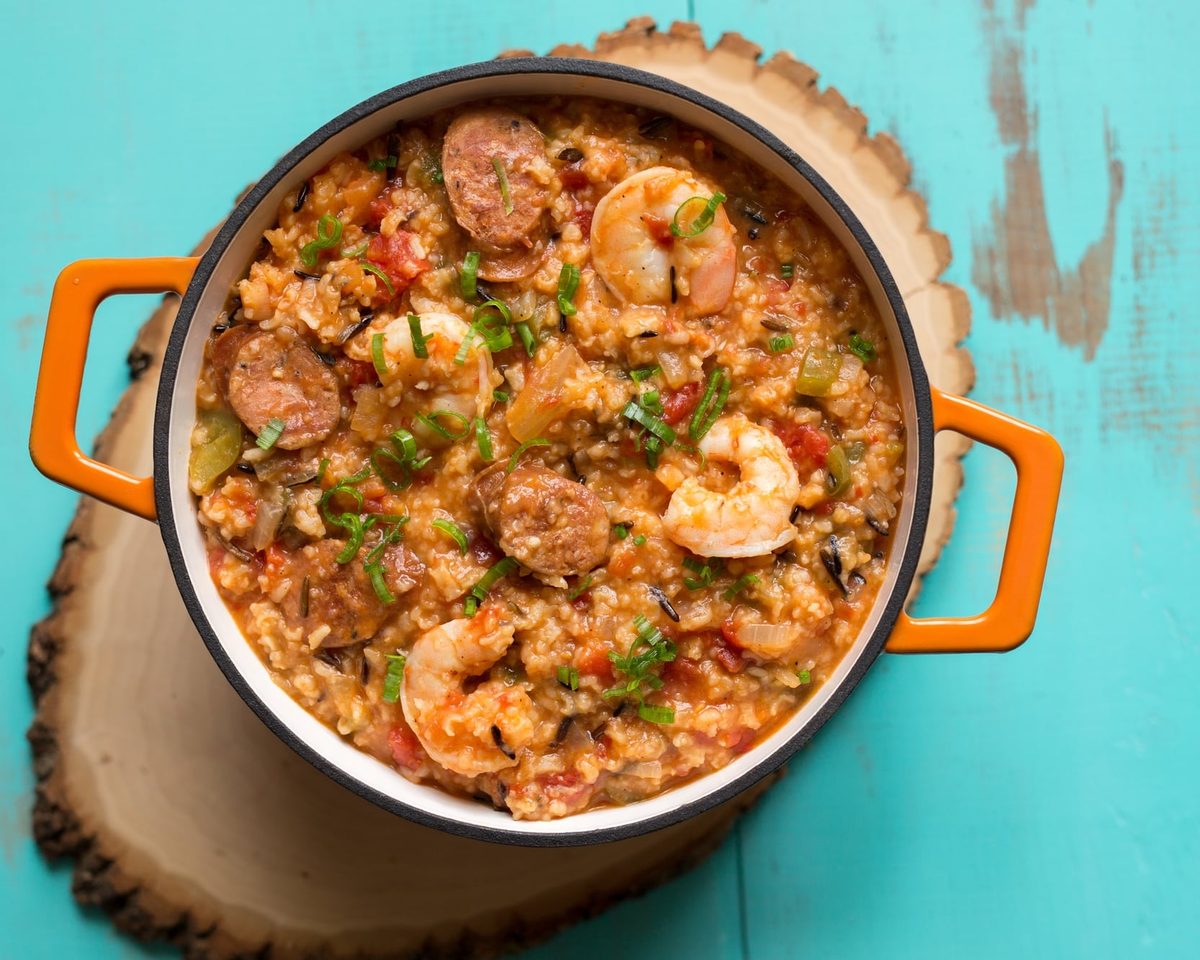
Jambalaya is a Louisiana rice dish of meat, seafood or both, cooked with vegetables, stock and seasonings.1 Its flavor rests on onion, celery and bell pepper, then a short list of herbs and spices: thyme, bay leaf and cayenne in both recipes cited here, with garlic and parsley. Many cooks use a bottled Cajun or Creole blend instead. This page covers the job each seasoning does and how the Creole and Cajun styles differ.
At a glance
| Seasoning | Job in the pot | Where it appears |
|---|---|---|
| Onion, celery, bell pepper | Aromatic base (“the trinity”) | Britannica; both recipes123 |
| Garlic | Pungent depth | Both recipes23 |
| Thyme | Herbal, slightly sharp note | Both recipes23 |
| Bay leaf | Background aroma in the simmer | Both recipes23 |
| Cayenne | Heat | Both recipes23 |
| Tomatoes | Body and acidity (Creole style only) | Britannica; both recipes123 |
| Parsley, green onion | Fresh finish | Both recipes23 |
| Cajun or Creole seasoning | All-in-one shortcut | Cook’s Country4 |
Creole and Cajun jambalaya
Britannica and Louisiana’s tourism office draw the same line: Creole jambalaya, the usual style in New Orleans, includes tomatoes; the Cajun version, common in the southern bayou country, does not.15 Louisiana’s tourism office describes Creole cooking as “city food” and Cajun as “country food,” and traces the Cajuns to French Canadians whom the British drove out of Acadia in the 18th century.5 Both recipes cited below include tomatoes, so both are Creole-style.23
Britannica says no one can say with certainty how the dish evolved, and describes it as a mix of the African, Spanish and French cultures that settled Louisiana; andouille sausage is one of its later French features.1
The core seasonings and what each does
Onion, celery and bell pepper
Britannica calls onions, celery and bell peppers the staple vegetables of jambalaya,1 and Louisiana’s tourism office names the same three as the holy trinity of Cajun cooking.5 The Louisiana Cookin’ recipe uses 1½ cups of each; the Cook’s Illustrated recipe uses one medium onion, one rib of celery and one red bell pepper.23 Garlic goes in with them: three cloves in one recipe, five in the other.23
Thyme
Both recipes use fresh thyme: 2 tablespoons chopped in the Louisiana Cookin’ version, ½ teaspoon minced in Cook’s Illustrated’s.23 The characteristic constituents of thyme oil are thymol and carvacrol.6 See cooking with thyme.
Bay leaf
Each recipe uses two bay leaves.23 Take them out before serving. J. Kenji López-Alt compares eating a dried bay leaf to eating a fish bone,7 and doctors have reported whole bay leaves lodged in the esophagus.8 See bay leaves and too much bay leaf.
Cayenne
The Louisiana Cookin’ recipe uses ½ teaspoon of cayenne, Cook’s Illustrated ¼ teaspoon.23 Louisiana’s tourism office puts cayenne’s role plainly: part of the pantry, but seasoning, not the main event.5
Parsley and green onion
Both recipes finish with 2 tablespoons of chopped fresh parsley; the Louisiana Cookin’ version adds chopped green onion as a garnish.23
Using a Cajun or Creole blend
Cook’s Country tests Cajun and Creole seasoning as one category, finds that commercial blends generally combine paprika, garlic, salt and pepper with a bit of heat, and suggests its own blend for chicken jambalaya.4 USDA’s purchasing specification sets different minimum ingredient lists for the two:9
| Blend | USDA minimum ingredients9 |
|---|---|
| Cajun seasoning | Salt and spices (red pepper, paprika, garlic and onion) |
| Creole seasoning | Salt, paprika, granulated garlic, cayenne pepper, ground black pepper, mustard, fresh lemon peel |
Because most blends start with salt, taste before adding more (our advice). For the differences, see Cajun vs. Creole seasoning.
Worcestershire sauce
Neither recipe here uses Worcestershire sauce,23 though some cooks add a dash for depth (our note). Britannica traces the sauce to about 1835, when a retired governor of Bengal asked the Worcester chemists John Wheeley Lea and William Henry Perrins to make up a sauce from a recipe he had acquired in India; they put it on sale in 1837.10 Its original form included tamarind, soy, garlic, red onions, anchovies and spices.10 See Worcestershire powder.
Two recipes side by side
| Recipe | Aromatics | Herbs and spices | Proteins | Liquid |
|---|---|---|---|---|
| Louisiana Cookin’, via Explore Louisiana2 | 1½ cups each onion, celery, green bell pepper; 3 garlic cloves | 2 fresh bay leaves, 2 tbsp fresh thyme, ½ tsp cayenne, 2 tbsp parsley, green onion | Chicken, andouille, shrimp | 28-oz can diced tomatoes |
| Cook’s Illustrated, via America’s Test Kitchen3 | 1 onion, 1 rib celery, 1 red bell pepper, 5 garlic cloves | 2 bay leaves, ½ tsp fresh thyme, ¼ tsp cayenne, 2 tbsp parsley | Chicken thighs, 8 oz andouille, shrimp | 14½-oz can diced tomatoes, clam juice, chicken broth |
These are the named recipes, not a house standard.
Related
Footnotes
-
Jambalaya, Encyclopaedia Britannica. britannica.com · Reference work ↩ ↩2 ↩3 ↩4 ↩5 ↩6
-
Chicken, Andouille and Shrimp Jambalaya, Louisiana Cookin’ Magazine, via Explore Louisiana. explorelouisiana.com · Publication ↩ ↩2 ↩3 ↩4 ↩5 ↩6 ↩7 ↩8 ↩9 ↩10 ↩11 ↩12 ↩13 ↩14 ↩15 ↩16
-
Chicken and Shrimp Jambalaya, Cook’s Illustrated, America’s Test Kitchen, 2007. americastestkitchen.com · Publication ↩ ↩2 ↩3 ↩4 ↩5 ↩6 ↩7 ↩8 ↩9 ↩10 ↩11 ↩12 ↩13 ↩14 ↩15 ↩16
-
Louisiana Cajun or Creole Seasoning, Cook’s Country, America’s Test Kitchen, 2019. americastestkitchen.com · Publication ↩ ↩2
-
Cajun vs. Creole Food: What is the Difference?, Jay D. Ducote, Explore Louisiana. explorelouisiana.com · Publication ↩ ↩2 ↩3 ↩4
-
Thymus vulgaris (PROSEA), S.H. Widodo, via Pl@ntUse. uses.plantnet-project.org · Reference work ↩
-
Bay leaves are an optional ingredient, David Leite with J. Kenji López-Alt, The Splendid Table, 2014. splendidtable.org · Publication ↩
-
Bay-leaf: an unusual oesophageal foreign body, Ahmed and McCormick, Journal of Laryngology & Otology, 1993. cambridge.org · Peer-reviewed ↩
-
Commercial Item Description A-A-20001C: Spices and Spice Blends, USDA Agricultural Marketing Service, 2023. ams.usda.gov · Regulator ↩ ↩2
-
Worcestershire sauce, Encyclopaedia Britannica. britannica.com · Reference work ↩ ↩2