Spice Comparisons · Comparison
Nutmeg vs. Cloves: Seed Kernel vs. Flower Bud, and How to Swap Them
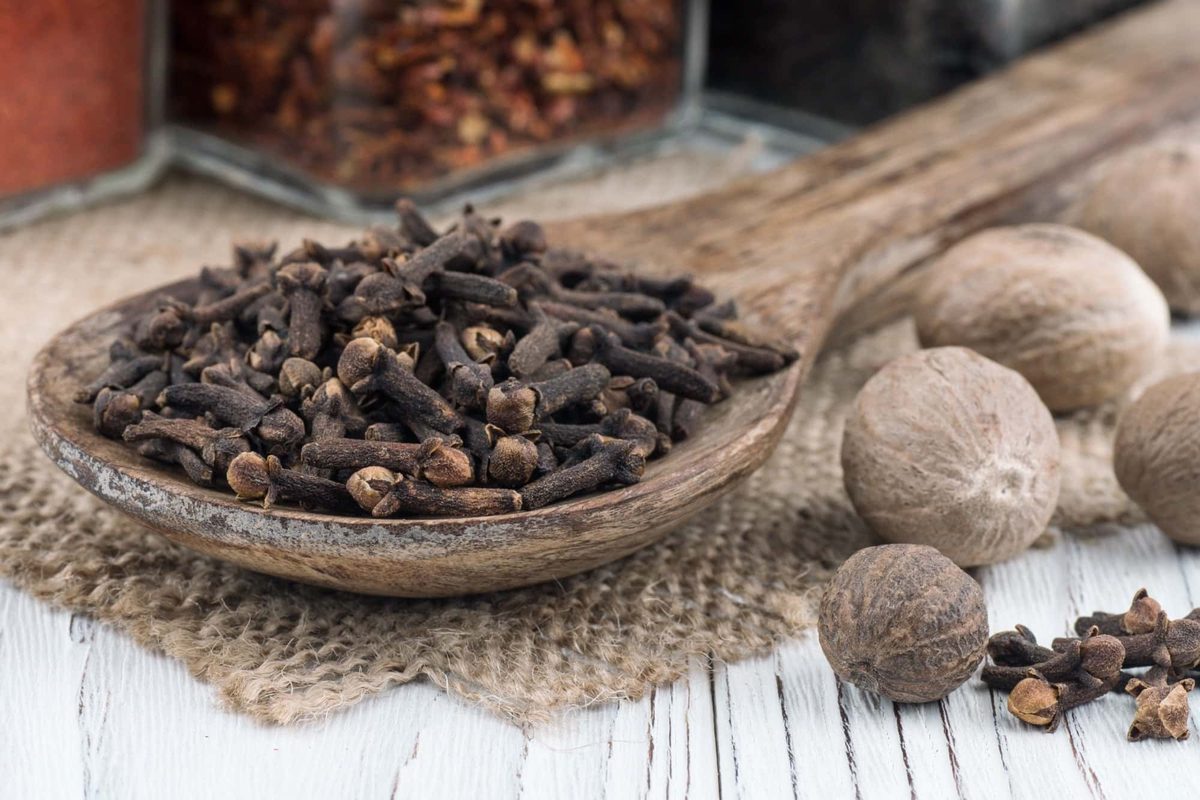
Nutmeg and cloves sit side by side in pumpkin pies, spice cakes and Cincinnati chili, but they are not related and they do not taste alike. Nutmeg is the dried seed kernel of a tree in the nutmeg family; a clove is the dried flower bud of a tree in the myrtle family.1234 Cloves are the stronger of the two by a wide margin: the bud can be up to a fifth essential oil, most of it eugenol, while nutmeg’s oil is led by pinenes and sabinene.546 That makes them partners more than stand-ins.
Side by side
| Nutmeg | Cloves | |
|---|---|---|
| Species | Myristica fragrans1 | Syzygium aromaticum2 |
| Family | Myristicaceae (nutmeg family), in the order Magnoliales1 | Myrtaceae (myrtle family)2 |
| Native range | Maluku (Banda Islands), Indonesia1 | Maluku, Indonesia2 |
| Part used | The dried seed kernel; the aril around the seed is sold separately as mace37 | The flower bud, picked just before it opens and dried4 |
| Size | One intact nutmeg weighs about 6 to 7 g8 | Buds 1 to 2 cm long4 |
| Essential oil | 5–15% of the kernel (FAO)6 | 14–20% of the bud (Britannica)5 |
| Main aroma compounds | α- and β-pinene and sabinene lead; aromatic ethers such as myristicin and elemicin make up 2–18% of the oil69 | Eugenol, 70–90% of bud oil, with eugenyl acetate up to 17%4 |
| Flavor | Britannica: a pungent fragrance and a warm, slightly sweet taste7 | Britannica: strong in aroma, hot and pungent in taste5 |
| Forms | Whole or ground; grated as needed910 | Whole buds or ground4 |
| Typical uses | Confectionery and baking, eggnog and milk puddings, sausages and soups911 | Meats and baked goods5 |
| Safety | Toxic only at doses far beyond cooking; EU aflatoxin limits name it (see below)812 | No concern level set for the spice; clove oil is a separate product (see below)13 |
| Price | No dated, sourced retail comparison found | No dated, sourced retail comparison found |
The oil rows come from different sources (FAO for nutmeg, Britannica and PROSEA for cloves) and different samples. They show that cloves carry several times more oil, built around a different compound, without fixing an exact multiple.
How they taste, and why
The difference is chemical. Clove bud oil is mostly eugenol,4 the compound that gives cloves their hot, medicinal edge. Nutmeg oil is mostly monoterpenes, with α- and β-pinene and sabinene as the major ones, and only a minor share of aromatic ethers such as myristicin.69 Neither source lists eugenol among nutmeg’s main constituents.
In our judgment, nutmeg reads as warm, woody and faintly sweet, and turns harsh only when overdone. Cloves read as sharper, sweet-warm and medicinal, with a numbing, bitter edge in quantity. A widely repeated description gives cloves notes of menthol and camphor; nothing in the oil chemistry above supports it, so treat it as one taster’s impression.
Telling them apart
Whole, they look nothing alike. A clove is a small nail shape: PROSEA describes buds 1 to 2 cm long, a tubular calyx topped by a ball of unopened petals.4 A nutmeg is the hard kernel of a seed, about 6 to 7 g apiece.38 Ground, ground cloves are noticeably darker than ground nutmeg; that is our observation, not a measurement.
Where they meet
They share the warm-spice shelf rather than a flavor:
- Cincinnati chili. Saveur’s recipe uses cloves, cinnamon and nutmeg together.14
- Allspice blends. The Spice House’s homemade stand-in for allspice is 2 parts cinnamon, 1 part nutmeg and 1 part ground cloves.15
- Pumpkin pie spice. Here they part ways in at least one brand: McCormick’s lists cinnamon, ginger, nutmeg and allspice, with no cloves.16 Check the label of your jar.
Where each one goes alone
Nutmeg. PROSEA says grated nutmeg flavors confectionery in small amounts in most countries, and goes into meat dishes and soups in western Europe.9 FAO’s tables list eggnog, ice cream and milk pudding, and sausages and soups among industrial uses.11 A pinch in white sauces and creamed vegetables is common kitchen practice.
Cloves. Britannica says cloves flavor many foods, particularly meats and baked goods.5 PROSEA notes they go into food whole or after grinding.4 Studding a ham with whole cloves and simmering them in mulled wine or cider are common practice, and whole cloves suit any liquid you will strain.
Can one stand in for the other?
Only roughly, because neither has the other’s main aroma compound. The ratios below come from our nutmeg substitutes and clove substitutes pages and keep their labels: Attributed quotes a named source, Method is a starting point where no published number exists, and Computed has a measurable basis.
| Swap | Starting amount | Treatment |
|---|---|---|
| Ground cloves for ground nutmeg | Half the amount | Attributed (Healthline) |
| Nutmeg (with cinnamon) for ground cloves | A combined amount slightly below the cloves, about 2 parts cinnamon to 1 part nutmeg, then taste | Method |
| Nutmeg alone for cloves | No published ratio; add a little at a time and taste | Method |
| Whole nutmeg to ground | 1/2 nutmeg = 1 teaspoon ground | Attributed (McCormick conversion) |
| Whole cloves to ground | 3 whole = 1/4 teaspoon ground | Attributed (McCormick conversion) |
Cloves in place of nutmeg. Healthline says to use half the amount of ground cloves.17 Expect a clove-forward result; this works best where nutmeg is one warm spice among several, not in a nutmeg-led custard or white sauce. For those, mace is the closer swap (see mace vs. nutmeg).
Nutmeg in place of cloves. The Spice House says a combination of cinnamon and nutmeg recreates the essence of cloves.18 Neither it nor any other source we found gives amounts, so the starting point above is ours. A widely repeated rule says nutmeg alone can replace cloves at a fixed ratio; we found no source for it. If a clove flavor matters, ground allspice is the closer swap, since its oil is also led by eugenol (see allspice vs. cloves).
Whole to ground. McCormick’s conversions put half a nutmeg at 1 teaspoon ground, and 3 whole cloves at 1/4 teaspoon ground.10 These convert within each spice, not between them.
Safety
Nutmeg. Used as a seasoning, nutmeg is not dangerous, the National Capital Poison Center says.19 The problem is large amounts. The Tennessee Poison Center says psychogenic effects have been reported at 15 to 20 g of ground nutmeg, about two to three tablespoons,20 and the Missouri Poison Center reports doses of 5 to 30 g among people who take it to get high.8 The two figures describe different things and are shown as given. Nutmeg is also one of the few spices named in the EU’s aflatoxin limits.12 More detail is on the nutmeg page.
Cloves. We found no regulator or clinical source that sets a level at which cloves eaten in food become a concern. Clove oil is another matter: the European Medicines Agency’s monograph on it as a traditional herbal medicine says use in children and adolescents under 18 is not recommended.13 Do not use clove oil in place of ground cloves in a recipe.
What isn’t known
- No published taste test compares the strength of nutmeg and cloves, so no measured ratio exists in either direction.
- No source gives a ratio for nutmeg alone in place of cloves.
- The oil figures come from different sources and samples, so the multiple between them is not fixed.
- No dated price comparison.
Related
- Nutmeg, nutmeg substitutes, fresh vs. ground nutmeg, too much nutmeg
- Cloves, clove substitutes, ground vs. whole cloves, too much clove
- Allspice vs. cloves, allspice vs. nutmeg, cinnamon vs. nutmeg, cloves vs. cinnamon, mace vs. nutmeg
- Pumpkin pie spice, garam masala
Footnotes
-
Myristica fragrans Houtt., Plants of the World Online, Royal Botanic Gardens, Kew. powo.science.kew.org · Reference work ↩ ↩2 ↩3 ↩4
-
Syzygium aromaticum (L.) Merr. & L.M.Perry, Plants of the World Online, Royal Botanic Gardens, Kew. powo.science.kew.org · Reference work ↩ ↩2 ↩3 ↩4
-
Production, handling and processing of nutmeg and mace, Section III: Post harvest handling, FAO. fao.org · Reference work ↩ ↩2 ↩3
-
E.W.M. Verheij and C.H.A. Snijders, Syzygium aromaticum, Plant Resources of South-East Asia (PROSEA). uses.plantnet-project.org · Reference work ↩ ↩2 ↩3 ↩4 ↩5 ↩6 ↩7 ↩8 ↩9
-
“Clove”, Encyclopaedia Britannica. britannica.com · Reference work ↩ ↩2 ↩3 ↩4 ↩5
-
Production, handling and processing of nutmeg and mace, Section VI: Composition and constituents, FAO. fao.org · Reference work ↩ ↩2 ↩3 ↩4
-
“Nutmeg”, Encyclopaedia Britannica. britannica.com · Reference work ↩ ↩2
-
“Nutmeg Abuse”, Missouri Poison Center, 2022 (updated 2026). missouripoisoncenter.org · Reference work ↩ ↩2 ↩3 ↩4
-
M. Flach and M. Tjeenk Willink, Myristica fragrans, Plant Resources of South-East Asia (PROSEA). uses.plantnet-project.org · Reference work ↩ ↩2 ↩3 ↩4 ↩5
-
“How to Grind Your Own Spices, Plus Spice Conversions”, McCormick, 2025. mccormick.com · Merchant ↩ ↩2
-
Production, handling and processing of nutmeg and mace, Section VII: Utilization of products, FAO. fao.org · Reference work ↩ ↩2
-
Commission Regulation (EU) 2023/915, European Commission. eur-lex.europa.eu · Regulator ↩ ↩2
-
Community herbal monograph on Syzygium aromaticum, floris aetheroleum, European Medicines Agency, 2011. ema.europa.eu · Regulator ↩ ↩2
-
“Cincinnati Chili”, Saveur. saveur.com · Publication ↩
-
“Allspice Substitute”, The Spice House. thespicehouse.com · Merchant ↩
-
McCormick Pumpkin Pie Spice, McCormick & Company. mccormick.com · Merchant ↩
-
Katey Davidson, “8 Great Substitutes for Nutmeg”, Healthline. healthline.com · Publication ↩
-
“Substitute for Cloves”, The Spice House, 2021. thespicehouse.com · Merchant ↩
-
Rose Ann Gould Soloway, “Kitchen surprises and cautions”, National Capital Poison Center. poison.org · Reference work ↩
-
Nena Bowman, “Nutmeg, a Potentially Uninvited Holiday Guest?”, Tennessee Poison Center, 2020. vumc.org · Reference work ↩