Spice Comparisons · Comparison
Rock Salt vs. Table Salt: Grain, Iodine and the Bag That Isn’t Food
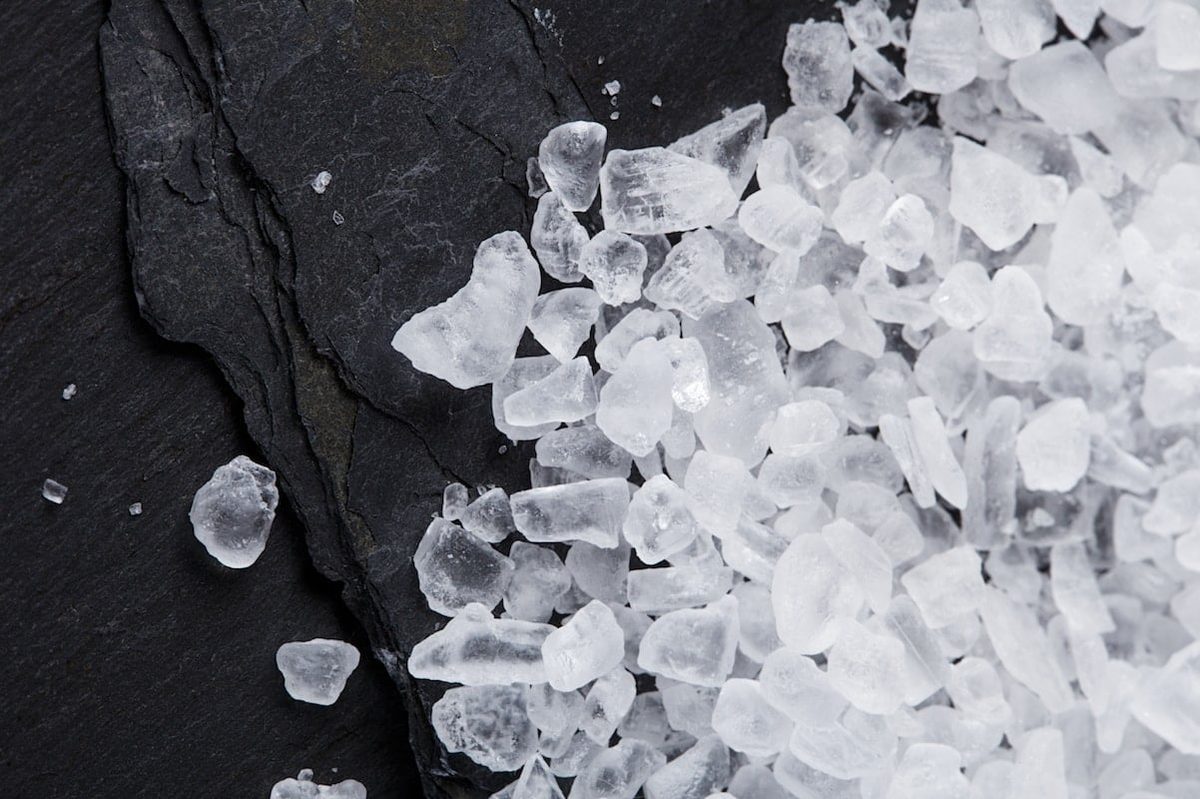
Rock salt and table salt are closer relatives than they look. Rock salt is salt mined from underground deposits,1 and the American Heart Association describes table salt as salt mined from deposits and then processed to a fine texture.2 So the real differences are the grain, what is added to the box, and one practical trap: much of the coarse “rock salt” sold in American stores is ice cream or de-icing salt, which Morton says is not intended for consumption.3
Side by side
| Rock salt | Table salt | |
|---|---|---|
| What it is | Salt mined from underground rock salt deposits1 | Salt mined from deposits and processed to a fine texture (AHA); tiny, uniform crystals from rapid vacuum evaporation (ATK)24 |
| Grain | Coarse crystals in most products; food-grade pink salt is sold fine and coarse5 | Tiny, uniform crystals4 |
| Additives | Not established for rock salt in general | Usually an anticaking agent; Morton iodized lists calcium silicate, dextrose and potassium iodide46 |
| Iodine | Himalayan salt, a rock salt, is not usually iodized7 | Iodized or plain; US iodized salt carries 45 mcg iodine per gram7 |
| Weight per ¼ teaspoon (Morton labels) | Coarse Himalayan: 1.5 g8 | Iodized table salt: 1.5 g6 |
| Non-food versions | Ice cream salt and de-icing salt3 | None common |
| Sodium | About 40%, like other salts2 | About 40%2 |
| Flavor (editorial) | Salty; a hard crunch when coarse | Salty; dissolves quickly |
| Price | No dated, sourced comparison found | No dated, sourced comparison found |
Food-grade or not
Morton describes its Ice Cream Salt as large rock salt crystals that give gradual cooling in ice cream makers and coolers, lists melting ice and snow among its uses, and states that it is not intended for consumption.3 In 2024, highway deicing took about 41% of all the salt consumed in the US.9 Use rock salt in food only when the package says it is food grade, or carries a nutrition panel and is sold as a cooking salt. We found no regulator data on what non-food rock salt contains, so this is a labeling rule rather than a claim that it is harmful. See rock salt.
Where each comes from
The Codex standard for food-grade salt covers salt from the sea, from rock salt deposits and from natural brine, and requires at least 97% sodium chloride on a dry basis, not counting additives.1 By that measure the two are the same substance. Rock salt is a large share of the US supply: in 2024 it made up 40% of salt sold or used, against 42% salt in brine, 9% solar salt and 9% vacuum pan salt.9
Table salt is defined more by its processing than its source. ATK describes its tiny, uniform crystals as the product of rapid vacuum evaporation and notes that it usually carries an anticaking agent so it pours smoothly.4 The AHA says the processing strips out other minerals.2
What’s added to table salt
Morton’s iodized table salt lists salt, calcium silicate (an anticaking agent), dextrose and potassium iodide.6 Under US rules, salt with added iodide may be labeled “iodized salt” and must say it supplies iodide, a necessary nutrient; salt with an anticaking agent may be labeled “free flowing.”10 US salt makers have added iodine since the 1920s, and iodization is voluntary.7
A widely repeated claim says these additives give table salt a faintly bitter taste. America’s Test Kitchen’s tasters found no detectable difference in taste between iodized and noniodized salt.4 We found no source on whether food-grade rock salts in general carry additives, so this page does not claim they are additive-free; read the label.
Minerals, measured
The 2016 Swiss government survey of 25 retail salts included one iodized table salt and four Himalaya salts, which are rock salts. The comparison below is for those samples, not rock salt in general.11
| Measured (Swiss FSVO, 2016) | Himalaya salt (4 samples) | Swiss iodized table salt |
|---|---|---|
| Iodine | Below 20 µg/kg in all four | Fortified at 25 mg/kg, the Swiss level since 2014 |
| Aluminum, µg/kg | 21,864 to 44,654 | 811 |
| Sodium, % | 37.7 to 38.2 | Not reported |
All figures from the FSVO report.11 The report found that specialty salts generally carried more contaminants than standard salts, though most did not reach even 1% of tolerable intake levels, and concluded that specialty salts have no advantages over standard salts.11
Can one stand in for the other?
In food, yes, if the rock salt is food grade. These treatments follow our rock salt substitute page.
| Swap | Starting amount | Treatment |
|---|---|---|
| Either, measured into a recipe by weight | The same weight | Computed |
| Morton coarse Himalayan (rock) salt for Morton table salt | Teaspoon for teaspoon | Attributed (Morton products only) |
| Table salt for 1 teaspoon of other coarse rock salt in a recipe | About ½ teaspoon, then taste | Method |
| Table salt for rock salt in an ice cream maker’s ice | About half the volume; add more if the mix isn’t getting colder | Method |
| Kosher salt for rock salt in an ice cream maker’s ice | The same volume | Attributed (CSU) |
| Non-food rock salt for table salt in food | Never | n/a |
How these were worked out. By weight: Codex requires at least 97% sodium chloride on a dry basis for salt from any source.1 By volume: Morton’s chart treats a teaspoon of its Himalayan salt as equal to a teaspoon of its table salt, for Morton products only,5 and its labels give both 1.5 g per ¼ teaspoon.86 For other coarse rock salts we found no published weight, and large crystals hold less salt per spoon only because fewer fit;2 table salt, at about 6 g a teaspoon, is the densest of the common salts,12 so starting at half and tasting keeps you from over-salting. For ice cream, Colorado State University Extension’s recipe calls for ½ cup of salt, “Kosher or rock salt,” and explains that salt lets the ice-and-salt mix get colder than pure ice.13 We found no credible recipe that chills with table salt, so the half-volume start is ours, not a tested figure.
Which to use when
- Food-grade rock salt: salt grinders, pasta water, salt crusts and roasting beds, where coarse, hard crystals help. These are common kitchen uses rather than tested claims.
- Table salt: anything measured by the spoon, baking, and the shaker. Morton markets its iodized salt for cooking and baking.6
- Non-food rock salt: the ice around an ice cream canister, and the driveway.
Health notes
- Sodium. Neither is lower in sodium by weight; table salt, kosher salt and most sea salts are about 40% sodium.2 The WHO recommends adults keep sodium under 2,000 mg a day and names raised blood pressure as its main health effect.14
- Iodine. This is the real difference. Iodized table salt carries 45 mcg of iodine per gram; specialty salts such as Himalayan salt are not usually iodized.7 If you switch to rock salt at home and rely on salt for iodine, keep iodized salt too; see iodized vs. non-iodized salt.
- Microplastics. In a 2018 study of 39 salt brands, reported in a Greenpeace press release, the nine rock salts had the least microplastic contamination of the three types tested.15 The release gives no separate figure for table salt.
What isn’t known
- No published weight per teaspoon for coarse rock salts outside Morton’s Himalayan label.
- No source on whether food-grade rock salts in general contain additives.
- What non-food rock salt contains beyond salt is not established by any regulator source we found.
- No test of ice cream made with table salt in the ice bath.
- No dated, sourced price comparison.
Related
- Rock salt and table salt, the full profiles
- Rock salt substitutes
- Rock salt vs. sea salt, Himalayan salt vs. table salt and kosher salt vs. table salt
- Cooking with rock salt and the best salt for cooking
Footnotes
-
Standard for Food Grade Salt, CXS 150-1985 (rev. 2012), Codex Alimentarius. services.bis.gov.in · Standard ↩ ↩2 ↩3 ↩4
-
Sodium Sources: Where Does All That Sodium Come From?, American Heart Association, 2025. heart.org · Reference work ↩ ↩2 ↩3 ↩4 ↩5 ↩6 ↩7
-
Morton Ice Cream Salt, product page, Morton Salt. mortonsalt.com · Merchant ↩ ↩2 ↩3
-
Salt Types and Measurements, America’s Test Kitchen. americastestkitchen.com · Publication ↩ ↩2 ↩3 ↩4 ↩5
-
Salt Conversion Chart, Morton Salt. mortonsalt.com · Merchant ↩ ↩2
-
Morton Iodized Table Salt, product page, Morton Salt. mortonsalt.com · Merchant ↩ ↩2 ↩3 ↩4 ↩5
-
Iodine: Fact Sheet for Health Professionals, NIH Office of Dietary Supplements. ods.od.nih.gov · Regulator ↩ ↩2 ↩3 ↩4
-
Morton Coarse Himalayan Pink Salt, product page, Morton Salt. mortonsalt.com · Merchant ↩ ↩2
-
Wallace P. Bolen, Salt, Mineral Commodity Summaries 2025, U.S. Geological Survey. pubs.usgs.gov · Regulator ↩ ↩2
-
21 CFR 100.155, Salt and iodized salt, Electronic Code of Federal Regulations. ecfr.gov · Regulator ↩
-
Esther Infanger and Max Haldimann, Report on the composition of prevalent salt varieties, Swiss Federal Food Safety and Veterinary Office, 2016. warwick.ac.uk · Regulator ↩ ↩2 ↩3
-
Kate Shannon Levine, The Best Kosher Salt, America’s Test Kitchen, 2019. americastestkitchen.com · Publication ↩
-
Ice Cream in a Bag: Changing Matter, Colorado State University Extension. garfield.extension.colostate.edu · Reference work ↩
-
Sodium reduction, World Health Organization fact sheet, 2026. who.int · Regulator ↩
-
Over 90% of sampled salt brands globally found to contain microplastics, Greenpeace International press release, 2018, on Kim J-S et al., Environmental Science & Technology, 2018. greenpeace.org · Publication ↩