Cooking · Cooking with
Cooking With Rock Salt: Food-Grade Only, Plus Ice Cream Makers and Salt Crusts
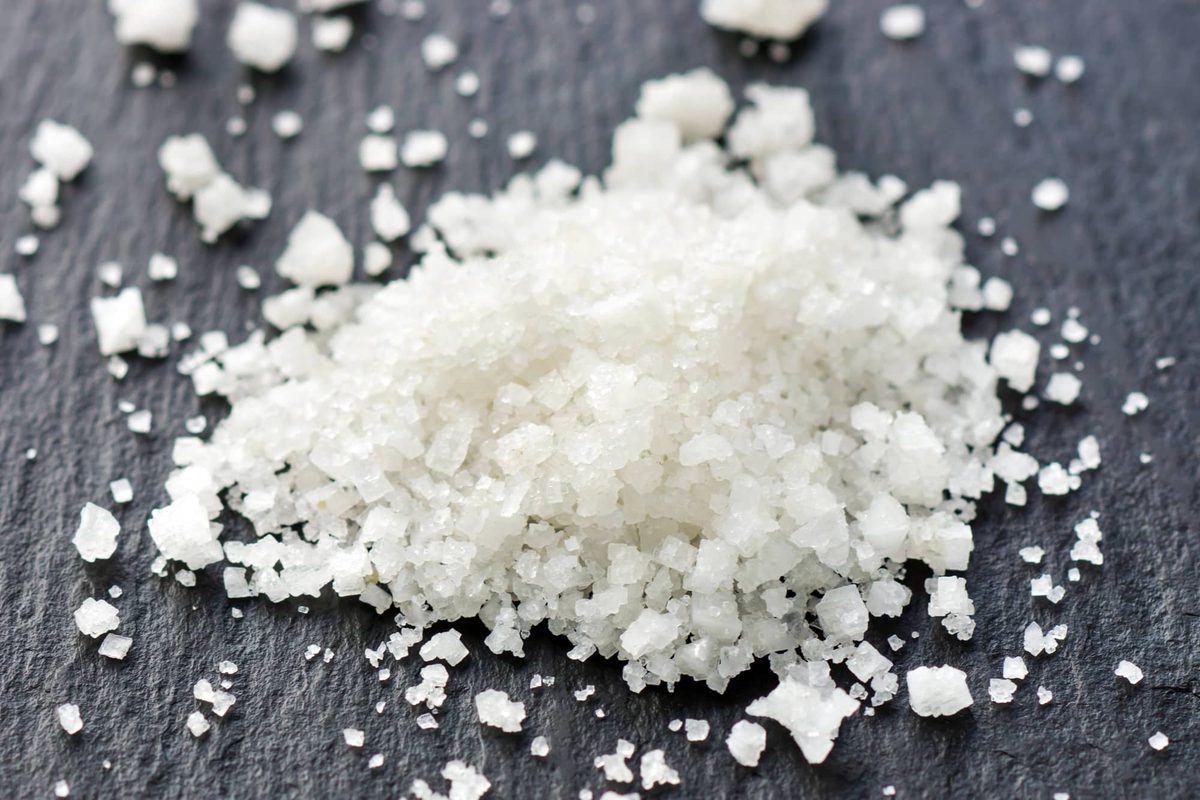
Rock salt is salt mined from underground deposits, and food-grade rock salt cooks like any other coarse salt. The catch is the label. Much of the coarse “rock salt” sold in American stores is meant for ice cream makers or for melting ice, and Morton states plainly that its Ice Cream Salt is not intended for consumption.1 So the first rule of cooking with rock salt is to know which kind you have. This page covers that, then the three jobs rock salt actually does in a kitchen: chilling an ice cream maker, building a salt crust, and seasoning.
Quick guide
| Job | Which salt | Basis |
|---|---|---|
| Chilling an old-style ice cream maker | Ice cream (non-food) rock salt, in the ice only | Morton; Nebraska Extension12 |
| Salt-crusted fish or meat | Food-grade coarse salt; Thomas Keller’s recipe uses kosher salt | Attributed3 |
| Grinders, pasta water, rubs | Food-grade rock salt, to taste | Kitchen practice |
| Pickling and canning | Canning or pickling salt, not rock salt | NCHFP4 |
Food-grade or not
Food-grade salt, whether it comes from the sea, rock deposits or natural brine, must be at least 97% sodium chloride on a dry basis under the Codex Alimentarius standard.5 America’s Test Kitchen puts it the same way from the kitchen side: salt is sodium chloride whatever its source.6 Much ordinary table salt starts as mined salt; the American Heart Association describes table salt as mined from salt deposits and processed to a fine texture.7 In the United States in 2024, rock salt was 40% of all salt sold or used, and highway deicing took about 41% of the salt consumed.8
That last figure explains the confusion. Morton describes its Ice Cream Salt as large rock salt crystals for gradual cooling in ice cream makers, lists melting ice and snow among its uses, and says it is not intended for consumption.1 Use rock salt in food only when the package says it is food grade or edible or carries a Nutrition Facts panel. A bag sold for ice cream makers, water softeners or de-icing belongs outside the food. That is a labeling rule, not a finding that such salt is harmful; we found no regulator data on what non-food rock salt contains.
Rock salt in an ice cream maker
In a hand-crank or bucket-style freezer, rock salt goes in the ice packed around the canister, never in the mix. Nebraska Extension’s coffee-can ice cream instructions pack crushed ice around the inner can, then pour “at least 3/4 cup of rock salt evenly over the ice,” and repack with ice and salt partway through.2 They also warn against overdoing it: too much salt freezes the mix too fast and gives the ice cream a poor texture.2 The same instructions say not to let any ice or ice water get into the inner can.2 We found no published ice-to-salt ratio from a regulator or university, only these minimums and warnings.
Salt-crusted fish and meat
Salt-crust cooking packs a whole fish or roast in a shell of moistened salt before it goes into the oven. A common claim calls the method ancient; we found no source that dates it. Thomas Keller’s recipe from Ad Hoc at Home is a well-documented version:3
| Thomas Keller, salt-crusted striped bass3 | |
|---|---|
| Fish | One 4-pound striped bass, gutted and scaled |
| Crust | 4 cups kosher salt mixed with 8 large egg whites |
| Oven | 425°F |
| Time | About 40 minutes, turning the pan once, to about 125°F at the thickest part; rest 10 minutes |
| To serve | Crack the crust with a wooden spoon or mallet and lift it off in large pieces |
Keller says the method gives very moist fish that is seasoned but “not at all salty.”3 His recipe uses kosher salt. Food-grade coarse rock salt can stand in for it by volume as a crust, since the crust is lifted off rather than eaten; that is our judgment, untested, so expect some difference in how the crust packs.
On doneness, Keller’s target and the federal guidance differ. FoodSafety.gov gives 145°F for fish, or cooking until the flesh is no longer translucent and separates easily with a fork.9 Keller’s 125°F is below that; if you follow the federal guidance, cook longer or check that the flesh flakes. The same chart gives 145°F with a 3-minute rest for beef, pork and lamb roasts.9
Seasoning with food-grade rock salt
Coarse food-grade rock salt works in a salt grinder, in pasta water and in spice rubs. These are common kitchen uses rather than tested claims. Because large crystals pack loosely, a spoonful holds less salt than a spoonful of table salt, and we found no published grams-per-teaspoon figure for coarse rock salt, so salt to taste or weigh it.
As a finishing salt, whole crystals are hard and slow to dissolve. It is often said that coarse salt stays on the surface without drawing moisture out of food; we found no test of that, so this page doesn’t claim it. For a crunchy finish, flaky sea salts are the more usual choice; see cooking with sea salt.
Not for pickling
The National Center for Home Food Preservation recommends canning or pickling salt for pickles.4 It also advises against flake salt because its density varies.4 A coarse rock salt is not the tested choice; see pickling salt.
Sodium
Rock salt is not a lower-sodium salt. Table salt, kosher salt and most sea salts are about 40% sodium, and mined salt is the same compound.75 The WHO recommends adults keep sodium below 2,000 mg a day and names raised blood pressure as the main health effect of high intake; the FDA’s Daily Value is less than 2,300 mg.1011
What isn’t known
- What non-food rock salt (ice cream, de-icing, water-softener grades) contains; no regulator data found.
- A grams-per-teaspoon figure for coarse food-grade rock salt.
- A published ice-to-salt ratio for ice cream freezers beyond extension minimums.
- Any test of claims that cooking meat on a bed of rock salt keeps it juicier.
Related
- Rock salt, the full profile, and rock salt substitutes
- Rock salt vs. sea salt and rock salt vs. table salt
- Himalayan salt, a food-grade rock salt, and cooking with Himalayan salt
- Kosher salt, table salt and too much salt?
Footnotes
-
Morton Ice Cream Salt, product page, Morton Salt. mortonsalt.com · Merchant ↩ ↩2 ↩3
-
Instructions for Ice Cream, Nebraska Extension, University of Nebraska–Lincoln, 2021. extension.unl.edu · Reference work ↩ ↩2 ↩3 ↩4
-
Thomas Keller, Salt-Crusted Striped Bass, from Ad Hoc at Home, via Field & Stream. fieldandstream.com · Publication ↩ ↩2 ↩3 ↩4
-
Salts Used in Pickling, National Center for Home Food Preservation. nchfp.uga.edu · Reference work ↩ ↩2 ↩3
-
Standard for Food Grade Salt, CXS 150-1985 (rev. 2012), Codex Alimentarius. services.bis.gov.in · Standard ↩ ↩2
-
Salt Types and Measurements, America’s Test Kitchen. americastestkitchen.com · Publication ↩
-
Sodium Sources: Where Does All That Sodium Come From?, American Heart Association, 2025. heart.org · Reference work ↩ ↩2
-
Wallace P. Bolen, Salt, Mineral Commodity Summaries 2025, U.S. Geological Survey. pubs.usgs.gov · Regulator ↩
-
Cook to a Safe Minimum Internal Temperature, FoodSafety.gov. foodsafety.gov · Regulator ↩ ↩2
-
Sodium reduction, World Health Organization fact sheet, 2026. who.int · Regulator ↩
-
Sodium in Your Diet, U.S. Food and Drug Administration. fda.gov · Regulator ↩