Spice Substitutes · Substitutes
Rock Salt Substitutes for Ice Cream Makers, Salt Crusts and Seasoning
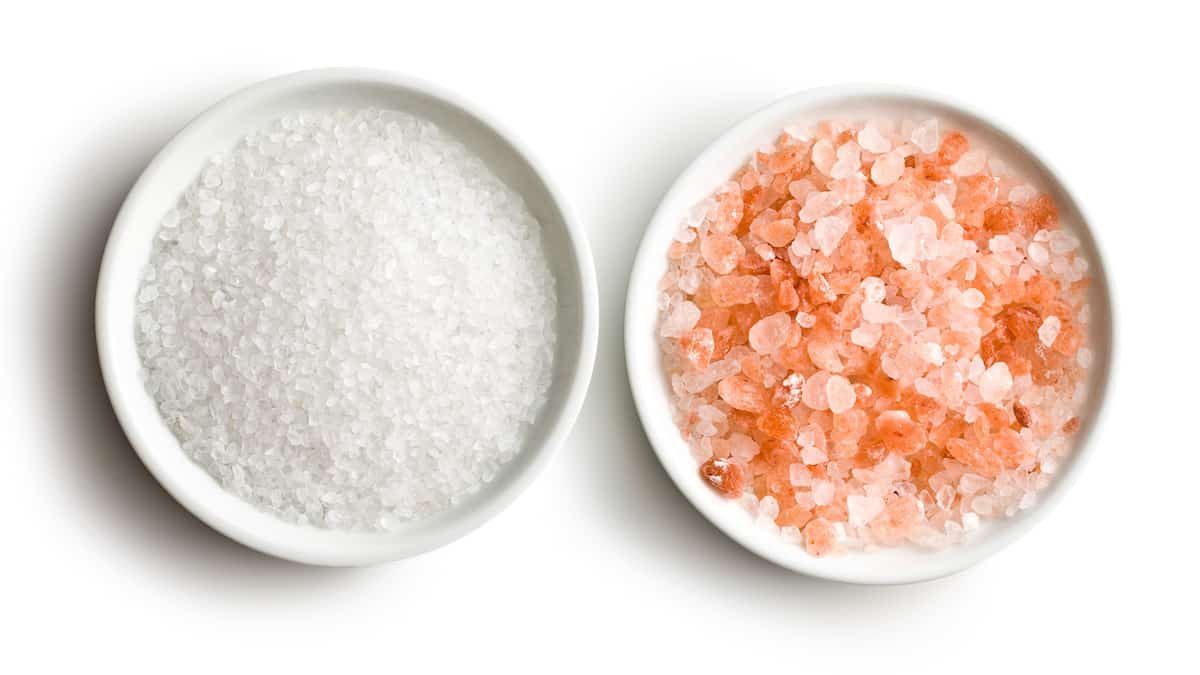
Rock salt is salt mined from underground deposits, and in a food-grade form it is the same compound as any other cooking salt: the Codex standard for food-grade salt covers salt from the sea, rock deposits and brine alike.1 In American stores, though, “rock salt” usually means something else: a coarse salt sold for chilling ice cream makers or melting ice, which is not food. Morton says plainly that its Ice Cream Salt is not intended for consumption.2 So a rock salt substitute depends on which of two very different jobs the salt is doing. If it chills the outside of an ice cream canister, any coarse salt will do. If it touches the food, it has to be a food-grade salt, and the question is how much.
Quick answer
| What rock salt is doing | Best substitute | Starting amount, per 1 cup rock salt | Treatment |
|---|---|---|---|
| Chilling an ice cream maker or a bag of ice cream | Kosher salt | 1 cup | Attributed |
| The same, with only table salt on hand | Table salt | About ½ cup, add more if the mix isn’t getting colder | Method |
| A salt crust or a bed of salt for roasting | Kosher salt | Enough to cover; amount not critical | Method |
| Coarse seasoning: grinder, pasta water, rubs | Coarse Himalayan pink salt or coarse sea salt | Season to taste | Method |
| Measured into a recipe | Any food-grade salt | The same weight | Computed |
How the ratios on this page are labeled
- Computed: based on a measurable physical relationship, with the source named.
- Attributed: a named source publishes this ratio. We quote it as theirs.
- Disputed: named sources give different answers to the same swap. We show each one and do not average them.
- Method: we found no published ratio. We give a direction and a cautious starting point, and say so.
We found no published grams-per-teaspoon figure for coarse rock salt, so no volume swap on this page can be computed.
First: is your rock salt food?
Read the bag. Morton describes its Ice Cream Salt as large rock salt crystals for ice cream makers and coolers, lists melting ice and snow among its uses, and says it is not intended for consumption.2 A bag labeled for ice cream makers, water softeners or ice melting belongs outside the canister, never in the food. A food-grade rock salt says so, or carries a nutrition panel and is sold as a cooking salt. We found no regulator data on what non-food rock salt contains, so this is a labeling rule, not a claim that such salt is harmful.
The substitutes below run the other way: they are all food-grade salts, so they can do the non-food job as well.
If rock salt is chilling an ice cream maker
In an old-fashioned ice cream maker, or the “ice cream in a bag” made in classrooms, salt goes into the ice around the container, not into the ice cream. Colorado State University Extension explains that the salt lets the ice-and-salt mixture get colder than pure ice, cold enough to freeze the ice cream.3 Morton says that rock salt sprinkled over the ice in a cooler chills drinks faster, and to lower temperatures, than ice alone.2
1. Kosher salt
Ratio (Attributed): Colorado State’s ice cream in a bag calls for ½ cup of salt, “Kosher or rock salt,” with four cups of ice.3 In other words, it treats the two as interchangeable by volume. Use the same volume of kosher salt as the recipe or machine calls for in rock salt. Either brand works, since this salt is never eaten.
Kosher salt is much coarser than table salt,4 which is why it is the closest stand-in for rock salt’s chunks. Morton credits rock salt’s large crystals with giving gradual cooling;2 we found no test comparing how fast kosher and rock salt chill an ice cream maker.
2. Table salt
Ratio (Method): We found no ice cream recipe from a credible source that uses table salt. Table salt is fine and dense: ATK weighs a teaspoon at about 6 grams, against 4.8 for Morton kosher salt and 2.8 for Diamond Crystal.5 A cup of it therefore holds more salt than a cup of kosher salt. Start with about half the volume of rock salt the recipe calls for, and add more if the mixture isn’t firming up. That is a starting point, not a tested figure.
Rinse the outside of the bag or canister before opening it, so salty water doesn’t drip into the ice cream. That is common practice.
If rock salt is a crust or a roasting bed
Whole fish, beets and potatoes are sometimes baked under a crust of coarse salt, and oysters or clams are roasted on a bed of it. These are common kitchen uses rather than tested claims.
1. Kosher salt
Ratio (Method): Use enough to cover, as the recipe directs; the amount is not a seasoning measurement, because most of the crust is discarded. Kosher salt’s coarse grains make it the usual choice for crusts in our judgment. Only a food-grade salt belongs here, never ice cream salt.
2. Coarse sea salt or coarse Himalayan pink salt
These have the chunkiest grains of the food-grade salts most stores sell. Use them the same way, by the recipe’s volume.
If rock salt is coarse seasoning
Food-grade coarse rock salt goes into salt grinders, pasta water and spice rubs.
1. Coarse Himalayan pink salt
This is itself a rock salt. Commercial supplies come from Pakistan, where the state-owned Pakistan Mineral Development Corporation runs the Khewra mine.67 Its pink color comes from traces of iron oxide, and the extra minerals made no clinically significant contribution to nutrient intake in a 2020 analysis of pink salts sold in Australia.6 Morton sells a coarse grind for grinders; its label gives 1.5 grams per ¼ teaspoon.8
Ratio (Method): In a grinder or for pasta water, season to taste. There is no published weight for coarse rock salt to compare against.
2. Coarse sea salt
Coarse sea salt fills a grinder the same way. Salt is sodium chloride whatever its source, ATK notes, and sea salts vary only slightly in flavor.9
Ratio (Method): Season to taste.
3. Kosher salt
Kosher salt is easy to pinch for rubs and pasta water. Morton’s kosher salt contains an anticaking agent, yellow prussiate of soda; Diamond Crystal has none, according to ATK.105
Ratio (Method): Season to taste.
If rock salt is measured into a recipe
By weight (Computed): Use the same weight of any food-grade salt. Codex requires at least 97% sodium chloride on a dry basis, from any source,1 so equal weights carry close to the same amount of salt.
By volume (Method): With no published weight for coarse rock salt, start with less of a finer salt and taste. Large crystals put less salt in a spoon simply because fewer of them fit.11 For a teaspoon of coarse rock salt, start with about ½ teaspoon of table salt, which is the densest of the common salts at about 6 grams a teaspoon, or about ⅔ teaspoon of Morton kosher salt, which holds the same amount of salt by ATK’s weights.5 These are cautious starting points, not equivalents.
Not for pickling: home-canning guidance from the National Center for Home Food Preservation recommends canning or pickling salt.12 See pickling salt substitutes.
A note on flaky salts
Flaky finishing salts such as Maldon, whose thin pyramid flakes form at the surface of the brine,13 are the opposite of rock salt: delicate where rock salt is hard. They are a poor fit for crusts, grinders or ice cream makers, and an expensive one. That is our judgment.
Notes for every swap
- Sodium. Table salt, kosher salt and most sea salts are about 40% sodium,11 and mined salt is the same compound. A swap changes how much sodium a dish carries only if it changes how much salt goes in.
- Additives and iodine. Table salt usually carries an anticaking agent and is often iodized: Morton’s iodized table salt lists calcium silicate, dextrose and potassium iodide.14 ATK’s tasters found no detectable taste difference between iodized and noniodized salt.9
What isn’t known
- No published weight per teaspoon or cup was found for coarse food-grade rock salt, so volume swaps here are starting points.
- No test was found comparing how quickly rock salt, kosher salt and table salt chill an ice cream maker, or how the texture of the ice cream changes.
- What non-food rock salt contains, beyond salt, is not established by any regulator source we found.
Related
- Rock salt and cooking with rock salt
- Rock salt vs. sea salt and rock salt vs. table salt
- Kosher salt, Himalayan salt, cooking with Himalayan salt, sea salt and table salt
- Kosher salt substitutes, sea salt substitutes and pickling salt substitutes
- The best salt for cooking and too much salt
Footnotes
-
Standard for Food Grade Salt, CXS 150-1985 (rev. 2012), Codex Alimentarius. services.bis.gov.in · Standard ↩ ↩2
-
Morton Ice Cream Salt, product page, Morton Salt. mortonsalt.com · Merchant ↩ ↩2 ↩3 ↩4
-
Ice Cream in a Bag: Changing Matter, Colorado State University Extension. garfield.extension.colostate.edu · Reference work ↩ ↩2
-
What’s the difference between kosher salt and other salt?, Tufts Health & Nutrition Letter, 2013 (updated 2019). nutritionletter.tufts.edu · Publication ↩
-
Kate Shannon Levine, The Best Kosher Salt, America’s Test Kitchen, 2019. americastestkitchen.com · Publication ↩ ↩2 ↩3
-
Fayet-Moore F et al., An Analysis of the Mineral Composition of Pink Salt Available in Australia, Foods, 2020. mdpi.com · Peer-reviewed ↩ ↩2
-
Pakistan Mineral Development Corporation, home page. pmdc.gov.pk · Merchant ↩
-
Morton Coarse Himalayan Pink Salt, product page, Morton Salt. mortonsalt.com · Merchant ↩
-
Salt Types and Measurements, America’s Test Kitchen. americastestkitchen.com · Publication ↩ ↩2
-
Morton Kosher Salt Flakes, product page, Morton Salt. mortonsalt.com · Merchant ↩
-
Sodium Sources: Where Does All That Sodium Come From?, American Heart Association, 2025. heart.org · Reference work ↩ ↩2
-
Salts Used in Pickling, National Center for Home Food Preservation. nchfp.uga.edu · Reference work ↩
-
Clare Finney, Clear as crystal: the decades-old traditions of Maldon sea salt, Foodism, 2018. foodism.co.uk · Publication ↩
-
Morton Iodized Table Salt, product page, Morton Salt. mortonsalt.com · Merchant ↩