Spice Comparisons · Comparison
Rock Salt vs. Sea Salt: Mined vs. Evaporated, and When Rock Salt Isn’t Food
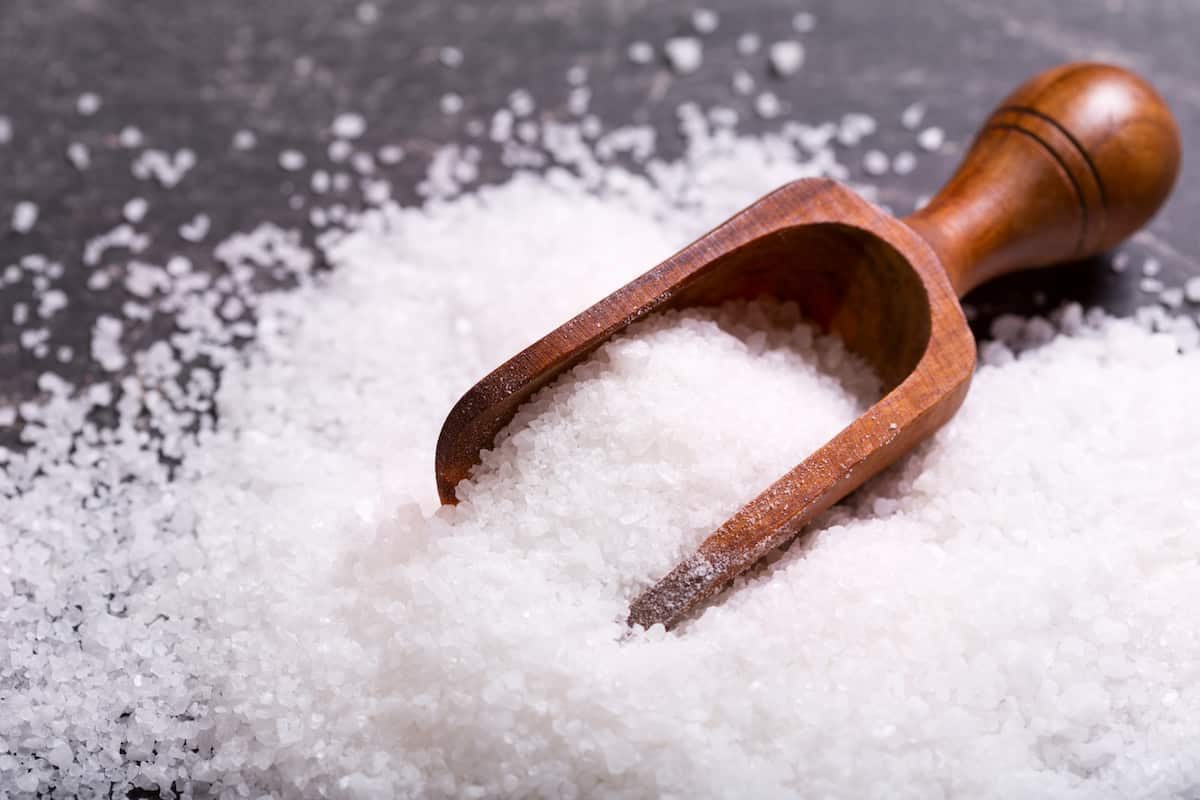
Rock salt is mined from underground deposits; sea salt is what remains when seawater evaporates.12 In food-grade form both are sodium chloride, and the international food-grade standard treats salt from the sea and from rock deposits alike.1 The difference a cook runs into is less about taste than about the bag: in American stores “rock salt” often means a coarse salt sold for ice cream makers or melting ice, which Morton says is not intended for consumption.3 Food-grade rock salt, such as Himalayan pink salt, and sea salt mostly differ in crystal and color.
Side by side
| Rock salt | Sea salt | |
|---|---|---|
| What it is | Salt mined from underground rock salt deposits1 | Salt left behind when seawater evaporates2 |
| Share of US salt, 2024 | 40% of salt sold or used4 | Solar salt, the sun-evaporated kind, 9%4 |
| Food-grade examples | Himalayan pink salt, mined in Pakistan5 | Fine, coarse and flaky sea salts6 |
| Non-food versions | Ice cream salt and de-icing salt; Morton’s Ice Cream Salt is not for consumption3 | None common |
| Color | Pink salt from traces of iron oxide5 | Usually white; Guérande gray salt is gray from clay particles7 |
| Iodine | Himalayan salt not usually iodized8 | Not usually iodized; noniodized sea salt provides virtually no iodine8 |
| Weight per ¼ teaspoon (Morton labels) | Coarse Himalayan: 1.5 g9 | Coarse sea salt: 1.4 g10 |
| Sodium | About 40%, like other salts2 | About 40% for most sea salts2 |
| Flavor (editorial) | Salty; a hard, dry crunch | Salty; flakes give a lighter crunch |
| Price | No dated, sourced comparison found | No dated, sourced comparison found |
First: is the rock salt food?
This is the difference that matters most. Morton describes its Ice Cream Salt as large rock salt crystals for ice cream makers and coolers, lists melting ice and snow among its uses, and says it is not intended for consumption.3 Rock salt is a big business partly because of roads: highway deicing took about 41% of the salt consumed in the US in 2024.4
So read the bag. A food-grade rock salt says so, or carries a nutrition panel and is sold as a cooking salt. A bag labeled for ice cream makers, water softeners or ice melting goes outside the ice cream canister, never into food. We found no regulator data on what non-food rock salt contains, so this is a labeling rule rather than a claim that such salt is harmful. See rock salt for more.
How each is made
Food-grade salt comes from three sources, the sea, rock salt deposits and natural brine, and the Codex standard requires all of it to be at least 97% sodium chloride on a dry basis, not counting additives.1 In the US, 2024 salt sold or used was 42% salt in brine, 40% rock salt, 9% solar salt and 9% vacuum pan salt.4
The best-known food-grade rock salt is Himalayan pink salt, mined in Pakistan and colored by traces of iron oxide.5 Sea salt is made by evaporating seawater: Morton describes its fine sea salt as seawater evaporated by the sun,11 while Maldon’s flakes form on the surface of brine heated in pans.12 The AHA describes sea salt as usually unprocessed or lightly processed.2
Minerals, measured
The only rock salts in the 2016 Swiss government survey of 25 retail salts were four Himalaya salts, so the comparison below is Himalayan rock salt against sea salt, not rock salt in general.13
| Measured (Swiss FSVO, 2016) | Himalaya salt (4 samples) | Sea salt (7 samples) |
|---|---|---|
| Sodium, % | 37.7 to 38.2 | 38.9 to 40.7 |
| Potassium, g/kg | Below 0.05 in all four | Below 0.05 in six; 1.2 in one |
| Iodine, µg/kg | Below 20 in all four | Below 20 or not detected in four; 28, 44 and 54 in three |
| Aluminum, µg/kg | 21,864 to 44,654 | Below the detection limit in six; 742 in one |
All figures from the FSVO report.13 The report attributes the high levels in Himalaya salt to natural contamination, found that most contaminants in specialty salts did not reach even 1% of tolerable intake levels, and concluded that specialty salts have no advantages over standard salts.13 A separate Australian study of 31 pink salts found that their extra minerals made no clinically significant contribution to nutrient intake.5
Microplastics. In a 2018 study of 39 salt brands, reported in a Greenpeace press release, contamination was highest in sea salt and lowest in rock salt, of which nine were tested.14 That is one study of specific products, not the market.
Flavor and texture
America’s Test Kitchen found that sea salts vary in color but only slightly in flavor, and once mixed into food taste no different from table salt.6 Its tasters also found no detectable difference between iodized and noniodized salt,6 so the common claim that rock salt tastes “cleaner” than salts with additives isn’t supported. We found no taste test of rock salt against sea salt. A widely repeated claim says sea salt’s trace minerals give it briny notes; no test we found shows it.
What differs is the crystal. Coarse rock salt is hard and slow to break down; flaky sea salt is light and crisp. Big crystals also put less salt in a spoon, since fewer of them fit.2
Ice cream makers
In an old-fashioned ice cream maker, salt goes into the ice around the canister, not into the ice cream. Colorado State University Extension explains that salt lets the ice-and-salt mix get colder than pure ice, and its “ice cream in a bag” calls for ½ cup of salt, “Kosher or rock salt.”15 Morton credits rock salt’s large crystals with gradual cooling.3 A common explanation adds that slow cooling gives a softer ice cream; we found no test of that. Sea salt would chill ice in principle, but no source we found uses it, and flaky sea salt is an expensive way to do the job (our judgment).
Can one stand in for the other?
In food, yes, if both are food grade. These treatments follow our rock salt substitute and sea salt substitute pages.
| Swap | Starting amount | Treatment |
|---|---|---|
| Either, measured into a recipe by weight | The same weight | Computed |
| Morton coarse Himalayan (rock) salt for Morton fine or coarse sea salt | Teaspoon for teaspoon | Attributed (Morton products only) |
| Coarse sea salt for food-grade coarse rock salt in a grinder, pasta water or rub | Season to taste | Method |
| Coarse rock salt for flaky sea salt as a finishing salt | By the pinch, fewer crystals | Method |
| Sea salt for non-food rock salt in an ice cream maker | Not tested; kosher salt is the sourced stand-in, at the same volume | Attributed (kosher salt, CSU) |
| Non-food rock salt for sea salt in food | Never | n/a |
How these were worked out. By weight: Codex sets at least 97% sodium chloride on a dry basis for salt from any source.1 By volume: Morton’s chart treats a teaspoon of its Himalayan salt as equal to a teaspoon of its table salt and its fine and coarse sea salts, for Morton products only,16 and its labels give 1.5 g and 1.4 g per ¼ teaspoon.910 We found no published weight per teaspoon for other coarse rock salts. For ice cream, Colorado State names kosher or rock salt.15
Which to use when
- Food-grade rock salt: grinders, pasta water, salt crusts and roasting beds, where a coarse, hard crystal is useful. These are common kitchen uses, not tested claims.
- Sea salt: finishing, which is where ATK recommends it;6 fine sea salt for everyday cooking.
- Non-food rock salt: the ice cream maker’s ice bath and the driveway, nothing else.
Health notes
- Sodium. Most salts are about 40% sodium, and total sodium intake is what matters most for heart health, the AHA says.2 The WHO recommends adults stay under 2,000 mg of sodium a day.17
- Iodine. The NIH Office of Dietary Supplements lists sea salt and Himalayan salt among specialty salts that are not usually iodized.8 See iodized vs. non-iodized salt.
What isn’t known
- No taste test comparing rock salt with sea salt.
- No published weight per teaspoon for coarse rock salts outside Morton’s Himalayan label.
- What non-food rock salt contains beyond salt is not established by any regulator source we found.
- No laboratory comparison covering rock salts other than Himalayan.
- No dated, sourced price comparison.
Related
- Rock salt and sea salt, the full profiles
- Rock salt substitutes and sea salt substitutes
- Rock salt vs. table salt, Himalayan salt vs. sea salt and table salt vs. sea salt
- Cooking with rock salt and cooking with sea salt
Footnotes
-
Standard for Food Grade Salt, CXS 150-1985 (rev. 2012), Codex Alimentarius. services.bis.gov.in · Standard ↩ ↩2 ↩3 ↩4 ↩5
-
Sodium Sources: Where Does All That Sodium Come From?, American Heart Association, 2025. heart.org · Reference work ↩ ↩2 ↩3 ↩4 ↩5 ↩6 ↩7
-
Morton Ice Cream Salt, product page, Morton Salt. mortonsalt.com · Merchant ↩ ↩2 ↩3 ↩4
-
Wallace P. Bolen, Salt, Mineral Commodity Summaries 2025, U.S. Geological Survey. pubs.usgs.gov · Regulator ↩ ↩2 ↩3 ↩4
-
Fayet-Moore F et al., An Analysis of the Mineral Composition of Pink Salt Available in Australia, Foods, 2020. mdpi.com · Peer-reviewed ↩ ↩2 ↩3 ↩4
-
Salt Types and Measurements, America’s Test Kitchen. americastestkitchen.com · Publication ↩ ↩2 ↩3 ↩4
-
Cahier des charges de l’IGP Sel de Guérande / Fleur de sel de Guérande, French Ministry of Agriculture, 2025. info.agriculture.gouv.fr · Regulator ↩
-
Iodine: Fact Sheet for Health Professionals, NIH Office of Dietary Supplements. ods.od.nih.gov · Regulator ↩ ↩2 ↩3
-
Morton Coarse Himalayan Pink Salt, product page, Morton Salt. mortonsalt.com · Merchant ↩ ↩2
-
Morton Coarse Sea Salt, product page, Morton Salt. mortonsalt.com · Merchant ↩ ↩2
-
Morton Fine Sea Salt, product page, Morton Salt. mortonsalt.com · Merchant ↩
-
Clare Finney, Clear as crystal: the decades-old traditions of Maldon sea salt, Foodism, 2018. foodism.co.uk · Publication ↩
-
Esther Infanger and Max Haldimann, Report on the composition of prevalent salt varieties, Swiss Federal Food Safety and Veterinary Office, 2016. warwick.ac.uk · Regulator ↩ ↩2 ↩3
-
Over 90% of sampled salt brands globally found to contain microplastics, Greenpeace International press release, 2018, on Kim J-S et al., Environmental Science & Technology, 2018. greenpeace.org · Publication ↩
-
Ice Cream in a Bag: Changing Matter, Colorado State University Extension. garfield.extension.colostate.edu · Reference work ↩ ↩2
-
Salt Conversion Chart, Morton Salt. mortonsalt.com · Merchant ↩
-
Sodium reduction, World Health Organization fact sheet, 2026. who.int · Regulator ↩