Spice Substitutes · Substitutes
Shiso Substitutes, Ranked by the Job Shiso Is Doing
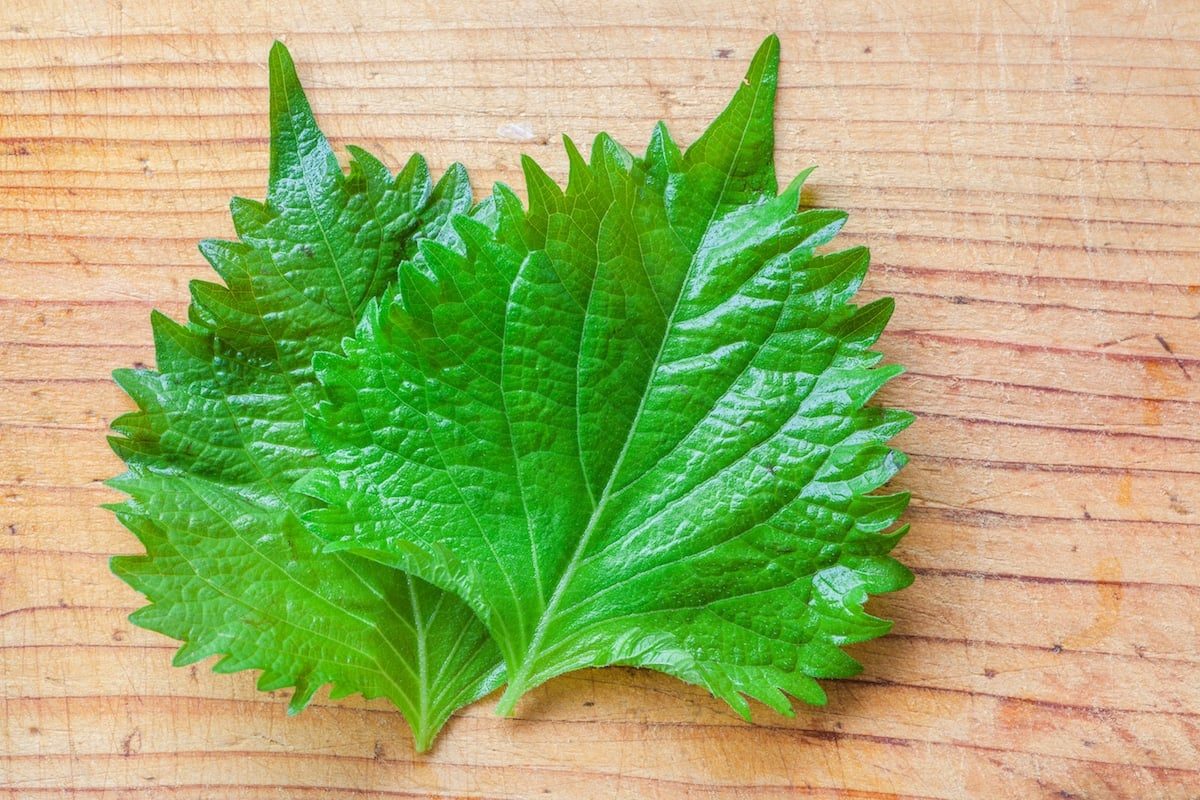
Shiso is the leaf of Perilla frutescens, an annual herb in the mint family (Lamiaceae).1 Its main aroma compound is perillaldehyde, which a 2022 review calls a major volatile component of the plant’s essential oil.2 Just One Cookbook’s Namiko Hirasawa Chen describes the flavor as “vibrant, herbaceous, and citrusy with a mildly astringent taste and bitter finish,” and says plainly that there is nothing like the taste and texture of shiso.3 So every swap below is a compromise. Which one works best depends on what the leaf is doing in your dish.
Quick answer
| What shiso is doing | Best substitute | Starting amount, per 1 part shiso | Treatment |
|---|---|---|---|
| Raw aromatic herb (sashimi, rice, noodles, salads) | Fresh mint and basil, mixed | 1 part in total, half and half, then taste | Method |
| Herb in drinks and desserts | Fresh mint | 1/2 part, then taste | Method |
| Herb in stir-fries and Southeast Asian dishes | Thai basil | 1/2 part, then taste | Method |
| A leaf to wrap rice or grilled meat | Korean perilla leaves (kkaennip) | 1 leaf per leaf | Method |
| Red shiso coloring pickles | No real substitute | Leave it out | Method |
The rest of the page explains each choice and the alternatives.
How the ratios on this page are labeled
Every ratio carries one of four labels.
- Computed: based on a measurable physical relationship, with the source named.
- Attributed: a named source publishes this ratio. We quote it as theirs.
- Disputed: named sources give different answers to the same swap. We show each one and do not average them.
- Method: we found no published ratio. We give a direction and a cautious starting point, and say so.
Every ratio on this page is Method. We found no published amount for replacing shiso with anything from a source that meets our standard, and no study comparing the strength of shiso with any other herb.
Why nothing matches exactly
Shiso’s aroma rests on perillaldehyde.2 The common substitutes are built on other compounds:
| Herb | Main aroma compounds in the sources we reviewed | Source |
|---|---|---|
| Shiso (Perilla frutescens) | Perillaldehyde, the main component in the most cultivated chemical type | Hou et al.; Katzer24 |
| Peppermint | Menthol and menthone | Singh & Pandey5 |
| Spearmint | Carvone | Singh & Pandey5 |
| Thai basil | Estragole, then geranial and neral, with anise and lime-like aromas | Tangpao et al.6 |
| Sweet (French-type) basil | Methyl chavicol (estragole) and linalool | PROSEA7 |
A substitute can match shiso’s job, its freshness and its place on the plate, but not its signature smell. Food52’s Lindsay-Jean Hard describes shiso as similar to mint “with a gingery edge” and suggests using it wherever you would use basil or mint.8 Reading that in reverse is the logic behind the first swaps below.
If shiso is a raw aromatic herb
This is shiso torn over rice, shredded onto cold noodles, tucked beside sashimi or tossed into a salad. Katzer notes that perilla leaves garnish sashimi, and Hard lists salads, dressings and rice dishes among its uses.48
1. Mint and basil together
Mint brings the cool, bright side of shiso and basil the sweet, slightly spicy side; neither covers both alone. That is our judgment, based on the descriptions above, not a tested blend. In cookery, “mint” usually means peppermint or spearmint.9 Spearmint, led by carvone rather than menthol,5 is the gentler choice here; in our judgment, peppermint’s menthol can taste cooling and medicinal in savory food.
Ratio (Method): No published ratio was found. Replace the shiso with an equal volume of mint and basil leaves, half of each, and taste before adding more.
2. Mint alone
Both are mint-family plants,19 and Purdue Extension’s guide to the weedy form uses the name “perilla mint.”10 Mint is the easiest substitute to find. It will taste more minty and less citrusy and astringent than shiso.
Ratio (Method): No published ratio was found. Start with about half the amount of shiso called for, chopped, and add more to taste.
3. Sweet basil alone
Basil gives sweetness and a mild anise note but little of shiso’s sharpness. Use it where shiso is one herb among several.
Ratio (Method): No published ratio was found. Start with an equal amount and taste.
If shiso is flavoring a drink or dessert
Chen suggests using shiso leaves in recipes that call for mint, such as mojitos, cocktails, ice cream and sorbets.3 Going the other way, mint is the obvious stand-in for shiso in a drink, syrup or sorbet. Hard also pairs shiso with lemonade and fruit cocktails.8
Two handling notes. LSU AgCenter counts mint among the delicate herbs whose flavor fades with prolonged heat, so steep it off the heat or add it late.11 And in a cocktail, press the leaves gently: Tasting Table’s Sylvia Tomczak warns that hard muddling releases mint’s vegetal, bitter side.12
Ratio (Method): No published ratio was found. Start with half the shiso amount of mint and adjust after tasting; mint can take over a drink quickly.
If shiso is an herb in stir-fries and Southeast Asian dishes
In a hot dish, the herb is usually stirred in at the end and wilted. Thai basil suits this job: in a Thai study of basil oils, its aroma was dominated by estragole and linked to anise, lime-like and fresh notes,6 so it adds a bright, licorice-tinged lift rather than shiso’s perillaldehyde. Andy Ricker notes that Thai basil has purple stems,13 which gives a little of the color of red or bicolor shiso, though the leaves themselves are green.
Ratio (Method): No published ratio was found. Because Thai basil’s anise note is strong, start with about half the shiso amount and add more to taste.
If shiso is a leaf for wrapping
In common practice, large shiso leaves are sometimes wrapped around rice, fish or grilled meat. Here the leaf’s size and texture matter as much as its smell.
1. Korean perilla leaves (kkaennip)
These come from the same species. Katzer notes that kkaennip (“sesame leaf”) is a common Korean name for perilla and that Korean cooking uses the leaves in ways similar to Japanese shiso.4 They are larger and sold in Korean groceries.
Not everyone accepts the swap. Chen writes that “Japanese shiso has different characteristics and culinary uses, so it’s not advised to substitute.”3 Use kkaennip where the leaf’s job is to wrap, and expect a different, earthier taste; that description is ours.
Ratio (Method): No published ratio was found. Use one leaf for each shiso leaf, trimming large leaves to size if needed.
2. Lettuce or grape leaves
For raw wraps, small lettuce leaves give the same shape with almost no flavor; add a few mint or basil leaves inside for aroma. For cooked rolls, brined grape leaves are sturdy and large, but they bring a salty, sour taste of their own, so rinse them first. Both are kitchen judgment, not sourced comparisons.
Ratio (Method): No published ratio was found. Use one leaf for each shiso leaf.
If red shiso is coloring a pickle
Red shiso is used mostly for color. Katzer says red-leaved cultivars are preferred in Japan for pickling, and that red perilla is used in making umeboshi, whose liquid in turn colors the ginger pickle beni shoga.4 The color comes from anthocyanins.42 Chen describes red shiso as used primarily for coloring foods.3
Ratio (Method): We found no published substitute for red shiso’s color in pickling. If you have none, make the pickle without it and accept a paler result. Chen notes that dried, ground shiso can also be sprinkled on rice and noodle dishes as a seasoning,3 so a jar of dried red shiso is worth keeping if you cook Japanese food often.
Dried shiso in place of fresh
We found no published conversion between fresh and dried shiso. America’s Test Kitchen lists basil and mint among the herbs it recommends using fresh rather than dried;14 shiso is not on its list, but it is a thin, tender leaf of the same family. In our judgment, dried shiso works as a seasoning sprinkled over rice, not as a stand-in for the fresh leaf.
Substitutes that work less well
| Substitute | Why it falls short |
|---|---|
| Cilantro | The key aroma compounds in cilantro are aldehydes, and some people find them soapy.15 It brings its own strong character, not shiso’s. Use it only where cilantro already suits the dish. |
| Dried mint or dried basil | ATK recommends both fresh.14 They lose the fresh, green quality that shiso is used for. |
| Wild or weedy perilla | Not a substitute. Katzer describes a perilla-ketone type that he considers toxic, with no kitchen use, and Purdue Extension documents lung disease in cattle that eat the weedy plant.410 Buy culinary shiso or grow a named culinary variety. |
What isn’t known
- No study compares the aroma of shiso with mint, basil or Thai basil in food, so every amount above is a cautious starting point.
- We found no fresh-to-dried conversion for shiso.
- No source we found gives a substitute for red shiso’s color in umeboshi.
- Shiso is sometimes called “Chinese basil” or “purple mint.” We could not trace either name to a source we could open.
Related
- Shiso
- Mint, spearmint, peppermint, types of mint
- Basil, Thai basil, basil vs. mint, basil vs. cilantro
- Mint substitutes, Thai basil substitutes
- Dried herbs vs. fresh, the master list of herbs and spices
Footnotes
-
Perilla frutescens (L.) Britton, Plants of the World Online, Royal Botanic Gardens, Kew. powo.science.kew.org · Reference work ↩ ↩2
-
Hou et al., “Perilla frutescens: A Rich Source of Pharmacological Active Compounds”, Molecules, 2022. mdpi.com · Peer-reviewed ↩ ↩2 ↩3 ↩4
-
Namiko Hirasawa Chen, “Shiso (Perilla)”, Just One Cookbook, 2024. justonecookbook.com · Publication ↩ ↩2 ↩3 ↩4 ↩5
-
“Perilla (Perilla frutescens)”, Gernot Katzer’s Spice Pages. gernot-katzers-spice-pages.com · Reference work ↩ ↩2 ↩3 ↩4 ↩5 ↩6
-
Singh and Pandey, “Prospective of Essential Oils of the Genus Mentha as Biopesticides”, Frontiers in Plant Science, 2018. frontiersin.org · Peer-reviewed ↩ ↩2 ↩3
-
Tangpao, Chung and Sommano, “Aromatic Profiles of Essential Oils from Five Commonly Used Thai Basils”, Foods, 2018. mdpi.com · Peer-reviewed ↩ ↩2
-
Aguilar, Pham Truong Thi Tho and Oyen, Ocimum basilicum, Plant Resources of South-East Asia (PROSEA). uses.plantnet-project.org · Reference work ↩
-
Lindsay-Jean Hard, “Shiso: Basil’s Asian Cousin”, Food52. vercel.food52.com · Publication ↩ ↩2 ↩3
-
“Mint (plant)”, Encyclopaedia Britannica. britannica.com · Reference work ↩ ↩2
-
Nice, Johnson and Shelton, “Beefsteak Plant (Perilla Mint)”, Purdue Extension WS-43-W, 2010. extension.purdue.edu · Reference work ↩ ↩2
-
“Flavorful Herbs”, LSU AgCenter. lsuagcenter.com · Reference work ↩
-
Sylvia Tomczak, “Why You Should Think Twice Before Muddling Mint In Your Next Mojito”, Tasting Table, 2024. tastingtable.com · Publication ↩
-
Andy Ricker with J.J. Goode, “Stir-fried chicken with hot basil (kai kaphrao)”, from Pok Pok, via The Splendid Table. splendidtable.org · Publication ↩
-
Danielle Lapierre, “When You Should Actually Use Dried Herbs (and Which Ones to Avoid)”, America’s Test Kitchen, 2022. americastestkitchen.com · Publication ↩ ↩2
-
Eriksson et al., “A genetic variant near olfactory receptor genes influences cilantro preference”, Flavour, 2012. link.springer.com · Peer-reviewed ↩