Spice Comparisons · Comparison
Basil vs. Cilantro: Different Families, Different Chemistry
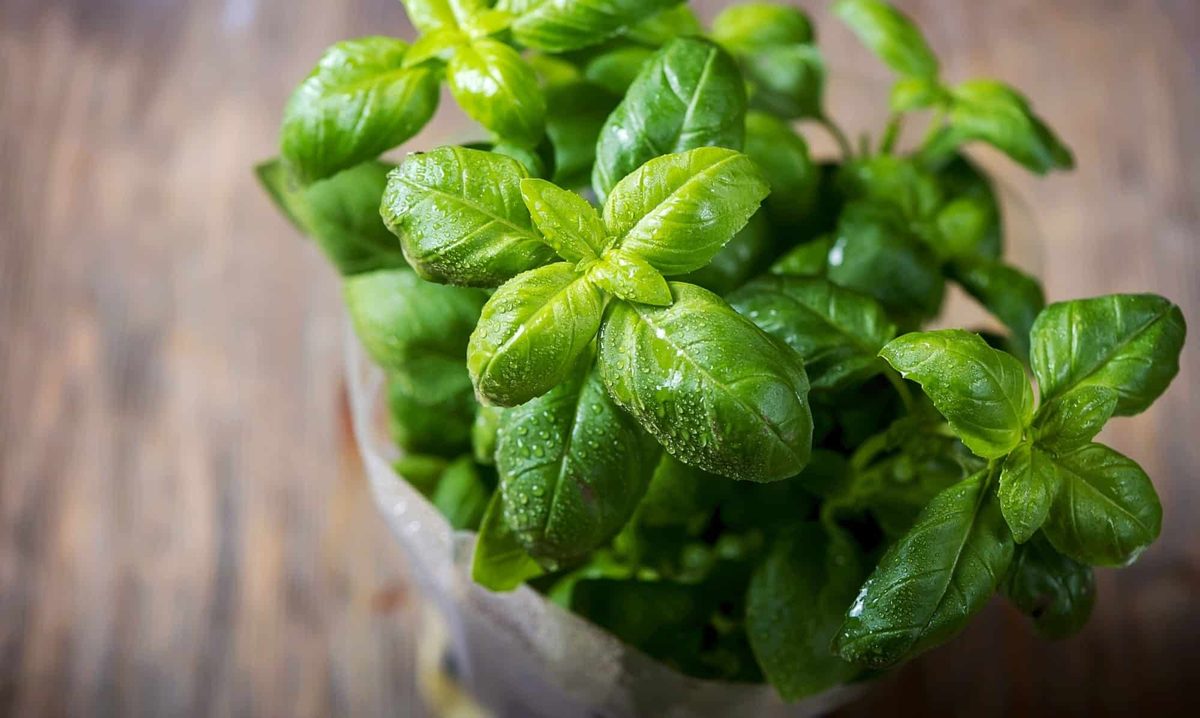
Basil and cilantro come from different plant families and smell of entirely different compounds. Sweet basil’s aroma is built on methyl chavicol (estragole), 53.3% of one French-type basil oil,1 while more than 80% of cilantro leaf’s volatile oil is aldehydes, the compounds behind both its fresh, citrusy taste and the soapy taste some people get from it.23 Each can stand in for the other in a few raw dishes, but neither tastes like the other.
Side by side
| Basil (sweet basil) | Cilantro | |
|---|---|---|
| Species | Ocimum basilicum L.4 | Coriandrum sativum L., the leaf of the plant whose seed is coriander56 |
| Family | Mint family (Lamiaceae)7 | Parsley family (Apiaceae)6 |
| Native range | Tropical and subtropical Asia to northern Australia (Kew)4 | Eastern Mediterranean to western Pakistan (Kew)5 |
| Plant | Annual or subshrub of the seasonally dry tropics4 | Annual, up to 1.3 m tall, with a taproot2 |
| Leaf | Glossy, oval, smooth or slightly toothed, often cupped7 | Feathery6 |
| Key aroma compounds | Methyl chavicol (estragole); one French-type oil: 53.3%1 | Aldehydes, more than 80% of the leaf oil, led by (E)-2-dodecenal at 15.6% in one analysis2 |
| Flavor (editorial) | Sweet and green, with anise and clove notes | Fresh, green and citrusy; soapy to some people |
| Forms | Fresh leaves, dried leaves | Fresh bunches, dried leaf |
| Typical uses | Italian tomato dishes, pesto, Thai cooking1 | Latin American, Indian and Chinese dishes; Mexican salsas68 |
| Cost | No dated, sourced price comparison found | No dated, sourced price comparison found |
| Safety | Estragole: BfR names basil pesto among foods that may contain high amounts9 | FDA import controls on fresh cilantro from Puebla, Mexico, over cyclosporiasis outbreaks10 |
The flavor row is our description. It fits the chemistry: PROSEA describes French-type basil oil as sweet-spicy, slightly green and fresh,1 and cilantro’s flavor is described anywhere from citrusy with a biting tang to soapy.8 Basil also varies more than most herbs: PROSEA recognizes at least six chemotypes within the species,1 which is why lemon basil, cinnamon basil and Thai basil smell so different from Italian basil.
The differences that change a dish
The soap problem belongs to cilantro alone
In a 2012 genetic study of 14,604 people of European ancestry who reported whether cilantro tasted soapy, Eriksson and colleagues found a variant near a cluster of smell-receptor genes; one of those genes codes for a receptor that binds several of cilantro’s aldehydes strongly.3 The effect is real but modest: the heritability tagged by common variants was about 0.087, so genes explain only part of who tastes soap.3 Basil’s aroma rests on different compounds,1 so it doesn’t carry that risk; for a cilantro-averse guest, basil changes the dish rather than spoiling it (editorial).
Heat
Both are delicate herbs. LSU AgCenter lists basil and cilantro among the herbs best added in the last minute or two of cooking, because prolonged heat costs flavor and aroma.11 Most cooks use cilantro raw; basil goes into sauces as well, usually near the end (common practice).
Cuisines
The two herbs mark different kitchens, though both travel. In Italian cooking basil goes into pizzas, pasta, chicken and cheese dishes and pesto, and PROSEA calls sweet basil an important ingredient in Thai cuisine.1 Cilantro’s young leaves are widely used in Latin American, Indian and Chinese dishes;6 it goes into Mexican salsas and meat dishes, and Arabic cooking uses both leaves and seeds in pickles, curries and chutneys.8
One common mix-up: the basil in the Thai stir-fry phat kaphrao is not Thai basil but holy basil, a different species that Thai cooks call kaphrao. Andy Ricker notes that “holy basil” labels are sometimes put on purple-stemmed Thai or sweet basil.12 See holy basil and Thai basil.
Nutrition
Per 100 g, fresh basil carries more vitamin K, calcium and iron, and cilantro more vitamin A, vitamin C and fiber:
| Per 100 g, fresh | Basil | Cilantro |
|---|---|---|
| Vitamin K | 415 µg (346% DV) | 310 µg (258% DV) |
| Vitamin A (RAE) | 264 µg (29% DV) | 337 µg (37% DV) |
| Vitamin C | 18.0 mg (20% DV) | 27.0 mg (30% DV) |
| Calcium | 177 mg (14% DV) | 67 mg (5% DV) |
| Iron | 3.17 mg (18% DV) | 1.77 mg (10% DV) |
| Fiber | 1.6 g (6% DV) | 2.8 g (10% DV) |
Source: USDA FoodData Central values;1314 percentages are our arithmetic against FDA Daily Values.15 Nobody eats 100 g of either at a sitting. USDA weighs a quarter cup of whole basil leaves at 6 g and a quarter cup of cilantro at 4 g,1314 which works out to about 25 µg of vitamin K from the basil (21% DV) and 12 µg from the cilantro (10% DV). Vitamin K is the only nutrient either supplies in a meaningful amount at normal servings. For vitamin K and blood thinners, see the basil profile.
Can one stand in for the other?
Only in some dishes, and the dish will taste different. No published ratio exists for swapping sweet basil and cilantro, so the starting points below are Method.
- Basil in place of cilantro. Works in raw uses such as a herb salad or a fresh salsa when someone can’t stand cilantro. Start with the same amount, torn or chopped, and taste. For Southeast Asian dishes, A Couple Cooks suggests Thai basil or mint as a 1:1 substitute (Attributed).16 Its final option for cilantro-haters is to leave cilantro out altogether.16 More options are ranked on cilantro substitutes.
- Cilantro in place of basil. Reasonable in a raw salad or a noodle bowl. Thai basil is one of the herbs on Andrea Nguyen’s pho garnish plate,17 and if it is missing, more cilantro and mint still give a plate of fresh herbs (editorial). It does not work where basil is the point: pesto, a tomato and mozzarella salad, or a Margherita pizza (editorial). Start with about half the basil amount, since cilantro is the more assertive of the two in our judgment.
What isn’t known
- No study compares the aroma strength of basil and cilantro, so every swap amount above is a starting point.
- The cilantro genetics study does not give a percentage of people who taste soap, and neither does this page.3
- Widely repeated heights for each plant (about 30 inches for basil, 18 for cilantro) could not be traced. PROSEA gives cilantro up to 1.3 m.2
Related
- Profiles: basil, cilantro, Thai basil, holy basil
- Cilantro substitutes and too much basil
- Comparisons: cilantro vs. parsley, coriander vs. cilantro, basil vs. parsley, basil vs. mint, basil vs. Thai basil
- Cooking with basil, cooking with cilantro and dried vs. fresh cilantro
Footnotes
-
N.O. Aguilar, Pham Truong Thi Tho and L.P.A. Oyen, Ocimum basilicum, Plant Resources of South-East Asia (PROSEA). uses.plantnet-project.org · Reference work ↩ ↩2 ↩3 ↩4 ↩5 ↩6 ↩7
-
Coriandrum sativum, Plant Resources of South-East Asia (PROSEA). uses.plantnet-project.org · Reference work ↩ ↩2 ↩3 ↩4
-
Eriksson et al., “A genetic variant near olfactory receptor genes influences cilantro preference”, Flavour, 2012. link.springer.com · Peer-reviewed ↩ ↩2 ↩3 ↩4
-
Ocimum basilicum L., Plants of the World Online, Royal Botanic Gardens, Kew. powo.science.kew.org · Reference work ↩ ↩2 ↩3
-
Coriandrum sativum L., Plants of the World Online, Royal Botanic Gardens, Kew. powo.science.kew.org · Reference work ↩ ↩2
-
“Coriander”, Encyclopaedia Britannica. britannica.com · Reference work ↩ ↩2 ↩3 ↩4 ↩5
-
“Basil”, Encyclopaedia Britannica, 2026. britannica.com · Reference work ↩ ↩2
-
Susan Mahr, “Cilantro”, Wisconsin Master Gardener Program, University of Wisconsin-Madison, 2017. mastergardener.extension.wisc.edu · Reference work ↩ ↩2 ↩3
-
“Alkenylbenzenes in food: how large is the health risk?”, BfR Communication No. 22/2022. bfr.bund.de · Regulator ↩
-
Import Alert 24-23, U.S. Food and Drug Administration. accessdata.fda.gov · Regulator ↩
-
“Flavorful Herbs”, LSU AgCenter. lsuagcenter.com · Reference work ↩
-
Andy Ricker with J.J. Goode, “Stir-fried chicken with hot basil (kai kaphrao)”, from Pok Pok, via The Splendid Table. splendidtable.org · Publication ↩
-
Basil, fresh (FDC 172232), USDA FoodData Central. fdc.nal.usda.gov · Regulator ↩ ↩2
-
Coriander (cilantro) leaves, raw (FDC 169997), USDA FoodData Central. fdc.nal.usda.gov · Regulator ↩ ↩2
-
Daily Value on the Nutrition and Supplement Facts Labels, U.S. Food and Drug Administration. fda.gov · Regulator ↩
-
Sonja Overhiser, “Best Cilantro Substitute”, A Couple Cooks, 2026. acouplecooks.com · Publication ↩ ↩2
-
Andrea Nguyen, “Pho Garnish Plate”, from The Pho Cookbook, via The Splendid Table. splendidtable.org · Publication ↩