Seasonings · Profile
Vindaloo Curry Powder: The Goan Dish, the Blend, and the Heat
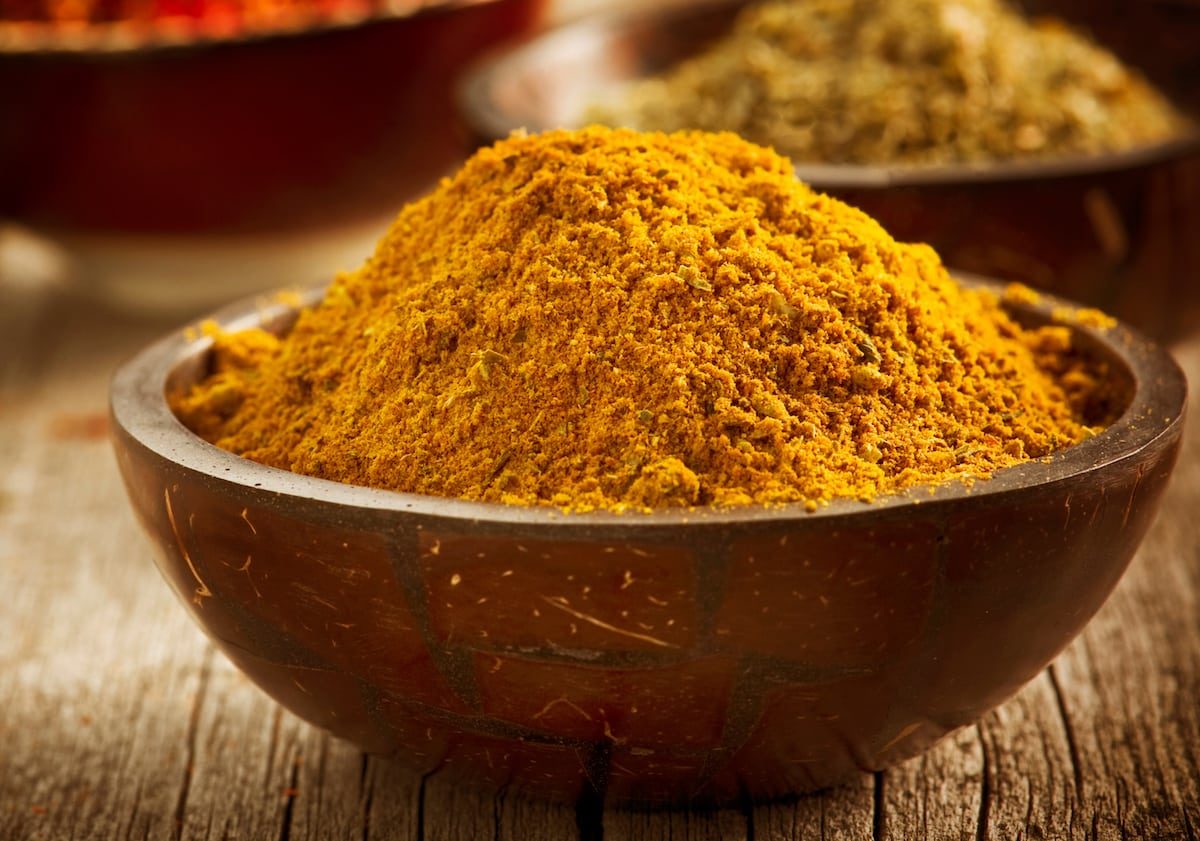
Vindaloo curry powder is a spice blend made to season vindaloo, the Goan dish whose name comes from the Portuguese carne de vinha d’alhos, meat marinated in wine vinegar and garlic.1 The three blends compared below share a core of chiles, cumin, black pepper, cinnamon and cloves; the USDA’s specification for plain curry powder, by contrast, names no chile.2345 The vinegar that defines the dish goes into the marinade, not the powder.16 This page covers where vindaloo comes from, what goes into the blend, how hot it is, and how to use it.
At a glance
| What it is | A spice blend for vindaloo, a dish from Goa, India, influenced by Portuguese cooking2 |
| Name origin | A garbled pronunciation of the Portuguese carne de vinha d’alhos (Collingham)1 |
| In all three blends below | Chiles, cumin, black pepper, cinnamon, cloves234 |
| Heat | Medium to fiery, depending on the blend23 |
| Traditional meat | Usually pork (Jackman)6 |
| Typical amount | About 1 teaspoon per pound of meat, per Savory Spice2 |
Where vindaloo comes from
Food historian Lizzy Collingham, writing for Saveur, traces vindaloo to carne de vinha d’alhos, a Portuguese dish of meat marinated in wine vinegar and garlic, which reached India with Portuguese explorers in the 15th century.1 India had no wine vinegar, so Franciscan priests made their own from palm wine, and local cooks added tamarind, black pepper, cinnamon and cardamom.1 Chiles, Collingham notes, were themselves part of Portugal’s legacy, brought to India from the Americas.1 Daily Maverick’s Tony Jackman likewise describes Goan cooks swapping palm vinegar for the red wine, and defines vindaloo as meat, usually pork, marinated in vinegar and garlic.6 Savory Spice sums it up as a dish from Goa influenced by Portuguese cuisine.2
On the meat, Collingham says Christian Goan cooks, free of caste and religious restrictions, were happy to make the beef and pork dishes that expatriates loved.1
When vindaloo traveled to Britain, it changed. Collingham writes that it became another hot curry, its balance of spices lost under a blistering excess of chiles.1 Jackman puts it the same way: the British version came to be understood as simply an extremely hot curry.6 Britannica notes, more generally, that curry powder itself was adapted by British settlers in India, whereas Indian cooks prepare their spice mixtures, or masalas, at home.7
What goes in it: three blends compared
There is no standard recipe, and the three versions below differ widely.
| Ingredient | Savory Spice (retail blend)2 | America’s Test Kitchen, Leah Colins (2020 recipe)3 | Silk Road Spices (retail blend)4 |
|---|---|---|---|
| Chiles | Cayenne | Árbol chiles (6 to 8), cayenne (1 tsp), paprika (1 tsp) | Chiles, paprika |
| Cumin | Yes | 1 1/2 tbsp | Yes |
| Coriander | Yes | 1 1/2 tbsp | No |
| Fenugreek | Yes | 1 tbsp | No |
| Black pepper | Yes | 1 1/2 tsp | Yes |
| Cinnamon | Saigon cinnamon | 1/2 tsp ground | Yes |
| Cloves | Yes | 1 whole | Yes |
| Turmeric | Yes | No | No |
| Mustard seed | Brown mustard | No | No |
| Cardamom | Yes | No | No |
| Ginger | Yes | No | Yes |
| Garlic | Yes | No | No |
| Other | Salt | None | Poppy seeds, amchur, star anise |
Five ingredients appear in all three: chiles, cumin, black pepper, cinnamon and cloves. None of the three lists vinegar. For comparison, the USDA’s purchase specification for plain curry powder lists turmeric, coriander, fenugreek, cinnamon, cumin, black pepper, ginger and cardamom, with no chile.5
Flavor, heat and the compounds behind it
How hot a vindaloo powder is depends entirely on the blend:
| Source | Heat description |
|---|---|
| Savory Spice2 | Vindaloo spices tend to be quite hot; its own blend is closer to medium and “not as hot as typical vindaloo” |
| America’s Test Kitchen3 | Árbol chiles, cayenne and paprika give “fiery complex heat” |
| Silk Road Spices4 | Pitched at those who like things hotter than yellow curry powder |
Savory Spice recommends adding extra cayenne for a spicier result.2 Behind the heat, the aroma is warm and sharp, with cumin’s earthiness, the sweetness of cinnamon and the medicinal edge of cloves; that description is ours. The compounds belong to the individual spices:
| Ingredient | Key compound | Source |
|---|---|---|
| Coriander | Linalool, 60–80% of the essential oil | Al-Khayri et al., 20238 |
| Cumin | Cuminaldehyde, 20–72% of the oil in the literature PROSEA summarizes | PROSEA9 |
| Fenugreek | Sotolon, responsible for fenugreek’s characteristic curry aroma | PROSEA10 |
| Cloves | Eugenol, 70–90% of bud oil | PROSEA11 |
How it is used
The main job is the dish. Savory Spice suggests about 1 teaspoon of its blend per pound of beef, pork, poultry or fish, and also suggests it for chicken, rice and roasted vegetables.2 Silk Road Spices says it can go into any recipe that calls for curry powder.4
To cook a vindaloo in the Goan spirit, the vinegar and garlic matter as much as the powder: the original marinade was wine vinegar and garlic, later palm vinegar in Goa.16 Pork is the traditional choice.6 Marinating the meat in the vinegar, garlic and spice mixture before cooking is common practice rather than a sourced instruction.
Buying and storage
Read the ingredient list: blends vary from medium to very hot, and some add salt.2 No sourced shelf-life figure for vindaloo powder was found. As with any ground blend, keep it sealed, dark and cool, and replace it when the aroma fades; that is general kitchen practice.
Safety
Lead in spices. A New York City health department review of spice samples found detectable lead in more than half of them.12 The abstract does not report results for vindaloo powder specifically.
Health claims. Vindaloo powder is often credited with preventing Alzheimer’s disease and cancer (through turmeric’s curcumin and chile’s capsaicin) and lowering blood pressure (through cardamom). No regulator summary or systematic review supporting those claims was found. NCCIH says there is not enough evidence to conclude that turmeric or curcumin is beneficial for any health purpose,13 and only one of the three blends above contains turmeric at all.2
Substitutes and comparisons
In our judgment, Madras curry powder or plain curry powder with added cayenne makes the closest stand-in. No source gives a tested ratio, so start with the same amount and adjust the heat (Method). See vindaloo vs. Madras curry powder, is curry powder spicy?, too much curry powder and Portuguese spices. The individual spices: cumin, coriander, fenugreek, black pepper, cinnamon, cloves, cardamom, turmeric and ginger.
Footnotes
-
Lizzy Collingham, “Fired Up: The History of Vindaloo”, Saveur, 2014. saveur.com · Publication ↩ ↩2 ↩3 ↩4 ↩5 ↩6 ↩7 ↩8 ↩9
-
Vindaloo, Savory Spice (product page). savoryspiceshop.com · Merchant ↩ ↩2 ↩3 ↩4 ↩5 ↩6 ↩7 ↩8 ↩9 ↩10 ↩11 ↩12
-
Leah Colins, “Vindaloo Curry Powder”, America’s Test Kitchen, 2020. americastestkitchen.com · Publication ↩ ↩2 ↩3 ↩4 ↩5
-
Vindaloo Curry Powder, Silk Road Spices (product page). silkroadspices.ca · Merchant ↩ ↩2 ↩3 ↩4 ↩5
-
Commercial Item Description A-A-20001C, Spices and Spice Blends, USDA Agricultural Marketing Service, 2023. ams.usda.gov · Regulator ↩ ↩2
-
Tony Jackman, “Throwback Thursday: The fascinating history of vindaloo”, Daily Maverick, 2023. dailymaverick.co.za · Publication ↩ ↩2 ↩3 ↩4 ↩5 ↩6
-
“Curry”, Encyclopaedia Britannica, 2026. britannica.com · Reference work ↩
-
Al-Khayri et al., “Essential Oil from Coriandrum sativum: A Review on Its Phytochemistry and Biological Activity”, Molecules, 2023. mdpi.com · Peer-reviewed ↩
-
P.C.M. Jansen, Cuminum cyminum, Plant Resources of South-East Asia (PROSEA). uses.plantnet-project.org · Reference work ↩
-
Trigonella foenum-graecum, Plant Resources of South-East Asia (PROSEA). uses.plantnet-project.org · Reference work ↩
-
Syzygium aromaticum, Plant Resources of South-East Asia (PROSEA). uses.plantnet-project.org · Reference work ↩
-
Hore et al., “A Spoonful of Lead: A 10-Year Look at Spices as a Potential Source of Lead Exposure”, Journal of Public Health Management and Practice, 2019. scholars.mssm.edu · Peer-reviewed ↩
-
“Turmeric: Usefulness and Safety”, NCCIH, 2025. nccih.nih.gov · Regulator ↩