Spices · Profile
Madras Curry Powder: What’s in It, How Hot It Is, and How to Use It
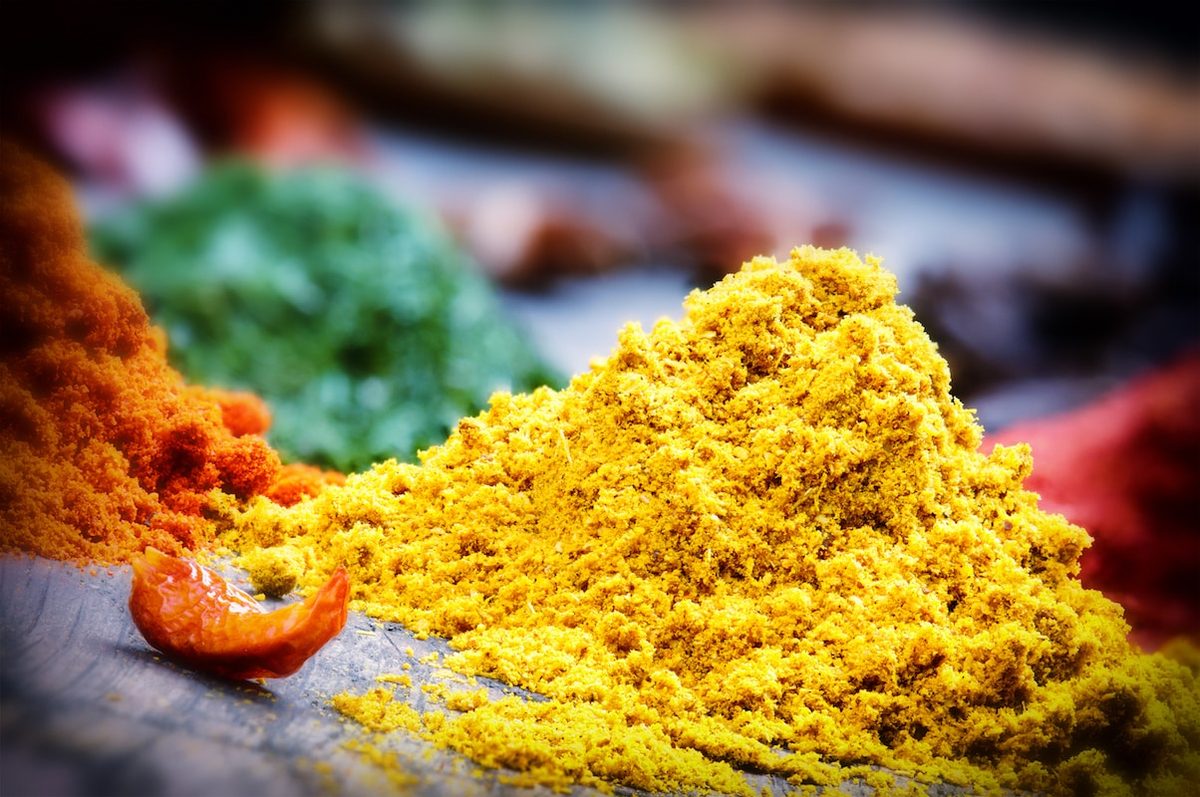
Madras curry powder is a style of curry powder with chile added for heat, sold under the old name of the city now called Chennai. Like curry powder in general, it grew out of British demand for Indian flavors rather than out of home cooking in Madras itself. There is no fixed recipe: commercial blends start from turmeric, coriander and cumin and add red chile, with fenugreek, mustard seed and warm spices in varying amounts. This page covers what goes into it, where the name comes from, how hot it is, and how to buy, use and store it.
At a glance
| What it is | A curry powder blend, usually hotter than standard curry powder12 |
| Named for | Madras, the former name of Chennai, capital of Tamil Nadu3 |
| Typical components | Coriander, mustard seed, turmeric, cumin, fenugreek, black pepper, red chile, cinnamon, cardamom, ginger (one merchant’s blend)2 |
| What sets it apart | Chile heat: the USDA’s minimum list for plain curry powder contains no chile4 |
| Heat | No published measurement found; one merchant rates its own blend 2 of 52 |
| Origin | A British-era product, advertised as “Genuine Madras Curry Powder”15 |
| Forms sold | Ground blend, in jars and tins |
Measured values
2 figures, sourced| Measure | Value | Scope | Source |
|---|---|---|---|
| Moisture, maximum Limit | 9.0 % | USDA Commercial Item Description A-A-20001C, curry powder bought under the specification | ams.usda.gov |
| Total ash, maximum Limit | 7.2 % | USDA Commercial Item Description A-A-20001C, curry powder bought under the specification | ams.usda.gov |
Each figure is quoted as its source states it, with the samples or standard it applies to. Where sources differ, both are shown; nothing is averaged. All measured values
Name and history
Chennai was formerly known as Madras.3 Britannica says curry powder as a product was adapted by British settlers in India, while in traditional Indian cookery the spice mixtures are called masala and are prepared at home.5 Madras curry powder belongs to that British line.
Historian Julia Fine, writing for the spice company Diaspora Co., gives the fullest account we found. Madras was home to one of the earliest English trading posts in India, and early on there were many kinds of curry powder: one English cookbook of the period has recipes for Delhi, Madras and Bengal curry powders. Advertisements for “Genuine Madras Curry Powder” multiplied, and Madras curry powder was often promoted as spicier than the Bengal and Bombay styles.1 Fine describes the 19th-century recipes as heavy on turmeric and chili or cayenne.1
ChefShop, which sells Sun Brand Madras Curry Powder, says the brand was established in 1876 for export to England.6 That date is the retailer’s statement and could not be checked against an independent source.
A widely repeated claim says the earliest Madras curry powder was sold at the Oriental Depot in Leicester Square in the mid-19th century. No source we could open supports it.
What is in it
There is no standard for Madras curry powder. The USDA’s purchase specification for curry powder says it should include, but is not limited to, turmeric, coriander, fenugreek, cinnamon, cumin, black pepper, ginger and cardamom, and it names no chile.4 Madras blends start from the same pool and add heat:
| Source | What it says goes in | Ref |
|---|---|---|
| World Spice Merchants, Madras South Indian Curry (own product) | Coriander, brown mustard seed, turmeric, cumin, fenugreek seed, black peppercorn, red chile flake, cinnamon, cardamom seed, ginger | 2 |
| Julia Fine, Diaspora Co. (19th-century recipes) | Heavy in turmeric and chili and/or cayenne; a Madras powder might have slightly more cayenne, and might call for fenugreek, saffron or cinnamon | 1 |
| USDA, plain curry powder (minimum) | Turmeric, coriander, fenugreek, cinnamon, cumin, black pepper, ginger, cardamom; no chile | 4 |
ChefShop’s listing for Sun Brand says there are many variations of the ingredients and proportions, and it does not print the brand’s recipe.6 Atlas Obscura makes the general point about curry powder: there has never been a set combination of spices.7
How hot is it?
The heat comes from the red chile, through capsaicinoids, the compounds that make chile peppers hot.8 How much heat a given jar delivers depends entirely on how much chile, and which chile, the maker uses. No published heat measurement of Madras curry powders was found. World Spice Merchants rates its own blend 2 on a scale of 5.2 Its reputation for heat goes back to 19th-century marketing.1
Flavor and the compounds behind it
Madras curry powder tastes earthy and warm, with a bitter edge from fenugreek and turmeric and a chile bite at the finish. That description is ours. The compounds belong to the individual spices:
| Spice | What it contributes | Source |
|---|---|---|
| Turmeric | Yellow color from curcumin; aroma from turmerone, ar-turmerone and zingiberene; a bitter, slightly acrid yet sweet taste | 910 |
| Coriander seed | Oil that is 60–80% linalool | 11 |
| Cumin | Cuminaldehyde, 20–72% of the oil across studies | 12 |
| Fenugreek | Sotolon, which PROSEA says gives fenugreek its characteristic curry aroma | 13 |
| Red chile | Heat, from capsaicinoids | 8 |
How Madras curry powder is used
Use it anywhere you would use curry powder and want more heat: meat, chicken and vegetable curries, dal, soups, and dry rubs for grilled meat. That is common practice rather than a sourced finding. Because the heat varies by brand, start with less than a recipe calls for and add more after tasting. A cooling side such as a yogurt raita is a common pairing.
Technique
Ground spices added straight into liquid can taste bland and musty, so America’s Test Kitchen recommends blooming them in fat first. It takes from 30 seconds to several minutes, and ground spices burn fairly quickly.14 See cooking with curry powder, and if a dish has gone over, too much curry powder.
Buying and quality
Check the ingredient list for where chile appears; as a rule of thumb, the higher up it is, the hotter the blend. A good blend should be evenly colored and free-flowing, without layers or lumps, which is what the USDA specification asks of curry powder.4 The USDA also caps moisture at 9.0% and total ash at 7.2% for curry powder bought under its specification.4
Storage
No regulator or standards body we found gives a shelf life for Madras curry powder. Keep it sealed, away from heat and light; if it smells faint when rubbed between the fingers, it has faded. That is common practice, not a measured figure.
Safety
Lead in spices. A New York City health department review of 1,496 spice samples from 41 countries, collected from 2008 to 2017, found detectable lead in more than half and above 2 parts per million in more than 30%, with higher average levels in spices bought abroad.15 The abstract does not break the results out by blend.
Turmeric adulteration. Turmeric, which gives the blend its color, has a documented problem with lead chromate, a yellow pigment added to improve color. A 2026 study of 503 turmeric samples from 34 cities in eastern India found 30% above India’s 10 µg/g lead limit.16 See turmeric.
Health claims
NCCIH, part of the National Institutes of Health, says there is not enough evidence to conclude that turmeric or curcumin is beneficial for any health purpose.10 For fenugreek, NCCIH says some research suggests it may help lower blood sugar in people with type 2 diabetes, but many of those studies were not of high quality.17 Neither finding applies to the small amounts in a spoonful of curry powder, and this page makes no health claim for the blend. Claims that the blend lowers cholesterol, or that its coriander removes lead and mercury from the body, could not be traced to any credible source.
Substitutes and comparisons
- Madras curry powder substitutes
- Madras curry powder vs. curry powder (see also curry powder and is curry powder spicy?)
- Vindaloo vs. Madras curry powder (see also vindaloo curry powder)
Other regional curry powders: Jamaican, Japanese and Malaysian. The individual spices: turmeric, coriander, cumin, fenugreek, brown mustard seeds, black pepper, cayenne pepper, cinnamon, cardamom and ginger; see also curry spices.
Footnotes
-
Julia Fine, “From Delhi to Durban: The Many Homes of Madras Curry Powder”, Diaspora Co., 2022. diasporaco.com · Merchant ↩ ↩2 ↩3 ↩4 ↩5 ↩6
-
“Madras South Indian Curry”, World Spice Merchants (product page). worldspice.com · Merchant ↩ ↩2 ↩3 ↩4 ↩5
-
“Chennai”, Encyclopaedia Britannica. britannica.com · Reference work ↩ ↩2
-
Commercial Item Description A-A-20001C, Spices and Spice Blends, USDA Agricultural Marketing Service, 2023. ams.usda.gov · Regulator ↩ ↩2 ↩3 ↩4 ↩5
-
“Curry”, Encyclopaedia Britannica, 2026. britannica.com · Reference work ↩ ↩2
-
“Madras Curry Powder - Sun Brand”, ChefShop (product page). chefshop.com · Merchant ↩ ↩2
-
Rohini Chaki, “The Subversive, Surprising History of Curry Powder”, Atlas Obscura, 2019. atlasobscura.com · Publication ↩
-
Bosland and Walker, “Measuring Chile Pepper Heat”, New Mexico State University, 2010. pubs.nmsu.edu · Reference work ↩ ↩2
-
Prasad and Aggarwal, “Turmeric, the Golden Spice”, in Herbal Medicine: Biomolecular and Clinical Aspects, 2011. ncbi.nlm.nih.gov · Reference work ↩
-
“Turmeric: Usefulness and Safety”, National Center for Complementary and Integrative Health, 2025. nccih.nih.gov · Regulator ↩ ↩2
-
Al-Khayri et al., “Essential Oil from Coriandrum sativum: A Review”, Molecules, 2023. mdpi.com · Peer-reviewed ↩
-
P.C.M. Jansen, Cuminum cyminum, Plant Resources of South-East Asia (PROSEA). uses.plantnet-project.org · Reference work ↩
-
C.S. Tawan and N. Wulijarni-Soetjipto, Trigonella foenum-graecum, Plant Resources of South-East Asia (PROSEA). uses.plantnet-project.org · Reference work ↩
-
“How to Bloom Spices”, America’s Test Kitchen, 2023. americastestkitchen.com · Publication ↩
-
Hore et al., “A Spoonful of Lead”, Journal of Public Health Management and Practice, 2019. scholars.mssm.edu · Peer-reviewed ↩
-
Forsyth et al., “Systemic drivers of toxic food adulteration: lead chromate in turmeric across eastern India”, npj Science of Food, 2026. nature.com · Peer-reviewed ↩
-
“Fenugreek”, National Center for Complementary and Integrative Health, 2025. nccih.nih.gov · Regulator ↩