Spices · Profile
Yellow Mustard Seeds: The Mildest Mustard, Its Chemistry and Its Uses
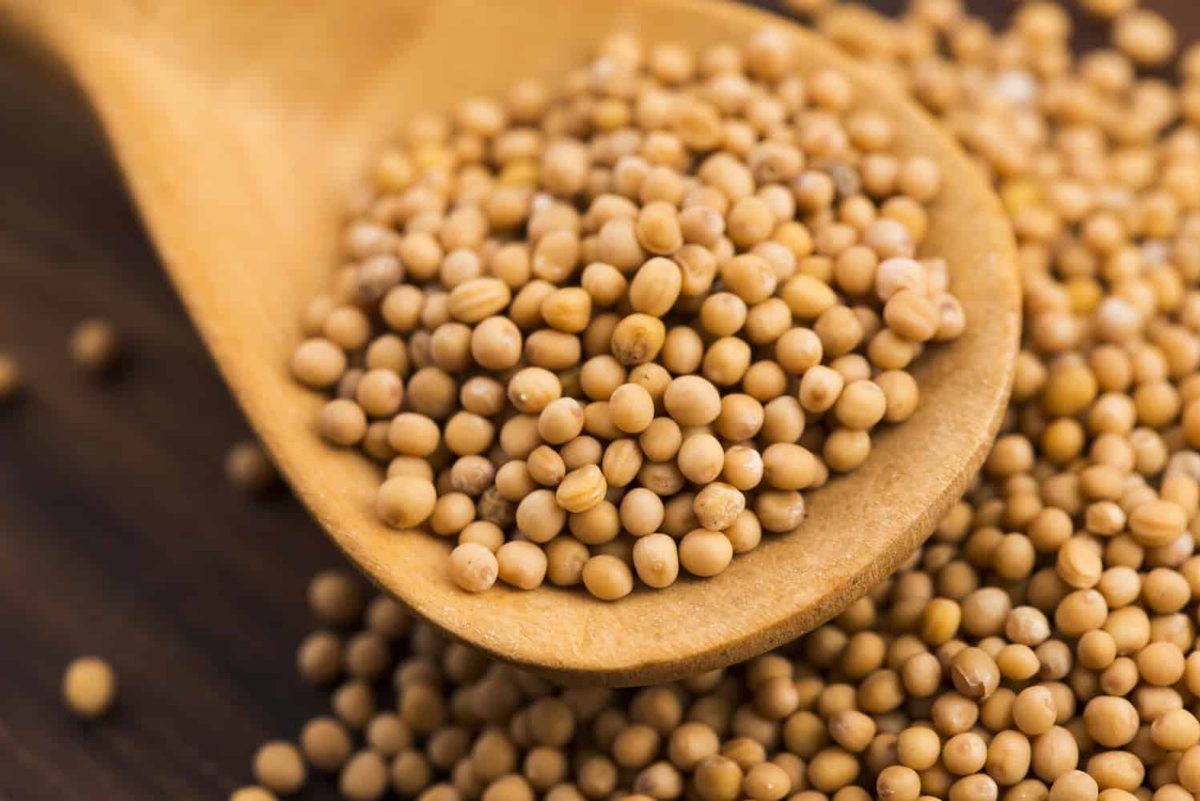
Yellow mustard seeds, also called white mustard seeds, come from Sinapis alba. They are the mildest of the three mustard seeds, and their chemistry is different too: their bite comes from a non-volatile compound, unlike the volatile one made by brown and black seed. They are the seed behind North American hot dog mustard, much of the world’s mustard powder, and the whole seeds in many pickle brines.
At a glance
| Botanical name | Sinapis alba L.1 |
| Plant family | Brassicaceae (cabbage family)1 |
| Other names | White mustard |
| Native range | Europe to China (Kew); Mediterranean (Britannica and Katzer)123 |
| Seed | Globular, light yellow, finely pitted, about 2.5 mm across2 |
| Pungent precursor | Sinalbin, about 2.5% of the seed3 |
| Pungent compound | p-Hydroxybenzyl isothiocyanate, non-volatile3 |
| Major exporter | Saskatchewan, Canada4 |
| Forms sold | Whole seed, ground (mustard powder or flour), prepared mustard |
| Allergen status | One of the 14 allergens UK food businesses must declare; not a major allergen in the US56 |
Measured values
1 figure, sourced| Measure | Value | Scope | Source |
|---|---|---|---|
| Sinalbin (glucosinolate) | about 2.5 % of seed | Yellow (white) mustard seed, per Katzer | gernot-katzers-spice-pages.com |
Each figure is quoted as its source states it, with the samples or standard it applies to. Where sources differ, both are shown; nothing is averaged. All measured values
Yellow, brown and black mustard
Three plants supply mustard seed, and yellow mustard is the odd one out.
- Yellow or white mustard, Sinapis alba, the subject of this page.1
- Brown mustard, long called Brassica juncea, which Kew now accepts as a hybrid, × Brassarda juncea, with Brassica rapa and black mustard as its parents.7
- Black mustard, long called Brassica nigra, now accepted by Kew as Mutarda nigra.8
Black mustard is one of brown mustard’s parents, while yellow mustard sits in a separate genus, Sinapis.17
Britannica gives yellow and brown mustard seeds about the same size, roughly 2.5 mm across,29 while PROSEA describes black mustard seed as about 1 mm.10 So yellow seed is larger than black, but not larger than brown.
Flavor and the chemistry of the heat
The dry seeds have no fragrance; chew them and a pungent taste develops after a while.3 Britannica describes white mustard as less intensely flavored than brown, which is why it goes into milder mustards.2
All mustard heat is made on demand. Crushing the seed and adding water lets the enzyme myrosinase act on a glucosinolate stored in the seed.311 What differs is the glucosinolate:
| Yellow (white) mustard | Brown and black mustard | |
|---|---|---|
| Glucosinolate | Sinalbin, about 2.5% of the seed3 | Sinigrin (black mustard about 1%)12 |
| Pungent product | p-Hydroxybenzyl isothiocyanate3 | Allyl isothiocyanate12 |
| Volatile? | No3 | Yes, highly volatile11 |
| Behavior in acid | Stable to hydrolysis in acid3 | Unstable toward water; stronger pastes carry more acid12 |
The chemistry also explains why Katzer considers white mustard better suited to mustard pastes: its pungent principle holds up in acidic mixtures, while black mustard’s does not hold up well in water.312
Two points of handling apply to all mustard seed. Water is what starts the reaction, and Popular Science reports that hot water slows or stops the enzyme while strong acid such as vinegar inhibits it, so vinegar fixes the heat level.11 Heat also matters once the seeds are whole and dry: Katzer notes that mustard seeds fried in fat or dry-toasted lose their pungency and take on a nutty, smoky taste, as in South Indian cooking with black and brown seed.12
History
The name. “Mustard” comes from the Latin for must, unfermented grape juice (vinum mustum), because the condiment was originally made by mixing must into the crushed seed.13 Katzer credits the Romans with popularizing mustard in Central and Western Europe, and with using must to make the paste.12
In North America. Commercial mustard growing in Canada began with 40 hectares planted in southern Alberta in 1936.4
Common claims that the Sumerians mixed mustard with verjuice, that the Egyptians cooked with it, that mustard was Europe’s main source of heat before pepper, and that Dioscorides prescribed it could not be traced to sources opened for this page.
Where it is grown
Katzer gives the Mediterranean as the likely origin of white mustard and says its cultivars are grown in northern, central and eastern Europe.3 Britannica notes that it is grown with mechanized harvesting in its main producing countries and is also grown as green manure and fodder.2
Saskatchewan grows three mustard types: yellow (Sinapis alba), and brown and oriental (both Brassica juncea).4 The provincial government describes Saskatchewan producers as the world’s largest mustard exporters, and the province has historically produced about 80% of Canada’s mustard crop.4 Neither figure is broken out by type or dated, and no FAOSTAT figure was opened.
How yellow mustard seeds are used
- Prepared mustard. Saskatchewan lists traditional hot dog mustard, mayonnaise and salad dressings among yellow mustard’s uses.4 The bright yellow of American-style mustard comes from turmeric, which some brands add for color, not from the seed.3 See turmeric.
- English and German mustards. British mustard powder is made by the Colman method, sold dry and mixed with water shortly before use; its flavor develops within about 10 minutes.3 Bavarian sweet mustard is made from coarsely ground white mustard seed.3 See mustard powder.
- Emulsified sauces. Mustard contains emulsifiers, so it improves the stability of emulsified sauces as well as their flavor, according to Katzer.3 Whisking mustard into vinaigrettes and mayonnaise is common practice.
- Pickling. Whole white mustard seeds are popular in pickled vegetables.3
- Processed meats. In the meat industry, yellow mustard serves as a water-binding agent and protein extender in prepared meats.4
- Rubs and marinades. Cracked or ground seed goes into dry rubs and brines; that is common practice.
A widely repeated claim that mustard seed is an important ingredient in hollandaise sauce has no support in the sources checked.
For more ideas, see mustard seed uses.
Buying and storage
Whole seed should be uniform, light yellow and free of grit and broken seed; that is kitchen judgment rather than a published grade. Because whole mustard seeds are odorless,23 smell is no test. A common kitchen test for ground seed is to mix a little with cool water, wait a few minutes and taste; a weak bite suggests old powder. No published shelf-life figure was found for whole or ground yellow mustard seed.
Safety
Allergy. Mustard is one of the 14 allergens that food businesses in the UK must declare.5 It is not one of the nine major food allergens in the United States.6
Erucic acid. The EU caps erucic acid in mustard (the condiment) at 35 g/kg.14
Health claims. This page makes no claim that yellow mustard seeds prevent or treat any disease. Claims that its isothiocyanates fight stomach or colon cancer, or that it aids weight loss, could not be traced to a regulator or systematic review.
Substitutes and comparisons
- Yellow vs. black mustard seeds
- Black mustard seeds and brown mustard seeds
- Black mustard seed substitutes
- Mustard powder vs. mustard seed and mustard powder substitutes
Footnotes
-
Sinapis alba L., Plants of the World Online, Royal Botanic Gardens, Kew. powo.science.kew.org · Reference work ↩ ↩2 ↩3 ↩4 ↩5
-
“White mustard”, Encyclopaedia Britannica. britannica.com · Reference work ↩ ↩2 ↩3 ↩4 ↩5 ↩6
-
Gernot Katzer, “White Mustard (Sinapis alba)”, Gernot Katzer’s Spice Pages. gernot-katzers-spice-pages.com · Reference work ↩ ↩2 ↩3 ↩4 ↩5 ↩6 ↩7 ↩8 ↩9 ↩10 ↩11 ↩12 ↩13 ↩14 ↩15 ↩16 ↩17
-
“Mustard”, Government of Saskatchewan. saskatchewan.ca · Regulator ↩ ↩2 ↩3 ↩4 ↩5 ↩6
-
Allergen guidance for food businesses, Food Standards Agency. gov.uk · Regulator ↩ ↩2
-
Food Allergies, U.S. Food and Drug Administration. fda.gov · Regulator ↩ ↩2
-
× Brassarda juncea, Plants of the World Online, Royal Botanic Gardens, Kew. powo.science.kew.org · Reference work ↩ ↩2
-
Mutarda nigra (L.) Bernh., Plants of the World Online, Royal Botanic Gardens, Kew. powo.science.kew.org · Reference work ↩
-
“Brown mustard”, Encyclopaedia Britannica. britannica.com · Reference work ↩
-
H. Toxopeus and I. Utomo, Brassica nigra, Plant Resources of South-East Asia (PROSEA). uses.plantnet-project.org · Reference work ↩
-
Sandra Gutierrez G., “When the mustard shortage hits, make your own”, Popular Science, 2022. popsci.com · Publication ↩ ↩2 ↩3
-
Gernot Katzer, “Mustard (Brassica nigra, B. juncea, Sinapis alba)”, Gernot Katzer’s Spice Pages. gernot-katzers-spice-pages.com · Reference work ↩ ↩2 ↩3 ↩4 ↩5 ↩6
-
“mustard (n.)”, Online Etymology Dictionary. etymonline.com · Reference work ↩
-
Commission Regulation (EU) 2023/915 on maximum levels for certain contaminants in food, EUR-Lex. eur-lex.europa.eu · Regulator ↩