Spice Substitutes · Substitutes
Black Mustard Seed Substitutes, Matched to What the Seed Is Doing
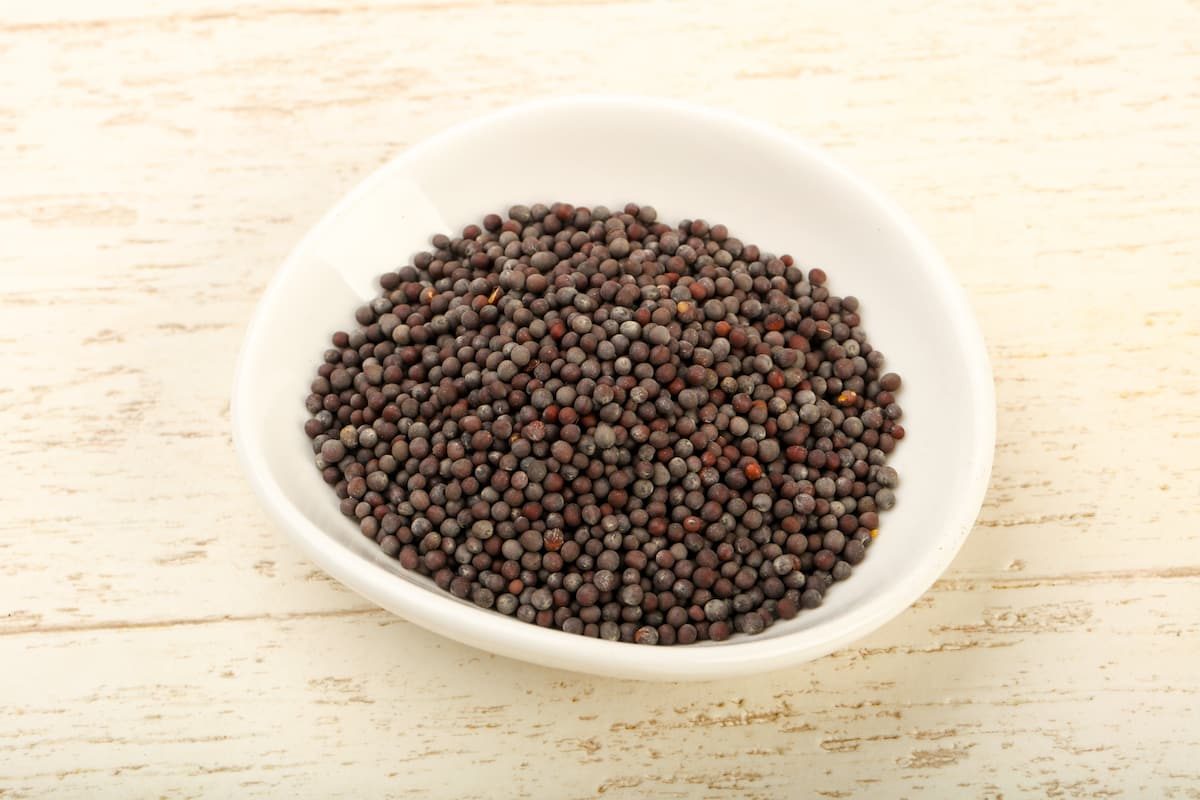
Black mustard seed comes from Brassica nigra, the smallest and darkest of the three mustards. Its seeds are about 1 mm across, black to red-brown.1 Like brown mustard, it gets its bite from a compound called sinigrin: when the seed is crushed and wet, the enzyme myrosinase breaks sinigrin down into allyl isothiocyanate, the sharp, volatile compound that makes mustard hot.21 Black mustard is now hard to buy. Its pods shatter as they ripen, which makes it unsuitable for machine harvesting, and brown mustard has largely replaced it as a crop.13 The jar you own may already be brown seed. What you swap in depends on what the seed is doing in your recipe.
Quick answer
| What black mustard seed is doing | Best substitute | Starting amount, per 1 part black mustard seed | Treatment |
|---|---|---|---|
| Whole seeds popped in hot oil (tadka, panch phoron) | Brown mustard seeds | 1 part, then adjust | Method |
| Sharp, nose-clearing heat in a raw paste, pickle or dressing | Ground brown seed, or mustard powder mixed with cool water | 1½ parts ground, by volume | Computed (volume only) |
| Mustard heat and tang in a sauce or dressing | Dijon mustard | About 1½ tablespoons per teaspoon of seed | Attributed (chained) |
| Whole seeds, and yellow is all you have | Yellow (white) mustard seeds | 1 part, then more to taste | Method |
How the ratios on this page are labeled
- Computed: based on a measurable physical relationship, with the source named.
- Attributed: a named source publishes this ratio. We quote it as theirs.
- Disputed: named sources give different answers to the same swap. We show each one and do not average them.
- Method: we found no published ratio. We give a direction and a cautious starting point, and say so.
We found no published ratio for swapping any mustard seed for black mustard seed, and no study that measures their pungency side by side in cooking.
If the seeds are popped in hot oil
This is black mustard’s best-known job. Gernot Katzer describes frying whole mustard seeds in fat as a typical South Indian technique, and lists black mustard in Tamil vegetable curries with curry leaves and in panch phoron, the Bengali five-seed blend.2 He also notes that mustard seeds are always fried in fat or dry-toasted before they are used this way.2
That matters for the swap. Fried or toasted mustard seeds “are no longer pungent,” Katzer writes; they turn nutty and smoky instead.2 Heat also destroys isothiocyanates that have already formed.2 So in a tadka, the difference in heat between black and brown seed largely drops out. That is our reading of Katzer, not a tested comparison.
1. Brown mustard seeds
Brown mustard (Brassica juncea, which Kew treats as a hybrid) is the seed that replaced black mustard in the fields.45 Katzer calls black and brown mustard botanically different but of equal use in the kitchen, with black mustard’s pungency “slightly stronger.”2 Both owe their heat to the same sinigrin-to-allyl isothiocyanate reaction.2 Brown seeds are a little larger, up to about 2 mm, and somewhat lighter in color.2 Katzer also notes that Indian brown mustard is probably the type most commonly sold in the West.2
Ratio (Method): No published ratio was found. Start one for one. If the dish relies on raw mustard heat rather than fried seeds, add a little more brown seed to taste.
2. Yellow (white) mustard seeds
Yellow mustard is a different plant, Sinapis alba. Britannica describes its seeds as less intensely flavored than brown mustard’s.6 Its heat also comes from a different compound: myrosinase releases p-hydroxybenzyl isothiocyanate from sinalbin, and Katzer describes that compound as pungent and non-volatile.7 It gives a bite on the tongue rather than the rising heat of black or brown mustard. Whole yellow seeds have no smell until they are chewed.76 This is the seed behind traditional hot dog mustard, and some brands add turmeric for the bright yellow color.87
Ratio (Method): No published ratio was found. Start one for one, then add more if you want more mustard flavor. Expect a milder, different result.
If the seeds give raw, sharp heat
In pickles, raw pastes and dressings, black mustard’s job is heat. That heat forms only when ground seed meets water: myrosinase and sinigrin react to make allyl isothiocyanate.9 Popular Science notes that water that is too hot deactivates the enzyme completely, and that vinegar inhibits it, which is why acid sets a mustard’s strength.9
1. Ground brown seed or mustard powder
Grind brown seed yourself if you have it. Ready-ground mustard is usually made from yellow seed; Popular Science says you’ll have a hard time finding any other mustard powder.9 McCormick says dried mustard and ground mustard are the same thing.10
Ratio (Computed, volume only): McCormick gives 1 teaspoon mustard seeds = 1½ teaspoons ground mustard.11 This is a bulking figure: ground powder takes up more room in the spoon than the seeds it came from. It says nothing about strength. McCormick also says mustard seeds “tend to be more potent than ground mustard.”10 So start at 1½ teaspoons of powder per teaspoon of seed and taste before adding more.
Mix powder with cool water and let it stand before it meets acid or heat. Popular Science reports that cold-water mustard needs resting time to develop.9
2. Dijon mustard
Dijon is made from the same seeds. Saveur reports that the rules for Dijon mustard allow only black and/or brown mustard seed.12 It also brings acid and liquid, so use it where those are welcome: dressings, marinades, sauces. It cannot stand in for whole seeds in oil.
Ratio (Attributed, chained): McCormick’s substitution for ground mustard is 1 tablespoon of Dijon for each teaspoon of ground mustard.10 Combined with McCormick’s seed-to-ground conversion above,11 that works out to about 1½ tablespoons of Dijon per teaspoon of seed. The chaining is our arithmetic, not McCormick’s. Start lower if the dish is already sharp or salty.
If you were going to use mustard oil
Mustard oil is not a seed substitute, but it is the other way the black-mustard flavor reaches the table in eastern India. Katzer calls West Bengal and Bangladesh the epicenter of mustard oil use.2 Heating destroys isothiocyanates that have already formed,2 so expect less bite from oil cooked hot. The European Union caps erucic acid, a fatty acid found in mustard, at 50 g/kg in mustard oil (with an exemption for some local production) and 35 g/kg in mustard as a condiment.13 We did not check mustard oil’s status in the United States.
Ratio (Method): No published ratio exists between mustard oil and mustard seed. Use the oil as the cooking fat for a dish that calls for both, rather than as a replacement for the seeds.
Allergy note
The UK counts mustard among the 14 allergens food businesses must declare.14 The US list of nine major food allergens does not include it.15 Every substitute on this page, including Dijon and mustard powder, is still mustard.
What isn’t known
- No published measurement compares the pungency of black, brown and yellow mustard seed in a cooked dish. Katzer’s “slightly stronger” is a qualitative judgment.2
- How much heat survives when seeds are fried for a tadka has not been measured, as far as we found. Katzer’s statement that fried seeds are no longer pungent is the best guide available.2
- A widely repeated claim says brown seeds need 1½ times the black-seed amount and yellow seeds twice. No source we found supports either number.
- Popular Science’s rule of thumb is that the darker the seed, the spicier.9 It is a guide to direction, not a ratio.
Related
- Black mustard seeds, brown mustard seeds and yellow mustard seeds
- Yellow vs. black mustard seeds and mustard powder vs. mustard seed
- Mustard powder, mustard powder substitutes and mustard powder vs. prepared mustard
- Mustard seed uses and mustard powder uses
- Curry leaves and garam masala
Footnotes
-
Toxopeus and Utomo, Brassica nigra, PROSEA, via Pl@ntUse. uses.plantnet-project.org · Reference work ↩ ↩2 ↩3
-
Katzer, Mustard (Brassica nigra, B. juncea, Sinapis alba), Gernot Katzer’s Spice Pages. gernot-katzers-spice-pages.com · Reference work ↩ ↩2 ↩3 ↩4 ↩5 ↩6 ↩7 ↩8 ↩9 ↩10 ↩11 ↩12 ↩13
-
Black mustard, Encyclopaedia Britannica. britannica.com · Reference work ↩
-
× Brassarda juncea, Plants of the World Online, Royal Botanic Gardens, Kew. powo.science.kew.org · Reference work ↩
-
Brown mustard, Encyclopaedia Britannica. britannica.com · Reference work ↩
-
White mustard, Encyclopaedia Britannica. britannica.com · Reference work ↩ ↩2
-
Katzer, White Mustard (Sinapis alba), Gernot Katzer’s Spice Pages. gernot-katzers-spice-pages.com · Reference work ↩ ↩2 ↩3
-
Mustard, Government of Saskatchewan. saskatchewan.ca · Regulator ↩
-
Gutierrez G., When the mustard shortage hits, make your own, Popular Science, 2022. popsci.com · Publication ↩ ↩2 ↩3 ↩4 ↩5
-
About Ground Mustard: Uses, Pairings and Substitutes, McCormick, 2025. mccormick.com · Merchant ↩ ↩2 ↩3
-
How to Grind Your Own Spices, McCormick. mccormick.com · Merchant ↩ ↩2
-
Sertl, Avez-Vous du Vrai Poupon?, Saveur, 2007. saveur.com · Publication ↩
-
Commission Regulation (EU) 2023/915, EUR-Lex. eur-lex.europa.eu · Regulator ↩
-
Allergen guidance for food businesses, Food Standards Agency. gov.uk · Regulator ↩
-
Food Allergies, U.S. Food and Drug Administration. fda.gov · Regulator ↩