Spice Substitutes · Substitutes
Mustard Powder Substitutes, Ranked by the Job Dry Mustard Is Doing
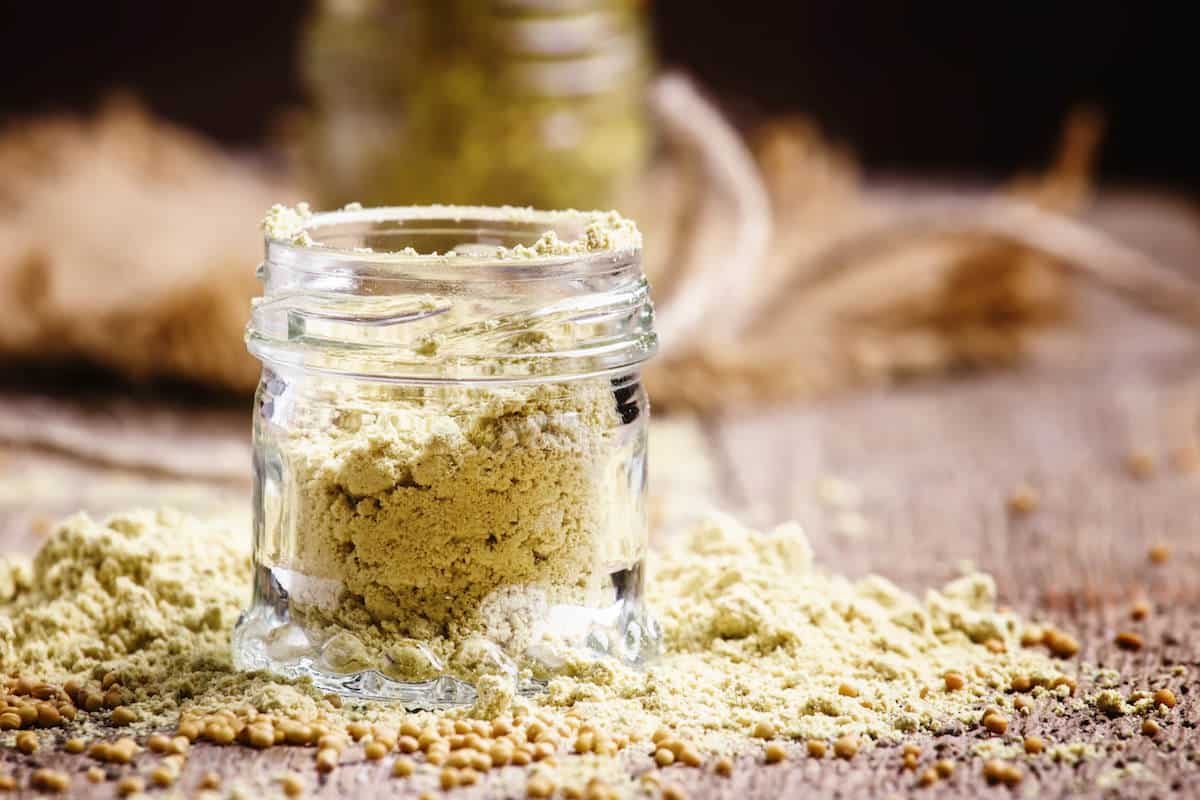
Mustard powder (ground or dry mustard) is mustard seed milled to a flour. Dry, it has little bite. Its heat appears only when water reaches it: the enzyme myrosinase acts on a compound in the seed called sinigrin to form allyl isothiocyanate, the volatile compound behind mustard’s kick.1 So a good substitute either brings that same chemistry with it or replaces whatever else the powder was doing in the recipe: tang and body in a sauce, yellow color in a cheese dish, or sharp heat in a rub or condiment.
Quick answer
| What mustard powder is doing | Best substitute | Per 1 teaspoon mustard powder | Treatment |
|---|---|---|---|
| Tang and body in dressings, sauces, mac and cheese, deviled eggs | Prepared mustard, Dijon first | 1 tablespoon | Attributed |
| Sharp heat in a rub, marinade or homemade condiment | Mustard seeds, ground | 1/2 teaspoon | Disputed |
| Heat in a cold sauce or condiment | Wasabi powder or horseradish powder | 1/2 teaspoon, then taste | Method |
| Yellow color, little or no heat needed | Turmeric | 1 teaspoon | Attributed |
How the ratios on this page are labeled
Every ratio carries one of four labels.
- Computed: based on a measurable physical relationship, with the source named.
- Attributed: a named source publishes this ratio. We quote it as theirs.
- Disputed: named sources give different answers to the same swap. We show each one and do not average them.
- Method: we found no published ratio. We give a direction and a cautious starting point, and say so.
The published figures below are kitchen equivalents from extension services and a spice company. None of them measures pungency, and no study we found compares the heat of mustard powder with any of its substitutes.
If mustard powder is adding tang and body
In dressings, cheese sauces, glazes and deviled eggs, the powder seasons and helps hold the sauce together. Katzer notes that mustard contains emulsifiers that help stabilize emulsified sauces.2 Prepared mustard does both jobs.
1. Dijon mustard
McCormick calls Dijon the best substitute for ground mustard because the two are similar in flavor.3 Under Dijon’s rules, it may be made only from black and/or brown mustard seeds,4 the more pungent kinds; Britannica describes white mustard seed as less intensely flavored than brown.5
Ratio (Attributed): Three sources agree. NDSU Extension and NMSU Extension both give 1 tablespoon of prepared mustard for 1 teaspoon of dry mustard,67 and McCormick gives the same figure for Dijon.3
2. Yellow (American) prepared mustard
Ratio (Attributed): The extension figure above, 1 tablespoon per teaspoon, applies to prepared mustard in general.67 In our judgment, yellow mustard is the mildest choice and adds the most yellow color. Katzer notes that some brands get their bright yellow from turmeric.2
Liquid (Method): A tablespoon of prepared mustard adds liquid that the powder didn’t. We found no published adjustment. In a tight sauce or dressing, hold back a little of the recipe’s vinegar or lemon juice, then taste and add it back if needed.
If mustard powder is bringing sharp heat
In a dry rub, a marinade or a homemade hot mustard, you want the heat itself. Mustard seed, horseradish and wasabi all form pungent isothiocyanates when their cells are broken.8
1. Mustard seeds, ground
This is the same ingredient in a different form. Grind the seeds in a spice grinder, or crush them in a mortar, as finely as you can. McCormick says mustard seeds tend to be more potent than ground mustard.3
Ratio (Disputed): The two published figures answer the question differently.
| Source | Mustard seeds per 1 tsp mustard powder | What the figure is |
|---|---|---|
| NDSU Extension, FN1986 | 1/2 teaspoon | A substitution equivalent |
| McCormick spice conversions9 | 2/3 teaspoon (our arithmetic from 1 tsp seeds = 1 1/2 tsp ground) | A volume conversion: ground seed takes more room than whole |
McCormick’s figure says how much powder a teaspoon of seeds makes, not how hot it will be. Because McCormick also says the seeds tend to be more potent,3 start with NDSU’s 1/2 teaspoon, taste once the mustard has had a few minutes in contact with liquid, and add more if you want it.
Which seeds. Ready-made mustard powder is usually yellow seed; Popular Science says you’ll have a hard time finding any other kind.1 Yellow seed matches it best. Brown or black seed will be hotter: Britannica rates white mustard less intense than brown,5 and Katzer rates black slightly more pungent than brown.10
Don’t toast them. Katzer notes that mustard seeds fried or toasted are no longer pungent and turn nutty and smoky.10 That suits Indian tempering, but not a swap for raw powder.
2. Wasabi powder
Most wasabi powder is not wasabi. S&B’s lists horseradish, mustard, corn starch, vitamin C, artificial flavor and artificial colors,11 and Chowhound reports that the vast majority of commercial wasabi is made from European horseradish.12 So a typical wasabi powder is mustard and horseradish powder, colored green.
Ratio (Method): We found no published ratio. Mix it with cool water (S&B’s label uses cold water)11 and start with half as much as the mustard powder called for, then taste. It will turn a cream sauce or dressing faintly green.
3. Horseradish powder
Horseradish belongs to the same plant family as mustard, Brassicaceae,13 and Britannica credits allyl isothiocyanate with its distinctive flavor, noting related compounds in mustard.8 A German spice merchant says ground horseradish develops pronounced pungency as soon as it meets water, and can taste quite bitter.14
Ratio (Method): No published ratio was found. Start with half as much horseradish powder as mustard powder, mixed with a little cool water, and taste.
Use grated fresh horseradish only if you will serve it soon. America’s Test Kitchen notes that grated horseradish turns milder the longer it sits, and that vinegar preserves its heat.15
Keep the heat out of the hot pan
Heat works against every substitute in this section. Popular Science reports that water that is too hot deactivates myrosinase completely, and that vinegar inhibits it as well.1 Katzer notes that heating quickly destroys the isothiocyanates once they have formed,10 and in a 2024 study of horseradish sauce, heat treatment inactivated the enzyme and caused an undesired loss of pungency.16 In a cooked dish, mix the substitute with a little cool water first and stir it in near the end. Advice to use horseradish only in cold dishes overstates the problem; add it at the end, off the heat.
If mustard powder is mostly there for color
Turmeric
Ratio (Attributed): McCormick suggests turmeric as a second option, saying it has a similar color and taste to dry mustard but won’t be as spicy, and that you can use the same measurement the recipe gives for ground mustard.3
Curcumin gives turmeric its yellow color.17 Turmeric has none of the enzyme chemistry above, so expect color and an earthy note but no mustard heat. Use it where the powder’s job was mostly to make macaroni and cheese or deviled eggs look right, and add a pinch of another substitute if you want bite as well.
What isn’t known
- No study compares the pungency of mustard powder with prepared mustard, ground seed, horseradish or wasabi. Every ratio here is a rule of thumb.
- It is often said that horseradish and wasabi powders are hotter than mustard powder. We found no measurement either way.
- We found no tested figure for how much liquid to remove when swapping prepared mustard for the powder.
Related
- Mustard powder, mustard powder uses, mustard powder vs. mustard seed and mustard powder vs. prepared mustard
- The seeds: yellow mustard seeds, brown mustard seeds, black mustard seeds, yellow vs. black mustard seeds and mustard seed uses
- Horseradish, horseradish powder, wasabi, wasabi vs. horseradish and wasabi powder vs. paste
- Turmeric and turmeric substitutes
Footnotes
-
Sandra Gutierrez G., When the mustard shortage hits, make your own, Popular Science, 2022. popsci.com · Publication ↩ ↩2 ↩3
-
Gernot Katzer, White Mustard, Gernot Katzer’s Spice Pages. gernot-katzers-spice-pages.com · Reference work ↩ ↩2
-
About Ground Mustard: Uses, Pairings and Substitutes, McCormick, 2025. mccormick.com · Merchant ↩ ↩2 ↩3 ↩4 ↩5
-
William Sertl, Avez-Vous du Vrai Poupon?, Saveur, 2007. saveur.com · Publication ↩
-
White mustard, Encyclopaedia Britannica. britannica.com · Reference work ↩ ↩2
-
Julie Garden-Robinson, Ingredient Substitutions (FN198), NDSU Extension, 2018. ksre.ksu.edu · Reference work ↩ ↩2 ↩3
-
In a Pinch Ingredient Substitution (E-131), NMSU Cooperative Extension, 2016. pubs.nmsu.edu · Reference work ↩ ↩2
-
Isothiocyanate, Encyclopaedia Britannica. britannica.com · Reference work ↩ ↩2
-
How to Grind Your Own Spices, Plus Spice Conversions, McCormick, 2025. mccormick.com · Merchant ↩
-
Gernot Katzer, Mustard, Gernot Katzer’s Spice Pages. gernot-katzers-spice-pages.com · Reference work ↩ ↩2 ↩3
-
S&B Wasabi Powder, label ingredients and directions as listed by Gourmet Food World. gourmetfoodworld.com · Merchant ↩ ↩2
-
Elias Nash, Why Genuine Wasabi Is So Expensive In The US, Chowhound, 2023. chowhound.com · Publication ↩
-
Horseradish, Encyclopaedia Britannica. britannica.com · Reference work ↩
-
Horseradish ground, Gewürzshop Mayer. gewuerzshop-mayer.de · Merchant ↩
-
Keeping the Kick in Fresh Horseradish, America’s Test Kitchen. americastestkitchen.com · Publication ↩
-
Bianchi et al., Substitution of additives in horseradish sauce, Applied Food Research, 2024. doaj.org · Peer-reviewed ↩
-
Turmeric: Usefulness and Safety, National Center for Complementary and Integrative Health. nccih.nih.gov · Regulator ↩