Spice Comparisons · Comparison
Mustard Powder vs. Mustard Seed: Heat, Storage and How Much to Swap
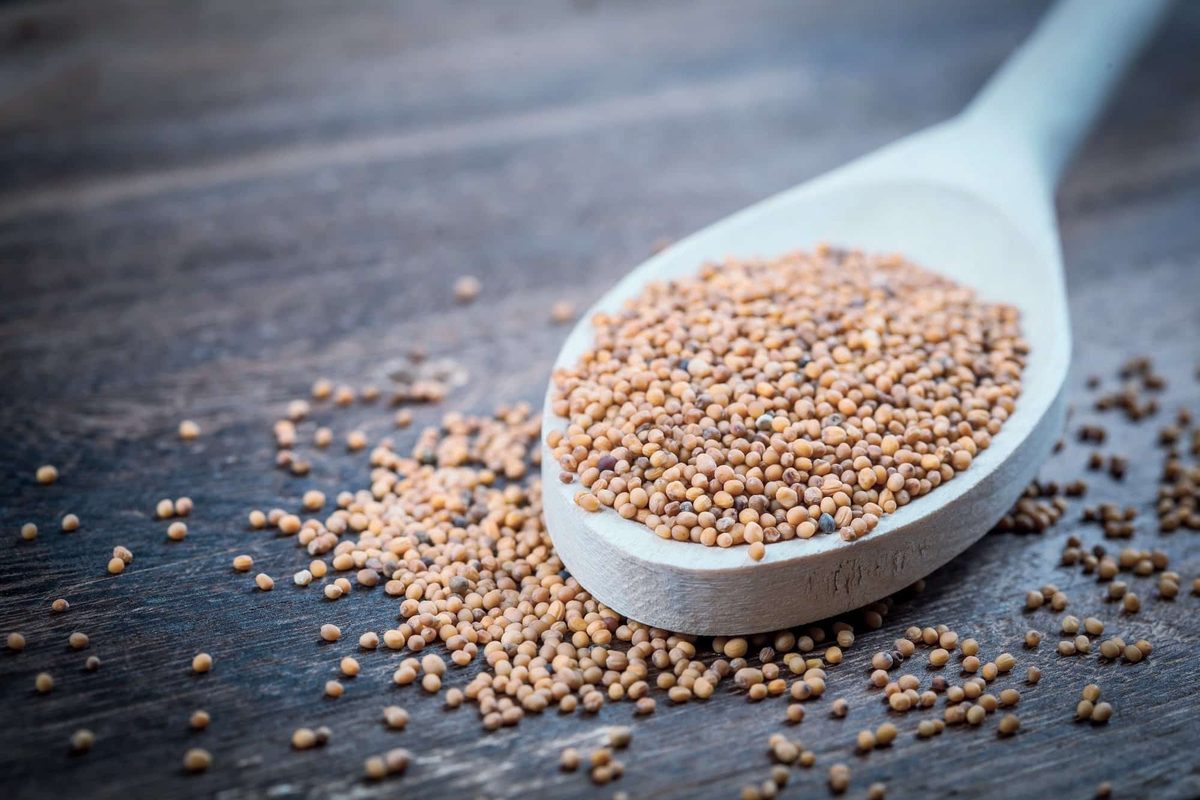
Mustard powder is mustard seed ground fine. McCormick says plainly that dried mustard and ground mustard are the same spice.1 The two forms share their chemistry: neither is hot until crushed seed meets water, which lets the enzyme myrosinase turn a compound stored in the seed into the sharp, nose-tingling allyl isothiocyanate.2 What differs is what you can do with each. Powder blends into liquids and dry mixes at once. Whole seed keeps longer, gives texture, and can be fried in oil, which changes its flavor completely.34
Side by side
| Mustard powder | Mustard seed | |
|---|---|---|
| What it is | Ground mustard seed; also sold as ground mustard or dry mustard1 | The whole seed of white (yellow), brown or black mustard3 |
| Plants | Mostly yellow mustard: Popular Science found it hard to buy powder from any other seed2 | Yellow: Sinapis alba;5 brown: Brassica juncea, now × Brassarda juncea at Kew;6 black: Brassica nigra, now Mutarda nigra at Kew7 |
| Family | Brassicaceae, the cabbage and mustard family7 | Brassicaceae7 |
| Size | Fine powder; 1 teaspoon weighs 2.0 g (USDA)8 | Yellow and brown about 2.5 mm across;910 black about 1 mm11 |
| Smell before wetting | Neutral and odorless, as PROSEA describes ground black mustard11 | Odorless when whole910 |
| Where the heat comes from | Myrosinase acting on sinigrin (brown and black seed) to form allyl isothiocyanate, once wet;2 yellow seed forms a non-volatile pungent compound instead12 | Same reaction, but only after the seed is crushed or chewed12 |
| In hot fat | Ground spices don’t fare well under intense heat13 | Fried or dry-toasted, the seeds lose their pungency and turn nutty and smoky3 |
| Keeping (general guideline) | ATK: ground spices about 1 year4 | ATK: whole spices about 2 years4 |
| Flavor (editorial) | Sharp, clean heat once mixed with water; little flavor dry | Mild and nutty when fried; sharp when cracked and soaked |
| Typical uses | Mixed to a paste; dressings, cheese sauces, rubs, emulsified sauces | Indian tempering, pickling, homemade whole-grain mustard |
| Price | No dated, sourced comparison found | No dated, sourced comparison found |
ATK’s keeping times are a general rule for whole and ground spices, not a figure measured for mustard.4 For each form on its own, see mustard powder, yellow mustard seeds, brown mustard seeds and black mustard seeds.
The heat is made, not stored
A common description says grinding mustard “releases” its volatile oils, which then drift away from the jar. The chemistry runs differently. Crushed seed holds an enzyme, myrosinase, and a glucosinolate called sinigrin; water brings them together, and the reaction forms allyl isothiocyanate, the highly volatile compound behind mustard’s kick.2 Dry powder is odorless until that happens.11 So a jar of mustard powder does not smell hot, and a pinch stirred into a dry rub does very little until it gets wet.
Yellow mustard works a little differently. Its glucosinolate is sinalbin, and the product is a pungent compound that is non-volatile.12 That is why yellow mustard bites on the tongue without much of the nasal rush of brown or black.
That doesn’t mean powder keeps forever. ATK advises buying spices whole and grinding them just before use, and gives about two years for whole spices against one year for ground.4 McCormick says mustard seeds tend to be more potent than ground mustard.1 Neither source measured how quickly mustard powder loses strength, and we found no study that did.
How each behaves in cooking
Water temperature controls the heat. Popular Science reports that water that is too hot deactivates myrosinase completely, while cold water works slowly, so mustard mixed with cold water needs time to rest.2 A laboratory study on brown mustard seed found the same direction: the higher the temperature across 30 to 80°C, the more enzyme was inactivated.14 This applies to powder and to cracked seed alike.
Vinegar fixes it. Strong acid such as vinegar completely inhibits myrosinase, according to Popular Science.2 Wet powder or cracked seed with water first, let it develop, then add vinegar to set the heat where you want it.
Frying turns seeds nutty. Frying whole seeds in fat is a typical South Indian technique.3 Katzer notes that seeds fried in fat or dry-toasted are no longer pungent and take on a nutty, smoky taste, and that heating quickly destroys any isothiocyanate already formed.3 So tempered seeds add flavor and texture, not heat. Powder can’t do this job: there is no whole seed to pop, and ground spices tend to scorch in hot fat.13
Emulsifying. Katzer notes that mustard seeds contain emulsifiers, so mustard improves the stability of emulsified sauces as well as their flavor.12 Powder disperses into a vinaigrette or mayonnaise at once; whole seed does not.
Can one stand in for the other?
How much seed equals a teaspoon of powder
The sources disagree, and the McCormick figure measures something different:
| Source | What it says | Seed per 1 tsp powder |
|---|---|---|
| NDSU Extension, FN19815 | 1 tsp dry mustard = 1/2 tsp mustard seeds | 1/2 tsp |
| McCormick conversion chart16 | 1 tsp mustard seeds = 1 1/2 tsp ground mustard | 2/3 tsp (our arithmetic) |
McCormick’s figure is a volume conversion: the volume of powder you get when you grind a teaspoon of seed. It says nothing about strength. NDSU’s is a kitchen equivalence. McCormick also says seeds tend to be more potent than ground mustard,1 which fits NDSU’s smaller amount.
Our starting point (Method): 1/2 teaspoon of seed per teaspoon of powder, ground fine and wetted before it goes in. Going the other way, use 1 1/2 to 2 teaspoons of powder per teaspoon of seed: McCormick’s chart gives the lower figure, and NDSU’s equivalence implies the higher one. Taste before adding more.
Which way the swap works
| Swap | Works for | Doesn’t work for |
|---|---|---|
| Seed in place of powder | Anything where you can grind the seed first: paste, dressing, rub, sauce. Freshly ground seed is likely the stronger of the two14 | Nothing, if you have a grinder. Whole seed left unground stays odorless and adds little heat9 |
| Powder in place of seed | Dishes where the seed would have been ground anyway | Tempering in hot oil;3 pickles and whole-grain mustard, where the seed’s texture is the point |
In pickle brine. Whole white mustard seeds are popular in pickled vegetables.12 Powder will flavor a brine but can cloud it; that is kitchen judgment rather than a tested finding. For blends, see pickling spice and corned beef and cabbage spices.
Which to keep on hand
These are kitchen judgments:
- Powder if you mostly make dressings, cheese sauces, glazes, rubs and quick mustard pastes. Mix it with cool water first when you want heat.
- Seed if you cook Indian food, pickle, or make your own whole-grain mustard. It keeps longer by ATK’s general guideline,4 and you can grind it to powder when you need to.
- Both for most cooks who do a bit of everything. Seed is the more flexible of the two, since it can become powder but not the reverse.
For more on the seeds, see mustard seed uses; for the powder, mustard powder uses.
What isn’t known
- No study measures how fast mustard powder loses pungency in storage compared with whole seed. The keeping times above are ATK’s general guideline for all spices.
- No published weight for a teaspoon of whole mustard seed was found, so no weight-based conversion between seed and powder is possible here.
- No sensory test compares the heat of freshly ground seed with store-bought powder.
- Which seed a given powder is made from is rarely stated on the label.
Related
- Mustard powder and mustard powder substitutes
- Yellow mustard seeds, brown mustard seeds and black mustard seeds
- Black mustard seed substitutes
- Mustard powder vs. prepared mustard and yellow vs. black mustard seeds
- Panch phoran and curry leaves, partners for tempered seeds
Footnotes
-
About Ground Mustard: Uses, Pairings and Substitutes, McCormick, 2025. mccormick.com · Merchant ↩ ↩2 ↩3 ↩4 ↩5
-
Sandra Gutierrez G., “When the mustard shortage hits, make your own”, Popular Science, 2022. popsci.com · Publication ↩ ↩2 ↩3 ↩4 ↩5 ↩6
-
Gernot Katzer, “Mustard (Brassica nigra, B. juncea, Sinapis alba)”, Gernot Katzer’s Spice Pages. gernot-katzers-spice-pages.com · Reference work ↩ ↩2 ↩3 ↩4 ↩5 ↩6
-
Keeping Spices and Dried Herbs Fresher Longer, America’s Test Kitchen. americastestkitchen.com · Publication ↩ ↩2 ↩3 ↩4 ↩5 ↩6 ↩7
-
Sinapis alba L., Plants of the World Online, Royal Botanic Gardens, Kew. powo.science.kew.org · Reference work ↩
-
× Brassarda juncea (L.) Su Liu & Z.H.Feng, Plants of the World Online, Royal Botanic Gardens, Kew. powo.science.kew.org · Reference work ↩
-
Mutarda nigra (L.) Bernh., Plants of the World Online, Royal Botanic Gardens, Kew. powo.science.kew.org · Reference work ↩ ↩2 ↩3
-
Spices, mustard seed, ground (FDC ID 170929), USDA FoodData Central. fdc.nal.usda.gov · Regulator ↩
-
“White mustard”, Encyclopaedia Britannica. britannica.com · Reference work ↩ ↩2 ↩3
-
“Brown mustard”, Encyclopaedia Britannica. britannica.com · Reference work ↩ ↩2
-
H. Toxopeus and I. Utomo, Brassica nigra, PROSEA, via Pl@ntUse. uses.plantnet-project.org · Reference work ↩ ↩2 ↩3
-
Gernot Katzer, “White Mustard (Sinapis alba)”, Gernot Katzer’s Spice Pages. gernot-katzers-spice-pages.com · Reference work ↩ ↩2 ↩3 ↩4 ↩5
-
Marco Rossi, How To Improvise Instant Pot Seasoning Without Burning Your Spices, Tasting Table, 2023. tastingtable.com · Publication ↩ ↩2
-
Okunade, Methven and Niranjan, “A Comparison of Myrosinase Activity and Stability in Fresh Broccoli and Brown Mustard Seeds”, Turkish Journal of Agriculture: Food Science and Technology, 2020. doaj.org · Peer-reviewed ↩
-
Julie Garden-Robinson, Ingredient Substitutions (FN198), NDSU Extension, 2018. ksre.ksu.edu · Reference work ↩
-
How to Grind Your Own Spices, Plus Spice Conversions, McCormick, 2025. mccormick.com · Merchant ↩