Spices · Profile
Brown Mustard Seeds: The Seed Behind Dijon, Mustard Oil and Mustard Greens
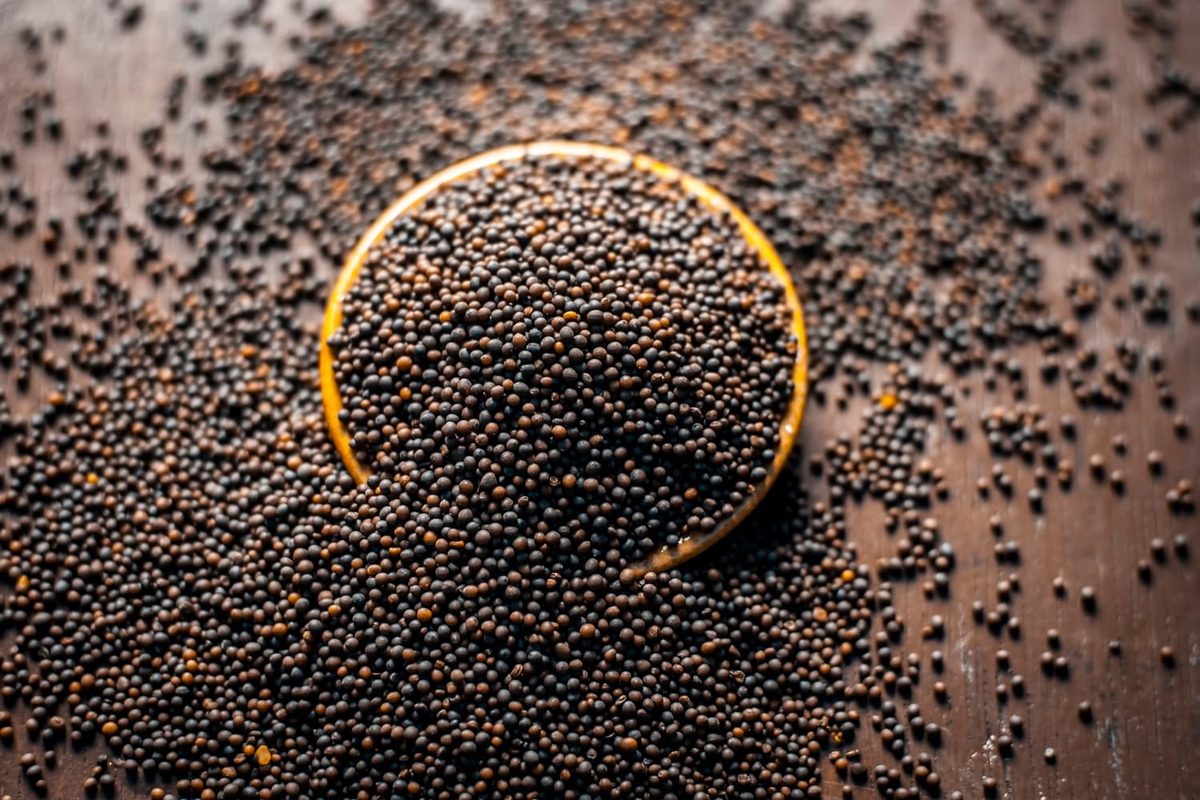
Brown mustard seeds are the small, round seeds of Brassica juncea, the mustard plant that also gives mustard greens and, in much of South Asia, cooking oil. It has almost entirely replaced true black mustard as a seed crop, and it is the seed behind many French-style paste mustards. This page covers what the plant is, where the heat comes from and how to keep it, how the seed is used, and what the regulators say.
At a glance
| Botanical name | Brassica juncea; Kew now accepts it as × Brassarda juncea, a hybrid of Brassica rapa and black mustard1 |
| Plant family | Brassicaceae (cabbage and mustard family)1 |
| Part used | Seeds; the leaves and stems are eaten as greens2 |
| Native range | Caucasus (Kew); the Himalayas (Britannica)12 |
| Seed size | About 2.5 mm (Britannica); up to 2 mm (Katzer)23 |
| Pungent compound | Allyl isothiocyanate, formed when the crushed seed meets water34 |
| Forms sold | Whole seed, ground seed, prepared mustard, mustard oil |
| Trade types | Saskatchewan grows two B. juncea types: brown (mainly for Europe) and oriental (mainly for Asia)5 |
What brown mustard is
Three plants supply the world’s mustard seed: white or yellow mustard (Sinapis alba), black mustard (Brassica nigra, which Kew now files as Mutarda nigra) and brown mustard (B. juncea). Kew treats brown mustard as a hybrid whose parents are Brassica rapa and black mustard, with a native range in the Caucasus.1 Britannica instead gives the Himalayas as its home.2 Gernot Katzer groups several kinds under the species: Sarepta or Romanian brown mustard from Eastern Europe, and what he calls Indian brown mustard, which he describes as a fertile hybrid.3
Britannica describes the seeds as dark yellow and about 2.5 mm across;2 Katzer says the brown species’ seeds are larger than black mustard’s, up to 2 mm, and lighter in color.3
Why brown replaced black
Unlike black mustard, brown mustard can be harvested by machine, and Britannica says it has almost entirely replaced black mustard for seed.23 Katzer calls brown mustard the dominant quality on the European market and says Indian brown mustard is probably the type most commonly sold in the West.3 For the older species, see black mustard seeds.
Flavor and the compounds behind it
Whole, dry mustard seeds have no smell.2 The heat appears only after the seed is crushed and wet. Mustard seeds hold a glucosinolate, sinigrin, and an enzyme, myrosinase; once water brings them together, the enzyme releases allyl isothiocyanate (AITC), the volatile compound that gives mustard its sinus-clearing bite.34 In Romanian brown mustard, Katzer reports a related compound, crotonyl isothiocyanate, alongside AITC.3
On strength, the sources line up as follows:
| Comparison | What the source says |
|---|---|
| Brown vs. black | Black mustard is slightly more pungent than brown3 |
| Brown vs. white | White mustard seeds are less intensely flavored than brown6 |
| Rule of thumb | Darker seeds are spicier (Popular Science)4 |
So brown is not the hottest mustard seed, as is sometimes said, but it is well above yellow. Fried or dry-toasted mustard seeds lose their pungency and turn nutty and smoky, because heat destroys the isothiocyanates that have formed.3 A slight bitterness in the background is our own tasting note.
Keeping the heat
The enzyme behind the heat is sensitive to temperature. In a lab comparison, the inactivation of brown mustard seed myrosinase rose as temperature went from 30 to 80 °C.7 Popular Science advises mixing ground mustard with water that is not too hot, since very hot water deactivates the enzyme entirely, and notes that vinegar, being strongly acidic, stops the reaction and so fixes the level of heat.4 For the full method, see mustard powder and mustard powder vs. mustard seed.
How brown mustard seeds are used
Prepared mustard
Britannica says brown mustard seeds are characteristic of many French-type paste mustards.2 Writing in Saveur, William Sertl reports that mustard sold as Dijon may be made only with black or brown mustard seed, mixed with wine, wine vinegar or verjus (the juice of unripe grapes), under rules dating to 1937; the rules govern the seeds and liquids, not where the seed is grown, and most of the seed in Dijon mustards today is imported from Canada.8 The Saskatchewan government says Europe is the main market for brown mustard and that the province’s growers are the world’s largest mustard exporters.5 Katzer adds that white mustard is usually preferred for milder mustard pastes.3
Brown mustard is often named as the seed in English, Düsseldorf and American “spicy brown” mustards. We could not find a source that documents the seed blend in any of those styles, so this page does not state it.
Indian cooking
Katzer describes frying whole mustard seeds in hot fat as a typical South Indian technique, and lists mustard among the five seeds of the Bengali mix panch phoron.3 He writes about these uses under black mustard, while noting that brown mustard is now the type mostly traded.3 Whole seeds are always fried in fat or dry-toasted before use in this cooking.3 See panch phoran, curry leaves, cumin and coriander, the seed’s usual companions.
Oil and greens
B. juncea is an important oil crop in northern India, Pakistan, China, southern Russia and Kazakhstan.2 Saskatchewan’s oriental type goes mainly to Asia, where it is used as a cooking oil and a condiment.5 Katzer places the center of mustard oil cooking in West Bengal and Bangladesh.3
The leaves and swollen leaf stems are eaten as greens, and Britannica calls them especially important vegetables in much of Asia and Africa.2 In China a variety with fleshy, swollen stems (B. juncea var. tsatsai) is salted, fermented with chile paste and sold as zha cai, known in English as Sichuan vegetable or Chinese pickled mustard.3
For more ideas, see mustard seed uses.
Buying and quality
No grading standard for retail brown mustard seed was found. Look for whole, uniformly sized, hard, unbroken seeds with no dust or debris; that is kitchen judgment, not a standard. Because whole seeds are odorless,2 smell is not a freshness test until you crack a few and add a drop of water.
Storage
We found no published shelf-life figure for whole or ground brown mustard seed from a regulator or standards body. Common practice is to keep whole seed sealed, cool and dry, and to grind it as needed.
Safety
- Allergen. Mustard is one of the 14 allergens that UK food businesses must declare.9 It is not one of the nine major food allergens under US law.10
- Erucic acid. The EU sets maximum levels of erucic acid for mustard products: 35 g/kg for mustard as a condiment, and 50 g/kg for mustard oil, with an exemption for locally produced and consumed oil.11
Health claims
Brown mustard seed is often promoted for minerals, vitamins and protection against disease. We found no regulator summary or systematic review on brown mustard seed as a food that supports those claims. This page makes no claim that it treats or prevents any condition.
Substitutes and comparisons
Black mustard seed is the closest swap, a little sharper; yellow seed is milder. No source gives a tested ratio, so start one for one and adjust by taste. See black mustard seed substitutes, yellow vs. black mustard seeds, yellow mustard seeds, mustard powder substitutes, mustard powder uses and mustard powder vs. prepared mustard.
Footnotes
-
× Brassarda juncea (L.) Su Liu & Z.H.Feng, Plants of the World Online, Royal Botanic Gardens, Kew. powo.science.kew.org · Reference work ↩ ↩2 ↩3 ↩4
-
“Brown mustard”, Encyclopaedia Britannica. britannica.com · Reference work ↩ ↩2 ↩3 ↩4 ↩5 ↩6 ↩7 ↩8 ↩9 ↩10 ↩11
-
Gernot Katzer, “Mustard (Brassica nigra, B. juncea, Sinapis alba)”, Gernot Katzer’s Spice Pages. gernot-katzers-spice-pages.com · Reference work ↩ ↩2 ↩3 ↩4 ↩5 ↩6 ↩7 ↩8 ↩9 ↩10 ↩11 ↩12 ↩13 ↩14 ↩15 ↩16
-
Sandra Gutierrez G., “When the mustard shortage hits, make your own”, Popular Science, 2022. popsci.com · Publication ↩ ↩2 ↩3 ↩4
-
“Mustard”, Government of Saskatchewan, Ministry of Agriculture. saskatchewan.ca · Regulator ↩ ↩2 ↩3
-
“White mustard”, Encyclopaedia Britannica. britannica.com · Reference work ↩
-
Okunade, Methven and Niranjan, “A Comparison of Myrosinase Activity and Stability in Fresh Broccoli and Brown Mustard (B. juncea) Seeds”, Turkish Journal of Agriculture: Food Science and Technology, 2020. doaj.org · Peer-reviewed ↩
-
William Sertl, “Avez-Vous du Vrai Poupon?”, Saveur, 2007. saveur.com · Publication ↩
-
“Allergen guidance for food businesses”, UK Food Standards Agency. gov.uk · Regulator ↩
-
“Food Allergies”, U.S. Food and Drug Administration. fda.gov · Regulator ↩
-
Commission Regulation (EU) 2023/915, European Union. eur-lex.europa.eu · Regulator ↩