Spice Comparisons · Comparison
Yellow vs. Black Mustard Seeds: Two Plants, Two Kinds of Heat
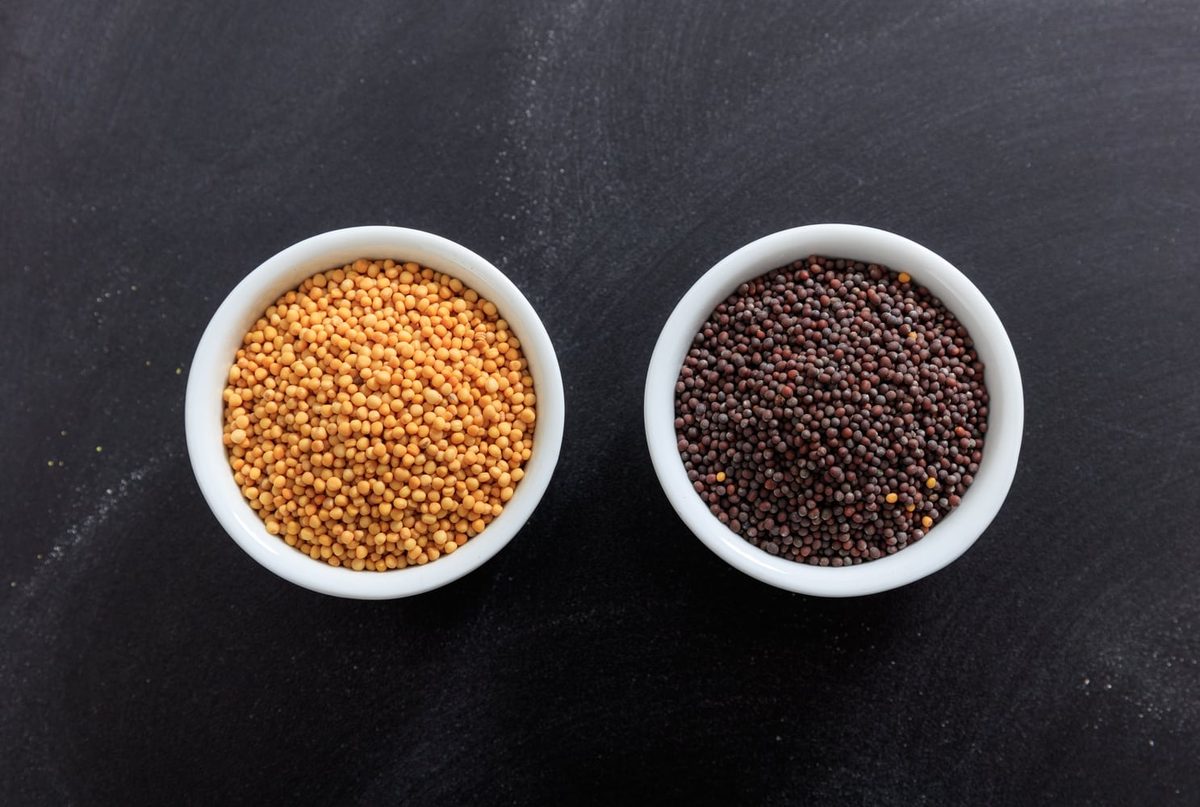
Yellow and black mustard seeds come from different plants. Yellow (also called white) mustard is Sinapis alba;1 black mustard is the plant long called Brassica nigra, which Kew now lists as Mutarda nigra.2 Both belong to the cabbage family, Brassicaceae.2 They differ in size, in how hot they get, and in the kind of heat: black seed makes a volatile pungent compound, yellow seed a non-volatile one.34 There is a twist for shoppers, too. True black mustard has almost disappeared from commercial farming, replaced by brown mustard.54
Side by side
| Yellow (white) mustard seed | Black mustard seed | |
|---|---|---|
| Plant | Sinapis alba1 | Mutarda nigra, syn. Brassica nigra2 |
| Native range (Kew) | Europe to China1 | Europe to western and northern China, and the Mediterranean to Ethiopia2 |
| Seed | Globular, light yellow, finely pitted, about 2.5 mm across6 | Round, about 1 mm across, black to red-brown, minutely pitted4 |
| Smell before wetting | Odorless when whole6 | Finely ground, a neutral, odorless powder4 |
| Pungent precursor | Sinalbin, about 2.5% of the seed3 | Sinigrin: about 1% (Katzer); 110 to 140 µmol/g (PROSEA)74 |
| Pungent product | p-Hydroxybenzyl isothiocyanate, non-volatile and stable in acid3 | Allyl isothiocyanate, volatile47 |
| Strength | Less intensely flavored than brown mustard6 | Slightly stronger than brown mustard7 |
| Farming | Fully mechanized in the main producing countries6 | Shattering pods make it unsuitable for mechanized cultivation; trade now minimal4 |
| Typical uses | Hot dog mustard, mayonnaise, dressings;8 whole in pickles3 | South Indian tempering, panch phoran, pickles7 |
| Flavor (editorial) | Mild, tangy bite on the tongue | Sharp heat that climbs into the nose; nutty once fried |
| Price | No dated, sourced comparison found | No dated, sourced comparison found |
The two sinigrin figures for black mustard are given in different units by different sources and are shown as each states them.74 For each seed on its own, see yellow mustard seeds and black mustard seeds.
Two kinds of heat
Neither seed is hot until it is crushed and wet. Then the enzyme myrosinase acts on a glucosinolate stored in the seed and makes a pungent isothiocyanate.79 The glucosinolate is what differs:
- Black seed stores sinigrin, which yields allyl isothiocyanate, the aggressive, volatile compound responsible for mustard’s sharp taste.4
- Yellow seed stores sinalbin, which yields p-hydroxybenzyl isothiocyanate. Katzer describes it as pungent but non-volatile, and stable in acid.3 Chewed whole, yellow seed turns pungent only after a while.3
That chemistry explains two things cooks notice. Yellow mustard’s pungent compound holds up in acid, and Katzer says white mustard is usually preferred for making mustard pastes.37 Black mustard’s heat is fiercer but fragile: heating quickly destroys isothiocyanates once they have formed, Katzer notes.7 As a description rather than a measurement: yellow bites on the tongue, black climbs into the nose.
Popular Science’s rule of thumb is that the darker the seed, the spicier,9 which matches Britannica and Katzer: yellow is milder than brown,6 and black slightly stronger than brown.7
Why black mustard is hard to find
Black mustard dropped out of large-scale farming. PROSEA explains that its shattering pods make it unsuitable for large-scale, mechanized cultivation, and that its importance in international trade has become minimal.4 Katzer notes that brown mustard, unlike black, can be harvested by machine.7 Britannica says brown mustard has almost entirely replaced black mustard,5 and that black mustard now occurs mainly as an introduced weed.10 Yellow mustard, by contrast, is fully mechanized.6
So the seed sold as “black mustard” may well be dark brown mustard (Brassica juncea, which Kew now treats as a hybrid with black mustard as one parent11). We found no survey of what retail “black mustard seed” contains. Katzer describes black and brown mustard as botanically different but of equal use in the kitchen,7 so for cooking purposes the difference is small.
A widely repeated explanation says black mustard must be picked by hand. The sources say only that it is unsuited to mechanized harvest, not how it is gathered, and none gives a cost figure.
How each is used
Black (and brown) seed in South Asian cooking. Frying whole seeds in fat is a typical South Indian technique, and the seeds often appear in Tamil vegetable curries.7 Black mustard seed is also a component of the Bengali five-spice mix panch phoran.7 Fried or dry-toasted, the seeds lose their pungency and take on a nutty, smoky taste;7 in tempering, flavor and texture are the point, not heat. See curry leaves, the usual partner.
Yellow seed in mustard and pickles. Saskatchewan’s agriculture ministry lists traditional hot dog mustard, mayonnaise and salad dressings among yellow mustard’s uses.8 Whole white seeds are popular in pickled vegetables.3 The bright yellow of American prepared mustard comes from turmeric in brands that add it, not from the seed.3
Strong prepared mustards use the dark seeds. Dijon mustard, by law, may be made only from black or brown seed.12
Can one stand in for the other?
No published ratio exists in either direction (see black mustard seed substitutes). These are starting points.
| Swap | Starting amount | Treatment | What changes |
|---|---|---|---|
| Yellow in place of black | 1 for 1, then more to taste | Method | A milder bite in raw mustards and pastes; in tempering, where fried seeds lose their pungency anyway,7 the difference is mostly in look and texture (kitchen judgment) |
| Black in place of yellow | Somewhat less than called for, then taste | Method | More heat, and nasal heat, in a raw mustard or dressing |
| Brown in place of black | 1 for 1 | Method | Very close; Katzer calls them of equal use in the kitchen7 |
Taming black seed’s heat. Popular Science reports that vinegar completely inhibits myrosinase and sets a mustard’s heat level.9 When you make mustard from black seed, adding vinegar early gives a milder result than letting the mixture stand in water first. In cooked dishes, frying the seeds takes the pungency away.7
What isn’t known
- No published measurement compares the pungency of yellow and black seed in a finished dish.
- No survey shows how much retail “black mustard seed” is true Mutarda nigra rather than dark brown mustard.
- No published substitution ratio exists in either direction.
- No dated price comparison was found.
Related
- Yellow mustard seeds, black mustard seeds and brown mustard seeds
- Black mustard seed substitutes
- Mustard powder, mustard powder vs. mustard seed and mustard powder vs. prepared mustard
- Mustard seed uses, panch phoran and Indian spices
Footnotes
-
Sinapis alba L., Plants of the World Online, Royal Botanic Gardens, Kew. powo.science.kew.org · Reference work ↩ ↩2 ↩3
-
Mutarda nigra (L.) Bernh., Plants of the World Online, Royal Botanic Gardens, Kew. powo.science.kew.org · Reference work ↩ ↩2 ↩3 ↩4
-
Gernot Katzer, “White Mustard (Sinapis alba)”, Gernot Katzer’s Spice Pages. gernot-katzers-spice-pages.com · Reference work ↩ ↩2 ↩3 ↩4 ↩5 ↩6 ↩7 ↩8 ↩9
-
H. Toxopeus and I. Utomo, Brassica nigra, PROSEA, via Pl@ntUse. uses.plantnet-project.org · Reference work ↩ ↩2 ↩3 ↩4 ↩5 ↩6 ↩7 ↩8 ↩9 ↩10
-
“Brown mustard”, Encyclopaedia Britannica. britannica.com · Reference work ↩ ↩2
-
“White mustard”, Encyclopaedia Britannica. britannica.com · Reference work ↩ ↩2 ↩3 ↩4 ↩5 ↩6
-
Gernot Katzer, “Mustard (Brassica nigra, B. juncea, Sinapis alba)”, Gernot Katzer’s Spice Pages. gernot-katzers-spice-pages.com · Reference work ↩ ↩2 ↩3 ↩4 ↩5 ↩6 ↩7 ↩8 ↩9 ↩10 ↩11 ↩12 ↩13 ↩14 ↩15 ↩16 ↩17
-
Mustard, Government of Saskatchewan, Ministry of Agriculture. saskatchewan.ca · Regulator ↩ ↩2
-
Sandra Gutierrez G., “When the mustard shortage hits, make your own”, Popular Science, 2022. popsci.com · Publication ↩ ↩2 ↩3
-
“Black mustard”, Encyclopaedia Britannica. britannica.com · Reference work ↩
-
× Brassarda juncea (L.) Su Liu & Z.H.Feng, Plants of the World Online, Royal Botanic Gardens, Kew. powo.science.kew.org · Reference work ↩
-
William Sertl, “Avez-Vous du Vrai Poupon?”, Saveur, 2007. saveur.com · Publication ↩