Cooking · Uses
Mustard Seed Uses: Pickles, Tempering, Homemade Mustard and More
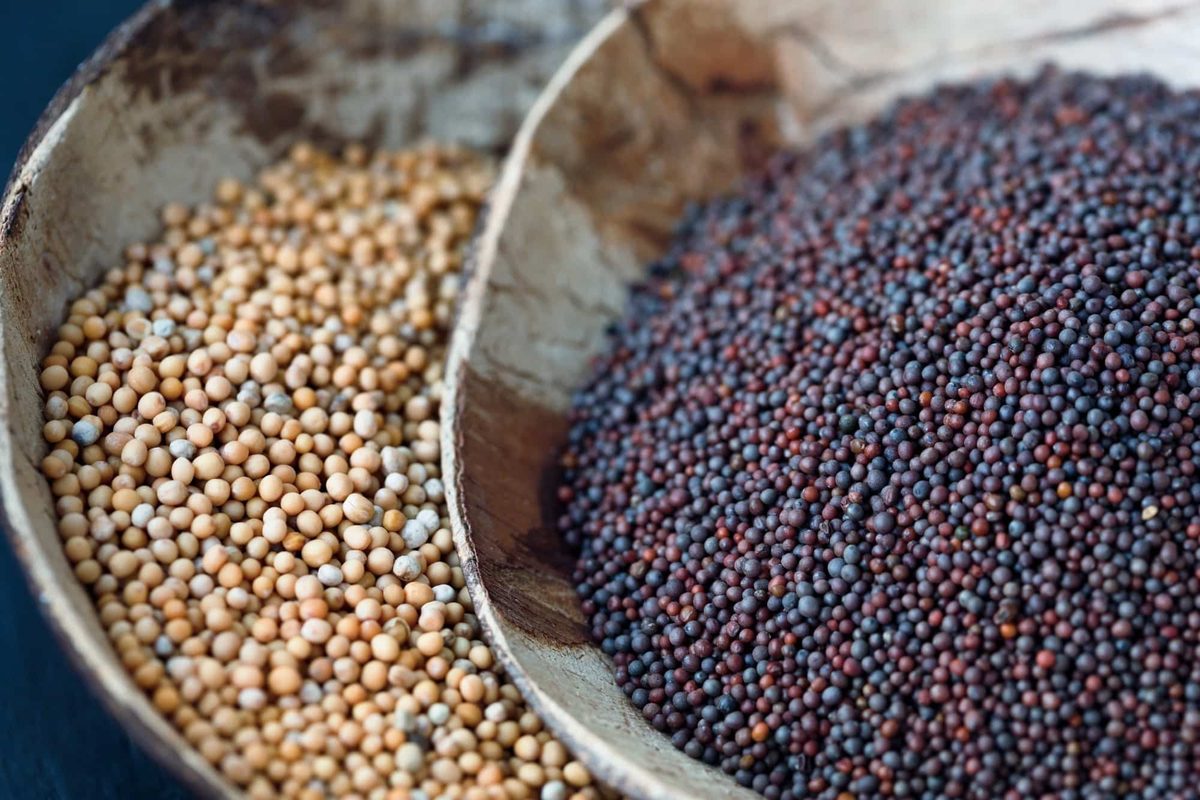
Whole mustard seeds are odorless1 and taste of little until you crush them, wet them or heat them, and each of those does something different. Wet and crushed, they make the sharp heat of a prepared mustard; fried in oil, they lose that heat and turn nutty; left whole in a brine, they add a mild bite to pickles. This page is about where to use them. For the three kinds of seed, see yellow mustard seeds, brown mustard seeds and black mustard seeds.
At a glance
| Use | What the seed does there | Named example |
|---|---|---|
| Pickles | Whole seed in the brine | NCHFP bread-and-butter pickles: 2 tablespoons for about 8 pints2 |
| Indian tempering | Fried in fat until they pop; nutty, not hot | Katzer: typical South Indian technique; Tamil vegetable curries3 |
| Bengali five-spice | One of five whole seeds | Bong Eats panch phoron: 1 tablespoon each4 |
| Homemade mustard | Crushed and soaked for heat | Katzer; Popular Science35 |
| Corned beef | Whole seed in the cure or cooking liquid | Alton Brown: 1 teaspoon; Leite’s Culinaria: 2 tablespoons67 |
| Dressings and rubs | Ground; adds flavor and helps emulsify | Katzer on emulsifiers8 |
Amounts are Attributed to the recipes named.
Which seed for which job
Yellow (white) mustard is the mildest; brown is stronger, and black slightly stronger again.13 Popular Science’s rule of thumb is that darker seeds are spicier.5 Whole yellow seed is popular in pickles, and yellow seed is behind traditional hot dog mustard;89 brown or black seed is the usual one for Indian cooking and for Dijon, which by its rules may be made only from black or brown seed.310 Katzer treats black and brown as botanically different but of equal use in the kitchen.3 Mustard is in the cabbage family, Brassicaceae, with horseradish.11
Pickles
This is where most whole yellow seed goes. Katzer notes that whole white mustard seeds are popular in pickled vegetables.8 Two tested home-canning recipes from the National Center for Home Food Preservation show the range:
- Bread-and-butter pickles: 2 tablespoons of mustard seed, 1 1/2 tablespoons of celery seed and 1 tablespoon of ground turmeric, boiled with 4 cups of vinegar and 4 1/2 cups of sugar, for about 8 pints of pickles.2
- Quick fresh-pack dill pickles: whole mustard seed goes into each jar separately, alongside the pickling spice tied in cloth.12
For canned pickles, use a tested recipe like these rather than improvising the brine (common food-safety practice). Mustard seed is also a standard part of pickling spice. In India, black mustard goes into pickled raw vegetables (achar), including the Andhra mango pickle avakaya.3
Tempering in Indian cooking
Frying whole mustard seeds in fat is a typical South Indian technique.3 Katzer writes that the seeds are always fried in fat, or dry-toasted, before use; that they pop and scatter, so the pan needs a lid; and that together with asafetida, curry leaves and cumin they often appear in Tamil vegetable curries.3 Frying changes their taste: fried or toasted seeds are no longer pungent and turn nutty and smoky.3 Mustard seed is also part of the South Indian spice blend sambar podi.3
The usual order, as common practice: heat the oil, add the seeds, wait for them to pop, then add curry leaves, cumin or chiles before the main ingredients. See cooking with curry leaves and sambar powder.
Bengal. Black mustard is one of the five seeds in panch phoron, the Bengali whole-spice blend;3 Bong Eats uses a tablespoon each of fennel, radhuni, mustard, fenugreek and nigella.4 Bengali cooks also grind mustard seeds with water into a fresh paste, and mustard oil is essential to several regional cuisines.3 See panch phoran.
Homemade mustard
To get the heat, crush the seeds and wet them. Katzer suggests crushing whole seeds and soaking them in water for an improvised mustard paste.3 The heat forms when water lets an enzyme in the seed, myrosinase, act on its sulfur compounds; water that is too hot deactivates the enzyme, and strong acid such as vinegar stops it.5 Popular Science suggests resting homemade mustard in the fridge for two to three days.5
Grinding decides the style. Dijon is made from black or brown seed mixed with wine, wine vinegar or verjus, the juice of unripe grapes.10 Bavarian sweet mustard is made from coarsely ground yellow seed.8 Leaving more seeds whole gives a grainier mustard (common practice). Stronger mustard pastes usually contain more acid.3
Corned beef and brined meats
Alton Brown’s corned beef uses 1 teaspoon of mustard seeds; Leite’s Culinaria’s homemade corned beef uses 2 tablespoons.67 Katzer notes that prepared mustard is a common condiment for boiled or broiled meat in Central and Northern Europe.8 See corned beef and cabbage spices.
Dressings and rubs
Ground mustard seed brings two things to a dressing: flavor and stability. Mustard contains emulsifiers, which help emulsified sauces hold together.8 Saskatchewan’s agriculture ministry lists mayonnaise and salad dressings among yellow mustard’s uses.9 For a vinaigrette, grind the seed fine, or use mustard powder.
In a dry rub, ground seed adds a sharp savor. Toasting the seeds before grinding gives a nuttier, less pungent result,3 which suits a rub that will be cooked anyway (our judgment). McCormick’s volume conversion is 1 teaspoon of seeds to 1 1/2 teaspoons ground,13 a measure of bulk, not of strength; see mustard powder vs. mustard seed.
When to add the seeds
Raw mustard heat does not survive long cooking: Katzer notes that heat quickly destroys the pungent compounds once formed, says it hardly makes sense to add intact seeds to boiling foods, and suggests adding mustard as late as possible if you want some pungency.3 So:
- For heat, add crushed and soaked seed, or mustard made from it, at the end or to cold dishes.3
- For a nutty, toasty note, fry the seeds first.3
- In brines, whole seed is there for a gentle background bite (our judgment).
Crushed seed in a honey or brown sugar glaze for ham or pork is another option (our suggestion; no source here gives an amount). See spices for ham.
Allergy note
Mustard is one of the 14 allergens UK food businesses must declare.14 It is not one of the nine major food allergens under US law,15 so check blends such as pickling spice and curry powders if you cook for someone with a mustard allergy.
Not yet measured
- How much pungency whole seeds release into a pickle brine over time.
- A standard ratio of seed to liquid for homemade mustard; recipes vary.
- How much stronger black seed is than brown in practice; Katzer says only “slightly”.3
Related
- Yellow mustard seeds, brown mustard seeds and black mustard seeds
- Yellow vs. black mustard seeds and black mustard seed substitutes
- Mustard powder uses and mustard powder vs. mustard seed
- Celery seed uses, its partner in bread-and-butter pickles
Footnotes
-
White mustard, Encyclopaedia Britannica. britannica.com · Reference work ↩ ↩2
-
Bread-and-Butter Pickles, National Center for Home Food Preservation. nchfp.uga.edu · Reference work ↩ ↩2
-
Gernot Katzer, Mustard (Brassica nigra, B. juncea, Sinapis alba), Gernot Katzer’s Spice Pages. gernot-katzers-spice-pages.com · Reference work ↩ ↩2 ↩3 ↩4 ↩5 ↩6 ↩7 ↩8 ↩9 ↩10 ↩11 ↩12 ↩13 ↩14 ↩15 ↩16 ↩17 ↩18 ↩19
-
Panch phoron, Bong Eats, 2017. bongeats.com · Publication ↩ ↩2
-
Sandra Gutierrez G., When the mustard shortage hits, make your own, Popular Science, 2022. popsci.com · Publication ↩ ↩2 ↩3 ↩4
-
Alton Brown, Corned Beef and Cabbage, Food Network. foodnetwork.com · Publication ↩ ↩2
-
Homemade Corned Beef, Leite’s Culinaria. leitesculinaria.com · Publication ↩ ↩2
-
Gernot Katzer, White Mustard (Sinapis alba), Gernot Katzer’s Spice Pages. gernot-katzers-spice-pages.com · Reference work ↩ ↩2 ↩3 ↩4 ↩5 ↩6
-
Mustard, Government of Saskatchewan, Ministry of Agriculture. saskatchewan.ca · Regulator ↩ ↩2
-
William Sertl, Avez-Vous du Vrai Poupon?, Saveur, 2007. saveur.com · Publication ↩ ↩2
-
Horseradish, Encyclopaedia Britannica. britannica.com · Reference work ↩
-
Quick Fresh-Pack Dill Pickles, National Center for Home Food Preservation. nchfp.uga.edu · Reference work ↩
-
How to Grind Your Own Spices, McCormick Kitchens, 2025. mccormick.com · Merchant ↩
-
Allergen guidance for food businesses, Food Standards Agency. gov.uk · Regulator ↩
-
Food Allergies, U.S. Food and Drug Administration. fda.gov · Regulator ↩