Spice Substitutes · Substitutes
All-Purpose Seasoning Substitutes: First, Find Out Whether Yours Has Salt
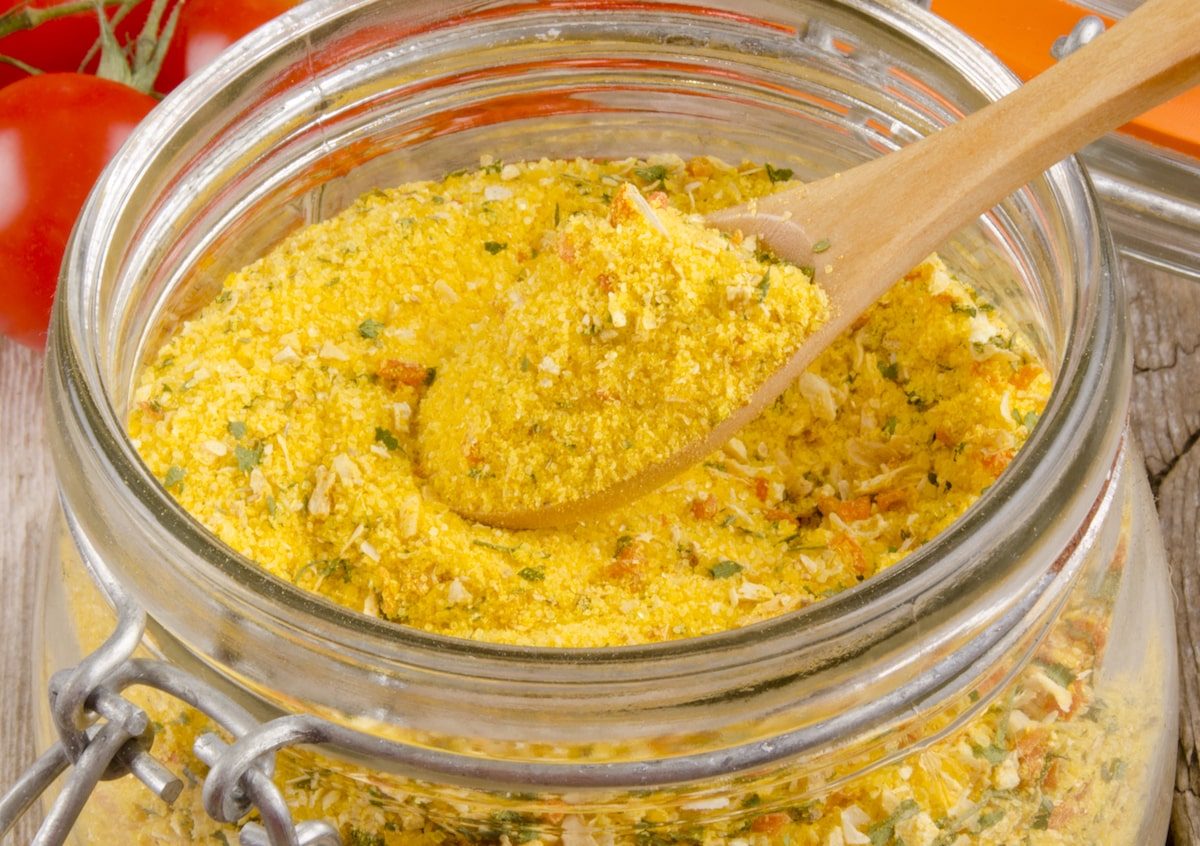
“All-purpose seasoning” is a label, not a recipe. The same words appear on salt-free blends of onion, garlic, pepper and herbs, on salt-led garlic blends such as Goya’s adobo, and, in everyday speech, on soy-based liquids.1234 The single biggest difference is salt. A salt-free blend such as Dash Original lists 0 mg of sodium per quarter teaspoon, while Goya’s all-purpose adobo lists 520 mg.23 So before choosing a substitute, check whether the blend your recipe means is salted.
Quick answer
| What the all-purpose seasoning is doing | Best substitute | Starting amount, per 1 part blend | Treatment |
|---|---|---|---|
| Salt-free savory base (onion, garlic, herbs) | Homemade mix led by onion powder | 1 part | Method |
| Salted savory base (adobo-style) | Another salt-led blend: adobo, seasoned salt or Creole seasoning | 1 part, then adjust salt using the table below | Computed (salt) |
| Recipe written for a salt-free blend, but you only have a salted one | The salted blend, with the recipe’s other salt cut | 1 part, minus up to 7/8 part salt elsewhere | Computed (salt) |
| Liquid aminos | Soy sauce | 1 part by volume | Computed (sodium) |
How the ratios on this page are labeled
Every ratio carries one of four labels.
- Computed: based on a measurable physical relationship, with the source named.
- Attributed: a named source publishes this ratio. We quote it as theirs.
- Disputed: named sources give different answers to the same swap. We show each one and do not average them.
- Method: we found no published ratio. We give a direction and a cautious starting point, and say so.
Every Computed figure here concerns salt only, worked out from the sodium on Nutrition Facts labels. None of it measures flavor, and we found no credible published ratio for swapping one all-purpose blend for another.
Which kind of all-purpose seasoning is in your recipe?
US labels list ingredients in descending order of weight,5 so the first ingredient tells you what the blend mostly is.
| Product | First ingredients | Sodium per 1/4 tsp | Source |
|---|---|---|---|
| Dash Salt Free Original | Dried onion, then spices (black pepper, parsley, celery seed, basil, bay, marjoram, oregano and more) | 0 mg | 2 |
| Simply Organic All Purpose | Onion, black pepper, garlic, parsley, celery seed, tomato powder, herbs | Not listed; no salt in the ingredients | 1 |
| Goya Adobo All-Purpose Seasoning with Pepper | Salt, garlic, anticaking agent, black pepper, oregano, turmeric | 520 mg | 3 |
| Lawry’s Seasoned Salt | Salt, sugar, spices (including paprika, celery seed, turmeric), onion | 380 mg | 6 |
| Tony Chachere’s Original Creole | Salt, red pepper, black pepper, chili powder, garlic | 340 mg | 7 |
| Slap Ya Mama Original Blend Cajun | Salt, black pepper, red pepper, granulated garlic | 310 mg | 8 |
| McCormick Signature Cajun | Salt, then paprika, red pepper, thyme, black pepper, celery seed, garlic, onion | 160 mg | 9 |
| Morton Iodized Table Salt, for comparison | Salt | 590 mg | 10 |
Salt-free blends lead with onion; salted ones lead with salt. These figures are for the products named, not for every jar on the shelf.
If the blend is salt-free
Dash Original and Simply Organic both lead with onion, then black pepper, garlic or both, then parsley, celery seed and a long list of dried herbs.12 The USDA’s purchasing specification for a salt-free seasoning with herbs and citrus reads much the same: onion, black pepper, parsley, celery seed, basil, bay leaves, marjoram, oregano, savory, thyme and more, plus garlic, carrot, citrus peel, tomato and citric acid.11
1. Make your own
Ratio (Method): None of these labels gives proportions, so there is no published formula to copy. Since onion is listed first on both salt-free labels,12 make onion powder the largest single ingredient. A workable starting point is 2 parts onion powder, 1 part garlic powder, 1/2 part black pepper and 1/2 part dried parsley, with a pinch each of celery seed, thyme and oregano. Use it 1:1 for the blend the recipe calls for. This is our starting point, not a copy of any brand. Dash also lists orange peel, lemon juice powder, citric acid and oil of lemon,2 so a little grated lemon zest is a reasonable addition.
2. A salted blend, if that’s all you have
This is where a straight swap goes wrong. A recipe written for a salt-free blend expects you to add salt separately, or not at all.
Ratio (Computed, salt only): A teaspoon of Goya’s adobo carries about 2,080 mg of sodium (4 servings × 520 mg).3 That is about the same as 7/8 teaspoon of Morton table salt, which lists 590 mg per quarter teaspoon.10 So if you use adobo in place of a salt-free blend, cut up to 7/8 teaspoon of salt from the rest of the recipe for every teaspoon of adobo, and taste before adding any back. For comparison, FDA’s Daily Value for sodium is less than 2,300 mg a day.12 Lawry’s, at 380 mg per quarter teaspoon, replaces about 5/8 teaspoon of table salt per teaspoon.610
If the blend is salted
If the recipe means a salted all-purpose blend such as Goya’s adobo, which Goya itself names “All-Purpose Seasoning,”3 the substitutes are other salt-led blends. See adobo seasoning substitutes for that swap in detail.
1. Adobo seasoning
TASTE describes most adobo blends as garlic, pepper, salt and oregano,13 and Goya’s label matches.3 It is closest to a salted all-purpose blend that leans on garlic. The word comes from a marinade: the Real Academia Española defines adobo as, among other things, a broth of vinegar, salt, oregano, garlic and pimentón used to season and preserve meat.14 The dry blend in a shaker contains no vinegar.3
Ratio (Computed, salt only): Adobo is among the saltiest blends in the table above. If the blend you are replacing has less sodium per quarter teaspoon, start with less adobo than the recipe’s amount: for example, to match Tony Chachere’s 340 mg, use about two thirds as much Goya adobo (340 ÷ 520 = 0.65).73
2. Creole seasoning
Explore Louisiana, the state tourism office’s guide, calls Creole cuisine the “city food” of New Orleans.15 On the shelf, Tony Chachere’s Original Creole, for one, lists salt first, then red pepper, black pepper, chili powder and garlic.7 The USDA’s purchasing specification for Creole seasoning lists salt, paprika, garlic, cayenne, black pepper, mustard and lemon peel as its minimum.11 Expect more pepper and chile than in most all-purpose blends.
Ratio (Computed, salt only): A 1:1 swap of Tony Chachere’s for Goya’s adobo gives about 65 percent of the sodium; add about 1/3 teaspoon of table salt per teaspoon to match.7310 Against Lawry’s Seasoned Salt, 1:1 gives about 89 percent, close enough to leave as is.6
3. Cajun seasoning
Cajun seasoning is often described as the spicier of the two Louisiana blends: Tasting Table, citing MasterClass, calls Cajun spicier and Creole more earthy.16 Labels vary a lot in salt. Slap Ya Mama’s Original Blend lists 310 mg per quarter teaspoon and McCormick’s Signature Cajun 160 mg.89
Ratio (Computed, salt only): Against Goya’s adobo, a 1:1 swap gives 60 percent of the sodium with Slap Ya Mama and 31 percent with McCormick Signature.893 Make up the difference with table salt rather than more blend, or the heat climbs with it.
4. Fajita seasoning, for Tex-Mex dishes only
A fajita history published by the Austin Chronicle traces the dish, on anecdotal evidence, to the ranch lands of South and West Texas as far back as the 1930s,17 so this is a Tex-Mex blend rather than a Latin American one. The USDA’s purchasing specification lists salt, black pepper, cumin, oregano, garlic, onion, red pepper and natural lime flavor;11 McCormick’s mix lists chili pepper, cumin, paprika, garlic, salt, sugar, onion, corn starch, citric acid and lime juice concentrate.18 The cumin and lime set it apart from any all-purpose blend.
Ratio (Method): We found no published ratio and no sodium figure for these blends. Start with half the amount of all-purpose seasoning called for, taste, and add salt separately.
If “all-purpose seasoning” means liquid aminos
Bragg Liquid Aminos is made from soybeans and water, and Bragg sells it as a soy sauce alternative.4
Soy sauce
Ratio (Computed, sodium): Bragg lists 310 mg of sodium per teaspoon.4 Kikkoman soy sauce lists 960 mg per tablespoon, which works out to about 320 mg per teaspoon.19 Per teaspoon they are close, so swap 1:1 by volume. A reduced-sodium soy sauce will carry less; check its label, and expect to need a little more of it, or a pinch of salt.
Bragg promotes its product as a gluten-free stand-in for soy sauce.4 If gluten is the reason you use liquid aminos, read the soy sauce label before swapping.
What isn’t known
- No credible source we found publishes a ratio for replacing any all-purpose blend with another. The salt figures above are arithmetic from labels; the flavor side is judgment.
- Brands do not publish the proportions of their spices, so the homemade salt-free mix is a starting point, not a copy.
- Sodium figures cover only the products named. Reduced-sodium versions of several blends exist, so read your own label.
Related
- All-purpose seasoning
- Adobo seasoning and adobo seasoning substitutes
- Seasoned salt and seasoned salt substitutes
- Creole seasoning, Cajun seasoning and Cajun vs. Creole seasoning
- Fajita seasoning and fajita vs. taco seasoning
- Onion powder, garlic powder, garlic powder vs. garlic, MSG vs. salt
Footnotes
-
Simply Organic All Purpose Seasoning, ingredients, via Giant Food Stores. giantfoodstores.com · Merchant ↩ ↩2 ↩3 ↩4
-
Dash Salt Free Original Seasoning Blend, ingredients and nutrition label, via Giant Food Stores. giantfoodstores.com · Merchant ↩ ↩2 ↩3 ↩4 ↩5 ↩6
-
Goya Foods, “Adobo All-Purpose Seasoning with Pepper”, trade product page. trade.goya.com · Merchant ↩ ↩2 ↩3 ↩4 ↩5 ↩6 ↩7 ↩8 ↩9 ↩10
-
Bragg, “Liquid Aminos”, product page. bragg.com · Merchant ↩ ↩2 ↩3 ↩4
-
21 CFR 101.4, Food; designation of ingredients. ecfr.gov · Regulator ↩
-
Lawry’s Seasoned Salt, ingredients and nutrition label, via Giant Food Stores. giantfoodstores.com · Merchant ↩ ↩2 ↩3
-
Tony Chachere’s Original Creole Seasoning, ingredients and nutrition label, via Giant Food Stores. giantfoodstores.com · Merchant ↩ ↩2 ↩3 ↩4
-
Slap Ya Mama Original Blend Cajun Seasoning, ingredients and nutrition label, via Giant Food Stores. giantfoodstores.com · Merchant ↩ ↩2 ↩3
-
McCormick Signature Seasonings Cajun, ingredients and nutrition label, via Giant Food Stores. giantfoodstores.com · Merchant ↩ ↩2 ↩3
-
Morton Iodized Table Salt, product page, Morton Salt. mortonsalt.com · Merchant ↩ ↩2 ↩3 ↩4
-
Commercial Item Description A-A-20001C, Spices and Spice Blends, USDA Agricultural Marketing Service, 2023. ams.usda.gov · Regulator ↩ ↩2 ↩3
-
“Sodium in Your Diet”, U.S. Food and Drug Administration. fda.gov · Regulator ↩
-
Alicia Kennedy, article on adobo seasoning, TASTE, 2018. tastecooking.com · Publication ↩
-
“adobo”, Diccionario de la lengua española, Real Academia Española. dle.rae.es · Reference work ↩
-
Jay D. Ducote, Cajun vs. Creole Food: What is the Difference?, Explore Louisiana. explorelouisiana.com · Publication ↩
-
Stephanie Friedman, Is It Possible To Substitute Creole Seasoning For Cajun Seasoning?, Tasting Table, 2023. tastingtable.com · Publication ↩
-
Virginia B. Wood, Fajita History, The Austin Chronicle, 2005. austinchronicle.com · Publication ↩
-
McCormick Fajita Seasoning Mix, product page, McCormick. mccormick.com · Merchant ↩
-
Kikkoman Soy Sauce, Nutrition Facts, via Giant Food Stores. giantfoodstores.com · Merchant ↩