Seasonings · Profile
Panch Phoran: Bengal’s Five Whole Spices and How to Temper With Them
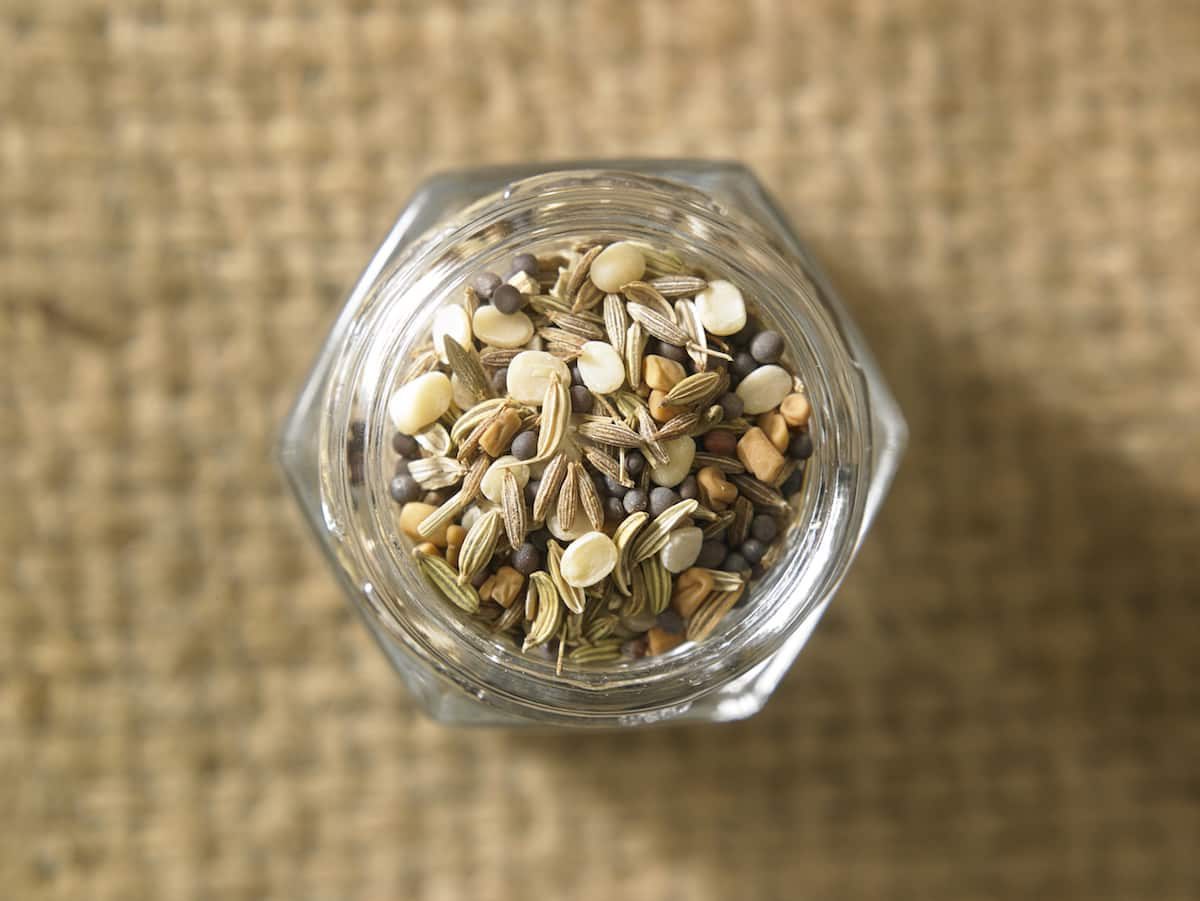
Panch phoran (also written panch phoron or paanch phoron) is a mix of five whole seeds from eastern India and Bangladesh. The name means “five spices,” and the mix is used for tempering: the seeds are fried in oil before use, almost always mustard oil in Bengal.12 The version most often printed is equal parts nigella, fenugreek, cumin, black mustard and fennel seed, but Bengali cooks use a local seed, radhuni, and which spice it replaces depends on who you ask.213 This page sets the versions side by side and explains what each seed does in hot oil.
At a glance
| What it is | Five whole seeds, mixed in equal parts21 |
| Name | “Five spices,” used in tempering1 |
| Where | West Bengal, Orissa, Sikkim, Bangladesh and southern Nepal2 |
| Most-printed version | Nigella, fenugreek, cumin, black mustard, fennel2 |
| Bengali version | Includes radhuni (Trachyspermum roxburghianum)23 |
| Used | Whole, fried in oil before the other ingredients2 |
| Typical dishes | Dals, vegetables, fish, chutneys, pickles, shukto213 |
| Official standard | None found |
What is in it
All the sources agree on whole seeds in equal amounts, but not on which five. Gernot Katzer notes that the composition most often given in the literature is whole nigella, fenugreek, cumin, black mustard and fennel in equal parts, and that this is not the authentic recipe: in Bengal, cooks use radhuni.2
| Version | Seeds (equal parts) | Source |
|---|---|---|
| Most-printed version, per Katzer | Nigella, fenugreek, cumin, black mustard, fennel | 2 |
| Bong Eats | Fennel, radhuni, mustard, fenugreek, nigella (1 tbsp each); no cumin | 1 |
| West Bengal, per Down To Earth | Radhuni replaces the mustard seeds | 3 |
So radhuni replaces cumin in the Bong Eats recipe and mustard in the version Down To Earth describes. Katzer says that outside Bengal, black mustard usually takes radhuni’s place.2 Bong Eats says cumin is an acceptable substitute if radhuni is unavailable.1 Celery seed is sometimes suggested as a radhuni stand-in elsewhere; none of the sources checked for this page gives it.
Radhuni is Trachyspermum roxburghianum, sometimes called wild celery, and is specific to Bengali cooking.3 Down To Earth describes it as adding an intense grassy taste that the other four spices lack.3
Name
Bong Eats explains that panch phoron literally means five spices, used in tempering.1 Panch is five. Explanations tying the number to the five elements of Hindu cosmology could not be traced to a source, and this page does not repeat them.
Flavor and the compounds behind it
The mix tastes nutty, bittersweet and faintly anise-like once fried. That description is ours. What the sources say about each seed:
| Seed | What the source says | Source |
|---|---|---|
| Fenugreek | Bitter and aromatic; dry toasting can enhance the flavor and reduce the bitterness if the seeds are not overheated | 4 |
| Fenugreek | Sotolon is responsible for its characteristic curry aroma | 5 |
| Nigella | Aromatic and slightly bitter; thymoquinone up to 50% of the essential oil. Katzer disagrees with comparisons to black pepper | 2 |
| Black mustard | Fried or toasted, the seeds are no longer pungent but nutty and smoky | 6 |
| Fennel | Anethole is responsible for the anise fragrance and sweet taste | 7 |
| Cumin | Cuminaldehyde, 20 to 72% of the essential oil | 8 |
| Radhuni | An intense grassy taste | 3 |
Katzer sums up the effect as a subtle, harmonious flavor, chiefly in vegetable and fish dishes.2
How to use it
Tempering. Katzer writes that panch phoran is always fried in oil before use, and that Bengali cooks almost always use mustard oil.2 Black mustard seeds in general are fried in fat or dry-toasted before use.6 Frying is also what changes the mustard: Katzer notes that fried or toasted mustard seeds are no longer pungent but nutty and smoky.6
Dishes. Bong Eats uses it in dals, vegetables, chutneys and pickles, including kacha moog-mosur dal, kochurir alur torkari and amra’r chutney.1 Down To Earth’s recipe for shukto, the Bengali mixed-vegetable dish, calls for panch phoron with radhuni, and a chef it quotes uses radhuni for tempering lentils and in fish.3 Katzer names vegetables and fish as its chief uses.2
Grinding the mix for a dry rub breaks with the tradition of whole seeds but can work; that is a kitchen suggestion, not a sourced practice.
Buying and making it
No standard for panch phoran was found. Check the label for whether the blend uses radhuni, mustard or cumin. To make it, mix equal measures of the five seeds; Bong Eats uses a tablespoon of each.1
Storage
Bong Eats says to store it in an airtight container.1 No source gives a shelf life.
Safety
Mustard allergy. Mustard is one of the 14 allergens that UK food businesses must declare.9 It is not among the nine major allergens in US labeling law.10
Fenugreek. The NIH’s NCCIH says fenugreek is believed to be safe for adults and children in the amounts commonly found in foods.11
Lead in spices generally. A New York City review of 1,496 spice samples collected from 2008 to 2017 found detectable lead in more than half.12 The abstract does not break results out by product.
Health claims
Fenugreek, cumin and nigella are often said to help control blood sugar. For fenugreek, the best-studied of the three, NCCIH says some research suggests it may lower blood sugar in people with type 2 diabetes, but that many of the studies were not of high quality.11 No study of panch phoran itself was found. This page makes no treatment claims.
Substitutes and comparisons
- Panch phoran substitutes
- The five seeds: nigella seeds, fenugreek, cumin, black mustard seeds, fennel seed
- Swaps and comparisons for the seeds: nigella seeds substitute, black mustard seed substitute, fenugreek vs fennel seed, fennel seeds vs cumin seeds, cumin seeds vs ground cumin, too much fenugreek
- Mustard seed uses, cooking with fenugreek
- A ground Indian blend for contrast: garam masala
Footnotes
-
“Panch phoron”, Bong Eats, 2017. bongeats.com · Publication ↩ ↩2 ↩3 ↩4 ↩5 ↩6 ↩7 ↩8 ↩9 ↩10 ↩11
-
Gernot Katzer, “Nigella (Nigella sativa L.)”, Gernot Katzer’s Spice Pages. gernot-katzers-spice-pages.com · Reference work ↩ ↩2 ↩3 ↩4 ↩5 ↩6 ↩7 ↩8 ↩9 ↩10 ↩11 ↩12 ↩13 ↩14 ↩15
-
Vibha Varshney, “The fifth element: Why radhuni needs to be mainstreamed”, Down To Earth, 2023. downtoearth.org.in · Publication ↩ ↩2 ↩3 ↩4 ↩5 ↩6 ↩7 ↩8
-
Gernot Katzer, “Fenugreek (Trigonella foenum-graecum L.)”, Gernot Katzer’s Spice Pages. gernot-katzers-spice-pages.com · Reference work ↩
-
C.S. Tawan and N. Wulijarni-Soetjipto, Trigonella foenum-graecum, Plant Resources of South-East Asia (PROSEA). uses.plantnet-project.org · Reference work ↩
-
Gernot Katzer, “Mustard (Brassica nigra, B. juncea, Sinapis alba)”, Gernot Katzer’s Spice Pages. gernot-katzers-spice-pages.com · Reference work ↩ ↩2 ↩3
-
Purwaningsih, Harmida and M. Brink, Foeniculum vulgare, Plant Resources of South-East Asia (PROSEA). uses.plantnet-project.org · Reference work ↩
-
P.C.M. Jansen, Cuminum cyminum, Plant Resources of South-East Asia (PROSEA). uses.plantnet-project.org · Reference work ↩
-
“Allergen guidance for food businesses”, UK Food Standards Agency. gov.uk · Regulator ↩
-
“Food Allergies”, U.S. Food and Drug Administration. fda.gov · Regulator ↩
-
“Fenugreek”, NIH National Center for Complementary and Integrative Health. nccih.nih.gov · Regulator ↩ ↩2
-
Hore et al., “A Spoonful of Lead: A 10-Year Look at Spices as a Potential Source of Lead Exposure”, Journal of Public Health Management and Practice, 2019. scholars.mssm.edu · Peer-reviewed ↩