Spice Substitutes · Substitutes
Chinese Five-Spice Substitutes, Ranked by the Job Each Spice Is Doing
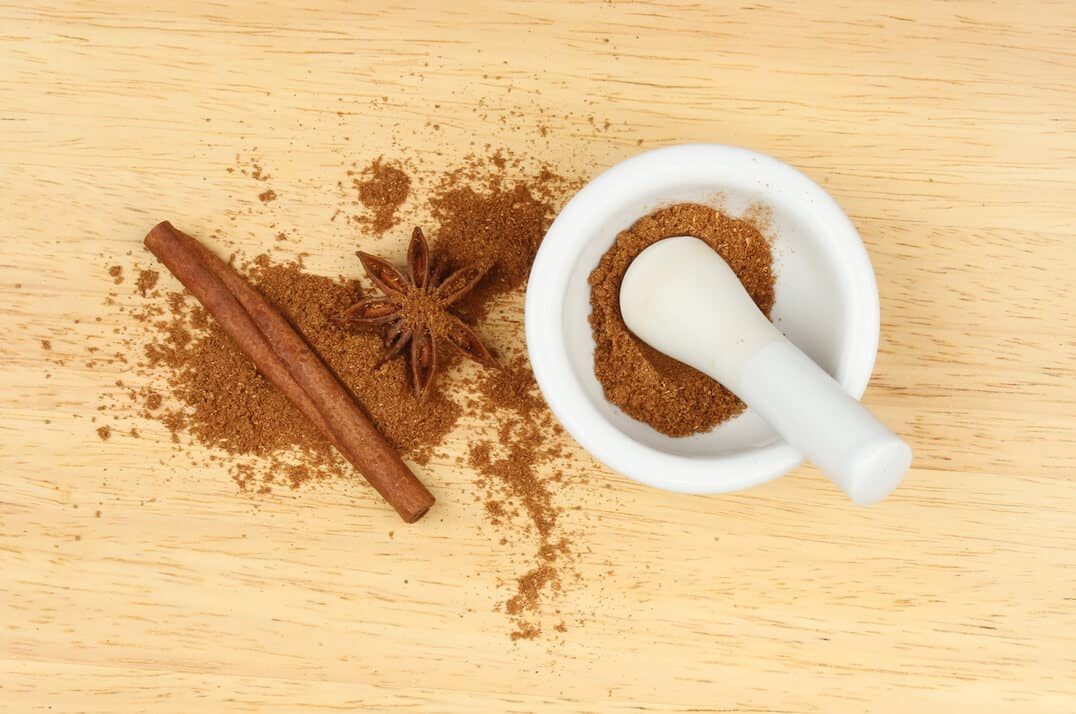
Chinese five-spice powder is a ground blend, usually of fennel seed, cassia (Chinese cinnamon), cloves, star anise and Sichuan pepper, though many variations exist.1 Britannica describes its flavor as licorice base notes and sweet top notes, accented by the slightly numbing effect of Sichuan pepper.1 Each spice does a different job, so the best substitute depends on which of those jobs matters most in your dish.
Quick answer
| What five-spice is doing | Best substitute | Starting amount, per 1 part five-spice | Treatment |
|---|---|---|---|
| Everything (roast pork, braises, marinades) | Homemade five-spice | 1 part | Method (recipe Attributed) |
| Licorice-like sweetness with cinnamon warmth | Ground star anise and cinnamon, equal parts | 1/2 part, then taste | Method |
| Licorice sweetness without star anise | Ground fennel seed and cinnamon | 1/2 part, then taste | Method |
| The numbing tingle | Ground Sichuan pepper, added to any of the above | A pinch, then taste | Method |
| Converting whole spices to ground | McCormick’s whole-to-ground figures | See the table below | Computed |
How the ratios on this page are labeled
Every ratio carries one of four labels.
- Computed: based on a measurable physical relationship, with the source named.
- Attributed: a named source publishes this ratio. We quote it as theirs.
- Disputed: named sources give different answers to the same swap. We show each one and do not average them.
- Method: we found no published ratio. We give a direction and a cautious starting point, and say so.
We found no published ratio from a credible source for replacing five-spice with partial blends. The Woks of Life, whose recipe is quoted below, says that if you have no five-spice it is fairly easy to make from scratch, and gives no shortcut ratio.2 The only measured figures on this page are McCormick’s whole-to-ground conversions, which are volume equivalents, not measures of strength.
If five-spice is doing everything
Make your own
Recipe (Attributed): The Woks of Life gives its homemade blend in parts: 2 parts fennel seed, 1 part ground cassia, 1 part Sichuan peppercorns, 1 part star anise (counting four stars as one part) and 1/3 part cloves.3 It toasts the whole spices in a dry pan over low heat until fragrant, then grinds them.3 The site encourages cooks to experiment with proportions “rather than adding equal amounts of each spice.”2
Amount (Method): A homemade blend replaces store-bought five-spice at the same amount. Taste a new batch before adding the full measure.
Store-bought blends differ from each other, too. McCormick Culinary’s lists anise, cinnamon, star anise, cloves and ginger, with no fennel or Sichuan pepper,4 while Schwartz’s lists star anise, fennel, cinnamon, cloves, black pepper and garlic.5 If you are making your own to match a particular brand, read its label.
Converting whole spices to ground (Computed)
If you have whole spices but no grinder, or want to measure ground spice in place of whole, McCormick publishes these conversions:6
| Whole | Ground equivalent |
|---|---|
| 1 whole star anise | 1/2 teaspoon ground |
| 3 whole cloves | 1/4 teaspoon ground |
| 1 teaspoon fennel seeds | 1 1/4 teaspoons ground |
| One 1 1/2-inch cinnamon stick | 1 teaspoon ground |
These are volume figures. They tell you how much powder a whole spice makes, not how strong it is.
If five-spice is licorice sweetness with cinnamon warmth
This is the flavor most people recognize as five-spice. The Woks of Life says the star anise “tastes faintly of licorice, while the cinnamon and fennel offer warm and sweet notes.”2
1. Star anise and cinnamon
The chemistry explains why this pair carries much of the blend. Star anise oil is 70 to 93 percent trans-anethole,7 and cassia bark oil is 70 to 95 percent cinnamaldehyde.8 In the Woks of Life recipe, the two are equal parts.3
What is missing: the clove note and the numbing tingle. Cloves are dominated by eugenol, which makes up 70 to 90 percent of clove bud oil.9 If you have ground cloves, a very small pinch brings the blend closer.
Ordinary ground cinnamon will usually do. The cinnamon in classic five-spice is cassia,1 and NCCIH says cassia is the most common type of cinnamon sold in North America.10
Ratio (Method): No published ratio. Mix equal parts ground star anise and ground cinnamon and start with about half the five-spice amount. Taste before adding more.
Buy the right star anise. In 2003 the FDA warned against teas made from star anise after illnesses in about 40 people. It noted that Japanese star anise “has long been recognized as toxic in many countries.”11 Use star anise sold as a food spice.
2. Fennel seed and cinnamon (no star anise)
Fennel seed also contains anethole, which PROSEA says is responsible for fennel’s anise fragrance and sweet taste.12 That shared compound is why fennel can stand in for star anise’s licorice side. Fennel is already the largest part of the Woks of Life recipe.3
Ratio (Method): No published ratio. Mix about 2 parts ground fennel to 1 part cinnamon, following the proportions in the Woks of Life recipe, and start with half the five-spice amount.
3. What about allspice?
Allspice is sometimes suggested in place of star anise. Its berry oil is 50 to 80 percent eugenol,13 the same main compound as cloves,9 so expect a warm, clove-like note rather than licorice. Use it only if the clove side of the blend is what you are missing.
Ratio (Method): No published ratio. Add a pinch and taste.
If five-spice is the numbing tingle
Sichuan pepper
Katzer describes Sichuan pepper as producing a numbing, almost anesthetic feeling on the tongue,14 and a systematic review identifies hydroxy-alpha-sanshool as the compound most responsible for the tingling.15 The Woks of Life describes the flavor as “floral, almost lemony.”2
If you have Sichuan pepper but no other five-spice ingredients, it will not stand in for the blend alone. Add it to the star anise and cinnamon mix above.
Ratio (Method): No published ratio. In the Woks of Life recipe, Sichuan pepper is the same part as star anise or cassia.3 Start with a pinch in a substitute mix and add more to taste.
What doesn’t work well
Chile-based mixes such as cayenne with cinnamon and cloves are sometimes suggested. None of the four five-spice ingredient lists compared on our five-spice profile contains chile,1345 so cayenne adds a heat the blend does not have. The suggestion often rests on the idea that the blend represents “the five flavors.” Britannica says the five components are thought to represent salty, bitter, aromatic, sweet and sour,1 which describes the blend’s balance, not a recipe you can rebuild from any five spices.
What isn’t known
- No published ratio was found for replacing five-spice with star anise and cinnamon, fennel and cinnamon, or any other partial mix. All amounts above are Method starting points.
- No published measurement compares the strength of five-spice with any substitute.
- Anise-flavored liqueur is sometimes suggested as a substitute. We found no source for that swap and did not include it.
Related
- Chinese five-spice powder and spices for Chinese food
- Star anise, star anise substitutes, cooking with star anise and star anise vs. anise seed
- Fennel seed, cassia cinnamon, cinnamon, ground cinnamon vs. cinnamon sticks, cloves and cloves vs. star anise
- Szechuan pepper and Szechuan pepper substitutes
- Allspice and allspice vs. cloves
- The master list of herbs and spices
Footnotes
-
Tony Hill, “Five-spice powder”, Encyclopaedia Britannica. britannica.com · Reference work ↩ ↩2 ↩3 ↩4 ↩5
-
“Five Spice Powder”, The Woks of Life, 2020. thewoksoflife.com · Publication ↩ ↩2 ↩3 ↩4
-
Kaitlin, “How to Make Five Spice Powder”, The Woks of Life, 2020. thewoksoflife.com · Publication ↩ ↩2 ↩3 ↩4 ↩5 ↩6
-
“McCormick Culinary Chinese Five Spice”, McCormick (product page). mccormick.com · Merchant ↩ ↩2
-
“Schwartz Chinese 5 Spice Seasoning”, Schwartz (product page). schwartz.co.uk · Merchant ↩ ↩2
-
“How to Grind Your Own Spices, Plus Spice Conversions”, McCormick, 2025. mccormick.com · Merchant ↩
-
Vu Ngoc Lô, Illicium verum, Plant Resources of South-East Asia (PROSEA). uses.plantnet-project.org · Reference work ↩
-
Cinnamomum, Plant Resources of South-East Asia (PROSEA), Spices. uses.plantnet-project.org · Reference work ↩
-
Verheij and Snijders, Syzygium aromaticum, Plant Resources of South-East Asia (PROSEA). uses.plantnet-project.org · Reference work ↩ ↩2
-
“Cinnamon: Usefulness and Safety”, National Center for Complementary and Integrative Health, 2024. nccih.nih.gov · Regulator ↩
-
“Teas Made from Star Anise Were Associated With Illnesses”, U.S. Food and Drug Administration, 2003. fda.gov · Regulator ↩
-
Purwaningsih, Harmida and Brink, Foeniculum vulgare, Plant Resources of South-East Asia (PROSEA). uses.plantnet-project.org · Reference work ↩
-
D. Sulistiarini, Pimenta dioica, Plant Resources of South-East Asia (PROSEA). uses.plantnet-project.org · Reference work ↩
-
Gernot Katzer, “Sichuan pepper”, Gernot Katzer’s Spice Pages. gernot-katzers-spice-pages.com · Reference work ↩
-
Zhang et al., “Zanthoxylum bungeanum Maxim. (Rutaceae): A Systematic Review”, International Journal of Molecular Sciences, 2017. mdpi.com · Peer-reviewed ↩