Spice Comparisons · Comparison
Maldon Salt vs. Kosher Salt: Flakes, Grains and How to Measure Each
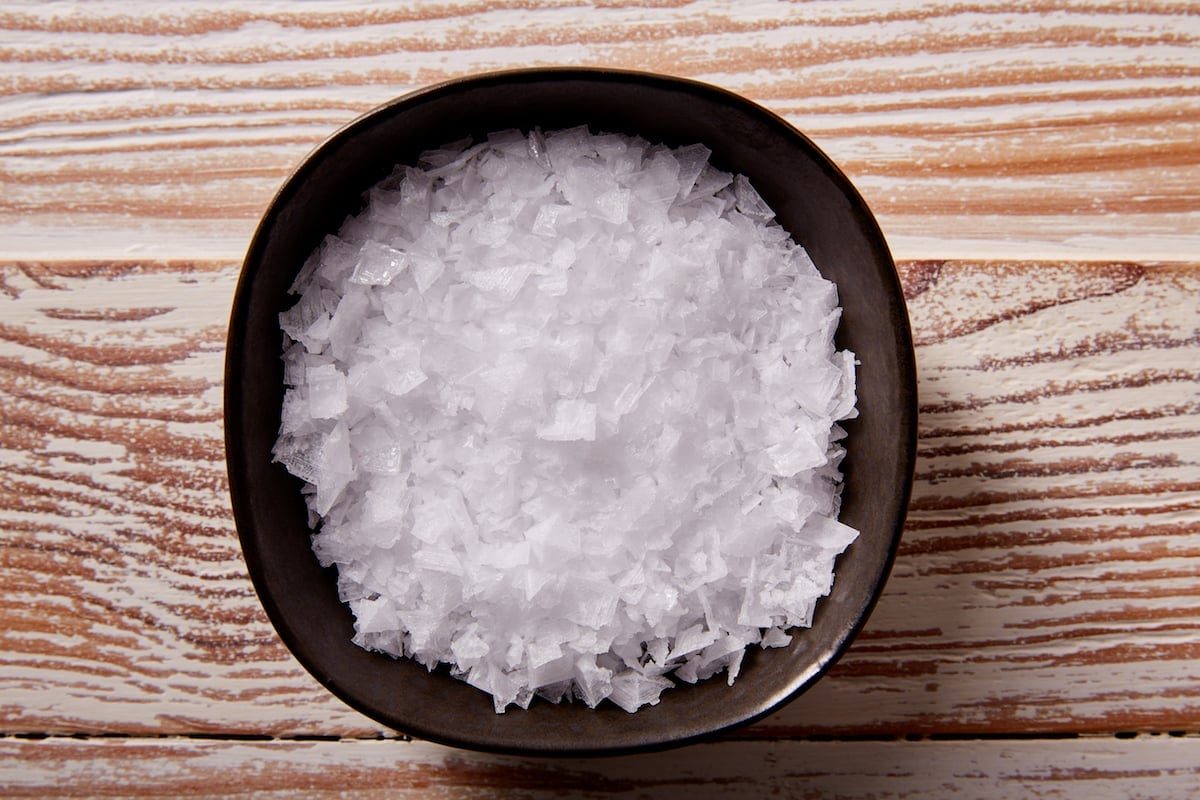
Maldon and kosher salt are both sodium chloride, but they are built for different jobs. Maldon is a flaky sea salt made in Maldon, in Essex in southeastern England, by boiling seawater until thin pyramid-shaped crystals form on the surface.12 Kosher salt is a coarse-grained salt named for its use in koshering meat, and in the US it mostly means Morton or Diamond Crystal, both made from evaporated brine.34 Maldon is a finishing salt. Kosher salt is for seasoning food before and during cooking. The practical trap is measuring: a teaspoon of Morton kosher weighs 4.8 grams, a teaspoon of Diamond Crystal 2.8 grams,4 and nobody publishes a figure for Maldon that we found.
Side by side
| Maldon salt | Kosher salt | |
|---|---|---|
| What it is | Flaky sea salt from Maldon, Essex, on the Blackwater estuary12 | Coarse-grained sodium chloride named for koshering meat53 |
| How it’s made | Seawater, taken according to the lunar cycle, brought to a boil; crystals form on the surface as the heat drops and are harvested by hand2 | Diamond Crystal: brine heated and stirred in open pans. Morton: brine evaporated in vacuum evaporators, then pressed into flakes4 |
| Crystal | Thin pyramids shaped by surface tension2 | Diamond Crystal: hollow pyramids. Morton: thin, dense flakes4 |
| Additives | Nothing added, per the producer2 | Morton: yellow prussiate of soda (anticaking agent). Diamond Crystal: none64 |
| Iodine | Not usually iodized (sea salt)7 | Not usually iodized7 |
| Grams per teaspoon | No published figure found | Morton 4.8 g; Diamond Crystal 2.8 g (ATK)4 |
| Main job | Finishing5 | Seasoning before cooking; ATK’s first choice for seasoning meat5 |
| Flavor (editorial) | Salty; a crisp crunch that dissolves fast | Salty; Diamond Crystal crunches lightly, Morton harder |
| Price | No dated, sourced comparison found | No dated, sourced comparison found |
How each is made
Maldon. The company has traded under the Maldon name since 1882.2 Foodism’s visit to the saltworks describes the process: seawater is collected according to the lunar cycle, brought to “a galloping boil,” and then cooled until crystals form on the surface, where surface tension bends each one into a thin pyramid.2 The salt is still harvested by hand, and the producer says nothing is added and nothing taken away.2 Foodism notes that salt evaporated by the sun does not form this pyramid shape.2
Kosher salt. The name describes a use: the Tufts Health & Nutrition Letter explains that its coarse grains draw blood out of meat, as Jewish dietary law requires.3 America’s Test Kitchen’s 2019 review describes the two leading brands. Diamond Crystal comes from the Alberger process, in which brine is heated and agitated in open containers so hollow, pyramid-shaped crystals form on the surface. Morton’s brine is evaporated in vacuum evaporators and the salt is pressed through rollers into thin, dense flakes.4 Both start as brine; the sources we read don’t say whether either brand’s brine comes from seawater or underground deposits.
Taste and texture
Weight for weight, the two taste alike. ATK found that sea salts vary in color but only slightly in flavor and taste no different from table salt once mixed into food.5 Equal weights of Morton and Diamond Crystal tasted exactly the same in ATK’s broth test.4 Maldon’s maker describes its flakes as having a “fresh intensity and clean taste,”8 and the producer told Foodism that the flavor spreads over the tongue and is not as hard and intense as regular salt.2 Those are the producer’s descriptions; no Maldon composition analysis or sensory test was found.
Texture is the real difference. Maldon’s thin flakes give a crisp crunch on the surface of food. Kosher salt is much coarser than table salt and dissolves more slowly, Tufts notes,3 and ATK’s tasters preferred Diamond Crystal’s “delicate and fleeting crunch” to Morton’s harder grains.4 ATK recommends sea salts as finishing salts, scattered on food just before serving,5 and makes kosher salt its first choice for seasoning meat because the large grains spread easily and cling.5
Measuring
Flakes and coarse grains pack loosely, so a teaspoon holds less salt than a teaspoon of fine salt: the American Heart Association notes that large-crystal salts have less sodium per teaspoon simply because fewer crystals fit.9 For kosher salt the weights are measured: 4.8 g per teaspoon for Morton, 2.8 g for Diamond Crystal.4 For Maldon, no maker or tester we found publishes one. Home-canning guidance from the National Center for Home Food Preservation does not recommend flake salt for pickling because its density varies.10 ATK recommends weighing salt rather than measuring it by volume.11
Can one stand in for the other?
Yes, with care. These treatments follow our Maldon salt substitute and kosher salt substitute pages.
| Swap | Starting amount | Treatment |
|---|---|---|
| Either, measured into a recipe by weight | The same weight | Computed |
| Diamond Crystal for Maldon, for finishing | By the pinch, to taste | Method |
| Morton kosher for Maldon, for finishing | By the pinch, with a lighter hand | Method |
| Maldon for kosher salt, for finishing | By the pinch, to taste | Method |
| Morton kosher for 1 tsp Maldon, measured into a recipe | About ⅔ teaspoon, then taste | Method |
| Diamond Crystal for 1 tsp Maldon, measured into a recipe | About 1 teaspoon, then taste | Method |
| Maldon for 1 tsp kosher salt, measured into a recipe | Weigh it; by volume start with 1 teaspoon and add after tasting | Method |
How these were worked out. By weight: the Codex standard requires food-grade salt to be at least 97% sodium chloride on a dry basis,12 so equal weights carry close to the same amount of salt. By volume: with no published weight for Maldon, the Maldon substitute page anchors one teaspoon of Maldon to half a teaspoon of table salt, a cautious starting point rather than a measurement, and converts with ATK’s weights (about 6 g per teaspoon of table salt, 4.8 g for Morton, 2.8 g for Diamond Crystal).4 Going the other way, the starting point is an equal volume of Maldon, because overshooting is the bigger risk. The Morton pinch is smaller because each pinch of its denser flakes carries more salt.4
Which to use
Kitchen judgment, not tested rules:
- Kosher salt for salting meat and vegetables before cooking, pasta water and anything you season by the pinch as you go.
- Maldon on the finished plate: sliced steak, tomatoes, eggs, buttered bread, chocolate and caramel.
- Inside a dough or batter, either works by weight. By volume, a fine salt gives the most predictable result.
Health notes
- Sodium. Table salt, kosher salt and most sea salts are all about 40% sodium,9 so swapping one for the other changes sodium only if the amount changes.
- Iodine. The NIH Office of Dietary Supplements lists sea salt and kosher salt among specialty salts that are not usually iodized, and says noniodized sea salt provides virtually no iodine.7 See iodized vs. non-iodized salt.
What isn’t known
- No published weight per teaspoon for Maldon; every volume swap involving it is a starting point.
- No composition analysis of Maldon salt was found.
- No sensory test comparing Maldon and kosher salt as finishing salts.
- Diamond Crystal’s own grams-per-teaspoon figure could not be retrieved from its maker.
- No dated, sourced price comparison.
Related
- Maldon sea salt and kosher salt, the full profiles
- Maldon salt substitutes and kosher salt substitutes
- Fleur de sel vs. Maldon salt and fleur de sel vs. kosher salt
- Kosher salt vs. sea salt, kosher salt vs. table salt and kosher salt vs. Himalayan salt
- Anglesey sea salt, cooking with kosher salt and cooking with sea salt
Footnotes
-
Maldon, Encyclopaedia Britannica. britannica.com · Reference work ↩ ↩2
-
Clare Finney, Clear as crystal: the decades-old traditions of Maldon sea salt, Foodism, 2018. foodism.co.uk · Publication ↩ ↩2 ↩3 ↩4 ↩5 ↩6 ↩7 ↩8 ↩9 ↩10
-
What’s the difference between kosher salt and other salt?, Tufts Health & Nutrition Letter, 2013 (updated 2019). nutritionletter.tufts.edu · Publication ↩ ↩2 ↩3 ↩4
-
Kate Shannon Levine, The Best Kosher Salt, America’s Test Kitchen, 2019. americastestkitchen.com · Publication ↩ ↩2 ↩3 ↩4 ↩5 ↩6 ↩7 ↩8 ↩9 ↩10 ↩11 ↩12
-
Salt Types and Measurements, America’s Test Kitchen. americastestkitchen.com · Publication ↩ ↩2 ↩3 ↩4 ↩5 ↩6
-
Morton Kosher Salt Flakes, product page, Morton Salt. mortonsalt.com · Merchant ↩
-
Iodine: Fact Sheet for Health Professionals, NIH Office of Dietary Supplements. ods.od.nih.gov · Regulator ↩ ↩2 ↩3
-
About Us, Maldon Salt (the producer’s own account). maldonsalt.com · Merchant ↩
-
Sodium Sources: Where Does All That Sodium Come From?, American Heart Association, 2025. heart.org · Reference work ↩ ↩2
-
Salts Used in Pickling, National Center for Home Food Preservation. nchfp.uga.edu · Reference work ↩
-
Eden Faithfull, The Wrong Brand of Kosher Salt Could Ruin Your Dinner, America’s Test Kitchen, 2022. americastestkitchen.com · Publication ↩
-
Standard for Food Grade Salt, CXS 150-1985 (rev. 2012), Codex Alimentarius. services.bis.gov.in · Standard ↩