Spice Substitutes · Substitutes
Cumin Substitutes, Ranked by the Job Cumin Is Doing
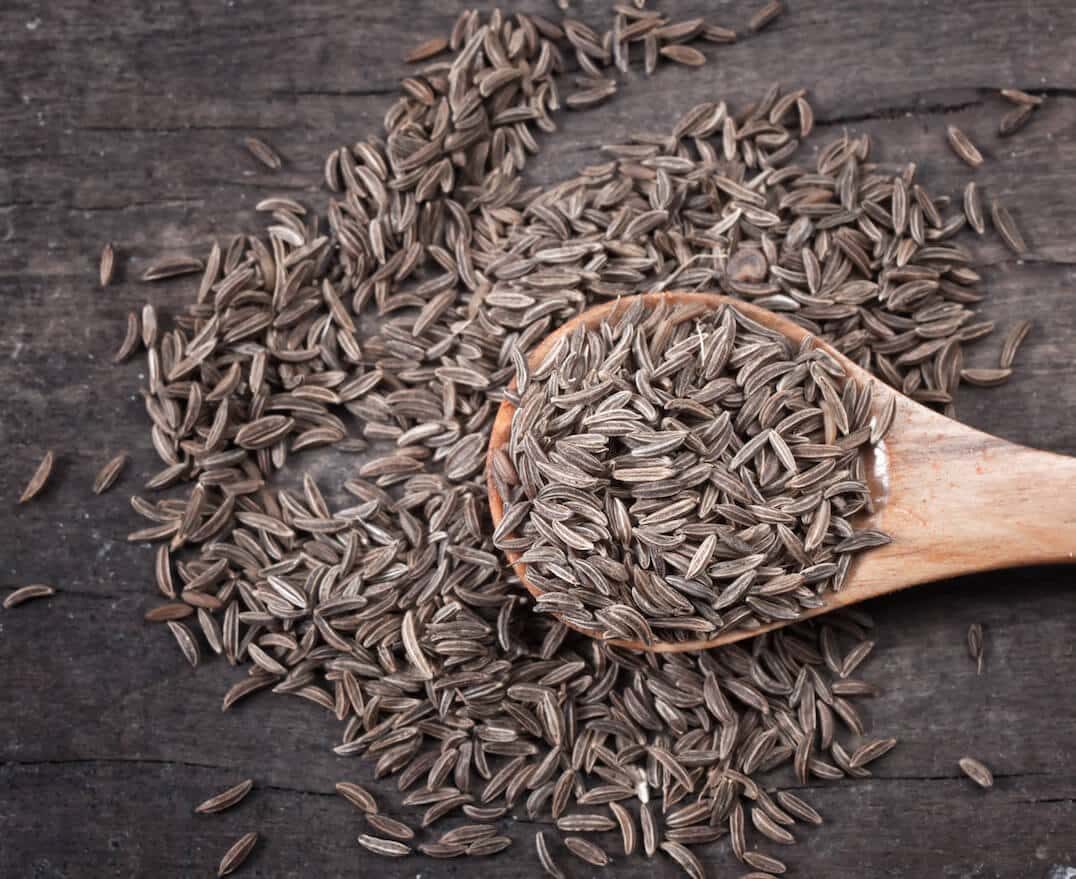
Cumin “seeds” are the dried fruits of Cuminum cyminum, a member of the parsley family (Apiaceae). They hold 2.5 to 4.5 percent essential oil, and the main component of that oil is cuminaldehyde.1 It is used across Asian, North African and Latin American cooking, and in many spice blends, including chili and curry powders.1 Every substitute below is a compromise, and which one works best depends on what cumin is doing in your recipe.
Quick answer
| What cumin is doing | Best substitute | Starting amount, per 1 part cumin | Treatment |
|---|---|---|---|
| Lead aroma (chili, tacos, cumin-heavy dishes) | Ground or crushed caraway | 1/2 to 3/4 part, then add to taste | Attributed |
| Earthy background warmth (stews, beans, rubs) | Ground coriander | 1/2 part vs 1 part or a little more | Disputed |
| Whole seeds sizzled in oil (tadka) | Whole caraway seeds | 1/2 to 3/4 part, then add to taste | Attributed |
| One spice among many in a blend | Curry powder | 1 part to start | Attributed |
The rest of the page explains each choice and lists the alternatives.
How the ratios on this page are labeled
Every ratio carries one of four labels.
- Computed: based on a measurable physical relationship, with the source named.
- Attributed: a named source publishes this ratio. We quote it as theirs.
- Disputed: named sources give different answers to the same swap. We show each one and do not average them.
- Method: we found no published ratio. We give a direction and a cautious starting point, and say so.
None of the published cumin-substitute ratios we found say how they were arrived at. They are cooks’ and merchants’ rules of thumb, not measurements of flavor strength. No published study compares the strength of cumin with any of its substitutes.
If cumin is the lead aroma
This is cumin as the flavor you would name if asked. The Spice House describes chili and tacos as “very cumin-forward” dishes.2 Here you want the closest aroma, not just something warm and brown.
1. Caraway
Britannica describes cumin’s taste as “reminiscent of caraway.”1 The two fruits look alike, too: cumin is a yellowish-brown, ridged oval about 6 mm long, and caraway is a brown, ridged fruit about 5 mm long.13 Their oils differ. Caraway’s is dominated by carvone and limonene,3 while cumin’s main compound is cuminaldehyde.14 Britannica describes caraway’s aroma as anise-like, with a warm, slightly sharp taste, so expect an anise-tinged result that lacks cumin’s heavy aroma.3
Ratio (Attributed): The Spice House says to start with half to three quarters as much caraway as cumin and add more if needed.2 Healthline and Tasting Table both say to start with half.56 All three say to start low and taste. None gives a final figure.
Grind caraway, or crush it, before using it in place of ground cumin. The Spice House suggests crushed caraway seeds for chili and tacos.2
2. Chili powder or taco seasoning (Mexican and Tex-Mex dishes only)
These are blends that already contain cumin. The USDA’s federal purchasing specification says chili powder should include ground chili pepper, cumin, oregano, salt and garlic powder.7 Using it puts cumin back into the dish, along with chile heat, salt and garlic. No source we found publishes how much of a typical chili powder is cumin.
Check the label. Chile powder, spelled with an e, is usually a single ground chile with no cumin in it.8 It will add heat and color but nothing of cumin.
Chili powder ratio (Disputed): The Spice House says to start with a 1:1 swap.2 Healthline says to use half as much chili powder as the cumin called for.5 Because chili powder also brings salt and heat, Healthline’s lower figure is the safer one if you can’t taste the dish as it cooks. That is a judgment, not a measurement.
Taco seasoning ratio (Attributed): The Spice House says to start 1:1 and adjust for heat and depth.2 Healthline lists taco seasoning as a substitute without giving an amount.5 The USDA purchasing specification does not define taco seasoning,7 so read the label before you salt the dish.
3. Black cumin (Bunium persicum), if you can find it
Bunium persicum is a separate parsley-family plant.9 Its essential oil contains cuminaldehyde, cumin’s main compound, along with the carvone and limonene found in caraway. Across the studies summarized in one 2025 review, cuminaldehyde ranged from 5.96 to 27.8 percent of the oil and carvone from 23.3 to 78.8 percent.9 Flavor will vary with the lot.
Ratio (Method): We found no published ratio for using Bunium persicum in place of cumin. Because some samples are dominated by carvone, treat it like caraway: start with about half the cumin quantity, taste, and add more.
Buying it is confusing. In several Indian languages, the name kala jeera (black cumin) is used for several very different spices.10 Nigella sativa, sold as nigella and also called black cumin, comes from the buttercup family, not the parsley family.11 Britannica describes its flavor as pungent and somewhat like nutmeg.11 It will not stand in for cumin.
If cumin is earthy background warmth
In stews, bean pots, dals and spice rubs, cumin is often one of several warm notes. In our judgment, a milder spice from the same family can fill the gap.
1. Coriander
Coriander comes from the same family as cumin.12 Healthline says both spices give a lemony, earthy flavor, with coriander being the milder of the two.5 The chemistry fits that description. Linalool makes up 60 to 80 percent of coriander essential oil,13 and the oil is described as mild, sweet and warm.13 Coriander gives you warmth and citrus without cumin’s heavy aroma.
Use the seed, whole or ground. The plant’s leaves are cilantro,12 which is a different ingredient altogether.
Ratio (Disputed): The Spice House says to use the same amount of coriander as cumin, or “a touch more.”2 Tasting Table says to use equal amounts.6 Healthline says to use half as much.5
2. Paprika
In our kitchen judgment, paprika adds color and a mild pepper warmth, but none of cumin’s distinctive aroma. Use it when cumin’s job is mostly to make a dish taste rounder and redder, as in a rub.
Ratio (Disputed): Healthline says to start with half the amount of cumin called for.5 Tasting Table says to use an equal amount, “if not more.”6
3. Fennel seed
Fennel seed is another seed that the Spice House lists as a substitute.2 It is sweeter and has an anise note, so use it where that suits the dish.
Ratio (Attributed): Healthline and Tasting Table both say to start with half as much fennel as cumin.56
If cumin is whole seeds sizzled in oil
In Indian tempering (tadka), whole or ground spices are heated in hot oil or ghee, and the mixture is added to the dish. The spices crackle when they’re ready. In NPR’s example, whole cumin seeds go in first and garlic follows, because garlic added earlier could burn.14 What you need here is a whole seed that can take the heat and flavor the oil.
1. Whole caraway seeds
Ratio (Attributed): This is the same Spice House guidance given above: start with half to three quarters as much caraway and add more if needed.2 None of the sources we found address tempering specifically.
2. Whole black cumin (Bunium persicum)
Ratio (Method): No published ratio was found. Use the same starting point as above: about half the cumin quantity, then taste.
3. Ground cumin, if seeds are what you’re missing
If you have ground cumin but the recipe calls for seeds, you can use the powder instead, but add it at the last moment and watch it closely. A powder has no seed to crackle, so the usual visual cue is lost.
Ratio (Computed): McCormick’s conversion is 1 teaspoon cumin seeds = 1¼ teaspoons ground cumin.15 This is a volume figure. It does not tell you anything about potency. Going the other way, the Spice House advises using “slightly less” ground spice than whole, because ground releases its flavor faster.2 Its advice gives a direction but no number, so if you are cautious, start below McCormick’s figure.
If cumin is one spice among many in a blend
If cumin is one of six or eight spices in a curry or rub, you can either use a ready-made blend that contains cumin or simply leave it out.
1. A blend that already contains cumin
Curry powder. The USDA purchasing specification lists turmeric, coriander, fenugreek, cinnamon, cumin, black pepper, ginger and cardamom.7 Turmeric is regulated in the US as a color additive,16 so expect the dish to turn yellower.
Curry powder ratio (Attributed): The Spice House says to start 1:1.2
Garam masala. Recipes vary widely. Saveur calls the number of versions as large as the number of home cooks in India, and its own recipe uses black cumin seeds rather than ordinary cumin, along with cardamom, black pepper, cloves, cinnamon and nutmeg.17 The Spice House says garam masala “often” contains cumin,2 so check the label.
Garam masala ratio (Disputed): The Spice House says to start 1:1.2 Healthline says to start with half the cumin amount.5
2. Leave it out and rebalance
Ratio (Method): We found no published ratio. If the recipe already contains coriander, you can increase it a little to fill the gap. If not, leave the cumin out, finish the dish, and taste before adding anything. In our judgment, a blend with several other warm spices will often hide the missing cumin.
What isn’t known
- There are no published measurements comparing the flavor strength of cumin and any substitute. Every Attributed and Disputed ratio above is a rule of thumb.
- No published figure was found for how much cumin a typical chili powder, taco seasoning or garam masala contains. The amount depends on the brand or recipe.
- It is sometimes said that cumin comes in black, white and amber varieties and that “black cumin” can replace the others. No source reviewed here supports this. “Black cumin” is a name applied to several different plants,10 not a grade of Cuminum cyminum.
Related
- Cumin and cumin seeds vs ground cumin
- Caraway seeds vs cumin, coriander vs cumin, fennel seeds vs cumin seeds
- Cumin vs curry powder, turmeric vs cumin
- Caraway seeds, coriander, chili powder, garam masala, nigella seeds
- Six classic cumin uses and too much cumin? how to fix the dish
Footnotes
-
Cumin, Encyclopaedia Britannica. britannica.com · Reference work ↩ ↩2 ↩3 ↩4 ↩5
-
Cumin Substitute, The Spice House. thespicehouse.com · Merchant ↩ ↩2 ↩3 ↩4 ↩5 ↩6 ↩7 ↩8 ↩9 ↩10 ↩11 ↩12
-
Caraway, Encyclopaedia Britannica. britannica.com · Reference work ↩ ↩2 ↩3
-
Johri, Cuminum cyminum and Carum carvi: An update, Pharmacognosy Reviews, 2011. e-lactancia.org · Peer-reviewed ↩
-
Wartenberg, 8 Good Substitutes for Cumin, Healthline. healthline.com · Publication ↩ ↩2 ↩3 ↩4 ↩5 ↩6 ↩7 ↩8
-
Peters, 12 Best Substitutes for Cumin, Tasting Table. tastingtable.com · Publication ↩ ↩2 ↩3 ↩4
-
Commercial Item Description A-A-20001C, Spices and Spice Blends, USDA Agricultural Marketing Service, 2023. ams.usda.gov · Regulator ↩ ↩2 ↩3
-
Spina, Chile Powder vs Chili Powder, Tasting Table. tastingtable.com · Publication ↩
-
Bhatt et al., Critical review on Bunium persicum, Exploration of Drug Science, 2025. explorationpub.com · Peer-reviewed ↩ ↩2
-
Sorting Cuminum names, Multilingual Multiscript Plant Name Database, University of Melbourne. plantnames.unimelb.edu.au · Reference work ↩ ↩2
-
Black cumin (Nigella sativa), Encyclopaedia Britannica. britannica.com · Reference work ↩ ↩2
-
Coriander, Encyclopaedia Britannica. britannica.com · Reference work ↩ ↩2
-
Al-Khayri et al., Essential Oil from Coriandrum sativum, Molecules, 2023. mdpi.com · Peer-reviewed ↩ ↩2
-
Bhide, The Crackling Spices of Indian Tempering, NPR. npr.org · Publication ↩
-
How to Grind Your Own Spices, McCormick. mccormick.com · Merchant ↩
-
21 CFR 73.600, Turmeric, US Code of Federal Regulations. ecfr.gov · Regulator ↩
-
Garam Masala, Saveur. saveur.com · Publication ↩