Spice Comparisons · Comparison
Coriander vs. Cumin: Linalool vs. Cuminaldehyde, and When to Swap
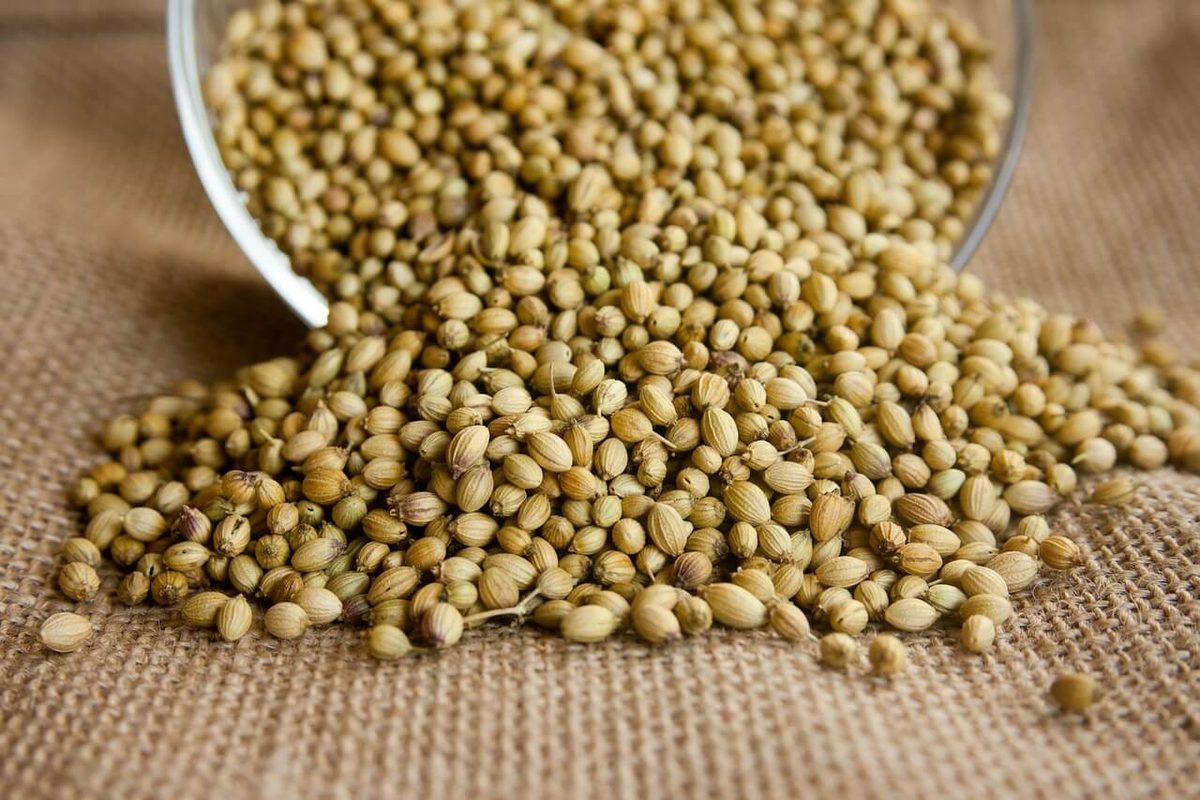
Coriander and cumin are both dried fruits of parsley-family plants, sold as “seeds”, and they turn up in the same curry powders and spice mixes.123 They do not taste alike. Cumin’s oil is led by cuminaldehyde and smells strong, warm and persistent; coriander’s is led by linalool and tastes mild, sweet and warm.45 In practice cumin is the louder of the two, which shapes how far one can stand in for the other.
Side by side
| Coriander | Cumin | |
|---|---|---|
| Plant | Coriandrum sativum6 | Cuminum cyminum7 |
| Family | Apiaceae (parsley family)6 | Apiaceae7 |
| Native range (Kew) | Eastern Mediterranean to western Pakistan6 | Iraq to Afghanistan; Britannica says the Mediterranean region72 |
| Part used | Dried fruit (schizocarp); the leaves are cilantro8 | Dried fruit (schizocarp)2 |
| The seed | Ovoid to round, up to 5 mm across, yellow-brown, ten straight ribs8 | Thin, yellowish-brown elongated oval about 6 mm long, five prominent ridges with fainter ridges between2 |
| Essential oil | Almost zero to 2% (PROSEA); 0.18–1.40% (2023 review)85 | 2.5–4.5% (Britannica); 2.5–5% (PROSEA)24 |
| Main aroma compound | Linalool, usually more than 60% of the oil (PROSEA); 60–80% (2023 review)85 | Cuminaldehyde, 20–72% of the oil across the studies PROSEA summarizes4 |
| Flavor | Mild, sweet, warm and aromatic5 | Strong, warm, pungent and persistent4 |
| India’s output, 2024-25 (final) | 844,095 tonnes9 | 1,163,907 tonnes9 |
| Quality standard | No Codex standard found | Codex CXS 327-201710 |
| Whole to ground (McCormick) | 1 tsp seed = 1 1/4 tsp ground11 | 1 tsp seed = 1 1/4 tsp ground11 |
The oil and compound figures in each column come from different references and samples, so compare the ranges rather than single numbers. The production figures are like for like: both come from the same Spices Board of India table for the same year.9 We found no current official world production figures for either spice.
Telling them apart
Whole, they are easy to tell apart once you know what to look for. Coriander is a round to slightly egg-shaped fruit up to 5 mm across with ten fine ribs.8 Cumin is a longer, thinner oval about 6 mm long with five prominent ridges.2 Britannica describes cumin as yellowish-brown and PROSEA describes coriander as yellow-brown,28 so color is a weaker clue than shape. Ground, color is not a reliable guide in our judgment; smell them instead. PROSEA describes cumin’s aroma as strong and pungent,4 and Healthline calls coriander the milder of the two.12
How they taste, and why
Coriander. PROSEA says the main component of the seed oil is always linalool, usually more than 60%,8 and a 2023 review gives 60 to 80% and describes the oil’s flavor as mild, sweet, warm and aromatic.5 The Wisconsin Master Gardener program calls the seeds sweetly aromatic, nutty and spicy.13 In cooking, coriander reads to us as soft and citrusy, a background spice.
Cumin. PROSEA describes cumin’s aroma as strong, warm, pungent and persistent, and calls cuminaldehyde its most important constituent, at 20 to 72% of the oil depending on the sample.4 Britannica also names cuminaldehyde as the oil’s principal component.2 In the pan it reads as earthy and savory with a slight bitterness; that is our description.
The two oils do not share a main compound, which is why neither is a close flavor match for the other.45
How they’re used together and apart
Together. AramcoWorld counts cumin and coriander, with chili and turmeric, among the “Big Four” spices of Indian cooking.14 USDA’s purchasing specification for curry powder lists both, along with turmeric, fenugreek, cinnamon, black pepper, ginger and cardamom, and PROSEA says curry powder can contain up to 40% coriander.38
Cumin first in the pan. In Indian tempering (tadka), whole spices are heated in hot oil or ghee; in NPR’s example cumin seeds go in first and garlic follows.15 AramcoWorld likewise notes that cumin is often the first thing into the hot pan.14
Cumin elsewhere. Britannica says cumin is especially popular in Asian, North African and Latin American cooking.2 AramcoWorld describes its use in Mexican moles, pipianes and adobos, usually in small amounts, and more prominently in northern Mexico.14 USDA’s chili powder specification includes cumin but not coriander.3
Coriander elsewhere. The Wisconsin program lists cookies and other baked goods, soups, casseroles and sausages.13 PROSEA calls coriander a spice in a large number of dishes.8 It is not mainly a dessert spice, and cumin is not only a meat spice: PROSEA lists cumin in soups, rice, meat dishes, stews, cheese, bread and pickles.4
Can one stand in for the other?
Partly, and more easily in one direction. Both swaps work best where the spice is one of several in a mix, not the flavor you would name. See coriander substitutes and cumin substitutes for the full lists.
Cumin in place of coriander (Attributed). The Spice House recommends cumin for warm, earthy depth and says to replace 1 teaspoon of ground coriander with 3/4 to 1 teaspoon of ground cumin, then adjust.16 Healthline says cumin can be used one to one.17 The two agree at the top of the range. Cumin is much louder, so start at the low end, and skip this swap in sweet bakes or delicate sauces (our judgment). If the dish already has cumin, add less.
Coriander in place of cumin (Disputed). Sources give different amounts for the same swap:
| Source | Coriander per 1 part cumin |
|---|---|
| The Spice House | Equal, or “a touch more”18 |
| Tasting Table | Equal19 |
| Healthline | Half12 |
We don’t average these. Healthline says coriander is the milder of the two,12 which fits the chemistry, so a cautious starting point (Method, ours) is the full equal amount, tasted before adding more. In our judgment coriander gives warmth but not cumin’s heavy aroma; where cumin is the lead flavor, as in chili or tacos, the cumin substitutes page ranks caraway first instead.
Whole and ground. McCormick’s conversion is the same for both: 1 teaspoon of seed to 1 1/4 teaspoons ground.11 That is a volume figure, not a strength figure.
Buying and safety
The Codex standard for cumin sets minimum volatile oil levels of 2.0 ml/100 g for Grade I whole cumin and 1.3 for ground, with moisture capped at 10%.10 We found no Codex standard for coriander.
Between late 2014 and mid-2015, more than 675 food products in the US were recalled over undeclared peanut traced to ground cumin.20 ASTA said at the time that it knew of no case of whole cumin at retail testing positive for peanut protein.21 For the full account, see the cumin profile.
What isn’t known
- No published study compares the flavor strength of coriander and cumin; every ratio above is a rule of thumb.
- The essential-oil and compound figures come from different samples and methods for each spice, so no exact strength multiple can be given.
- Claims that the two are often mistaken for each other, that ground coriander is noticeably more yellow, and that cumin has more health benefits than almost any other spice could not be traced to a source.
Related
- Coriander, cooking with coriander, too much coriander
- Cumin, cumin uses, cumin seeds vs. ground cumin, too much cumin
- Coriander vs. cilantro, caraway vs. cumin, fennel seeds vs. cumin seeds, turmeric vs. cumin, cumin vs. curry powder
Footnotes
-
“Coriander”, Encyclopaedia Britannica. britannica.com · Reference work ↩
-
“Cumin”, Encyclopaedia Britannica. britannica.com · Reference work ↩ ↩2 ↩3 ↩4 ↩5 ↩6 ↩7 ↩8 ↩9
-
Commercial Item Description A-A-20001C: Spices and Spice Blends, USDA Agricultural Marketing Service, 2023. ams.usda.gov · Regulator ↩ ↩2 ↩3
-
P.C.M. Jansen, Cuminum cyminum, Plant Resources of South-East Asia (PROSEA). uses.plantnet-project.org · Reference work ↩ ↩2 ↩3 ↩4 ↩5 ↩6 ↩7 ↩8
-
Al-Khayri et al., “Essential Oil from Coriandrum sativum: A Review on Its Phytochemistry and Biological Activity”, Molecules, 2023. mdpi.com · Peer-reviewed ↩ ↩2 ↩3 ↩4 ↩5 ↩6
-
Coriandrum sativum L., Plants of the World Online, Royal Botanic Gardens, Kew. powo.science.kew.org · Reference work ↩ ↩2 ↩3
-
Cuminum cyminum L., Plants of the World Online, Royal Botanic Gardens, Kew. powo.science.kew.org · Reference work ↩ ↩2 ↩3
-
Coriandrum sativum, Plant Resources of South-East Asia (PROSEA). uses.plantnet-project.org · Reference work ↩ ↩2 ↩3 ↩4 ↩5 ↩6 ↩7 ↩8 ↩9
-
Spice wise area and production in India, 2021-22 to 2025-26, Spices Board India. indianspices.com · Regulator ↩ ↩2 ↩3
-
Standard for Cumin, CXS 327-2017, Codex Alimentarius. fao.org · Standard ↩ ↩2
-
“How to Grind Your Own Spices, Plus Spice Conversions”, McCormick, 2025. mccormick.com · Merchant ↩ ↩2 ↩3
-
Lisa Wartenberg, “8 Good Substitutes for Cumin”, Healthline, 2023. healthline.com · Publication ↩ ↩2 ↩3
-
Susan Mahr, “Cilantro”, Wisconsin Master Gardener Program, University of Wisconsin-Madison, 2017. mastergardener.extension.wisc.edu · Reference work ↩ ↩2
-
Jeff Koehler, “Spice Migrations: Cumin”, AramcoWorld, 2021. aramcoworld.com · Publication ↩ ↩2 ↩3
-
Monica Bhide, “The Crackling Spices of Indian Tempering”, NPR. npr.org · Publication ↩
-
“Coriander Substitute”, The Spice House, 2018. thespicehouse.com · Merchant ↩
-
Jillian Kubala, “The 7 Best Substitutes for Coriander and Cilantro”, Healthline, 2018. healthline.com · Publication ↩
-
“Cumin Substitute”, The Spice House, 2017. thespicehouse.com · Merchant ↩
-
Steve Peters, “12 Best Substitutes for Cumin”, Tasting Table, 2024. tastingtable.com · Publication ↩
-
Ishani Nath, “Special Report: Investigating Motive and Spice Safety in the Big Peanut-Tainted Cumin Recalls”, Allergic Living, 2016. allergicliving.com · Publication ↩
-
ASTA statement on FDA consumer advice on ground cumin with undeclared peanuts, American Spice Trade Association, 2015. astaspice.org · Standard ↩