Spice Comparisons · Comparison
Cumin vs. Curry Powder: One Spice Against the Blend That Contains It
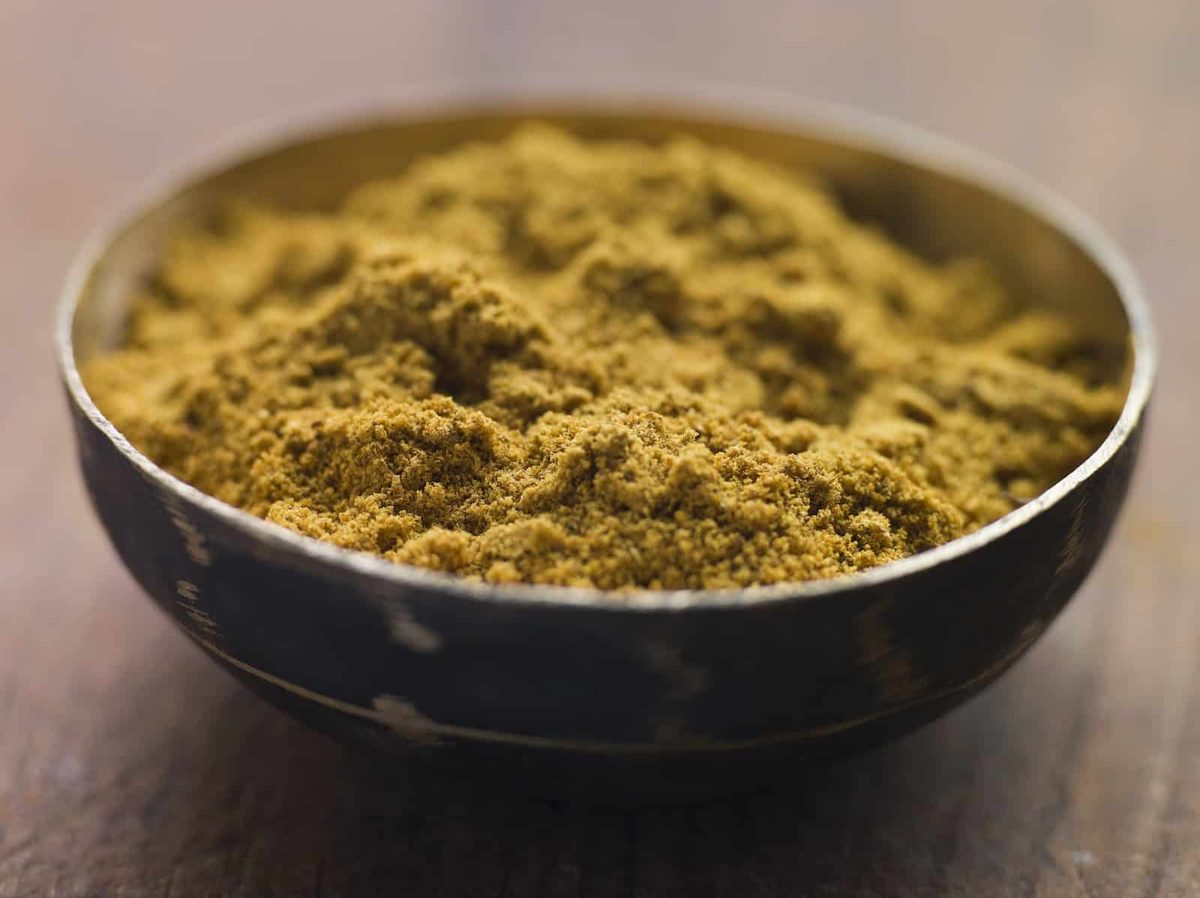
Cumin is a single spice, the dried fruit of Cuminum cyminum.12 Curry powder is a blend, and cumin is usually one of its ingredients: the USDA’s purchasing specification lists turmeric, coriander, fenugreek, cinnamon, cumin, black pepper, ginger and cardamom as the minimum contents of curry powder.3 So curry powder tastes partly of cumin, but its color comes from turmeric and much of its bulk can be coriander.45 That is why curry powder can stand in for cumin in some dishes, while cumin on its own can’t replace curry powder.
Side by side
| Cumin | Curry powder | |
|---|---|---|
| What it is | One spice: the dried fruit (“seed”) of Cuminum cyminum, parsley family (Apiaceae)12 | A blend of ground spices with no fixed recipe6 |
| Contents | Just cumin | USDA minimum list: turmeric, coriander, fenugreek, cinnamon, cumin, black pepper, ginger, cardamom; “not limited to” these, and no proportions set3 |
| Origin | Native range Iraq to Afghanistan (Kew)1 | A mixture adapted by British settlers in India (Britannica)7 |
| Key compounds | Cuminaldehyde, the most important constituent of the oil (20 to 72 percent across the literature)8 | Several, one per spice: curcumin gives turmeric its yellow;9 fenugreek’s sotolon gives what PROSEA calls the “characteristic curry aroma”;10 coriander oil is 60 to 80 percent linalool;11 plus cumin’s cuminaldehyde8 |
| Color | Yellowish-brown2 | Yellow, from turmeric49 |
| Aroma and taste (sourced) | Strong, warm, pungent and persistent (PROSEA)8 | “Fragrant aromatic aroma and a warm bitter taste” (USDA specification)3 |
| Heat | Contains no chile; PROSEA describes its aroma as pungent8 | Depends on the blend: the USDA list has no chile,3 while 19th-century Madras-style recipes were laden with chili or cayenne12 |
| Forms | Whole seed and ground | Ground |
| Typical uses | Mixed spices, chutneys, and chili and curry powders; especially popular in Asian, North African and Latin American cooking2 | British-style curries; Britannica says the commercial powder let British cooks recreate the flavor of Indian food7 |
| How much cumin is in it | Not applicable | No published figure found. Coriander alone can be up to 40 percent of curry powder (PROSEA)5 |
| Flavor (editorial) | Earthy, savory, slightly bitter; nutty when toasted | Warm and rounded, with cumin as one note among several; brighter and more bitter-sweet, depending on the blend |
One spice against a blend
There is no single curry powder. Atlas Obscura’s history of the blend says there has never been a set combination of spices, and quotes an 1870 recipe built from coriander seed, turmeric, ginger, black pepper, mustard, allspice, cumin and cardamom.6 The USDA specification sets a minimum ingredient list but no proportions,3 so two jars that both meet it can taste very different.
Curry powder is also a different idea from the spice mixes of Indian home cooking. Britannica says curry powder was adapted by British settlers in India, while in traditional Indian cookery the spice mixtures are called masala and are prepared in the home.7 Atlas Obscura quotes the cookbook author Madhur Jaffrey, writing in 1974, that “no Indian ever uses curry powder.”6 Cumin, by contrast, is a basic ingredient across many cuisines: Britannica names it as essential in mixed spices, chutneys, and chili and curry powders.2 In Mexico it arrived with Spanish colonists and traders, according to AramcoWorld’s history of the spice.13 The USDA specification also lists cumin in chili powder,3 and The Spice House calls chili and tacos “very cumin-forward.”14
What the other spices change
Color. Turmeric lends curry its distinctive yellow color,4 and curcumin is the compound responsible.9 Cumin is yellowish-brown.2 Swap one for the other and the dish changes color, which matters more in some dishes than others.
Aroma. The smell most people call “curry” isn’t cumin’s alone. PROSEA attributes fenugreek’s characteristic curry aroma to sotolon,10 and coriander, a large part of many blends,5 brings an oil dominated by linalool.11 Cumin’s cuminaldehyde is one note in that mix.8
Heat. Curry powder’s heat depends on the blend: the USDA list includes black pepper but no chile,3 while Madras-style blends were historically promoted as spicier, with 19th-century recipes laden with chili or cayenne.12 See is curry powder spicy? for a blend-by-blend look.
Cooking. Both are usually used ground, so both behave like ground spices in hot fat. America’s Test Kitchen recommends blooming ground spices in fat, for anywhere from 30 seconds to several minutes, and warns that they burn fairly quickly.15 Whole cumin seed has its own techniques; see cumin seeds vs. ground cumin.
Can one stand in for the other?
Curry powder in place of cumin (Attributed). The Spice House says to start with a 1:1 swap when using a powdered blend such as curry powder in place of cumin.14 Expect a yellower dish and the extra flavors of turmeric, coriander and fenugreek. In our judgment, it works best in dishes that already lean Indian or British-curry, and least well in Mexican and Tex-Mex dishes, where the yellow color and the other spices stand out. A blend that lists cumin near the top of its ingredients is the safer choice. See cumin substitutes.
Cumin in place of curry powder (Method). We found no published ratio, and cumin alone can’t supply turmeric’s color or coriander’s bulk. Our starting point, not a tested figure: use about half the curry powder amount in ground cumin, add a pinch of turmeric if you have it, and adjust after tasting. If you have ground coriander too, add some of that before adding more cumin.
Safety notes
Turmeric, the coloring spice in curry powder, has a documented adulteration problem with lead chromate. A 2026 study in eastern India found 30 percent of turmeric samples above India’s permissible lead limit of 10 micrograms per gram.16 That finding is about turmeric sold in that region, not about curry powder in general. For cumin, the 2015 US peanut warnings concerned products containing ground cumin; see the cumin profile.
What isn’t known
- No published figure gives the share of cumin in commercial curry powders. Ingredient lists name cumin but not how much.
- No study compares the flavor strength of cumin and curry powder, so every swap amount is a rule of thumb.
- No dated, sourced price comparison was found.
Related
- Cumin, cumin uses, cumin substitutes and too much cumin?
- Curry powder, curry spices, is curry powder spicy? and too much curry powder?
- Turmeric vs. curry powder, garam masala vs. curry powder, Madras curry powder vs. curry powder, curry paste vs. curry powder
- Turmeric vs. cumin and coriander vs. cumin
Footnotes
-
Cuminum cyminum L., Plants of the World Online, Royal Botanic Gardens, Kew. powo.science.kew.org · Reference work ↩ ↩2 ↩3
-
“Cumin”, Encyclopaedia Britannica. britannica.com · Reference work ↩ ↩2 ↩3 ↩4 ↩5 ↩6
-
Commercial Item Description A-A-20001C, Spices and Spice Blends, USDA Agricultural Marketing Service, 2023. ams.usda.gov · Regulator ↩ ↩2 ↩3 ↩4 ↩5 ↩6 ↩7
-
Prasad and Aggarwal, “Turmeric, the Golden Spice”, in Herbal Medicine: Biomolecular and Clinical Aspects, via NCBI Bookshelf. ncbi.nlm.nih.gov · Reference work ↩ ↩2 ↩3
-
Coriandrum sativum, Plant Resources of South-East Asia (PROSEA). uses.plantnet-project.org · Reference work ↩ ↩2 ↩3
-
Rohini Chaki, “The Subversive, Surprising History of Curry Powder”, Atlas Obscura, 2019. atlasobscura.com · Publication ↩ ↩2 ↩3
-
“Curry”, Encyclopaedia Britannica. britannica.com · Reference work ↩ ↩2 ↩3
-
P.C.M. Jansen, Cuminum cyminum, Plant Resources of South-East Asia (PROSEA). uses.plantnet-project.org · Reference work ↩ ↩2 ↩3 ↩4 ↩5
-
“Turmeric: Usefulness and Safety”, NCCIH, 2025. nccih.nih.gov · Regulator ↩ ↩2 ↩3
-
Tawan and Wulijarni-Soetjipto, Trigonella foenum-graecum, Plant Resources of South-East Asia (PROSEA). uses.plantnet-project.org · Reference work ↩ ↩2
-
Al-Khayri et al., “Essential Oil from Coriandrum sativum: A Review on Its Phytochemistry and Biological Activity”, Molecules, 2023. mdpi.com · Peer-reviewed ↩ ↩2
-
Julia Fine, “From Delhi to Durban: The Many Homes of Madras Curry Powder”, Diaspora Co., 2022. diasporaco.com · Merchant ↩ ↩2
-
Jeff Koehler, “Spice Migrations: Cumin”, AramcoWorld, 2021. aramcoworld.com · Publication ↩
-
“Cumin Substitute”, The Spice House, 2017. thespicehouse.com · Merchant ↩ ↩2
-
“How to Bloom Spices”, America’s Test Kitchen, 2023. americastestkitchen.com · Publication ↩
-
Forsyth et al., “Systemic drivers of toxic food adulteration: lead chromate in turmeric across eastern India”, npj Science of Food, 2026. nature.com · Peer-reviewed ↩