Spice Comparisons · Comparison
Madras Curry Powder vs. Curry Powder: What the Chile Changes
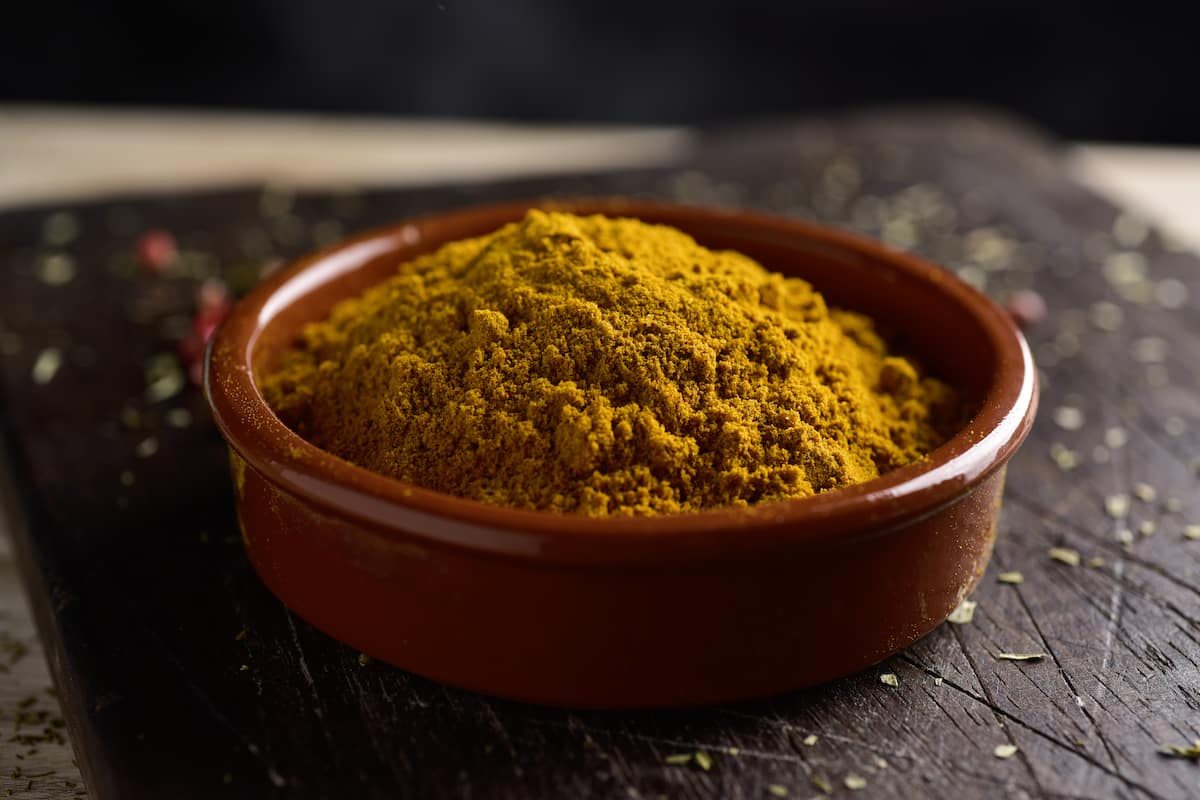
Madras curry powder is curry powder with chile in it. Food writer Dan Toombs puts it that way: a Madras curry powder is a blend like any curry powder that also has dried chiles for a spicy kick.1 Plain curry powder may have none. The USDA’s purchase specification lists turmeric, coriander, fenugreek, cinnamon, cumin, black pepper, ginger and cardamom for curry powder and names no chile.2 Beyond that, neither blend has a fixed recipe,34 so the label matters more than the name.
Both come from the same place. Britannica says curry powder was adapted by British settlers in India, while Indian home cooks call their spice mixtures masala and make them at home.5 Madras is the former name of Chennai,6 and historian Julia Fine, writing for the spice merchant Diaspora Co., notes it was one of the earliest English trading posts in India and gave its name to a style of curry powder that was often promoted as spicier than the Bengal and Bombay styles.7 “Curry” itself comes from the Tamil kari, “sauce.”5
Side by side
| Madras curry powder | Curry powder | |
|---|---|---|
| What it is | A curry powder with dried chiles added1 | A blend adapted by British settlers in India5 |
| Name | From Madras, now Chennai6 | From the Tamil kari, “sauce”5 |
| Fixed recipe? | No: one retailer notes many variations of ingredients and proportions4 | No: Atlas Obscura says there has never been a set combination3 |
| Example ingredients | World Spice Merchants: coriander, brown mustard seed, turmeric, cumin, fenugreek, black pepper, red chile flake, cinnamon, cardamom and ginger8 | USDA minimum list: turmeric, coriander, fenugreek, cinnamon, cumin, black pepper, ginger, cardamom2 |
| Chile | Yes, by definition18 | None on the USDA list; some brands add it2 |
| Heat | Promoted historically as spicier;7 World Spice rates its blend 2 of 58 | Depends on the brand (editorial) |
| Color | Yellow from turmeric’s curcumin;9 19th-century recipes were “laden with turmeric, chili, and/or cayenne”7 | Yellow from curcumin;9 the USDA spec calls for a uniform color2 |
| Key compounds | Curcumin; sotolon in fenugreek; linalool in coriander; cuminaldehyde in cumin; plus capsaicinoids from the chile910111213 | The same base compounds, without capsaicinoids unless chile is added9101112 |
| Official standard | None found | USDA purchase spec: max 9.0% moisture and 7.2% total ash; fragrant aroma, “warm bitter taste”2 |
| Price | No dated, sourced comparison found | No dated, sourced comparison found |
The two columns describe one merchant’s Madras blend and a US government purchasing list, not the whole market. For more on each, see Madras curry powder and curry powder.
The differences that change a dish
Heat
This is the main one. Chile heat comes from capsaicinoids,13 and plain curry powder made to the USDA list has no chile to supply them.2 How hot a Madras powder is depends on how much chile, and which, its maker uses. Toombs says his blend can be made as spicy or mild as you like.1 We found no published heat measurement for any Madras curry powder. World Spice Merchants rates its own blend 2 on a scale of 5,8 so “Madras” on a label does not by itself promise a very hot powder.
The base is the same
Strip out the chile and the two are close. Toombs notes that his Madras blend made without the chiles would still be a great curry powder.1 Both start from turmeric, whose curcumin gives the yellow;9 the reference chapter by Prasad and Aggarwal says turmeric lends curry its yellow color and flavor.14 Both usually carry fenugreek, which PROSEA credits with the characteristic curry aroma through a compound called sotolon.1082
Smaller differences
Individual Madras blends can differ from plain curry powder in more than chile. World Spice’s includes brown mustard seed,8 which is not on the USDA list.2 Fine notes that 19th-century Madras recipes might use more cayenne, fenugreek, saffron or cinnamon than other styles.7 Those are differences between particular blends, not rules.
Color
Both are yellow from turmeric.9 A common claim says Madras powder is darker or redder because of its chile. We found no source that describes or measures this.
Can one stand in for the other?
Yes, and most easily in one direction. Our Madras curry powder substitutes page ranks regular curry powder plus cayenne as the best stand-in.
| Swap | Starting amount, per 1 tablespoon | Treatment |
|---|---|---|
| Curry powder plus cayenne for Madras | 1 tablespoon curry powder plus 1/8 teaspoon cayenne, then taste | Method |
| Madras for curry powder | 1 tablespoon if you like heat; otherwise start with less and add mild curry powder or turmeric to make up the base | Method |
| Homemade Madras | Toombs’s published recipe, used 1:1 | Attributed (recipe), Method (amount) |
- Curry powder in place of Madras. Add chile. Method: no published ratio exists. Start with about 1/8 teaspoon cayenne per tablespoon of curry powder; Toombs advises adding chili powder gradually, to taste.1 Check the label first, since some curry powders already contain chile. Fresh hot chiles work too, but they add their own flavor and moisture as well as heat (our judgment).
- Madras in place of curry powder. It will make the dish hotter. Method: use the same amount if heat is welcome. If not, start with half and taste; the base spices will be lighter, so a pinch of extra turmeric helps keep the color (our judgment, no source gives an amount).
- Bloom either one. America’s Test Kitchen recommends blooming ground spices in fat, for 30 seconds to several minutes, before liquid goes in.15
When to reach for each
- Madras curry powder when you want a hot curry, or an Anglo-Indian dish written for it. Mulligatawny, which the Christian Science Monitor describes as a soup created for officers of the British Raj, is one; the same article says it can be made with commercial curry powder.16
- Plain curry powder when the heat should come from somewhere you control, or not at all. See cooking with curry powder and is curry powder spicy?
What isn’t known
- No heat measurement of any Madras curry powder was found, and no source gives a Scoville figure for either blend.
- Brand proportions are not published, so how much chile a given Madras powder contains can’t be checked.
- Claims that Madras powder is darker or redder than plain curry powder, that it sits at the hot end of a UK scale with korma at the mild end, or that it is mainly sold in British food aisles, could not be traced.
- Whether Madras curry powder is sold or used in India today is not addressed by the sources reviewed.
Related
- Vindaloo vs. Madras curry powder and vindaloo curry powder
- Jamaican vs. Indian curry powder, Japanese curry powder and Malaysian curry powder
- Garam masala vs. curry powder, curry paste vs. curry powder and turmeric vs. curry powder
- Too much curry powder?, cayenne pepper and curry spices
Footnotes
-
Dan Toombs, “Homemade hot Madras curry powder,” Great Curry Recipes, 2015 (updated 2023). greatcurryrecipes.net · Publication ↩ ↩2 ↩3 ↩4 ↩5 ↩6
-
Commercial Item Description A-A-20001C, Spices and Spice Blends, USDA Agricultural Marketing Service, 2023. ams.usda.gov · Regulator ↩ ↩2 ↩3 ↩4 ↩5 ↩6 ↩7 ↩8
-
Rohini Chaki, “The Subversive, Surprising History of Curry Powder,” Atlas Obscura, 2019. atlasobscura.com · Publication ↩ ↩2
-
“Madras Curry Powder - Sun Brand” (product page), ChefShop. chefshop.com · Merchant ↩ ↩2
-
“Curry,” Encyclopaedia Britannica. britannica.com · Reference work ↩ ↩2 ↩3 ↩4
-
“Chennai,” Encyclopaedia Britannica. britannica.com · Reference work ↩ ↩2
-
Julia Fine, “From Delhi to Durban: The Many Homes of Madras Curry Powder,” Diaspora Co., 2022. diasporaco.com · Merchant ↩ ↩2 ↩3 ↩4
-
“Madras South Indian Curry” (product page), World Spice Merchants. worldspice.com · Merchant ↩ ↩2 ↩3 ↩4 ↩5 ↩6
-
“Turmeric: Usefulness and Safety,” NCCIH, NIH, 2025. nccih.nih.gov · Regulator ↩ ↩2 ↩3 ↩4 ↩5 ↩6
-
C.S. Tawan and N. Wulijarni-Soetjipto, Trigonella foenum-graecum, Plant Resources of South-East Asia (PROSEA). uses.plantnet-project.org · Reference work ↩ ↩2 ↩3
-
Al-Khayri et al., “Essential Oil from Coriandrum sativum,” Molecules, 2023. mdpi.com · Peer-reviewed ↩ ↩2
-
P.C.M. Jansen, Cuminum cyminum, Plant Resources of South-East Asia (PROSEA). uses.plantnet-project.org · Reference work ↩ ↩2
-
Paul W. Bosland and Stephanie J. Walker, “Measuring Chile Pepper Heat” (Guide H-237), New Mexico State University, 2010. pubs.nmsu.edu · Reference work ↩ ↩2
-
Prasad and Aggarwal, “Turmeric, the Golden Spice,” in Herbal Medicine: Biomolecular and Clinical Aspects, CRC Press, 2011. ncbi.nlm.nih.gov · Reference work ↩
-
“How to Bloom Spices,” America’s Test Kitchen, 2023. americastestkitchen.com · Publication ↩
-
Phyllis Hanes, “British, Indian traditions blend in Mulligatawny Soup,” The Christian Science Monitor, 1985. csmonitor.com · Publication ↩