Spices · Dish guide
The Best Spices for Curry: What Cumin, Mustard Seed, Coriander, Turmeric, Chile, Cardamom and Garam Masala Each Do
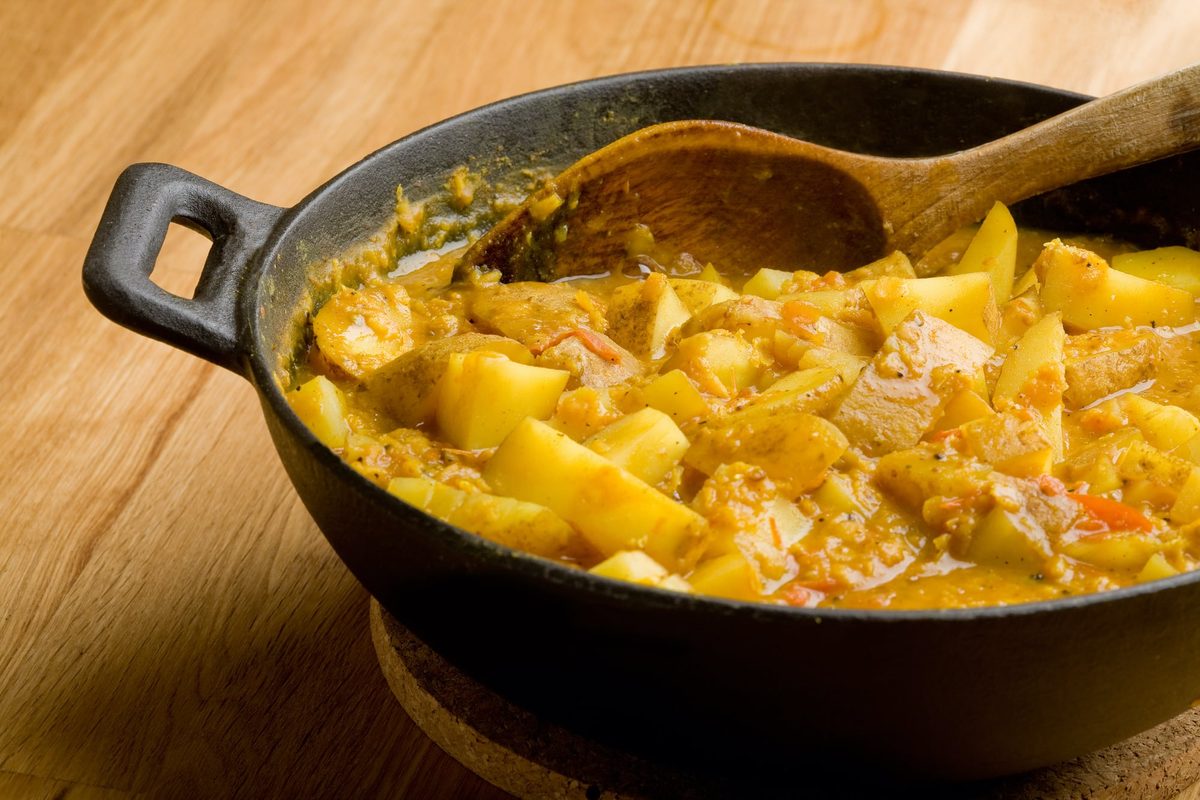
“Curry” covers a huge range of Indian and Indian-influenced dishes, and no single spice list defines it. Britannica derives the word from the Tamil kari, “sauce”, and notes that in India the spice mixtures are called masalas and are made at home.1 Still, a core set of spices turns up again and again. This page covers what each one does in the pot, how it goes in, and where the published lists agree and differ. Quantities appear only where a named source gives them.
At a glance
| Spice | Job in the curry | How it usually goes in (common practice unless cited) | Full profile |
|---|---|---|---|
| Cumin | Warm, earthy backbone (cuminaldehyde)2 | Whole seeds in hot fat, or ground in the masala | Cumin |
| Black or brown mustard seed | Nutty, smoky note once fried3 | Fried in fat or dry-toasted first3 | Black mustard seeds |
| Coriander seed | Mild, sweet, warm bulk4 | Ground; up to 40% of curry powder5 | Coriander |
| Turmeric | Yellow color, earthy bitterness67 | Ground, early in cooking | Turmeric |
| Red chile | Heat8 | Ground or whole dried | Cayenne pepper |
| Green cardamom | Camphor-like, warm aroma910 | Pods or ground seed | Cardamom |
| Garam masala | Aromatic finish11 | Early, or at the end11 | Garam masala |
What the published lists say
There is no fixed recipe. Atlas Obscura’s history of curry powder says there has never been a set combination of spices, and quotes Madhur Jaffrey’s 1974 line that no Indian ever uses curry powder.12 Two published lists show the common ground:
| Spice | Britannica: spices that typically flavor curries1 | USDA curry powder purchase specification (minimum list)13 |
|---|---|---|
| Cumin | Yes | Yes |
| Coriander | Yes | Yes |
| Turmeric | Yes | Yes |
| Fenugreek | Yes | Yes |
| Cardamom | Yes | Yes |
| Cinnamon | Yes | Yes |
| Mustard seed | Yes | No |
| Cloves | Yes | No |
| Fennel seed | Yes | No |
| Black pepper | No | Yes |
| Ginger | No | Yes |
| Chile | No | No |
Neither list includes chile, though many curries are hot; the heat is the cook’s choice. Fenugreek, on both lists, carries sotolon, which PROSEA says gives fenugreek its characteristic curry aroma.14 See fenugreek and curry powder.
Cumin
Cumin is an essential ingredient in many mixed spices and in chili and curry powders, according to Britannica.15 Its main aroma compound is cuminaldehyde, 20 to 72% of the essential oil depending on the study.2 Calling it the most important curry spice is a judgment; it is on every list above. Whole seeds are usually fried in the cooking fat at the start, and ground cumin goes into the spice paste; that is common practice. See cumin and cumin vs. curry powder.
Mustard seed
Curries use the dark seeds. Katzer describes frying black mustard seeds in fat, or dry-toasting them, as a typical South Indian technique, notes they often appear in Tamil vegetable curries, and lists them in the Bengali five-spice mix panch phoron.3 Popular Science’s rule of thumb is that the darker the seed, the spicier it is,16 and Katzer rates black mustard slightly more pungent than brown.3
Frying changes them completely. Katzer says fried or toasted mustard seeds are no longer pungent but take on a nutty, smoky taste.3 So the seeds that crackle in hot oil at the start of a South Indian curry add aroma and texture, not mustard heat. See black mustard seeds, brown mustard seeds and panch phoran.
Coriander seed
Coriander seed comes from the same plant as cilantro, which is used both as an herb and a spice.17 The two taste different because, as PROSEA explains, the aldehydes that dominate the leaf’s oil disappear as the fruit ripens.5 The seed’s oil is 60 to 80% linalool, and its flavor is mild, sweet, warm and aromatic.4
Coriander is a bulk spice: PROSEA says curry powder can contain up to 40% coriander.5 Toast whole seeds before grinding, or bloom ground coriander in fat; America’s Test Kitchen warns that ground spices burn fairly quickly and recommends blooming for anywhere from 30 seconds to several minutes.18 The claim that coriander aids digestion is widely repeated; no systematic review supporting it was found. See coriander and coriander vs. cilantro.
Turmeric
Turmeric comes from a plant in the ginger family.6 Curcumin gives it its yellow color,6 and turmeric lends curry both its distinctive yellow and part of its flavor.7 The taste is bitter, slightly acrid and yet sweet, and its aroma comes from turmerone, ar-turmerone and zingiberene.7 It is not just a coloring agent, and a little goes a long way; that is cooking judgment.
On health, NCCIH says there is not enough evidence to conclude whether turmeric or curcumin is beneficial for any health purpose.6 See turmeric, cooking with turmeric and turmeric vs. curry powder.
Red chile
The McCormick Science Institute lists Indian cooking among the cuisines where red pepper adds heat and bite.8 The chiles are New World plants; Capsicum annuum is native from the southern United States to Brazil and the Caribbean.19 Use ground red chile or cayenne for heat, adjusting to taste. The idea that chile powder is what makes many Indian dishes red is widely repeated, but no source measuring it was opened for this page. See cayenne pepper and is curry powder spicy?.
Garam masala
Garam masala is a blend, not a single spice: Great British Chefs describes it as a blend used across the Indian subcontinent, varying widely by region and personal taste,11 and Gulf News writes that it changes with every state and every home.20 The name means “hot spices”, which Saveur explains as spices thought to be body-warming in Ayurvedic medicine, not chile heat.21
The base varies. Bong Eats gives the most basic Bengali form as just cardamom, cinnamon and cloves,22 while Great British Chefs lists cloves, bay leaf, fennel, cinnamon and cardamom among the commonly used spices.11 Cumin is not part of the Bengali base. Timing varies too: Great British Chefs says it can go into marinades and sauces early, or be used to finish a dish at the end of cooking.11 See garam masala, cooking with garam masala and garam masala vs. curry powder.
Green cardamom
PROSEA calls cardamom an important ingredient of curries and describes its warm, slightly pungent taste.9 Its oil is mainly 1,8-cineole (20 to 60%) and alpha-terpinyl acetate (20 to 53%);9 1,8-cineole has a camphor-like odor.10 It is strong enough to dominate a dish, so use it with restraint; that is cooking judgment. See cardamom, black vs. green cardamom and cooking with cardamom.
Safety: lead in spices
Ground spices, including those in curry, can carry lead. A ten-year review of spices tested in New York City found detectable lead in more than half of the samples.23 Turmeric is a particular concern: a 2026 study in eastern India found 30% of turmeric samples above India’s permissible lead limit of 10 micrograms per gram, in a study of lead chromate adulteration.24 See our turmeric profile for more.
Related pages
- Curry powder, Madras curry powder and curry paste vs. curry powder
- Is curry powder spicy? and too much curry powder?
- Curry leaves and fenugreek
- Ginger, cloves and cinnamon
Footnotes
-
Curry (Britannica Editors, revised by Charles Preston, updated 29 Aug 2026), Encyclopaedia Britannica. britannica.com · Reference work ↩ ↩2
-
Cuminum cyminum (PROSEA), P.C.M. Jansen, Plant Resources of South-East Asia, via Pl@ntUse. uses.plantnet-project.org · Reference work ↩ ↩2
-
Mustard (Brassica nigra, B. juncea, Sinapis alba), Gernot Katzer’s Spice Pages, Gernot Katzer. gernot-katzers-spice-pages.com · Reference work ↩ ↩2 ↩3 ↩4 ↩5
-
Essential Oil from Coriandrum sativum: A Review on Its Phytochemistry and Biological Activity (Al-Khayri et al.), Molecules 28(2):696, 2023, MDPI Molecules. mdpi.com · Peer-reviewed ↩ ↩2
-
Coriandrum sativum (PROSEA), Plant Resources of South-East Asia, via Pl@ntUse. uses.plantnet-project.org · Reference work ↩ ↩2 ↩3
-
Turmeric: Usefulness and Safety (last updated April 2025), National Center for Complementary and Integrative Health (NIH). nccih.nih.gov · Regulator ↩ ↩2 ↩3 ↩4
-
Turmeric, the Golden Spice (Prasad S, Aggarwal BB), in Herbal Medicine: Biomolecular and Clinical Aspects, 2nd ed., 2011, CRC Press / Taylor & Francis, via NCBI Bookshelf. ncbi.nlm.nih.gov · Reference work ↩ ↩2 ↩3
-
Red Pepper, McCormick Science Institute. mccormickscienceinstitute.com · Merchant ↩ ↩2
-
Elettaria cardamomum (PROSEA), T.H. Wardini & A. Thomas, Plant Resources of South-East Asia, via Pl@ntUse. uses.plantnet-project.org · Reference work ↩ ↩2 ↩3
-
1,8-Cineole (CID 2758), Odor (from the Hazardous Substances Data Bank), PubChem, U.S. National Library of Medicine. pubchem.ncbi.nlm.nih.gov · Reference work ↩ ↩2
-
How to make garam masala (GBC Kitchen, updated 14 Feb 2025), Great British Chefs. greatbritishchefs.com · Publication ↩ ↩2 ↩3 ↩4 ↩5
-
The Subversive, Surprising History of Curry Powder (Rohini Chaki, 9 Apr 2019), Atlas Obscura. atlasobscura.com · Publication ↩
-
Commercial Item Description A-A-20001C: Spices and Spice Blends (28 Aug 2023), USDA Agricultural Marketing Service. ams.usda.gov · Regulator ↩
-
Trigonella foenum-graecum (PROSEA), C.S. Tawan and N. Wulijarni-Soetjipto, Plant Resources of South-East Asia, via Pl@ntUse. uses.plantnet-project.org · Reference work ↩
-
Cumin, Encyclopaedia Britannica (revised by Sohini Dasgupta, updated 14 Aug 2026). britannica.com · Reference work ↩
-
When the mustard shortage hits, make your own (Sandra Gutierrez G., 30 Jul 2022), Popular Science. popsci.com · Publication ↩
-
Coriander, Encyclopaedia Britannica. britannica.com · Reference work ↩
-
How to Bloom Spices (Technique #2: Bloom Spices for Depth and Complexity, 31 Oct 2023), America’s Test Kitchen. americastestkitchen.com · Publication ↩
-
Capsicum annuum L., Plants of the World Online, Royal Botanic Gardens, Kew. powo.science.kew.org · Reference work ↩
-
How Hyderabadi biryani taught me not all of India’s garam masalas are the same (Karishma H. Nandkeolyar, updated 14 Jun 2021), Gulf News. gulfnews.com · Publication ↩
-
Garam Masala (recipe from Madhur Jaffrey, Aug/Sep 2014 India issue), Saveur. saveur.com · Publication ↩
-
Bengali Garam Masala (24 Nov 2016), Bong Eats. bongeats.com · Publication ↩
-
A Spoonful of Lead: A 10-Year Look at Spices as a Potential Source of Lead Exposure (Hore, Alex-Oni, Sedlar, Nagin, Journal of Public Health Management and Practice 25:S63–S70, 2019), abstract, Icahn School of Medicine at Mount Sinai, research portal. scholars.mssm.edu · Peer-reviewed ↩
-
Systemic drivers of toxic food adulteration: lead chromate in turmeric across eastern India (Forsyth et al., 2026), npj Science of Food 10:220, Nature Portfolio. nature.com · Peer-reviewed ↩