Spice Comparisons · Comparison
Garam Masala vs. Curry Powder: Ingredients, Color and When to Use Each
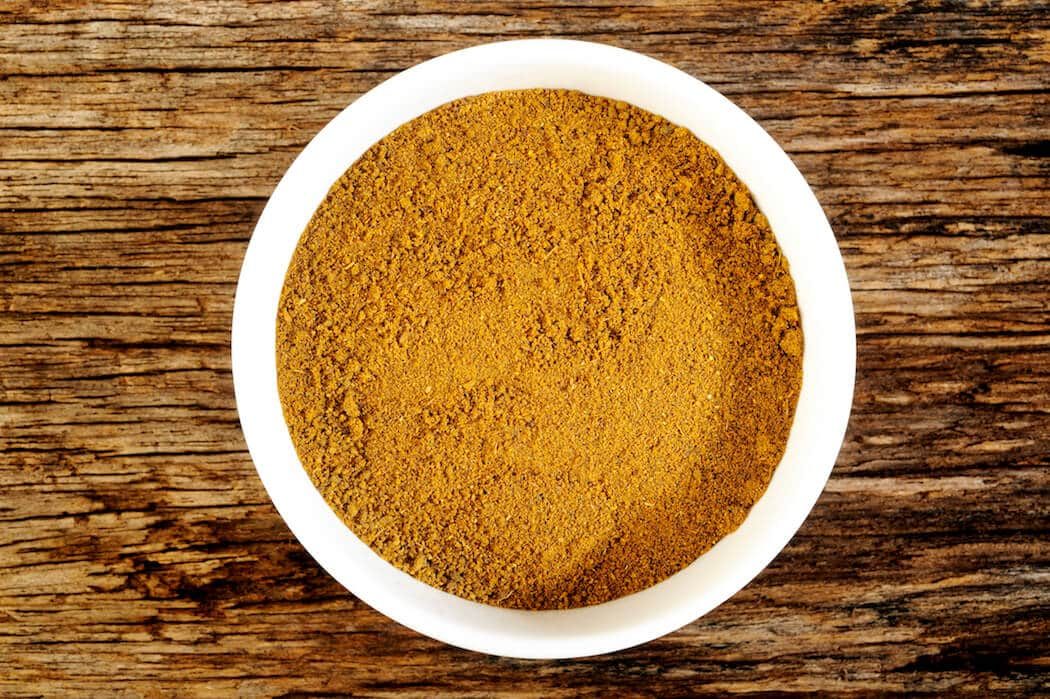
Garam masala and curry powder are both spice blends with no fixed recipe, but they come from different places and do different jobs. Garam masala is a blend used across the Indian subcontinent;1 at its most basic, the Bengali version is cardamom, cinnamon and cloves.2 Curry powder is the mixture that Britannica says British settlers in India adapted, while Indian home cooks make their own spice mixtures, called masalas.3 The visible difference is turmeric. It leads the USDA’s ingredient list for curry powder and gives curry its yellow color, and none of the garam masala recipes compared here uses it.45162
Side by side
| Garam masala | Curry powder | |
|---|---|---|
| Origin | A blend used across the Indian subcontinent1 | Adapted by British settlers in India3 |
| Name | Masala is a varying blend of spices used in Indian cooking;7 garam masala is literally “hot spices”;8 Saveur says the heat refers to spices thought to warm the body in Ayurvedic medicine, not chile6 | “Curry” from the Tamil kari, “sauce”3 |
| Fixed recipe? | No: varies by region and personal taste1 | No: Atlas Obscura says there has never been a set combination9 |
| Typical ingredients | Bengali basic: cardamom, cinnamon, cloves;2 Great British Chefs’ common list adds bay leaf, fennel, cumin, coriander seed, mace and black and white pepper1 | USDA purchase specification: turmeric, coriander, fenugreek, cinnamon, cumin, black pepper, ginger and cardamom, “not limited to” these4 |
| Turmeric | Not in the Bengali, Saveur or Great British Chefs versions261 | On the USDA list; gives curry its yellow color45 |
| Color | Brown (editorial) | Yellow, from turmeric’s curcumin105 |
| Key compounds | Eugenol, about 85 to 92% of clove oil; 1,8-cineole, up to about 31% of cardamom oil; cinnamaldehyde, about 49.9 to 62.8% of Ceylon cinnamon bark oil111213 | Curcumin for color;10 sotolon, which PROSEA credits with fenugreek’s curry aroma;14 linalool, 60 to 80% of coriander oil; cuminaldehyde, 20 to 72% of cumin oil1516 |
| Taste | Warm and sweet-smelling (editorial) | The USDA spec calls for “a warm bitter taste”4 |
| Chile heat | Not chile-hot, per The Spice House17 | None on the USDA minimum list; depends on the brand4 |
| Official standard | Not covered by the USDA spice-blend specification4 | Covered: max 9.0% moisture, 7.2% total ash, uniform color4 |
| Price | No dated, sourced comparison found | No dated, sourced comparison found |
The compound figures describe each spice’s own oil, from separate studies. No analysis of either finished blend was found. For each blend on its own, see garam masala and curry powder.
The differences that change a dish
Color and turmeric
Turmeric’s curcumin is a yellow pigment,10 and the reference chapter by Prasad and Aggarwal credits turmeric with curry’s distinctive yellow color and flavor.5 A dish seasoned with curry powder turns yellow; one seasoned with garam masala doesn’t. Turmeric’s own taste is bitter and slightly acrid, yet sweet,5 and fenugreek, also on the USDA list, has a strong, sweetish and somewhat bitter aroma and taste.184 The USDA’s specification asks for curry powder with “a warm bitter taste.”4
Sweet spices
Garam masala leans on the sweet-smelling spices. The Bengali blend is nothing but cardamom, cinnamon and cloves,2 and Madhur Jaffrey’s recipe in Saveur starts from a quarter cup of cardamom seeds.6 Curry powder includes cardamom and cinnamon on the USDA list,4 but alongside turmeric, coriander, fenugreek and ginger, which in our judgment push it toward the earthy and savory.
When each goes in
Curry powder is generally cooked into a dish. America’s Test Kitchen recommends blooming ground spices in fat, for anywhere from 30 seconds to several minutes, before adding liquid.19 Garam masala works both ways. Great British Chefs says it can go into a dish’s base and can also finish a dish at the end of cooking,1 and Bong Eats sprinkles a pinch with ghee over finished dishes.2 A widely repeated rule says garam masala is only a finishing spice; these sources show cooks use it at both ends.
Where they come from
Garam masala belongs to Indian cooking, and Great British Chefs says its spices vary widely by region and personal taste.1 Curry powder is the British-made shortcut. Atlas Obscura quotes Madhur Jaffrey’s 1974 line that “no Indian ever uses curry powder.”9 That is her view, and a strong one; Britannica’s version is that Indian spice mixtures are called masala and prepared in the home.3
Can one stand in for the other?
Partly. It is often said the two are not interchangeable, but two spice merchants suggest curry powder as a garam masala stand-in. Either way, the swap changes the color and the balance.
| Swap | Starting amount | Treatment |
|---|---|---|
| Curry powder for garam masala | Half as much, then taste | Method |
| Curry powder plus cinnamon and cloves for garam masala | A pinch of each per spoonful of curry powder | Attributed (mix), Method (amount) |
| Garam masala plus turmeric for curry powder | 2 parts garam masala to 1 part turmeric | Method |
- Curry powder in place of garam masala. The Spice House calls curry a suitable substitute when you have no garam masala,17 and Frontier Co-op suggests combining curry powder with cinnamon and cloves.20 Neither gives an amount. Method: start with about half as much curry powder as the garam masala called for, add a pinch of cinnamon and cloves if you have them, and expect the dish to turn yellow. See garam masala substitutes.
- Garam masala in place of curry powder. It supplies the warm spices but not turmeric’s color, or fenugreek’s curry aroma unless your blend contains it. Method: no source gives a ratio. As on our Madras curry powder substitutes page, add turmeric: start with 2 parts garam masala to 1 part ground turmeric (2 teaspoons and 1 teaspoon per tablespoon of curry powder), taste, and adjust.
When to reach for each
- Curry powder for dishes built around it, bloomed in oil at the start.19 See cooking with curry powder and is curry powder spicy?
- Garam masala for curries, stews and samosas,6 in the base or as a last-minute finish.12 See garam masala uses and cooking with garam masala.
What isn’t known
- No published analysis of either finished blend was found; the compound figures describe the individual spices.
- No source gives a ratio for swapping one blend for the other.
- Whether curry powder or garam masala is easier to find in Western shops was not measured by any source reviewed.
- A widely repeated derivation says kari meant a thin sauce for meat and vegetables; Britannica gives only “sauce.”3
Related
- Chaat masala vs. garam masala, garam masala vs. allspice, tikka masala vs. garam masala
- Curry paste vs. curry powder, cumin vs. curry powder, turmeric vs. curry powder, tikka masala vs. curry powder
- Madras curry powder vs. curry powder and curry spices
- Too much garam masala? and too much curry powder?
Footnotes
-
GBC Kitchen, “How to make garam masala,” Great British Chefs, 2025. greatbritishchefs.com · Publication ↩ ↩2 ↩3 ↩4 ↩5 ↩6 ↩7 ↩8 ↩9
-
“Bengali Garam Masala,” Bong Eats, 2016. bongeats.com · Publication ↩ ↩2 ↩3 ↩4 ↩5 ↩6 ↩7
-
“Curry,” Encyclopaedia Britannica. britannica.com · Reference work ↩ ↩2 ↩3 ↩4 ↩5
-
Commercial Item Description A-A-20001C, Spices and Spice Blends, USDA Agricultural Marketing Service, 2023. ams.usda.gov · Regulator ↩ ↩2 ↩3 ↩4 ↩5 ↩6 ↩7 ↩8 ↩9 ↩10
-
Prasad and Aggarwal, “Turmeric, the Golden Spice,” in Herbal Medicine: Biomolecular and Clinical Aspects, CRC Press, 2011. ncbi.nlm.nih.gov · Reference work ↩ ↩2 ↩3 ↩4 ↩5
-
“Garam Masala” (Madhur Jaffrey recipe), Saveur, 2014. saveur.com · Publication ↩ ↩2 ↩3 ↩4 ↩5
-
“masala,” Merriam-Webster.com Dictionary. merriam-webster.com · Reference work ↩
-
“garam masala,” Merriam-Webster.com Dictionary. merriam-webster.com · Reference work ↩
-
Rohini Chaki, “The Subversive, Surprising History of Curry Powder,” Atlas Obscura, 2019. atlasobscura.com · Publication ↩ ↩2
-
“Turmeric: Usefulness and Safety,” NCCIH, NIH, 2025. nccih.nih.gov · Regulator ↩ ↩2 ↩3
-
Batiha et al., “Syzygium aromaticum L. (Myrtaceae),” Biomolecules, 2020. mdpi.com · Peer-reviewed ↩
-
Blažeković et al., “Content and Chemical Composition of Essential Oil from Cardamom,” Croatica Chemica Acta. hrcak.srce.hr · Peer-reviewed ↩
-
Ranasinghe et al., “Medicinal properties of ‘true’ cinnamon: a systematic review,” BMC Complementary and Alternative Medicine, 2013. link.springer.com · Peer-reviewed ↩
-
C.S. Tawan and N. Wulijarni-Soetjipto, Trigonella foenum-graecum, Plant Resources of South-East Asia (PROSEA). uses.plantnet-project.org · Reference work ↩
-
Al-Khayri et al., “Essential Oil from Coriandrum sativum,” Molecules, 2023. mdpi.com · Peer-reviewed ↩
-
P.C.M. Jansen, Cuminum cyminum, Plant Resources of South-East Asia (PROSEA). uses.plantnet-project.org · Reference work ↩
-
“Garam Masala Substitute,” The Spice House, 2018. thespicehouse.com · Merchant ↩ ↩2
-
“Fenugreek,” Encyclopaedia Britannica. britannica.com · Reference work ↩
-
“How to Bloom Spices,” America’s Test Kitchen, 2023. americastestkitchen.com · Publication ↩ ↩2
-
“Our Guide to the Best Garam Masala Substitutes,” Frontier Co-op. frontiercoop.com · Merchant ↩