Spice Comparisons · Comparison
English Thyme vs. French Thyme: Two Cultivars of One Herb
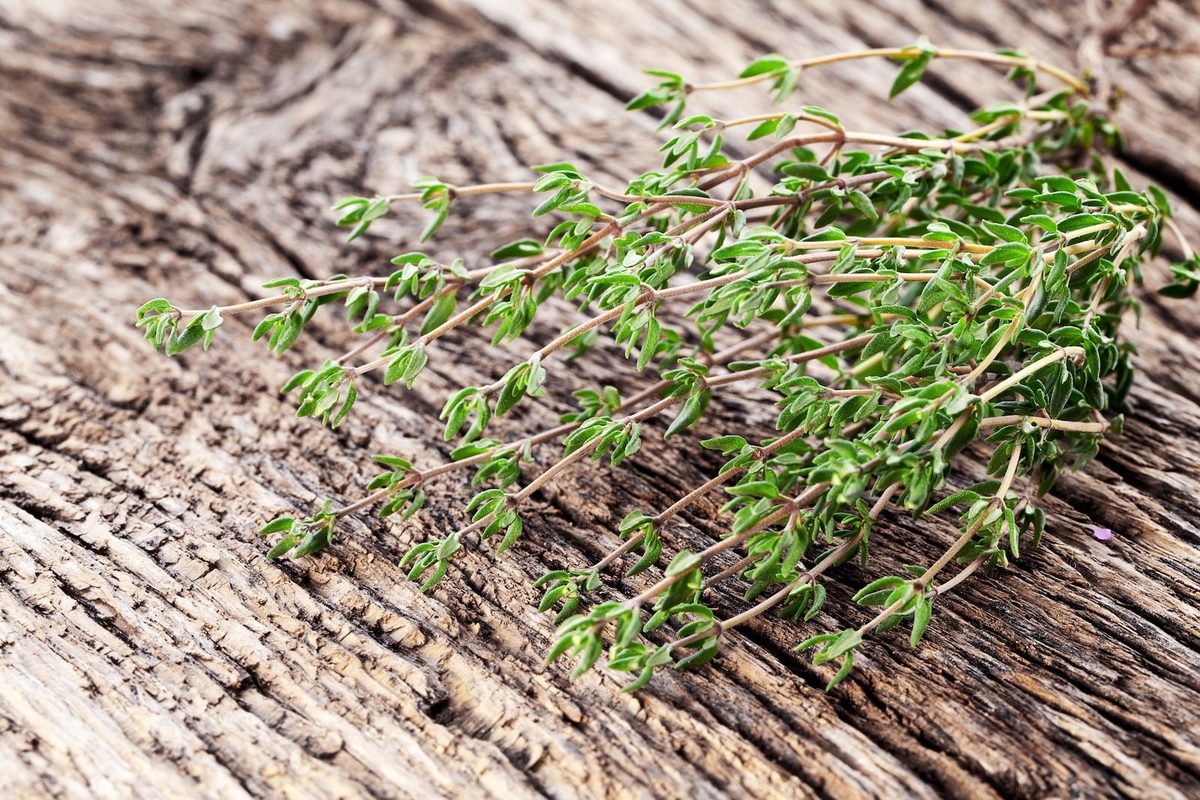
English thyme and French thyme are not two species. Both are garden forms, or cultivars, of common thyme, Thymus vulgaris: Penn State Extension and NC State Extension list ‘Broadleaf English’ and ‘Narrow Leaf French’ among its cultivars.12 You can tell them apart by the leaf, broad on English and fine and gray on French.1 The flavor difference is one of degree. Extension writers describe French as the lighter or milder of the two and English as the more robust,23 but they do not agree on which one is sweeter, and no one has measured either.
Side by side
| English thyme | French thyme | |
|---|---|---|
| Species | Thymus vulgaris, cultivar ‘Broadleaf English’12 | Thymus vulgaris, cultivar ‘Narrow Leaf French’12 |
| Family | Lamiaceae (mint family)4 | Lamiaceae4 |
| Native range of the species | Southwestern Europe and southeastern Italy: Spain, France, Italy and the Balearic Islands (Kew)4 | Same species, same range4 |
| Part used | Leaves and flowering tops, fresh or dried5 | Leaves and flowering tops, fresh or dried5 |
| Leaves | Broad and small1 | Fine and gray1 |
| Flowers | White1 | White1 |
| Key compounds | No analysis of this cultivar found. Common thyme oil is usually led by thymol and carvacrol, but the species has several chemotypes (see below).56 | No analysis of this cultivar found; same species-level picture56 |
| Flavor, as sources describe it | “The most robust” (Penn State);2 “sweeter fragrance” (NC State)1 | A “lighter, sweeter taste” (Penn State);2 “slightly milder” (UC Master Gardeners)3 |
| Flavor (editorial) | Fuller and sharper, with more of the resinous, medicinal edge | Gentler, with the same notes turned down |
| Cost | No dated, sourced comparison found | No dated, sourced comparison found |
What the names mean
“English” and “French” are cultivar names, not botanical ones. We found no botanical authority that defines them: Kew’s entry is for the species as a whole,4 and Britannica simply calls T. vulgaris common or garden thyme.7 The names on plant tags overlap in confusing ways:
- English thyme is the usual kitchen thyme in at least one extension’s view. UC Master Gardeners in Santa Clara County count more than 300 varieties of thyme and say English thyme is the one most commonly grown for cooking.3
- “Common thyme” is not one cultivar. NC State lists common thyme, garden thyme and German thyme as names for the whole species,1 and Penn State describes a separate cultivar, ‘German Winter’, as very winter-hardy with good culinary flavor.2
- Not every French-sounding thyme is French thyme. Both extensions describe a cultivar called ‘Provencial’, with tiny, narrow gray-green leaves, white flowers and a strong citrus aroma.12 A tag that says “Provence” or “French” may mean either plant, so check the cultivar name.
A widely repeated claim says French thyme comes from Provence and is also called summer thyme, and that English thyme spread from England to Jamaica. We found no source for any of these.
How the flavor differs, and where sources disagree
| Source | English thyme | French thyme |
|---|---|---|
| Penn State Extension (Carol Kagan, 2026) | ‘Broadleaf English’ is “the most robust”2 | ‘Narrow Leaf French’ has a “lighter, sweeter taste” and is preferred by chefs2 |
| UC Master Gardeners of Santa Clara County (Pam Roper) | The thyme most commonly grown for cooking3 | A similar, slightly milder taste3 |
| NC State Extension Plant Toolbox | ‘Broadleaf English’ has a “sweeter fragrance”1 | ‘Narrow Leaf French’: white flowers, fine gray leaves; no flavor note1 |
All three point the same way on strength: French is the milder. On sweetness they split. Penn State calls French the sweeter in taste, while NC State gives the sweeter fragrance to English. One is describing taste and the other aroma, so the two may not truly conflict, but no test settles it. We show both rather than pick one.
Why thyme varies at all. PROSEA reports that Mediterranean T. vulgaris comes in six chemotypes with different main monoterpenes, under genetic control, and that in one of them thymol and carvacrol are each below 5% of the oil.5 Thyme oil is more often thymol-led: one T. vulgaris oil in a 2023 study held 42.44% thymol and 2.28% carvacrol.6 Growing conditions may matter too. UC Master Gardeners say thyme gives its best flavor in nutrient-poor soil.3 Whether ‘Broadleaf English’ and ‘Narrow Leaf French’ differ in chemotype, in oil content or only in leaf size is not known, because no study we found has analyzed them.
In the kitchen
The two cook the same way. America’s Test Kitchen classes thyme as a hearty herb to add early, because the flavor compounds in hearty herbs are somewhat more heat-stable.8 The French classics call for thyme without naming a cultivar: Britannica’s classic bouquet garni is parsley, thyme and a bay leaf,9 and the Label Rouge specification for herbes de Provence gives thyme as 19% of the blend.10
Our judgment, not a sourced finding: reach for French thyme where thyme is out front in a light dish, such as fish, eggs, a quiche or a butter sauce, and for English in roasts, stuffings, stocks and long braises, where its fuller flavor holds up.
Can one stand in for the other?
Yes, almost always. No source gives a ratio for this swap, so both directions below are Method starting points.
- English in place of French (Method). Start with about three quarters of the amount and taste, since English is described as the more robust.2
- French in place of English (Method). Use the same amount, and add a little more at the end if the dish needs it.
- Fresh and dried. For converting between fresh sprigs and dried leaves, see fresh thyme vs. dried. For other herbs in place of either, see thyme substitutes.
What isn’t known
- No published analysis of the oil or flavor compounds of ‘Broadleaf English’ or ‘Narrow Leaf French’ was found.
- Sources agree that French is milder but disagree on which is sweeter.
- No botanical authority defines “English” or “French” thyme; the names come from nursery cultivars.
- Jars of dried thyme are sold as thyme, and we found no labeling source that says which cultivar they contain.
- No dated, sourced price comparison was found.
Related
- Thyme, thyme substitutes, thyme uses, cooking with thyme
- Lemon thyme and thyme vs. lemon thyme
- Oregano vs. thyme, rosemary vs. thyme, tarragon vs. thyme
- Herbes de Provence, bouquet garni
- How to store thyme, too much thyme?
Footnotes
-
Thymus vulgaris, North Carolina Extension Gardener Plant Toolbox, NC State University. plants.ces.ncsu.edu · Reference work ↩ ↩2 ↩3 ↩4 ↩5 ↩6 ↩7 ↩8 ↩9 ↩10 ↩11 ↩12 ↩13
-
Carol Kagan, “Herb Garden Plants: Thyme”, Penn State Extension, 2026. extension.psu.edu · Reference work ↩ ↩2 ↩3 ↩4 ↩5 ↩6 ↩7 ↩8 ↩9 ↩10 ↩11
-
Pam Roper, “English Thyme”, UC Master Gardeners of Santa Clara County. ccfruitandnuts.ucanr.edu · Reference work ↩ ↩2 ↩3 ↩4 ↩5 ↩6
-
Thymus vulgaris L., Plants of the World Online, Royal Botanic Gardens, Kew. powo.science.kew.org · Reference work ↩ ↩2 ↩3 ↩4 ↩5
-
S.H. Widodo, Thymus vulgaris, Plant Resources of South-East Asia (PROSEA). uses.plantnet-project.org · Reference work ↩ ↩2 ↩3 ↩4 ↩5
-
Dong et al., “Chemical Compositions of Essential Oil Extracted from Eight Thyme Species”, Plants, 2023. mdpi.com · Peer-reviewed ↩ ↩2 ↩3
-
“Thyme”, Encyclopaedia Britannica. britannica.com · Reference work ↩
-
Liz Bomze, “Our Guide to Fresh Herbs”, America’s Test Kitchen, 2019. americastestkitchen.com · Publication ↩
-
“Bouquet garni”, Encyclopaedia Britannica. britannica.com · Reference work ↩
-
Label Rouge “Herbes de Provence” (LA 02/03), specification modification request, INAO, 2014. extranet.inao.gouv.fr · Regulator ↩