Spices · Profile
Anglesey Sea Salt (Halen Môn): How It Is Made, What It Contains and How to Use It
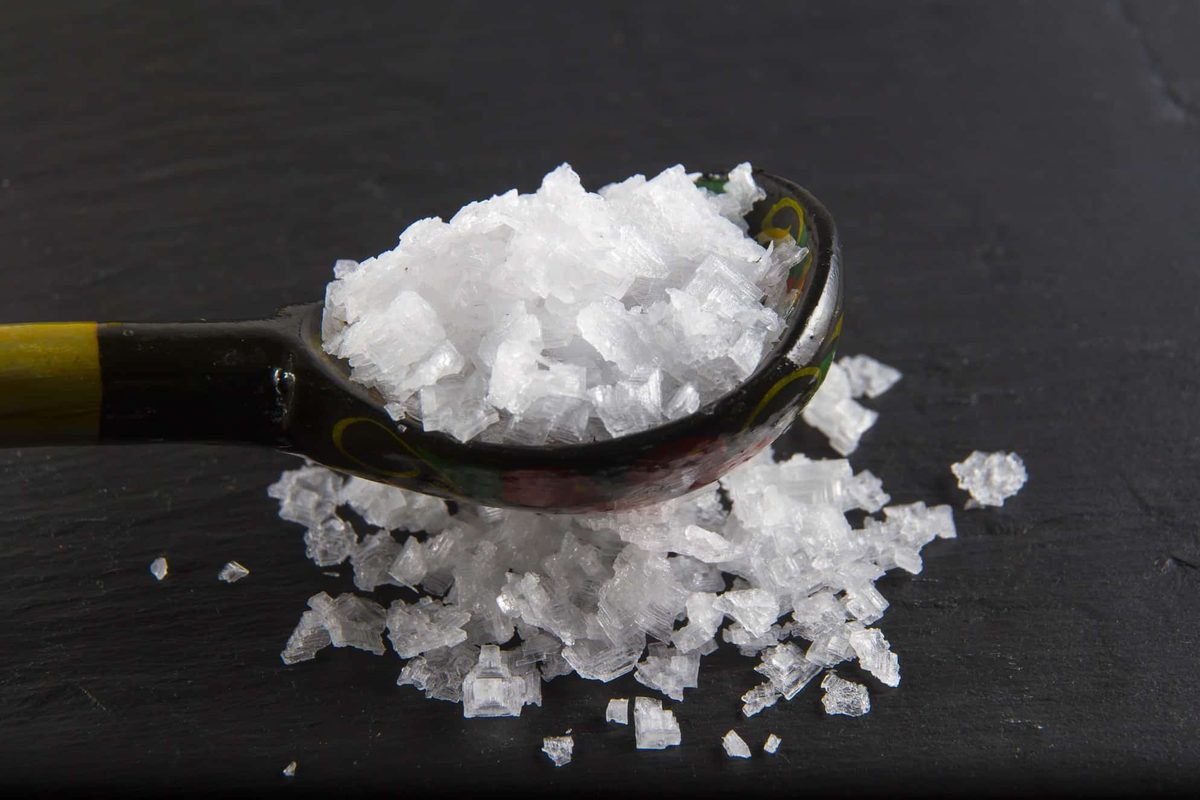
Anglesey sea salt is a flaky white sea salt made from the water of the Menai Strait, the channel between the Isle of Anglesey and mainland Wales.1 Sold under the producer’s name Halen Môn, it has been a Protected Designation of Origin since 2014, which means a published specification fixes where and how it may be made and what it may contain.12 Most cooks use it as a finishing salt, for its soft, crisp flakes.
At a glance
| What it is | Sea salt evaporated from Menai Strait seawater1 |
| Producer | The Anglesey Sea Salt Company Limited / Halen Môn1 |
| Protection | Protected Designation of Origin; EU registration 15 January 2014, UK scheme from 31 December 20202 |
| Form | Crystalline white, flat, soft flakes, no larger than 2 cm across at grading1 |
| Grades | Coarse, fine and ground1 |
| Composition (specification) | Over 90% sodium chloride, under 4% water, 0.08 to 0.15% calcium, at least 0.2% magnesium1 |
| Additives | None; additive free1 |
Measured values
12 figures, sourced| Measure | Value | Scope | Source |
|---|---|---|---|
| Sodium chloride Limit | over 90 % | PDO product specification | assets.publishing.service.gov.uk |
| Water (moisture) Limit | under 4 % | PDO product specification | assets.publishing.service.gov.uk |
| Calcium Limit | 0.08 to 0.15 % | PDO product specification | assets.publishing.service.gov.uk |
| Magnesium Limit | at least 0.2 % | PDO product specification | assets.publishing.service.gov.uk |
| Lead, maximum Limit | less than 2 mg/kg | PDO product specification | assets.publishing.service.gov.uk |
| Arsenic, maximum Limit | less than 0.5 mg/kg | PDO product specification | assets.publishing.service.gov.uk |
| Cadmium, maximum Limit | less than 0.5 mg/kg | PDO product specification | assets.publishing.service.gov.uk |
| Mercury, maximum Limit | less than 0.1 mg/kg | PDO product specification | assets.publishing.service.gov.uk |
| Copper, maximum Limit | less than 2 mg/kg | PDO product specification | assets.publishing.service.gov.uk |
| Tin, maximum Limit | less than 200 mg/kg | PDO product specification | assets.publishing.service.gov.uk |
| Iodine, maximum Limit | up to 1 mg/kg | PDO product specification | assets.publishing.service.gov.uk |
| Sodium Nutrient | about 40 % by weight (most sea salts) | most sea salts generally (American Heart Association); not a measurement of Anglesey salt | heart.org |
Each figure is quoted as its source states it, with the samples or standard it applies to. Where sources differ, both are shown; nothing is averaged. All measured values
Where it comes from
The Isle of Anglesey sits off the northwest coast of Wales; the 2021 census counted around 68,900 residents, down from just under 69,800 in 2011.3 The Menai Strait is the strip of water separating it from the mainland.1
The specification argues that the water itself is the point. It describes the strait as served by the Gulf Stream, with no large cities or heavy industry on its banks, and says that a sandbank and a mussel bank naturally filter the seawater before it is drawn in.1 It also notes that shellfish draw calcium out of the seawater during the growing season.1
How it is made
The specification sets out the method:1
- Seawater is drawn from the Menai Strait after passing the sandbank and mussel bank, then run through sand, carbon and spun polypropylene filters.
- It is concentrated in a seawater vacuum evaporator and flows into a saturator tank.
- In the crystallizing tanks, gas heaters above the brine concentrate it further at 50 to 65 °C for a maximum of 23 hours, and crystals form on the surface.
- The flakes are harvested by hand, scooped out with a shovel, and rinsed by hand in concentrated brine.
- The salt is dried in a low-temperature oven at 85 °C to under 4% moisture.
At no point may rock salt or other sea salt be added.1
Flavor and texture
The specification credits the salt with a clean taste without the bitterness that excess calcium can cause, and caps calcium at 0.08 to 0.15%.1 Its flakes are flat and soft and give a light crunch between the teeth. That last description is ours.
The specification also says the salt contains over 30 trace elements, and sets maximum levels for several of them:1
| Element | Specification limit |
|---|---|
| Lead | Less than 2 mg/kg |
| Arsenic | Less than 0.5 mg/kg |
| Cadmium | Less than 0.5 mg/kg |
| Mercury | Less than 0.1 mg/kg |
| Copper | Less than 2 mg/kg |
| Tin | Less than 200 mg/kg |
| Zinc | Trace |
| Iodine | Up to 1 mg/kg |
These are ceilings set by the specification, not measured averages. See Health below for what health authorities say about the minerals in sea salt.
History
According to the specification, the first records of salt making on Anglesey date from Roman times, salt making on the island peaked in the early 18th century, and it closed down in the 18th century because rock salt was being added to strengthen the brine, which was seen as adulteration.1 The remains of a salt works survive at Holyhead in the north of the island.1 The specification does not say where that rock salt came from; the often-repeated claim that it was Cheshire rock salt is not in any source we found.
The present salt works, Halen Môn, was started at Brynsiencyn in 1997.1 A widely repeated claim that production resumed in the 1970s is not supported by the specification.
Protected status
The name “Anglesey Sea Salt / Halen Môn” was registered as a Protected Designation of Origin with the EU on 15 January 2014 and, after Brexit, under the UK scheme on 31 December 2020, in product class 2.6, salt.2 The producer notes that the UK scheme protects the name in Great Britain and the EU scheme protects it in Northern Ireland and the EU.4
The specification describes an additive-free salt and does not mention smoked or flavored versions.1
How to use it
Anglesey sea salt is mainly a finishing salt: crumble the flakes over steak, roast vegetables, salads, eggs, buttered bread or chocolate desserts just before serving, where the texture is part of the point. Fine and ground grades work for everyday cooking. That is common practice, not a sourced rule. Flakes are bulkier than fine salt, so in baking, measure by weight or follow the recipe’s salt type rather than swapping spoon for spoon. For the general principles, see cooking with sea salt.
Buying and storage
Look for the protected name “Anglesey Sea Salt / Halen Môn”; the specification is what defines it.1 Salt does not spoil. Keep flakes in a closed container in a dry place so they stay crisp. That storage advice is common practice.
Health
Most sea salts are about 40% sodium by weight, like table salt, and the American Heart Association says sea salt may carry trace minerals such as magnesium, potassium and calcium but that total sodium intake is what matters most for heart health.5 FDA sets the Daily Value for sodium at less than 2,300 mg a day,6 and WHO recommends that adults eat less than 2,000 mg of sodium a day.7 Anglesey sea salt counts toward those limits like any other salt.
The specification allows up to 1 mg/kg of iodine and no additives,1 so this is not an iodized salt.
Related salts and comparisons
- Sea salt
- Maldon sea salt and fleur de sel vs. Maldon salt
- Fleur de sel
- Celtic sea salt
- Smoked sea salt
- Table salt vs. sea salt
- Himalayan salt vs. sea salt
- Sea salt substitutes
- Too much sea salt
Footnotes
-
Anglesey Sea Salt / Halen Môn, PDO product specification, GOV.UK. assets.publishing.service.gov.uk · Regulator ↩ ↩2 ↩3 ↩4 ↩5 ↩6 ↩7 ↩8 ↩9 ↩10 ↩11 ↩12 ↩13 ↩14 ↩15 ↩16 ↩17 ↩18 ↩19 ↩20 ↩21
-
Anglesey Sea Salt / Halen Môn, protected food name register entry, GOV.UK. gov.uk · Regulator ↩ ↩2 ↩3
-
“How life has changed in Isle of Anglesey: Census 2021”, Office for National Statistics. ons.gov.uk · Regulator ↩
-
“Protected by Law”, Halen Môn. halenmon.com · Merchant ↩
-
“Sodium Sources: Where Does All That Sodium Come From?”, American Heart Association, 2025. heart.org · Publication ↩
-
“Sodium in Your Diet”, US Food and Drug Administration. fda.gov · Regulator ↩
-
“Sodium reduction”, World Health Organization, 2026. who.int · Regulator ↩