Spice Substitutes · Substitutes
Gomasio Substitutes: Make It in Minutes, or Use These Sesame Blends
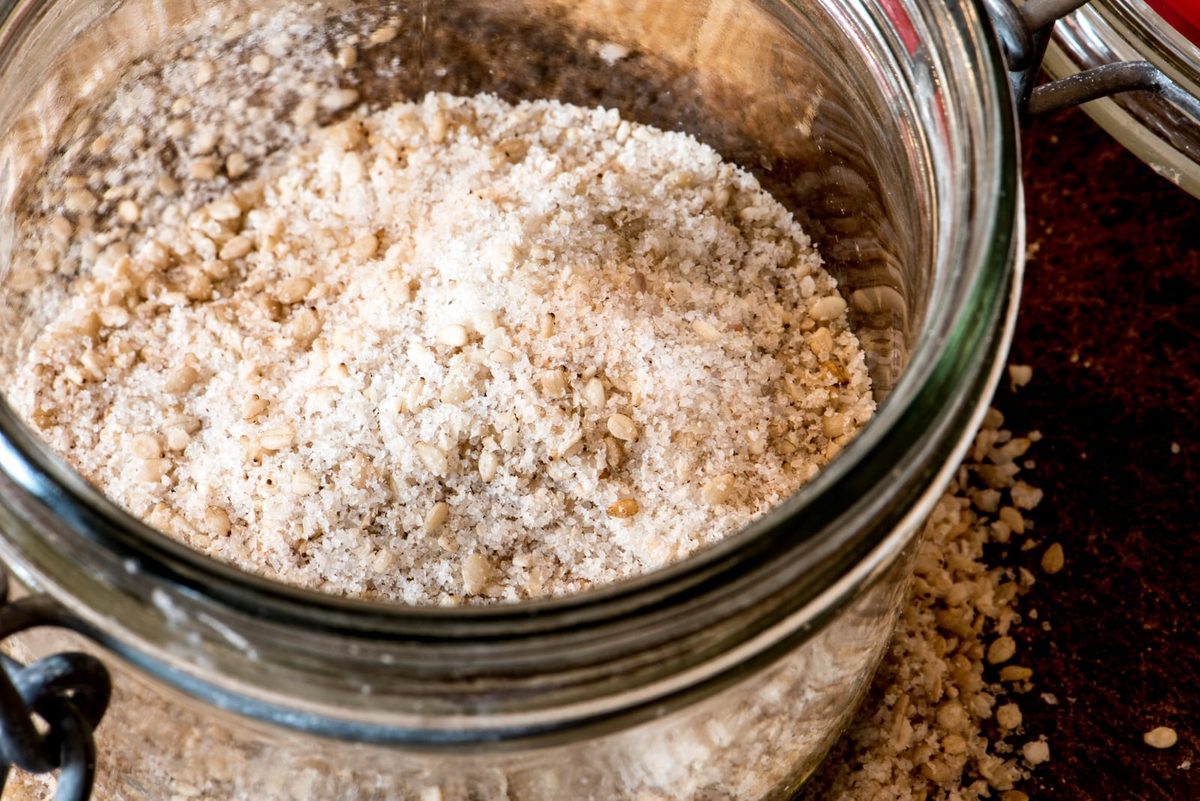
Gomasio, or gomashio (ごま塩, “sesame salt”), is toasted sesame seed mixed with salt, a basic Japanese table seasoning for plain rice and an essential topping for the red-bean rice sekihan.1 With only two ingredients, the best substitute is almost always to make it, which takes a few minutes in a dry pan. If you can’t, the other options trade one of gomasio’s two jobs, salt and toasted sesame, for flavors of their own.
Quick answer
| What gomasio is doing | Best substitute | Starting amount | Treatment |
|---|---|---|---|
| Nutty, lightly salty topping for rice, vegetables, eggs | Homemade gomasio | 10 parts toasted sesame to 1 part salt by weight, then taste | Disputed |
| The same, needed right now | Toasted sesame seeds plus table salt | 1 tablespoon seeds plus 1/8 teaspoon salt per tablespoon of gomasio | Method (from Disputed ratios) |
| A rice topping with more flavor | Furikake | Same amount, then taste | Method |
| Sesame crunch with heat, for noodles and hot pots | Shichimi togarashi, plus a pinch of salt | A small pinch; it is much hotter | Method |
| Sesame and salt with herbs, for flatbread, eggs, vegetables | Za’atar | Same amount, then taste | Method |
How the ratios on this page are labeled
- Computed: based on a measurable physical relationship, with the source named.
- Attributed: a named source publishes this ratio. We quote it as theirs.
- Disputed: named sources give different answers to the same swap. We show each one and do not average them.
- Method: we found no published ratio. We give a direction and a cautious starting point, and say so.
If gomasio is a nutty, salty topping
1. Make your own gomasio
Ratio (Disputed): Published recipes don’t agree on the proportion of sesame to salt:
| Source | Sesame : salt | Basis |
|---|---|---|
| JustBento (Makiko Itoh), describing commercial gomashio | 8 : 1, “usually” | Weight1 |
| JustBento, Itoh’s own recipe | 10 : 1 (100 g sesame to 10 g salt) | Weight1 |
| Gernot Katzer’s Spice Pages | About 10% salt | Not stated2 |
| Gourmandelle (Ruxandra Niță), macrobiotic recipe | 18 : 1, with 10 : 1 for a saltier result | Tablespoons (volume)3 |
Weight and volume ratios are not interchangeable, so compare like with like. Method starting point: begin at 10 to 1 by weight, the middle of the weight-based figures, and taste on rice.
How to make it. The two published methods differ. Itoh dissolves the salt in water and toasts the raw seeds in that brine over medium-low heat until they start to pop, so each whole seed is coated with salt; she advises against grinding the seeds, because ground seeds release oils that go rancid quickly.1 Gourmandelle’s macrobiotic method toasts the salt in a dry pan, toasts the seeds until they start to crack, then grinds the two together lightly in a mortar or a suribachi, a Japanese mortar.3 Either way, the mix must be completely dry before it goes into a jar.1
Why toasting matters. Toasting is what makes sesame taste like gomasio. Katzer reports that pyrazines dominate the flavor of sesame toasted under mild conditions (160 °C) and that some of its aroma compounds form only during toasting.2 Untoasted seeds will give crunch but little of that roasted flavor. Milk Street prefers unhulled seeds, which it describes as larger, plumper and nuttier.4
2. Toasted sesame seeds and salt, unmixed
If you don’t want to make a jar, toast a spoonful of seeds in a dry pan and salt the food separately.
Amount (Method, worked from the Disputed ratios): USDA’s FoodData Central puts a tablespoon of whole dried sesame seeds at 9 grams,5 and ATK weighs a teaspoon of table salt at about 6 grams regardless of brand.6 At Itoh’s 10 to 1 by weight, a tablespoon of seeds goes with 0.9 gram of salt, about 1/7 teaspoon of table salt; at the 8 to 1 she gives for commercial gomashio, about 1.1 grams, or 1/5 teaspoon. Start with 1/8 teaspoon of table salt per tablespoon of seeds, the low end, and add more to taste. Those figures are our arithmetic, and the seed weight is for untoasted seeds.
If you want a rice topping with more flavor
Furikake
Itoh calls gomashio the most basic furikake, the family of dry Japanese rice toppings.1 A common furikake goes further: Namiko Hirasawa Chen’s contains bonito flakes, toasted sesame seeds, nori seaweed, sugar and salt.7 It suits plain rice and onigiri,7 the same places gomasio goes, but it is sweeter and tastes of fish and seaweed. In Itoh’s homemade noritama, the bonito flakes give most of the flavor.8 Furikake in its current form dates to the early 20th century, when it was invented as a nutritional supplement, according to Chen.7
Ratio (Method): Start with the same amount and taste. Salt levels vary by recipe and brand; Itoh describes her own noritama as lower on salt.8
Check the label if you are cooking for someone with allergies. Fish, soybeans and sesame are all major food allergens in the US,9 and furikake can contain all three.
If you want sesame crunch with heat
Shichimi togarashi
Shichimi togarashi, Japanese seven-spice, varies by maker, but chile, sansho pepper and sesame are its standard ingredients.1011 Chen’s list adds hemp seeds among others.11 It is a table condiment for noodles and hot dishes: Chen names ramen, udon, soba, gyudon, tonjiru and yakitori.11
It is a different seasoning from gomasio. It is hot where gomasio is mild, and it may carry no salt at all: Shichimiya Honpo’s ingredient list, for example, is chile, white and black sesame, sansho, aonori, green shiso and hemp seed.12
Ratio (Method): Use a small pinch where you would use a spoonful of gomasio, and salt the food separately. No published ratio exists for this swap.
If you want sesame and salt with herbs
Za’atar
Za’atar recipes share gomasio’s sesame and often its salt, with herbs and sour sumac on top. UC Cooperative Extension describes the basic blend as sumac, thyme, oregano and sesame seeds.13 One version published in Fine Gardening uses 4 parts each of Origanum syriacum and roasted sesame to 1 part each of sumac and salt,14 which by our arithmetic puts salt at about a tenth of the mix, close to gomasio’s share. It tastes strongly of herbs and is tart from the sumac, so it suits flatbread, eggs and roasted vegetables better than plain rice. That is kitchen judgment.
Ratio (Method): Start with the same amount and taste. Check whether your za’atar contains salt: UC Cooperative Extension’s basic list of ingredients doesn’t include it.13
A note on salt
Gomasio is sometimes presented as a low-sodium alternative to salt. It contains less salt than the same weight of plain salt, in proportion to its ratio, but how much sodium you eat depends on how much you sprinkle. George Ohsawa, who named the macrobiotic diet, counted sesame salt among its sodium-rich foods, along with soy sauce, miso and pickles.15 Every substitute on this page except plain toasted sesame also carries salt.
What isn’t known
- There is no single gomasio ratio. Named sources range from 8 to 1 by weight to 18 to 1 by volume, and no source explains how the macrobiotic 18 to 1 figure was arrived at.
- The salt content of commercial furikake and za’atar blends varies by brand, and we found no survey of it.
- No published ratio exists for using furikake, shichimi togarashi or za’atar in place of gomasio. Each amount above is a starting point.
Related
- Gomasio and gomasio vs. furikake
- Sesame seeds, black sesame seeds, black vs. white sesame seeds and hulled vs. unhulled sesame seeds
- Furikake seasoning and furikake substitutes
- Shichimi togarashi and shichimi togarashi substitutes
- Za’atar, za’atar substitutes and sesame seed substitutes
Footnotes
-
Makiko Itoh, “Homemade furikake no. 6: Gomashio, sesame salt”, JustBento, 2008 (updated 2019). justbento.com · Publication ↩ ↩2 ↩3 ↩4 ↩5 ↩6
-
Gernot Katzer, “Sesame”, Gernot Katzer’s Spice Pages. gernot-katzers-spice-pages.com · Reference work ↩ ↩2
-
Ruxandra Niță, “How to Make Gomasio (Macrobiotic Sesame Salt)”, Gourmandelle, 2015 (updated 2026). gourmandelle.com · Publication ↩ ↩2
-
“Sesame Salt (Gomasio)”, Christopher Kimball’s Milk Street. prod.177milkstreet.com · Publication ↩
-
Seeds, sesame seeds, whole, dried (FDC ID 170150), USDA FoodData Central. fdc.nal.usda.gov · Regulator ↩
-
Levine, The Best Kosher Salt, America’s Test Kitchen, 2019. americastestkitchen.com · Publication ↩
-
Namiko Hirasawa Chen, Homemade Furikake (Rice Seasoning), Just One Cookbook. justonecookbook.com · Publication ↩ ↩2 ↩3
-
Makiko Itoh, “Homemade furikake no. 3: Noritama”, JustBento, 2007 (updated 2019). justbento.com · Publication ↩ ↩2
-
Food Allergies, U.S. Food and Drug Administration. fda.gov · Regulator ↩
-
七味唐辛子の七つ全部言える? (Japan Data), nippon.com. nippon.com · Publication ↩
-
Namiko Hirasawa Chen, Shichimi Togarashi, Just One Cookbook. justonecookbook.com · Publication ↩ ↩2 ↩3
-
京名物七味唐がらし, product page, Shichimiya Honpo. shichimiya.co.jp · Merchant ↩
-
Za’atar Spice Blend, recipe from the kitchen of MFP Laura Crowley, University of California Cooperative Extension. ccfruitandnuts.ucanr.edu · Reference work ↩ ↩2
-
Susan Belsinger, Za’atar: An Exotic Herb Blend, Fine Gardening, 2010. finegardening.com · Publication ↩
-
Nancy Stalker, “Macrobiotics”, The SAGE Encyclopedia of Food Issues, SAGE Publications, 2015. sk.sagepub.com · Reference work ↩