Spice Substitutes · Substitutes
Garlic Salt Substitutes: How Much Salt and Garlic to Use Instead
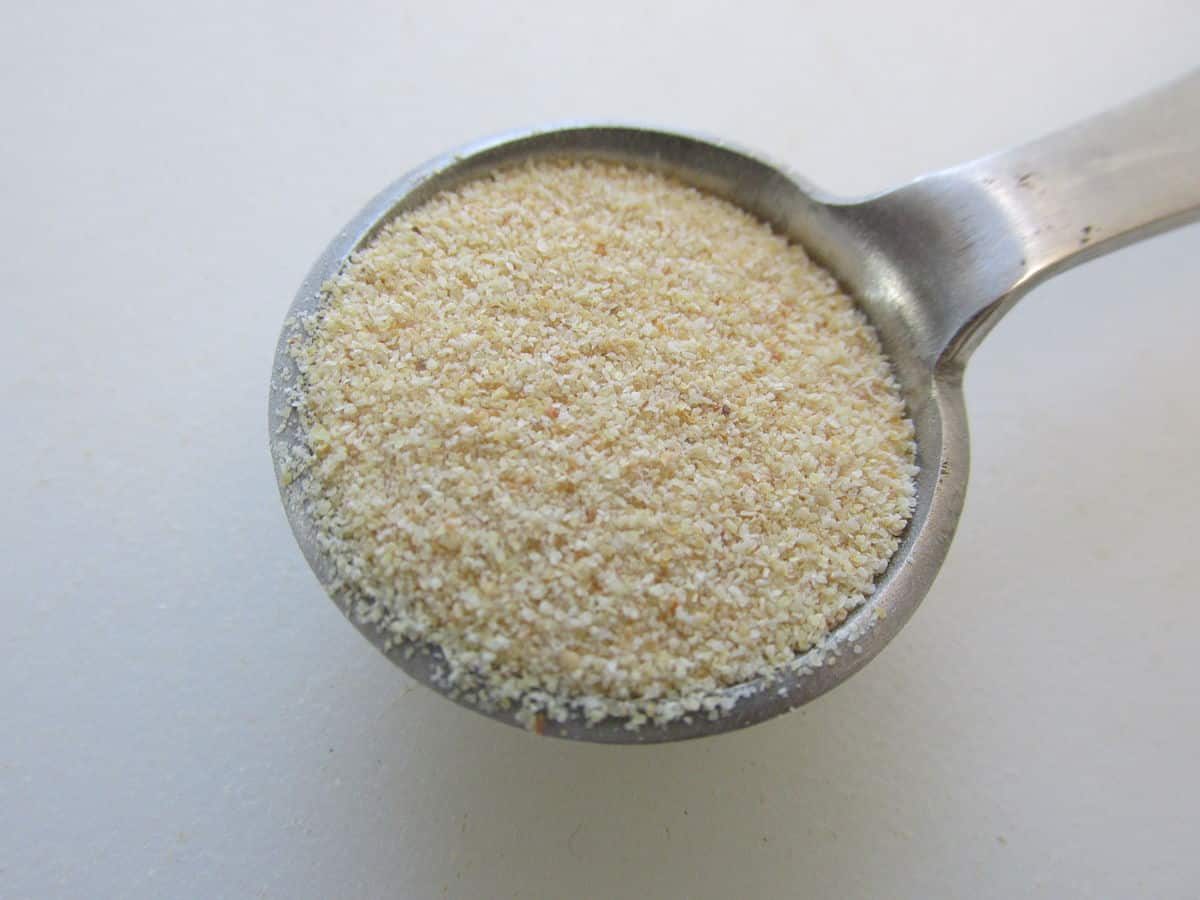
Garlic salt is mostly salt. McCormick’s lists salt, garlic, calcium silicate and garlic oil, and carries 540 mg of sodium per ¼ teaspoon,1 against 590 mg in the same measure of Morton’s iodized table salt.2 So a garlic salt substitute has two parts to get right: nearly a full measure of salt, and a modest amount of garlic. Get the salt wrong and the dish is bland or oversalted; the garlic is more forgiving. The best substitute depends on whether the dish is dry (a rub, popcorn, fries) or wet (a sauce, marinade or dressing).
Quick answer
| What garlic salt is doing | Best substitute | Per 1 teaspoon garlic salt | Treatment |
|---|---|---|---|
| Salt plus garlic in a dry use: rubs, popcorn, fries, garlic bread | Salt plus garlic powder or granulated garlic | 5/8 to 7/8 tsp table salt, by brand, and a scant 1/4 tsp garlic powder | Computed (salt) and Attributed (garlic) |
| A jar to keep on hand | Homemade garlic salt | 4 parts salt to 1 part garlic powder (UC ANR) | Attributed |
| Salt plus garlic in a wet dish: sauces, marinades, dressings | Fresh garlic and salt | 1 1/3 medium cloves (about 2/3 tsp minced), plus table salt matched to your brand | Attributed (garlic) and Computed (salt) |
| Salt plus a general savory note | Seasoned salt | Same volume, then taste | Method |
How the ratios on this page are labeled
- Computed: based on a measurable physical relationship, with the source named.
- Attributed: a named source publishes this ratio. We quote it as theirs.
- Disputed: named sources give different answers to the same swap. We show each one and do not average them.
- Method: we found no published ratio. We give a direction and a cautious starting point, and say so.
The salt figures are computed from the sodium on brand labels. They match sodium, not flavor. No label gives the proportion of salt to garlic in a commercial garlic salt, so the garlic figures come from an extension service’s home recipe and its substitution chart.
Match the salt first
Garlic salt brands differ more than you might expect. Per ¼ teaspoon, McCormick Garlic Salt has 540 mg of sodium and Lawry’s Garlic Salt with Parsley, which also contains corn starch, sugar and parsley, has 350 mg.13 Morton’s iodized table salt has 590 mg.2
Salt (Computed): For each teaspoon of garlic salt, use about this much table salt to match its sodium:
| Garlic salt you’re replacing | Sodium per teaspoon (label × 4) | Table salt to match (Morton, 2,360 mg per teaspoon) |
|---|---|---|
| McCormick Garlic Salt | 2,160 mg1 | About 7/8 teaspoon |
| Lawry’s Garlic Salt with Parsley | 1,400 mg3 | About 5/8 teaspoon |
| Brand unknown | Start at 3/4 teaspoon and taste |
Kosher and flaky salts hold less salt per spoon, because fewer large crystals fit;4 if you use one, add a little more by volume and taste.
If garlic salt is seasoning a dry dish
1. Salt plus garlic powder or granulated garlic
This is the closest substitute, because garlic salt is salt plus dried garlic.1 Powdered or dehydrated garlic is usually made from cloves sliced and dried at a low temperature,5 which is the same kind of garlic that goes into the jar.
Garlic (Attributed): Two extension sources put the garlic in a teaspoon of garlic salt at roughly the same amount. UC Agriculture and Natural Resources’ home recipe is 4 parts salt to 1 part garlic powder,6 which puts about 1/5 teaspoon of garlic powder in each teaspoon of the mix. NDSU Extension treats 3/4 teaspoon of garlic salt and 1/8 teaspoon of garlic powder as each equal to one clove of garlic,7 which works out to about 1/6 teaspoon of powder per teaspoon of garlic salt. Those two figures are our arithmetic from each source’s own numbers. Use a scant 1/4 teaspoon of garlic powder with the salt from the table above.
If your recipe is a rub or a garlic butter, there is a way to get more out of the powder. America’s Test Kitchen found that garlic powder straight from the jar has not developed its full flavor, and that mixing it with water first activates alliin and the enzyme alliinase to create allicin.8 Stir the powder into an equal amount of water, or into the dish’s butter or liquid, before using it.
2. Homemade garlic salt
Ratio (Attributed): UC Agriculture and Natural Resources gives 4 parts salt to 1 part garlic powder, blended for 1 to 2 seconds.6 By our arithmetic from the Morton label, a teaspoon of that blend made with table salt carries about 1,900 mg of sodium, between the McCormick and Lawry’s figures above. Pack it in an airtight container, as UC ANR advises for dried garlic.6
You can make it more garlicky by changing the ratio, but then the blend no longer matches a store-bought garlic salt one for one. Use it by taste rather than by the recipe’s measure.
If garlic salt is seasoning a wet dish
Fresh garlic and salt
In sauces, marinades, soups and dressings, fresh garlic works well and dissolves into the liquid.
Garlic (Attributed): NDSU Extension equates 3/4 teaspoon of garlic salt with one medium clove of garlic or 1/2 teaspoon of minced fresh garlic.7 Per teaspoon of garlic salt, that is about 1 1/3 medium cloves, or 2/3 teaspoon minced.
Salt (Computed): Add the salt from the table above, about 7/8 teaspoon of table salt per teaspoon of McCormick’s garlic salt. Leaving it out is the most common way this swap goes wrong.
Fresh garlic does not taste like dried. In garlic, alliinase acts on alliin to create allicin when the clove is cut or crushed, and heat inactivates the enzyme.5 ATK found that how you cut garlic changes its strength, and that minced garlic left to sit keeps developing stronger flavors.9 Expect a sharper, fresher garlic note than garlic salt gives. Mashing the minced garlic with the measured salt on a cutting board into a paste helps it disappear into a sauce; that is common kitchen practice, not a tested method.
If you want a ready-made shaker
Seasoned salt
Seasoned salt is another salt-first blend that contains garlic, but with much else. Lawry’s The Original Seasoned Salt lists salt, sugar, spices including paprika, celery seed and turmeric, onion, corn starch and garlic, and carries 380 mg of sodium per ¼ teaspoon.10 It will add color, sweetness and onion along with the garlic.
Ratio (Method): Start with the same volume and taste. The sodium is close to that of the garlic salts above, but the flavor is different, so it suits burgers, fries and roast potatoes better than garlic bread.
What doesn’t work as well
- Garlic juice. Bottled garlic juice and salt can season a marinade, but we found no published ratio for replacing garlic salt with it. A widely repeated figure, 2 teaspoons of garlic juice and 2/3 teaspoon of salt per teaspoon of garlic salt, has no source we could find. If you use it, add the salt from the table above and add the juice a little at a time.
- Homemade garlic oil left out overnight. Garlic in oil is a botulism risk. UC ANR says not to store garlic in oil at room temperature, and to refrigerate garlic in oil for no more than 4 days or freeze it.6 Commercial garlic-in-oil products are made under strict guidelines.6 If you want garlic oil for a dressing, make it the day you use it and refrigerate any leftovers, or buy a commercial one. Salt does not dissolve in oil, so add it separately.
What isn’t known
- No garlic salt label gives its ratio of salt to garlic, so the garlic amounts on this page come from UC ANR’s home recipe and NDSU’s substitution chart, not from a commercial product.
- No published comparison of the flavor strength of garlic salt against fresh garlic, garlic juice or garlic oil was found.
- Sodium differs by brand. The two brands checked here differ by about 54 percent per ¼ teaspoon, so check your label.13
Related
- Garlic salt, garlic powder and garlic
- Garlic powder vs. garlic salt, granulated garlic vs. garlic powder and garlic powder vs. fresh garlic
- Garlic powder substitutes and fresh garlic substitutes
- Seasoned salt, onion salt and onion salt substitutes
- Too much garlic powder, too much garlic and too much salt
Footnotes
-
McCormick Garlic Salt, label ingredients and Nutrition Facts as listed by Stop & Shop. stopandshop.com · Merchant ↩ ↩2 ↩3 ↩4 ↩5
-
Morton Iodized Table Salt, Nutrition Facts, Morton Salt. mortonsalt.com · Merchant ↩ ↩2
-
Lawry’s Garlic Salt with Parsley, label ingredients and Nutrition Facts as listed by Stop & Shop. stopandshop.com · Merchant ↩ ↩2 ↩3
-
Sodium Sources: Where Does All That Sodium Come From?, American Heart Association, 2025. heart.org · Reference work ↩
-
Garlic, Linus Pauling Institute, Oregon State University. lpi.oregonstate.edu · Reference work ↩ ↩2
-
Linda J. Harris, Garlic: Safe Methods to Store, Preserve, and Enjoy, UC Agriculture and Natural Resources, 2016. ccfruitandnuts.ucanr.edu · Reference work ↩ ↩2 ↩3 ↩4 ↩5
-
Julie Garden-Robinson, Ingredient Substitutions, NDSU Extension, 2018. ksre.ksu.edu · Reference work ↩ ↩2
-
Carolyn Grillo, For Great Garlic Bread, Hydrate Your Garlic Powder First, America’s Test Kitchen, 2021. americastestkitchen.com · Publication ↩
-
The Strength of Garlic’s Flavor Depends on How You Cut It, America’s Test Kitchen. americastestkitchen.com · Publication ↩
-
Lawry’s The Original Seasoned Salt, label ingredients and Nutrition Facts as listed by ShopRite. shoprite.com · Merchant ↩