Spices · Profile
Tellicherry Pepper: What the Name Means, How It’s Graded and How It Tastes
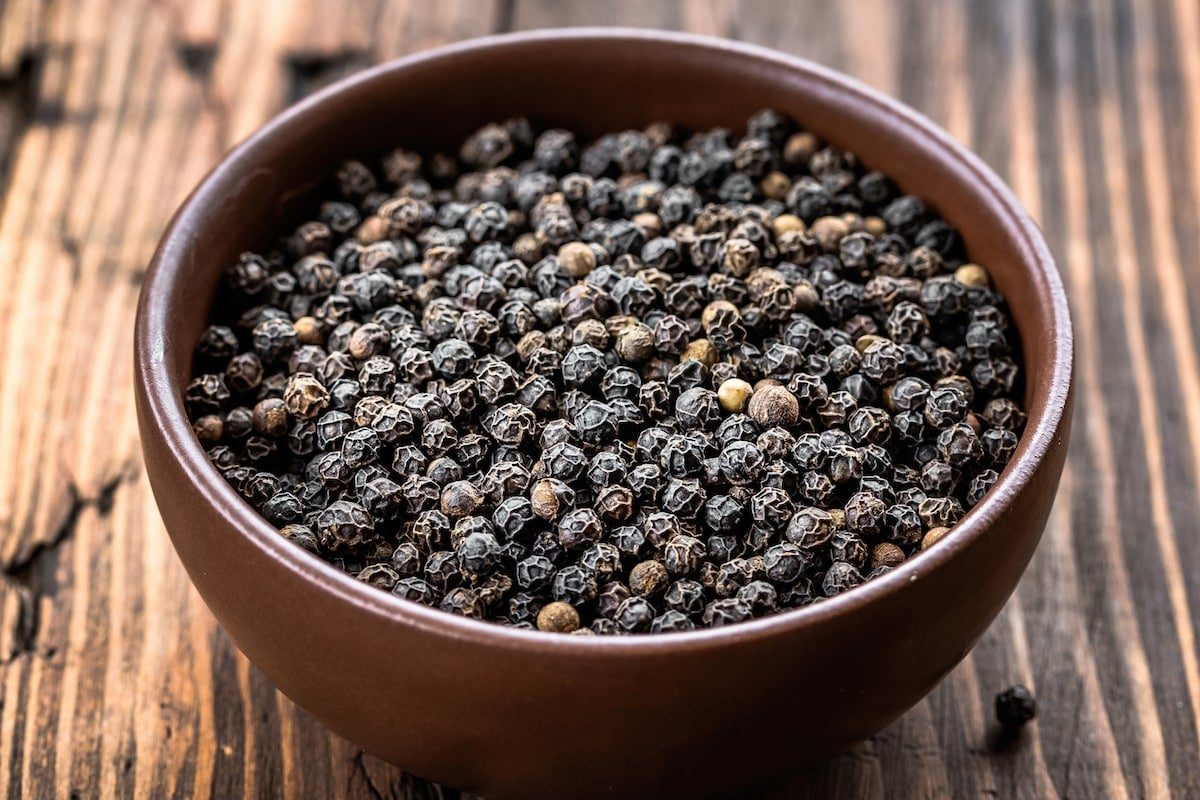
Tellicherry pepper is black pepper, Piper nigrum, sold under the name of a port on India’s Malabar Coast.12 The name has come to mean two things at once: an origin (pepper from the Malabar region of Kerala) and a size grade (the largest berries, sorted by sieve). Neither meaning is defined by an international standard, which is why it pays to read the full grade on the bag. This page covers where the name comes from, what the grades mean, what the evidence says about its flavor, and how to use it.
At a glance
| What it is | Whole black pepper, Piper nigrum, sold under an origin and grade name23 |
| Plant family | Piperaceae4 |
| Named for | Tellicherry, now Thalassery, a port in northern Kerala on the Malabar Coast1 |
| Example grade | TGSEB, “Tellicherry Garbled Special Extra Bold”: berries at least 4.75 mm across, per one seller3 |
| International grades | Codex CXS 326-2017 grades black pepper by density, light berries, oil and piperine; it does not mention Tellicherry5 |
| Flavor reputation | “Highest quality and most flavorful,” per McCormick Science Institute (an opinion, not a measurement)2 |
| Indian pepper output | 104,751 tonnes in 2024-25 (all pepper, all grades)6 |
Measured values
26 figures, sourced| Measure | Value | Scope | Source |
|---|---|---|---|
| Bulk density, minimum Limit | 550 g/L | Codex CXS 326-2017, whole black pepper (any trade name; Tellicherry not mentioned), Grade I | fao.org |
| Bulk density, minimum Limit | 500 g/L | Codex CXS 326-2017, whole black pepper (any trade name; Tellicherry not mentioned), Grade II | fao.org |
| Bulk density, minimum Limit | 400 g/L | Codex CXS 326-2017, whole black pepper (any trade name; Tellicherry not mentioned), Grade III | fao.org |
| Light berries, maximum Limit | 2.0 % | Codex CXS 326-2017, whole black pepper (any trade name; Tellicherry not mentioned), Grade I | fao.org |
| Light berries, maximum Limit | 5.0 % | Codex CXS 326-2017, whole black pepper (any trade name; Tellicherry not mentioned), Grade II | fao.org |
| Light berries, maximum Limit | 10.0 % | Codex CXS 326-2017, whole black pepper (any trade name; Tellicherry not mentioned), Grade III | fao.org |
| Pinheads, maximum Limit | 1.0 % | Codex CXS 326-2017, whole black pepper (any trade name; Tellicherry not mentioned), Grade I | fao.org |
| Pinheads, maximum Limit | 2.0 % | Codex CXS 326-2017, whole black pepper (any trade name; Tellicherry not mentioned), Grade II | fao.org |
| Pinheads, maximum Limit | 4.0 % | Codex CXS 326-2017, whole black pepper (any trade name; Tellicherry not mentioned), Grade III | fao.org |
| Moisture, maximum Limit | 12.0 % | Codex CXS 326-2017, whole black pepper (any trade name; Tellicherry not mentioned), Grade I | fao.org |
| Moisture, maximum Limit | 12.0 % | Codex CXS 326-2017, whole black pepper (any trade name; Tellicherry not mentioned), Grade II | fao.org |
| Moisture, maximum Limit | 13.0 % | Codex CXS 326-2017, whole black pepper (any trade name; Tellicherry not mentioned), Grade III | fao.org |
| Volatile oil, minimum Limit | 2.0 mL/100 g, dry basis | Codex CXS 326-2017, whole black pepper (any trade name; Tellicherry not mentioned), Grade I | fao.org |
| Volatile oil, minimum Limit | 1.5 mL/100 g, dry basis | Codex CXS 326-2017, whole black pepper (any trade name; Tellicherry not mentioned), Grade II | fao.org |
| Volatile oil, minimum Limit | 1.0 mL/100 g, dry basis | Codex CXS 326-2017, whole black pepper (any trade name; Tellicherry not mentioned), Grade III | fao.org |
| Piperine, minimum Limit | 3.5 %, dry basis | Codex CXS 326-2017, whole black pepper (any trade name; Tellicherry not mentioned), Grade I | fao.org |
| Piperine, minimum Limit | 3.0 %, dry basis | Codex CXS 326-2017, whole black pepper (any trade name; Tellicherry not mentioned), Grade II | fao.org |
| Piperine, minimum Limit | 2.0 %, dry basis | Codex CXS 326-2017, whole black pepper (any trade name; Tellicherry not mentioned), Grade III | fao.org |
| Berry diameter, minimum (TGSEB grade) | 4.75 mm | "Tellicherry Garbled Special Extra Bold", as defined by one seller (Pure Indian Foods) for its own productOne seller's definition; the official 1969 Indian grading rules could not be opened, and IS 1798:2010 removed whole-pepper grades. Company's own figures. | pureindianfoods.com |
| Vitamin K Nutrient | 164 µg per 100 g | USDA FoodData Central, spices, pepper, black, ground (FDC ID 170931, SR Legacy); not specific to Tellicherry | fdc.nal.usda.gov |
| Dietary fiber Nutrient | 25.3 g per 100 g | USDA FoodData Central, spices, pepper, black, ground (FDC ID 170931, SR Legacy); not specific to Tellicherry | fdc.nal.usda.gov |
| Iron Nutrient | 9.71 mg per 100 g | USDA FoodData Central, spices, pepper, black, ground (FDC ID 170931, SR Legacy); not specific to Tellicherry | fdc.nal.usda.gov |
| Magnesium Nutrient | 171 mg per 100 g | USDA FoodData Central, spices, pepper, black, ground (FDC ID 170931, SR Legacy); not specific to Tellicherry | fdc.nal.usda.gov |
| Calcium Nutrient | 443 mg per 100 g | USDA FoodData Central, spices, pepper, black, ground (FDC ID 170931, SR Legacy); not specific to Tellicherry | fdc.nal.usda.gov |
| Aflatoxin B1, maximum Limit | 5.0 µg/kg | EU Regulation 2023/915, pepper (fruits of Piper species, including black and white pepper) | eur-lex.europa.eu |
| Total aflatoxins, maximum Limit | 10.0 µg/kg | EU Regulation 2023/915, pepper (fruits of Piper species, including black and white pepper) | eur-lex.europa.eu |
Each figure is quoted as its source states it, with the samples or standard it applies to. Where sources differ, both are shown; nothing is averaged. All measured values
What “Tellicherry” means
There is no single official definition that covers every bag sold under the name. What the sources show:
| Source | What it says Tellicherry is |
|---|---|
| McCormick Science Institute | One of the “various grades/varieties of pepper identified by their geographic origin”; Tellicherry pepper is from India2 |
| Pure Indian Foods (a merchant, describing its own product) | TGSEB, Tellicherry Garbled Special Extra Bold: “garbled” means sorted to remove undersized berries, dust and debris, and “Special Extra Bold” means a minimum diameter of 4.75 mm; single origin, Malabar Coast, Kerala3 |
| AramcoWorld (spice writers quoted) | Grade names used by cooks are Malabar grades: Ian Hemphill prefers Malabar Garbled No. 1, which the article calls the highest grade; another writer quoted, Reshii, asks for Malabar Garbled Extra Bold7 |
| Codex CXS 326-2017 | Three grades for whole black pepper, set by bulk density, light berries, pinheads, moisture, ash, volatile oil and piperine; no origin names5 |
| Indian Standard IS 1798:2010 | The 2010 revision removed the grading of whole black pepper into grades8 |
India’s older grade names come from the Pepper Grading and Marking Rules of 1969, which a 2002 export-inspection document still cites as setting the minimum quality for each grade.9 The rules themselves could not be opened for this page, so the official sieve sizes for TGSEB, TGEB and the other Tellicherry grades are not given here. Treat the 4.75 mm figure as one seller’s definition.
So a Tellicherry label is a seller’s claim about origin, size or both. The full grade code and a stated growing region say more than the name alone.
Flavor
Good Tellicherry pepper smells strongly of pepper with resinous, woody and citrus notes, and bites hard. That description is editorial. Two sellers’ claims about it:
- McCormick Science Institute says Tellicherry is “widely considered to be the highest quality and most flavorful variety of black pepper.”2
- Pure Indian Foods describes its TGSEB pepper as “peppery, warm, nutty” with “a citrus-forward brightness.”3
No study comparing the aroma or piperine content of Tellicherry-grade pepper with smaller berries was found for this page. The compounds behind pepper’s bite (piperine) and smell (its essential oil) are the same as in any black pepper; see black pepper for what is measured.
Tellicherry, the port
The town. Britannica gives Tellicherry as the former name of Thalassery, a town and port in northern Kerala on the Malabar Coast of the Arabian Sea.1 It says the British established the town in 1683 for the pepper and cardamom trade, as their first settlement on the Malabar Coast; a fort followed in 1708, and Hyder Ali of Mysore attacked it unsuccessfully in 1781.1 Thalassery remains a major port for exporting pepper, coffee, sandalwood and coconuts.1
What could not be confirmed. Several details often told about the town did not appear in any source checked for this page: that its name means “head office” in Malayalam, that it sat near a French military base, that the East India Company let pepper be traded there duty-free, that the Company ran the world’s largest cinnamon plantation nearby, and the dates of its lighthouse and warehouse. They are left out.
The older pepper trade. Malabar was “pepper country” to the Moroccan traveler Ibn Battuta, who described merchants from China, Java, Sri Lanka, the Maldives, Yemen and Persia gathering at the harbor of Kozhikode, and AramcoWorld credits Arab traders with helping Calicut grow before the Portuguese arrived.7 Black peppercorns were inserted into the nasal cavity of the mummy of the pharaoh Ramesses II, according to a 2024 review of spices in the ancient world citing a 1985 study.10 Vasco da Gama reached India by sailing around Africa at the end of the 15th century,7 and Britannica notes that pepper often served as a medium of exchange.11
Claims that Arab traders controlled the Malabar pepper trade from 1500 BCE, and that their settlement explains the region’s Muslim population, could not be traced to a source checked for this page.
Production
McCormick Science Institute lists the largest black pepper producers in 2022 as Vietnam, Indonesia, Brazil, India, Burkina Faso and Malaysia, citing a secondary compilation.2 AramcoWorld reported in 2021 that Vietnam, Brazil and Indonesia together grow more than 60% of the world’s pepper.7 India’s Spices Board reports 104,751 tonnes of pepper in 2024-25 (final) and an advance estimate of 93,716 tonnes for 2025-26.6 No figure was found for how much of India’s crop is sold as Tellicherry grade.
How to use it
Use Tellicherry pepper anywhere you use black pepper. Buying it whole and grinding it fresh is the usual kitchen advice for any black pepper. As kitchen practice:
- At the table and to finish, ground over eggs, steak, pasta and salads.
- Cracked, for a pepper crust on steak; see cracked vs. ground black pepper and best spices for steak.
- In blends such as lemon pepper.
Large berries may not feed evenly through small or cheap grinders; that is kitchen judgment. If a dish ends up over-peppered, see too much pepper.
Buying and quality
Codex sets three grades for whole black pepper, whatever its trade name:5
| Requirement | Grade I | Grade II | Grade III |
|---|---|---|---|
| Bulk density, minimum (g/L) | 550 | 500 | 400 |
| Light berries, maximum (%) | 2.0 | 5.0 | 10.0 |
| Pinheads, maximum (%) | 1.0 | 2.0 | 4.0 |
| Moisture, maximum (%) | 12.0 | 12.0 | 13.0 |
| Volatile oil, minimum (mL/100 g dry basis) | 2.0 | 1.5 | 1.0 |
| Piperine, minimum (% dry basis) | 3.5 | 3.0 | 2.0 |
Retail jars rarely state these values. In practice, a shopper can look for the full grade (for example TGSEB rather than just “Tellicherry”), a stated origin, and berries that look uniform in size, dark and wrinkled, with little dust. That is kitchen judgment.
Storage
Keep whole peppercorns airtight, dark and cool, and grind as needed. No shelf-life figure for whole or ground black pepper from a regulator or standards body was found; figures that circulate online could not be traced.
Nutrition and health
USDA FoodData Central’s entry for ground black pepper (not specific to Tellicherry) gives 1 tablespoon as 6.9 g and 1 teaspoon as 2.3 g.12 Per tablespoon, that works out to:
| Nutrient | Per 100 g12 | Per 1 tbsp (6.9 g), computed | % Daily Value per tbsp13 |
|---|---|---|---|
| Vitamin K | 164 µg | about 11 µg | about 9% (DV 120 µg) |
| Dietary fiber | 25.3 g | about 1.7 g | about 6% (DV 28 g) |
| Iron | 9.71 mg | about 0.67 mg | about 4% (DV 18 mg) |
| Magnesium | 171 mg | about 12 mg | about 3% (DV 420 mg) |
| Calcium | 443 mg | about 31 mg | about 2% (DV 1,300 mg) |
A tablespoon is far more pepper than most people eat in a meal; a typical pinch supplies a small fraction of these amounts.
Piperine and curcumin. The widely repeated “2000 percent” figure comes from a 1998 study in which 20 mg of piperine taken with 2 g of curcumin increased curcumin’s bioavailability in human volunteers by 2000%.14 It is a finding about curcumin supplements, not about pepper improving the absorption of food or drugs in general. NCCIH says combining curcumin with piperine is one way to improve curcumin’s bioavailability, and cautions that highly bioavailable curcumin formulations may harm the liver.15 See turmeric.
Britannica notes that pepper has a limited medicinal use as a carminative (to relieve gas).11 Claims that Tellicherry pepper improves digestion by boosting stomach acid, enhances brain function or breaks down fat cells were not supported by any source reviewed for this page. No claim is made here that it treats or prevents any disease.
Safety
- Mycotoxins (EU). EU law caps aflatoxin B1 at 5.0 µg/kg and total aflatoxins at 10.0 µg/kg in pepper, defined as the fruits of Piper species including black and white pepper.16
- Salmonella. Black pepper has been linked to Salmonella outbreaks; see black pepper for the record.
Substitutes and comparisons
- Tellicherry pepper substitutes
- Tellicherry vs. black pepper
- Other named peppers: Malabar pepper, Lampong pepper, Kampot pepper
- The same vine: black pepper, green peppercorns, white peppercorns
Footnotes
-
“Thalassery”, Encyclopaedia Britannica. britannica.com · Reference work ↩ ↩2 ↩3 ↩4 ↩5
-
“Black Pepper”, McCormick Science Institute. mccormickscienceinstitute.com · Merchant ↩ ↩2 ↩3 ↩4 ↩5 ↩6
-
Tellicherry Special Extra Bold Peppercorns, Pure Indian Foods (product page). pureindianfoods.com · Merchant ↩ ↩2 ↩3 ↩4
-
Piper nigrum L., Plants of the World Online, Royal Botanic Gardens, Kew. powo.science.kew.org · Reference work ↩
-
Standard for Black, White and Green Peppers, CXS 326-2017, Codex Alimentarius. fao.org · Standard ↩ ↩2 ↩3
-
Spice wise area and production in India, 2021-22 to 2025-26, Spices Board India. indianspices.com · Regulator ↩ ↩2
-
Jeff Koehler, “Spice Migrations: Pepper”, AramcoWorld, 2021. aramcoworld.com · Publication ↩ ↩2 ↩3 ↩4
-
IS 1798:2010, Black Pepper, Whole and Ground, Specification, Bureau of Indian Standards. law.resource.org · Standard ↩
-
Certification of Black Pepper, Export Inspection Council of India, 2002. eicindia.gov.in · Regulator ↩
-
Matthew Adam Cobb, “Spices in the Ancient World”, 2024. repository.uwtsd.ac.uk · Reference work ↩
-
“Black pepper”, Encyclopaedia Britannica. britannica.com · Reference work ↩ ↩2
-
Spices, pepper, black (FDC 170931), USDA FoodData Central. fdc.nal.usda.gov · Regulator ↩ ↩2
-
Daily Value on the Nutrition and Supplement Facts Labels, FDA. fda.gov · Regulator ↩
-
Shoba et al., “Influence of Piperine on the Pharmacokinetics of Curcumin in Animals and Human Volunteers”, Planta Medica, 1998. thieme-connect.com · Peer-reviewed ↩
-
“Turmeric: Usefulness and Safety”, National Center for Complementary and Integrative Health, 2025. nccih.nih.gov · Regulator ↩
-
Commission Regulation (EU) 2023/915, EUR-Lex. eur-lex.europa.eu · Regulator ↩