Spice Comparisons · Comparison
Ground Cloves vs. Whole Cloves: When to Use Each, and How to Convert
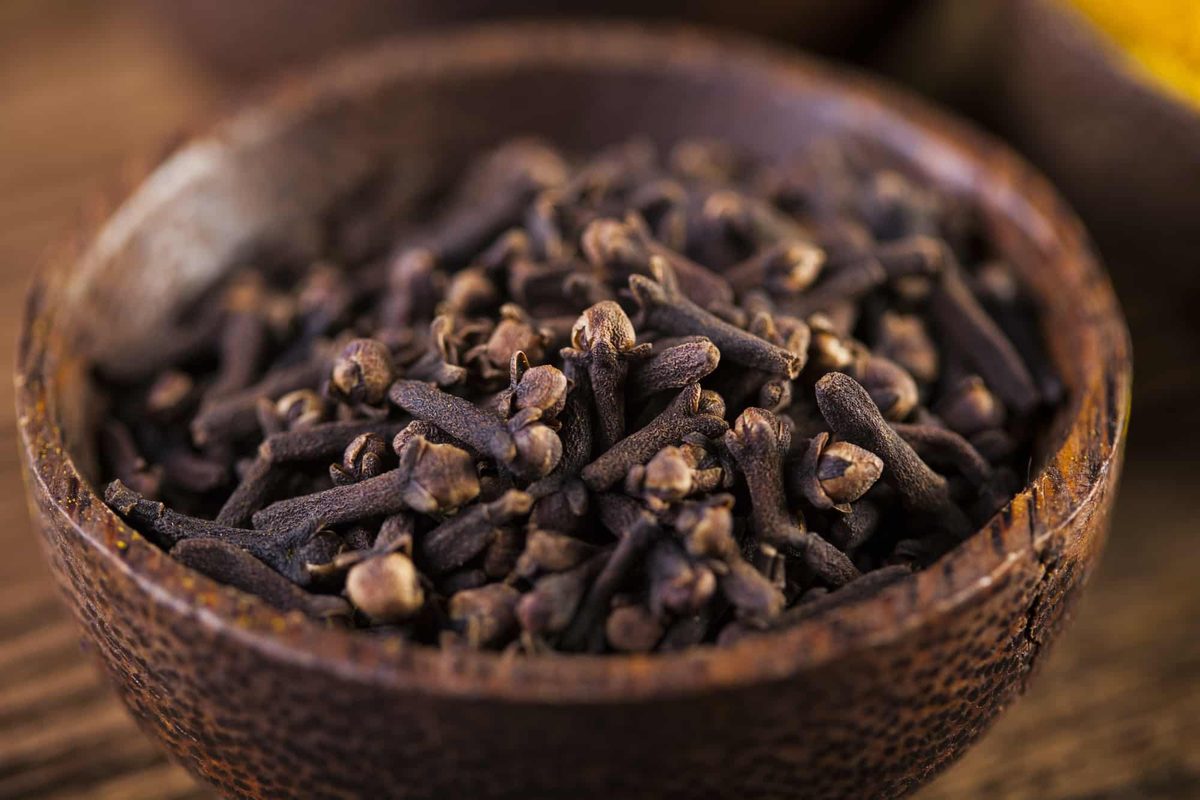
Whole and ground cloves are the same spice: the dried, unopened flower bud of Syzygium aromaticum, a tree in the myrtle family native to the Maluku islands of Indonesia.123 The difference is in how they deliver it. Whole cloves are for flavoring a liquid and being removed, or for studding a ham; ground cloves are for anything the spice has to disappear into, such as a batter, a rub or a pie filling.34 Ground cloves are also strong enough that America’s Test Kitchen uses them sparingly in baking.3
Side by side
| Whole cloves | Ground cloves | |
|---|---|---|
| What it is | The dried flower bud; PROSEA says the whole flower cluster is picked just before the first buds open5 | The same buds, milled; PROSEA notes cloves go into food whole or after grinding5 |
| Where the flavor lives | An essential oil, 14 to 20 percent of the bud (Britannica);6 eugenol makes up 70 to 90 percent of bud oil (PROSEA)5 | The same oil. No measured figure for retail ground cloves was found |
| Typical jobs | Poaching liquids for fruit, stocks, studding holiday hams (America’s Test Kitchen)3 | Baked goods, used sparingly (America’s Test Kitchen)3 |
| In a simmered drink | Strains out; mulled cider with ground cloves turns grainy (A Couple Cooks)4 | Stays suspended |
| In hot oil | Can go into a tempering, where whole or ground spices are heated in oil or ghee7 | Ground spices burn fairly quickly when bloomed (America’s Test Kitchen)8 |
| Named shelf-life windows | 2 years (UC Cooperative Extension, America’s Test Kitchen); 3 to 4 years (McCormick)91011 | 1 year (UC Cooperative Extension, America’s Test Kitchen); 2 to 4 years (McCormick)91011 |
| Conversion | 1 teaspoon whole | ¾ teaspoon ground (The Spice House, A Couple Cooks)124 |
The shelf-life row records a disagreement among three named sources; none of the figures was measured on cloves. Every source gives whole spices an equal or longer window than ground. More on how long spices last.
What grinding changes
Britannica describes cloves as strong in aroma and hot and pungent in taste, and puts their essential oil at 14 to 20 percent of the bud.6 That oil is mostly eugenol.5 Whole and ground carry the same oil; what differs is how the form behaves in the jar and in the pot.
- In the jar. Tasting Table states the general rule that pre-ground spices begin to lose flavor and aroma almost as soon as they are ground,13 and America’s Test Kitchen advises buying spices whole and grinding just before using.10 Both speak of spices in general. We found no study measuring how quickly ground cloves lose their oil compared with whole buds.
- In the pot. Long-simmered recipes tend to use whole cloves: Oregon State University’s hot cider simmers 12 whole cloves for 2 hours.14 Ground cloves stay in the dish and can’t be taken out, so too much is hard to undo. See too much clove. We found no measurement of how fast either form releases its flavor.
- In hot fat. In Indian tempering, whole or ground spices are heated in hot oil or ghee and the flavored fat goes into the dish; NPR’s guide notes that a burned tempering can’t be saved.7 America’s Test Kitchen says ground spices burn fairly quickly when bloomed, leaving a scorched flavor.8 If you use ground cloves in hot fat, add them last and keep them moving (our suggestion).
When whole cloves are the right choice
- Studding. America’s Test Kitchen uses whole cloves to stud holiday hams,3 and A Couple Cooks says cloves poked into oranges or meat can’t be replaced with ground.4
- Steeped liquids. Poaching liquids, stocks and mulled drinks.314 A Couple Cooks says most recipes that call for whole cloves really need them, and that mulled cider made with ground cloves turns grainy.4
- Braises you want to fish them out of. Bundle them: Saveur’s choucroute garnie ties cloves with juniper, garlic and bay leaf in cheesecloth.15 Whole cloves are hard and unpleasant to bite into, which is our reason to remove them, not a sourced rule.
When ground cloves are the right choice
- Baking and sweet fillings: gingerbread, spice cake, pumpkin pie, where the spice has to be evenly spread. America’s Test Kitchen uses ground cloves sparingly in baked goods because they are potent.3
- Rubs, sauces and spice blends where nothing will be removed.
- Short cooking. Ground cloves suit dishes that don’t simmer long enough to draw flavor from whole buds; that is our judgment.
Can one stand in for the other?
Yes, as long as the recipe isn’t studding or steeping with them.
Ratio (Attributed): The Spice House and A Couple Cooks both say to use ¾ teaspoon of ground cloves for every 1 teaspoon of whole cloves.124 McCormick counts it a different way: 3 whole cloves equal ¼ teaspoon ground.16 Because no source we found says how many whole cloves fill a teaspoon, the two rules can’t be checked against each other. Cloves vary in size, so measure loosely and taste.
- Ground in place of whole, in a liquid: use the conversion, add it later in the cooking, and expect some cloudiness. A tea ball or a twist of cheesecloth keeps ground spice out of a clear drink; that is a practical suggestion, not a sourced method.
- Whole in place of ground: grind them. A spice grinder or a mortar and pestle works; for a few cloves, crushing them in a folded towel with something heavy also works (Method). Ground cloves are potent,3 so start at the low end of the conversion and taste.
For other swaps, see clove substitutes.
Storage
Keep both forms tightly closed and away from heat and light. The windows in the table are general spice guidance. A simple check is to press a whole clove with a fingernail or open the jar and smell; a faint aroma means faded cloves.
What isn’t known
- No study measures how fast ground cloves lose eugenol and other volatiles compared with whole buds.
- No source gives the number of whole cloves in a teaspoon, so McCormick’s count and the ¾-teaspoon rule can’t be reconciled.
- No shelf-life figure specific to cloves was found.
- A common claim says whole cloves are a choking hazard. We found no source that documents it.
Related
- Cloves, cooking with cloves, clove substitutes and too much clove
- Allspice vs. cloves, nutmeg vs. cloves, cloves vs. cinnamon, cardamom vs. cloves and cloves vs. star anise
- Mulling spices for apple cider and spices for ham
- Other whole-versus-ground comparisons: ground cinnamon vs. cinnamon sticks, cumin seeds vs. ground cumin and fresh vs. ground nutmeg
Footnotes
-
Syzygium aromaticum, Plants of the World Online, Royal Botanic Gardens, Kew. powo.science.kew.org · Reference work ↩
-
Batiha et al., Syzygium aromaticum L. (Myrtaceae): Traditional Uses, Bioactive Chemical Constituents, Pharmacological and Toxicological Activities, Biomolecules, 2020. mdpi.com · Peer-reviewed ↩
-
Getting to Know: Baking Spices, America’s Test Kitchen. americastestkitchen.com · Publication ↩ ↩2 ↩3 ↩4 ↩5 ↩6 ↩7 ↩8 ↩9
-
Sonja Overhiser, “Best Substitute for Cloves”, A Couple Cooks, 2026. acouplecooks.com · Publication ↩ ↩2 ↩3 ↩4 ↩5 ↩6
-
Verheij and Snijders, Syzygium aromaticum, PROSEA, via Pl@ntUse. uses.plantnet-project.org · Reference work ↩ ↩2 ↩3 ↩4
-
Clove, Encyclopaedia Britannica. britannica.com · Reference work ↩ ↩2
-
Monica Bhide, “The Crackling Spices of Indian Tempering”, NPR, 2011. npr.org · Publication ↩ ↩2
-
How to Bloom Spices, America’s Test Kitchen, 2023. americastestkitchen.com · Publication ↩ ↩2
-
Anna Martin, “Add a Little Spice to Your Life! Part II”, University of California Cooperative Extension, 2002. ucanr.edu · Reference work ↩ ↩2
-
Keeping Spices and Dried Herbs Fresher Longer, America’s Test Kitchen. americastestkitchen.com · Publication ↩ ↩2 ↩3
-
How Long Do Spices Last?, McCormick, 2025. mccormick.com · Merchant ↩ ↩2
-
Substitute for Cloves, The Spice House, 2021. thespicehouse.com · Merchant ↩ ↩2
-
Hope Ngo, “Why You Should Start Toasting Your Spices”, Tasting Table, 2016. tastingtable.com · Publication ↩
-
Hot Apple Orange Cider, Food Hero, Oregon State University Extension Service. extension.oregonstate.edu · Reference work ↩ ↩2
-
Sauerkraut With Pork and Sausages (Choucroute Garnie), Saveur. saveur.com · Publication ↩
-
How to Grind Your Own Spices, McCormick, 2025. mccormick.com · Merchant ↩