Spice Substitutes · Substitutes
Hawaiian Sea Salt Substitutes for White, Red (Alaea) and Black Salt
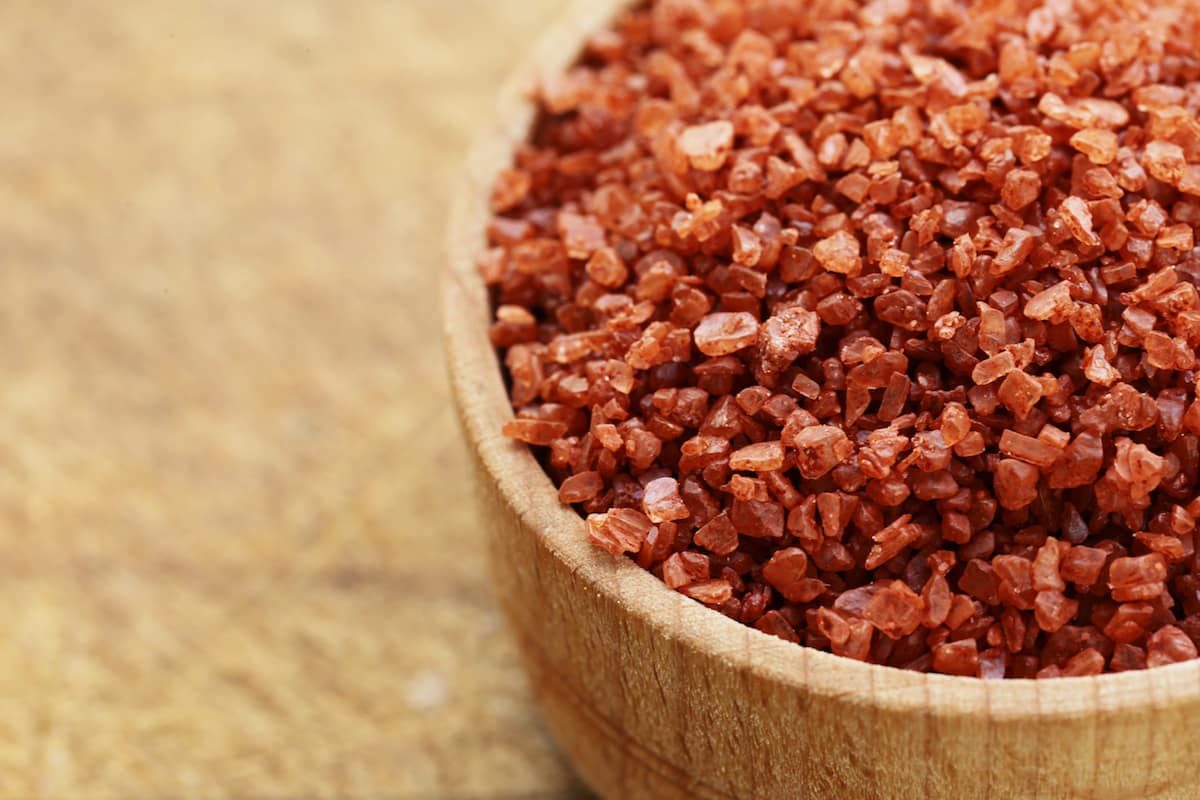
Hawaiian sea salt is sold in three forms: plain white salt, red salt mixed with ʻalaea clay, and black salt colored with activated charcoal.12 All three are sea salt underneath. Once salt dissolves into a dish, America’s Test Kitchen found, sea salt tastes no different from table salt,3 so for seasoning almost any clean coarse salt will do. The color is harder to replace. Pick your substitute by what the Hawaiian salt is doing, and, if it is on top of the food, by which color you have.
Quick answer
| What the Hawaiian salt is doing | Best substitute | Starting amount, per 1 part Hawaiian salt | Treatment |
|---|---|---|---|
| Seasoning kalua pig, poke or another dish (any color) | Coarse sea salt or coarse kosher salt | 1 part for white salt; about 3/4 part for red alaea, then taste | Method |
| The same, measured by weight | Any food-grade salt | No more than 1 part by weight | Computed (upper limit) |
| Finishing with red (alaea) color | Coarse Himalayan pink salt | Sprinkle to taste | Method |
| Finishing with black color | Another black flake salt colored with charcoal | Sprinkle to taste | Method |
| Finishing with white crystals and crunch | Fleur de sel, or another flaky or coarse sea salt | Sprinkle to taste | Method |
How the ratios on this page are labeled
- Computed: based on a measurable physical relationship, with the source named.
- Attributed: a named source publishes this ratio. We quote it as theirs.
- Disputed: named sources give different answers to the same swap. We show each one and do not average them.
- Method: we found no published ratio. We give a direction and a cautious starting point, and say so.
No producer we found publishes the weight of a teaspoon of any Hawaiian salt, and none says how much clay or charcoal goes into the colored ones. That is why most amounts here are starting points.
If Hawaiian salt is seasoning a dish
Kalua pig is the classic case. Food writer Sue Lau describes it as seasoned simply with ʻalaea salt,4 and SaltWorks says its alaea salt is traditionally used on kalua pig.5 Traditional poke, Martha Cheng writes, was raw fish seasoned with sea salt dried in the sun, limu (seaweed) and ʻinamona (roasted, crushed kukui nut).6 In both, the salt dissolves into the food, and what matters is the amount.
Salt is sodium chloride whatever its source.3 Table salt, kosher salt and most sea salts are about 40 percent sodium,7 and one black Hawaiian salt analyzed by the Swiss Federal Food Safety and Veterinary Office in 2016 was 36.7 percent sodium,2 not far off.
Coarse sea salt or coarse kosher salt
Ratio (Method): For white Hawaiian salt, start with the same volume of a coarse sea salt and taste. For red alaea, start with about three quarters of the volume. Lau, who seasons her pork with 2 tablespoons of coarse alaea salt, says alaea is “not quite as salty as other salt types” and can’t be swapped on an equal basis, but gives no figure;4 the three-quarters figure is our starting point, not a measurement. Kosher salt brands differ in how much a spoonful weighs: ATK weighed a teaspoon of Morton kosher salt at 4.8 grams and Diamond Crystal at 2.8 grams.8 With the lighter Diamond Crystal, you may end up close to the full volume.
By weight (Computed, upper limit): The Codex standard for food-grade salt requires at least 97 percent sodium chloride on a dry basis.9 Commercial alaea is sea salt plus red clay; SaltWorks lists its ingredients as exactly those two,5 and the black Hawaiian salt in the Swiss analysis listed salt, active coal and taro.2 So a gram of colored Hawaiian salt cannot hold more salt than a gram of plain salt. If a recipe gives a weight, use no more than the same weight of ordinary salt, and taste.
Fine table salt: Table salt packs more salt into a spoon. ATK puts a teaspoon at about 6 grams regardless of brand,8 and larger crystals carry less sodium per teaspoon because fewer fit.7 Start with about half the volume of a coarse Hawaiian salt (Method), and taste.
If red alaea salt is finishing a dish
Coarse Himalayan pink salt
Both salts owe their color to iron oxide: ʻalaea to the iron oxide in its clay,1 Himalayan pink salt to traces of iron oxide in the salt itself.10 The shade is different, pink rather than brick red, so it is a near miss rather than a match. Himalayan pink salt is rock salt, not sea salt. The pink salt sold commercially comes from Pakistan,10 from beds Harriet Hall describes as deposited from ancient oceans about 250 million years ago.11
Ratio (Method): Sprinkle to taste. Finishing salt is used by eye, and no published ratio exists.
A note on flavor. Red alaea is often described as earthy or nutty, but we found no sensory test of it. ATK’s broader finding is that sea salts vary in color but only slightly in flavor.3 For more options, see alaea salt substitutes.
If black Hawaiian salt is finishing a dish
Another black flake salt colored with charcoal
Black “lava” salt gets its color from activated charcoal, not lava, in the products checked.2 The closest swap is therefore another salt made the same way. The Meadow’s Black Diamond flake salt, from Cyprus, lists sea salt and activated charcoal, and the merchant says the flakes resist dissolving even on very moist foods.12
Ratio (Method): Sprinkle to taste.
New York City’s health department tells food businesses that activated charcoal is approved only for filtering food, not as a food colorant or additive, and that it may reduce the absorption of certain nutrients or medication.13 That guidance is written for restaurants, but it applies to any charcoal-colored salt, including the one you are replacing.
Why kala namak is not a substitute
Kala namak, the Indian “black salt,” is a different product. It is made in northern India by firing common salt, according to a chemistry text quoted in a 1970 Allahabad High Court ruling,14 and its sulfurous taste comes from hydrogen sulfide: the Swiss analysis attributes its “characteristic sulfuric taste” to a high hydrogen sulfide content.2 We found no source reporting a sulfur note in charcoal-colored salts. Using kala namak would add a sulfur note that black Hawaiian salt isn’t documented to have. See black salt for more.
If white Hawaiian salt is finishing a dish
The University of Hawaiʻi describes Hawaiian salt as white salt raked from the top of shallow ponds, then rinsed and dried.1 Any clean finishing salt can take its place.
Fleur de sel, or another flaky or coarse sea salt
Fleur de sel is the thin layer of crystals that forms on the surface of seawater salt pans and is skimmed off by hand; at Guérande, on France’s Atlantic coast, it is white, sometimes faintly pink.15 A flaky salt such as Maldon, or any coarse sea salt, also gives crunch. ATK recommends sea salts as finishing salts.3
Ratio (Method): Sprinkle to taste.
Notes for every swap
- Iodine. None of these salts is a reliable iodine source unless the label says iodized. The NIH Office of Dietary Supplements lists sea salt, kosher salt, Himalayan salt and fleur de sel among specialty salts that are not usually iodized.16
- Labels. “Hawaiian” or “Hawaiian-style” in a product name doesn’t by itself say where the salt was harvested. SaltWorks’ “Hawaiian-style” alaea, for example, is Pacific sea salt with clay from the Hawaiian islands.5 Traditional salt from the Hanapēpē ponds on Kauaʻi may be given or traded but not sold.1
What isn’t known
- No published weight per teaspoon, sodium figure or clay content was found for red alaea salt, and no weight per teaspoon for white or black Hawaiian salt.
- Whether alaea tastes less salty than plain salt is one cook’s view.4 We found no sensory test of any Hawaiian salt.
- Descriptions of red alaea as nutty, or of black salt as earthy and sulfurous, have no measured basis that we found.
Related
- Hawaiian sea salt, alaea salt and alaea salt substitutes
- Black lava salt, black lava salt uses and black salt (kala namak)
- Himalayan salt, alaea salt vs. Himalayan salt and fleur de sel
- Sea salt, kosher salt, table salt vs. sea salt and cooking with sea salt
- Too much sea salt
Footnotes
-
Traditional Ways of Knowing: Salt Harvesting, Exploring Our Fluid Earth, University of Hawaiʻi at Mānoa, 2011. manoa.hawaii.edu · Reference work ↩ ↩2 ↩3 ↩4
-
Infanger and Haldimann, Report on the composition of prevalent salt varieties, Swiss Federal Food Safety and Veterinary Office, 2016. warwick.ac.uk · Regulator ↩ ↩2 ↩3 ↩4 ↩5
-
Salt Types and Measurements, America’s Test Kitchen. americastestkitchen.com · Publication ↩ ↩2 ↩3 ↩4
-
Sue Lau, Hawaiian pulled pork, The Christian Science Monitor, 2015. csmonitor.com · Publication ↩ ↩2 ↩3
-
Alaea Red Hawaiian-style Sea Salt, product page, SaltWorks. seasalt.com · Merchant ↩ ↩2 ↩3
-
Martha Cheng, How Hawaiʻi Taught the World to Love Raw Seafood, Zócalo Public Square. live-zocalopublicsquare.ws.asu.edu · Publication ↩
-
Sodium Sources: Where Does All That Sodium Come From?, American Heart Association, 2025. heart.org · Reference work ↩ ↩2
-
Levine, The Best Kosher Salt, America’s Test Kitchen, 2019. americastestkitchen.com · Publication ↩ ↩2
-
Standard for Food Grade Salt, CXS 150-1985, Codex Alimentarius Commission. services.bis.gov.in · Standard ↩
-
Fayet-Moore et al., An Analysis of the Mineral Composition of Pink Salt Available in Australia, Foods, 2020. mdpi.com · Peer-reviewed ↩ ↩2
-
Hall, Pink Himalayan Sea Salt: An Update, Science-Based Medicine, 2017. sciencebasedmedicine.org · Publication ↩
-
Black Diamond Flake Sea Salt, product page, The Meadow. themeadow.com · Merchant ↩
-
Adulterated Food: What Food Service Operators Need To Know, New York City Department of Health and Mental Hygiene. nyc.gov · Regulator ↩
-
Commissioner, Sales Tax vs Balwant Singh Jag Roshan Lal, Allahabad High Court, 1970, quoting Satya Prakash, via Indian Kanoon. indiankanoon.org · Reference work ↩
-
Cahier des charges de l’IGP Sel de Guérande / Fleur de sel de Guérande, French Ministry of Agriculture, 2025. info.agriculture.gouv.fr · Regulator ↩
-
Iodine: Fact Sheet for Health Professionals, NIH Office of Dietary Supplements. ods.od.nih.gov · Regulator ↩