Spice Comparisons · Comparison
Herb vs. Spice: The Kitchen, Reference and Legal Definitions
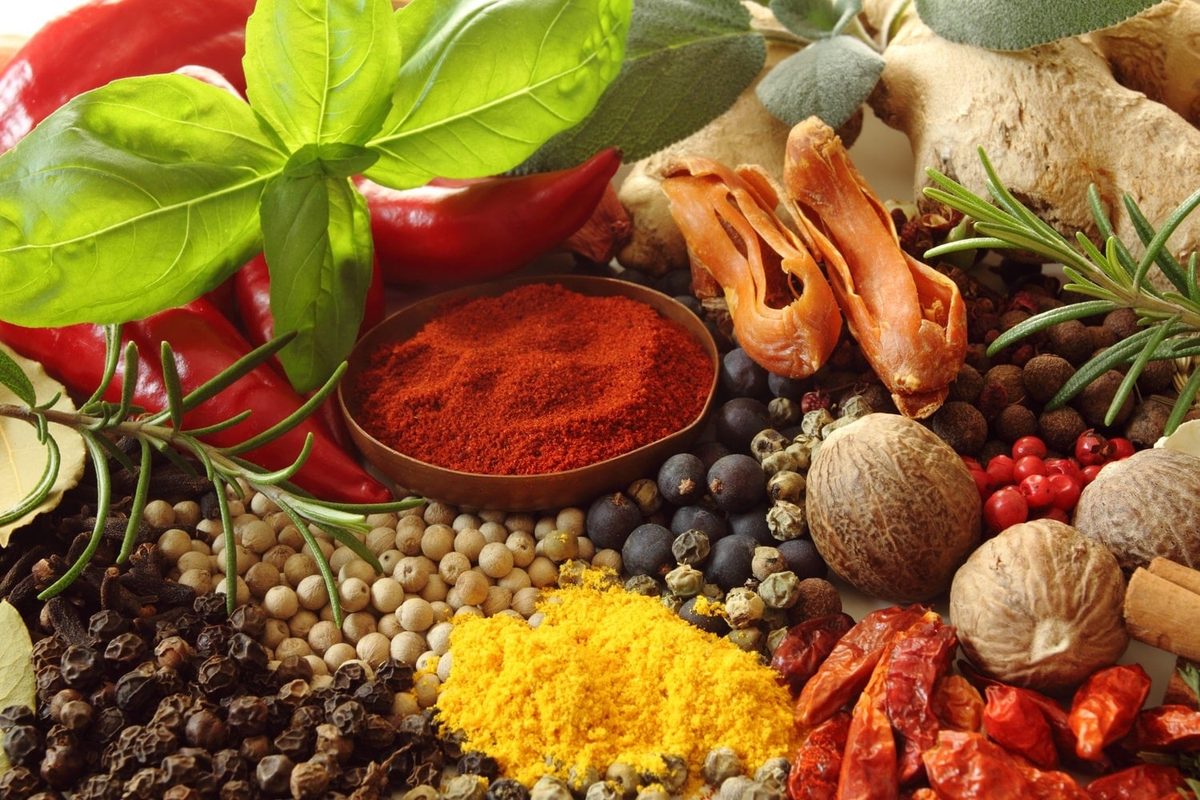
There is no single dividing line between herbs and spices, and the answer depends on who is drawing it. In everyday cooking, herbs are leaves and spices are everything else: seeds, bark, roots, buds, berries. Britannica treats the two together, as parts of plants grown for their aromatic, pungent or otherwise desirable substances.1 US labeling law ignores the leaf rule entirely: the FDA counts basil, thyme and bay leaves as spices, and leaves garlic and onions out.2
Three definitions side by side
| Kitchen usage | Britannica | US labeling law (21 CFR 101.22) | |
|---|---|---|---|
| What counts | Herbs: leaves. Spices: other plant parts | Spices and herbs together: rhizomes, bulbs, barks, flower buds, stigmas, fruits, seeds and leaves1 | A “spice” is any aromatic vegetable substance, whole, broken or ground, whose significant function in food is seasoning rather than nutrition2 |
| How it divides them | Leaf or not | Commonly into spices, spice seeds and herbs1 | Doesn’t separate herbs: basil, bay leaves, marjoram, oregano, parsley, rosemary, sage, tarragon and thyme are all listed as spices2 |
| Edge cases | Coriander, dill and fennel give both | Not addressed in the passage we read | Onions, garlic and celery are excluded, because they have traditionally been regarded as foods2 |
| Status | Common usage, not a rule | Reference definition | Federal regulation, for ingredient labels |
The kitchen definition in the first column is common usage; we found no authority that sets it as a rule, and this site follows it in its list of herbs and spices.
Herbs and spices in kitchen terms
| Herbs | Spices | |
|---|---|---|
| Plant part | Leaves (sometimes with tender stems) | Seeds, fruits, bark, roots and rhizomes, flower buds, stigmas1 |
| Typical form | Fresh or dried | Dried; whole, broken or ground (the forms the FDA definition names)2 |
| Examples | Basil, parsley, cilantro, thyme, oregano, rosemary, bay | Cumin, cinnamon, cloves, black pepper, ginger, saffron, allspice |
| On a US ingredient label | Can be declared as “spice”2 | Can be declared as “spice”2 |
| When to add | Delicate herbs at the end; hardy herbs earlier34 | Often early, bloomed in fat5 |
The examples are illustrations, not a classification from a source.
How the difference plays out in cooking
Herbs split into delicate and hardy. LSU AgCenter groups basil, chives, cilantro, dill leaves, parsley and mint as delicate herbs, best added in the last minute or two, and treats oregano, rosemary and thyme as less delicate.3 America’s Test Kitchen says the flavors of hardy herbs such as oregano, sage, thyme, rosemary and marjoram stay stable at high temperatures.4 So the rule that herbs go in late really applies to the soft, leafy ones.
Fresh herbs usually win, but not always. When America’s Test Kitchen cooked its way through 24 recipes, tasters preferred fresh herbs to dried in all but one. The exception was chili, where dried oregano was the favorite.6 Details and conversions are on dried herbs vs. fresh.
Spices are often bloomed in fat. Blooming means cooking spices briefly in oil or butter to draw out their flavor. America’s Test Kitchen warns that ground spices burn fairly quickly when bloomed and leave a scorched flavor.5
Strength isn’t a category trait. It is often said that spices are stronger than herbs and should be used in smaller amounts. The University of Delaware’s extension service groups bay leaf and rosemary and sage together with cardamom, ginger, pepper and mustard as strong or dominant flavors,7 so strength cuts across the line. LSU AgCenter’s starting point for seasoning is the same for both: about ¼ teaspoon of most ground spices or ground dried herbs.3
Plants that give both an herb and a spice
Coriander is the classic example. Britannica describes it as a plant used as both an herb and a spice,8 and Oxford defines coriander as a plant whose leaves are used as an herb and whose seeds are used as a spice.9 The two parts don’t taste alike, and the chemistry shows why. PROSEA says the main component of the seed oil is always linalool, and that the aldehydes in the plant’s oil disappear as the fruit ripens.10 See coriander vs. cilantro.
Dill and fennel are also used both ways in common kitchen practice, leaf as herb and seed as spice. See dill seed vs. dill weed and fennel seed.
Bay leaves are leaves, so kitchen usage makes them an herb, and the FDA lists them among spices like everything else.2 They are used dried and simmered like a spice, which is probably why they’re often called the exception; that is our observation. A widely repeated tip says ground bay leaf can replace allspice and vice versa. We found no source for it.
Garlic sits outside both groups on a US label. The FDA excludes garlic, onions and celery from “spice” because they have traditionally been regarded as foods.2 In the kitchen, garlic powder behaves like a spice; that is usage, not a definition. See garlic powder vs. garlic.
Where they come from
Several familiar spices come from the Americas. Kew gives the native range of Capsicum annuum, a chile pepper species, as the southern United States to Brazil and the Caribbean;11 allspice as southern Mexico to Central America and the Caribbean;12 and annatto as Mexico to tropical South America.13 A common claim says only a few spices come from the Western Hemisphere and that herbs grow everywhere. We found no source that counts either.
Can you swap an herb for a spice?
Rarely, because they do different jobs: most swaps happen within a group, herb for herb and spice for spice. That is cooking judgment, not a sourced rule. Where the same plant gives both, the leaf and seed still aren’t interchangeable; see coriander vs. cilantro. For specific swaps, each ingredient’s substitutes page lists options by the job the herb or spice is doing.
What isn’t known
- No authority sets the leaf-versus-other-parts rule; it is common usage.
- No source we found counts how many spices come from each hemisphere.
- The claims that green coriander seeds are “both herb and spice” and that ground bay can stand in for allspice could not be traced.
- The Britannica passage reviewed defines spices and herbs together and does not give its own test for telling them apart.
Related
- List of herbs and spices
- Dried herbs vs. fresh, how to rehydrate herbs and how long spices last
- Coriander vs. cilantro, dill seed vs. dill weed and fennel vs. dill
- Bay leaves, allspice, garlic powder vs. garlic
- Must-have spices
Footnotes
-
Spice and herb, Encyclopaedia Britannica. britannica.com · Reference work ↩ ↩2 ↩3 ↩4
-
21 CFR 101.22, Foods; labeling of spices, flavorings, colorings and chemical preservatives, US Food and Drug Administration. ecfr.gov · Regulator ↩ ↩2 ↩3 ↩4 ↩5 ↩6 ↩7 ↩8 ↩9
-
Flavorful Herbs, LSU AgCenter. lsuagcenter.com · Reference work ↩ ↩2 ↩3
-
Danielle Lapierre, “When You Should Actually Use Dried Herbs (and Which Ones to Avoid)”, America’s Test Kitchen, 2022. americastestkitchen.com · Publication ↩ ↩2
-
How to Bloom Spices, America’s Test Kitchen, 2023. americastestkitchen.com · Publication ↩ ↩2
-
Science: Substituting Dried Herbs for Fresh, America’s Test Kitchen. americastestkitchen.com · Publication ↩
-
Using Herbs and Spices, University of Delaware Cooperative Extension, 2025. udel.edu · Reference work ↩
-
Coriander, Encyclopaedia Britannica. britannica.com · Reference work ↩
-
coriander, Oxford Learner’s Dictionaries. oxfordlearnersdictionaries.com · Reference work ↩
-
Coriandrum sativum, PROSEA, via Pl@ntUse. uses.plantnet-project.org · Reference work ↩
-
Capsicum annuum L., Plants of the World Online, Royal Botanic Gardens, Kew. powo.science.kew.org · Reference work ↩
-
Pimenta dioica (L.) Merr., Plants of the World Online, Royal Botanic Gardens, Kew. powo.science.kew.org · Reference work ↩
-
Bixa orellana L., Plants of the World Online, Royal Botanic Gardens, Kew. powo.science.kew.org · Reference work ↩