Spice Comparisons · Comparison
Mustard Powder vs. Prepared Mustard: What’s in Each and How to Swap Them
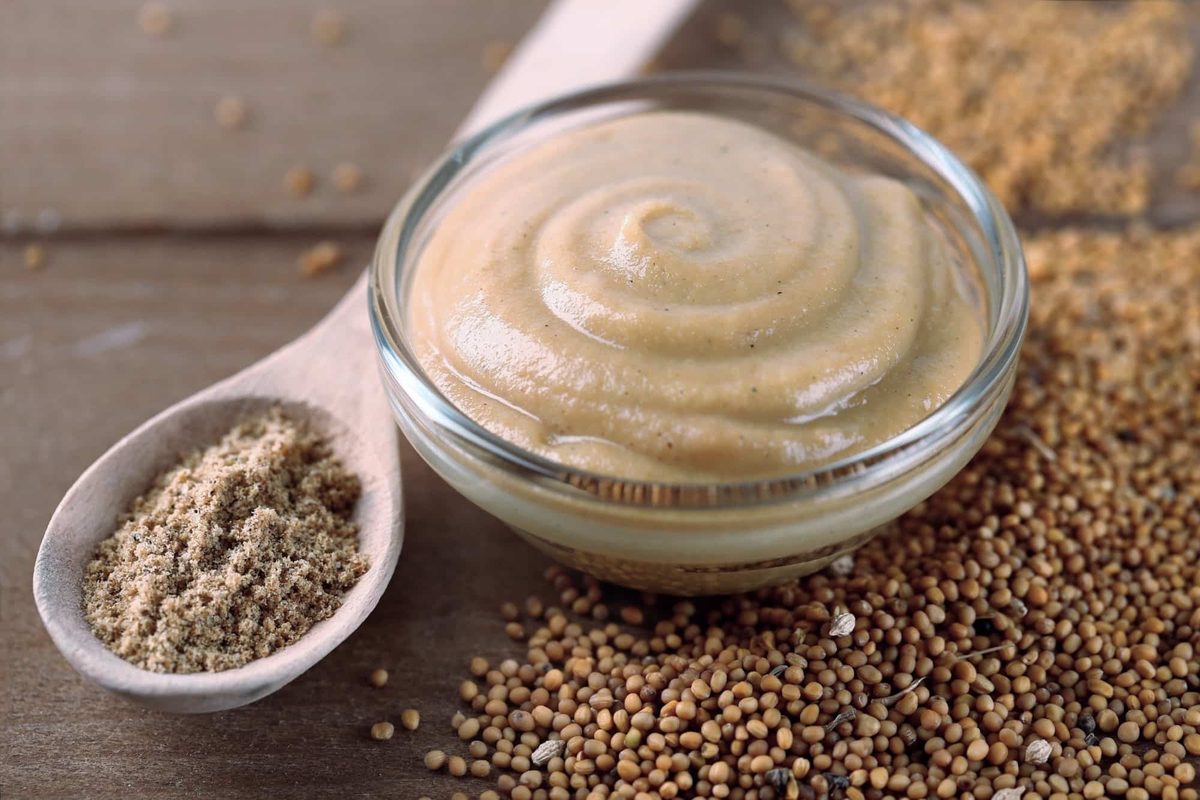
Mustard powder is mustard seed ground to a fine, dry flour.1 Prepared mustard is ground or cracked seed already mixed with a liquid, usually an acidic one such as vinegar, wine or verjus, plus salt and often other seasonings.2 That liquid is the whole difference. In powder, mustard’s heat hasn’t been made yet: it forms only when water reaches the crushed seed.3 In prepared mustard the seed has already met its liquid, and the acid in that liquid sets how hot it stays.3 Three named guides agree on the swap: 1 teaspoon of powder for 1 tablespoon of prepared mustard.145
Side by side
| Mustard powder | Prepared mustard | |
|---|---|---|
| What it is | Ground mustard seed, also called ground or dry mustard1 | Ground or cracked seed in wine, wine vinegar or verjus, with salt and herbs (Dijon, per Saveur);2 yellow American-style mustard is colored with turmeric in some brands6 |
| Seed used | Mostly yellow (white) mustard: Popular Science found other powders hard to buy3 | Varies by style. Dijon must use brown or black seed;2 yellow hot dog mustard is a yellow-mustard product7 |
| Water, per 100 g (USDA) | 5.27 g8 | 83.7 g (yellow prepared mustard)9 |
| Sodium, per 100 g (USDA) | 13 mg8 | 1,100 mg (yellow prepared mustard)9 |
| One teaspoon weighs (USDA) | 2.0 g8 | 5 g9 |
| Heat | Forms only after wetting; you control it with water temperature, time and when you add acid3 | Set by the maker; acid such as vinegar stops the enzyme reaction3 |
| Flavor (editorial) | Clean, sharp mustard heat once mixed with water; little flavor dry | Mustard plus the tang of its liquid and any seasonings |
| Swap | 1 teaspoon | 1 tablespoon (NDSU, NMSU, McCormick)451 |
| Price | No dated, sourced comparison found | No dated, sourced comparison found |
The two USDA records are separate analyses of different products, not the same mustard measured before and after mixing.98
Why powder and prepared mustard taste different
Powder needs water to wake up. Crushed mustard seed holds an enzyme, myrosinase, and a glucosinolate, sinigrin. Water brings them together and the reaction forms allyl isothiocyanate, the volatile compound that gives mustard its kick.3 Until then, dry powder tastes of very little. Water that is too hot deactivates the enzyme; cold water works but slowly.3 Katzer describes English mustard, made by the Colman method, as sold dry and mixed with water shortly before use, its flavor developing within about 10 minutes.6
Acid sets the level. Popular Science reports that strong acidity, like vinegar’s, completely inhibits myrosinase, and that vinegar is what sets how spicy a mustard ends up.3 That is the key to mixing your own: water first, wait, then acid. Pour vinegar onto dry powder and you get a milder mustard.
Seed type matters too. Yellow mustard’s pungent compound is non-volatile and stable in acid, which Katzer gives as a reason it is usually preferred for mustard pastes.610 Brown and black seed make the volatile allyl isothiocyanate instead.10 Katzer adds that the stronger pastes usually contain more acid than the milder ones made from white seed.10
The liquid and seasonings come along. Saveur describes the rules for Dijon mustard, protected by an appellation granted in 1937: only black or brown seed, mixed with wine, wine vinegar or verjus (the juice of unripe grapes), with salt and herbs such as tarragon added.2 Wine vinegar, which makes a slightly more pungent mustard, is the most widely used in Dijon.2 The name itself comes from Latin vinum mustum, the new wine or must that was once mixed into the crushed seed.11
Can one stand in for the other?
The ratio (Attributed)
| Source | Mustard powder | Prepared mustard |
|---|---|---|
| NDSU Extension, FN1984 | 1 tsp | 1 Tbsp |
| NMSU Extension, E-1315 | 1 tsp | 1 Tbsp |
| McCormick, for Dijon1 | 1 tsp | 1 Tbsp |
All three agree, which is rare for a substitution ratio. None says how it was arrived at. The extension charts don’t name a style of prepared mustard; McCormick gives the figure for Dijon, which it calls the best substitute for ground mustard.1
What the swap adds or takes away (Computed)
Using USDA’s figures for yellow prepared mustard, 5 g per teaspoon,9 a tablespoon weighs about 15 g by our arithmetic. That tablespoon brings:
- About 12.5 g of water, roughly 2 1/2 teaspoons, from its 83.7% water content.9
- About 165 mg of sodium, from 1,100 mg per 100 g.9 The teaspoon of powder it replaces carries about 0.3 mg.8
These figures hold for USDA’s yellow prepared mustard only. Dijon and other styles differ, so check the label for sodium.
Powder in place of prepared mustard. Mix 1 teaspoon of powder with about 2 1/2 teaspoons of cool water, let it stand a few minutes, then add a splash of vinegar or wine if the dish wants tang. Add a pinch of salt if the recipe relied on the mustard for seasoning. The water amount comes from the arithmetic above; the rest is method.
Prepared mustard in place of powder. Use 1 tablespoon per teaspoon, and cut a little liquid and salt elsewhere in the recipe. This works in sauces, marinades, dressings, glazes and cheese sauces. It doesn’t work in a dry rub, a spice blend or a seasoned flour, where the moisture turns the mix into a paste. That is kitchen judgment.
When to use which
These are kitchen judgments, apart from the cited points:
- Mustard powder for dry rubs and spice mixes; for cheese sauces and macaroni and cheese, where it sharpens without adding vinegar; for making your own mustard to the heat you want; and anywhere you want mustard without salt or acid.
- Prepared mustard as a condiment, for sandwiches and sausages, and in vinaigrettes and mayonnaise. Katzer notes that mustard contains emulsifiers that help stabilize emulsified sauces,6 and prepared mustard is the easier form to whisk in.
- Yellow prepared mustard is the hot dog standard;7 its bright color comes from turmeric in brands that add it, not from the seed.6 See turmeric.
Making your own. Mustard powder is the base of homemade prepared mustard: cool water first, rest, then acid. Popular Science recommends letting homemade mustard rest in the fridge for two to three days before eating it.3 Whole-grain mustard starts from seed rather than powder; see mustard powder vs. mustard seed.
Safety
- Allergy. Mustard is one of the 14 allergens food businesses in the UK must declare,12 in any form.
- Erucic acid (EU). EU law caps erucic acid, a fatty acid found in mustard, at 35 g/kg in mustard as a condiment.13 The regulation lists no separate limit for mustard powder.
What isn’t known
- The extension guides don’t say which style of prepared mustard their 1-to-3 ratio assumes, and none of the three sources says how it was derived.
- USDA’s nutrient record covers yellow prepared mustard only. Dijon, brown and whole-grain mustards were not checked.
- No source measures how hot store-bought prepared mustard is compared with powder mixed at home.
Related
- Mustard powder and mustard powder substitutes
- Mustard powder uses and mustard seed uses
- Mustard powder vs. mustard seed and yellow vs. black mustard seeds
- Yellow mustard seeds, brown mustard seeds and black mustard seeds
- Horseradish and wasabi, with the same kind of heat
Footnotes
-
About Ground Mustard: Uses, Pairings and Substitutes, McCormick, 2025. mccormick.com · Merchant ↩ ↩2 ↩3 ↩4 ↩5 ↩6
-
William Sertl, “Avez-Vous du Vrai Poupon?”, Saveur, 2007. saveur.com · Publication ↩ ↩2 ↩3 ↩4 ↩5
-
Sandra Gutierrez G., “When the mustard shortage hits, make your own”, Popular Science, 2022. popsci.com · Publication ↩ ↩2 ↩3 ↩4 ↩5 ↩6 ↩7 ↩8 ↩9
-
Julie Garden-Robinson, Ingredient Substitutions (FN198), NDSU Extension, 2018. ksre.ksu.edu · Reference work ↩ ↩2 ↩3
-
In a Pinch Ingredient Substitution (E-131), NMSU Cooperative Extension, 2016. pubs.nmsu.edu · Reference work ↩ ↩2 ↩3
-
Gernot Katzer, “White Mustard (Sinapis alba)”, Gernot Katzer’s Spice Pages. gernot-katzers-spice-pages.com · Reference work ↩ ↩2 ↩3 ↩4 ↩5
-
Mustard, Government of Saskatchewan, Ministry of Agriculture. saskatchewan.ca · Regulator ↩ ↩2
-
Spices, mustard seed, ground (FDC ID 170929), USDA FoodData Central. fdc.nal.usda.gov · Regulator ↩ ↩2 ↩3 ↩4 ↩5
-
Mustard, prepared, yellow (FDC ID 172234), USDA FoodData Central. fdc.nal.usda.gov · Regulator ↩ ↩2 ↩3 ↩4 ↩5 ↩6 ↩7
-
Gernot Katzer, “Mustard (Brassica nigra, B. juncea, Sinapis alba)”, Gernot Katzer’s Spice Pages. gernot-katzers-spice-pages.com · Reference work ↩ ↩2 ↩3
-
mustard (n.), Online Etymology Dictionary. etymonline.com · Reference work ↩
-
Allergen guidance for food businesses, Food Standards Agency. gov.uk · Regulator ↩
-
Commission Regulation (EU) 2023/915, EUR-Lex. eur-lex.europa.eu · Regulator ↩