Spices · Uses
Mustard Powder Uses: Cheese Sauces, Dressings, Rubs and Homemade Mustard
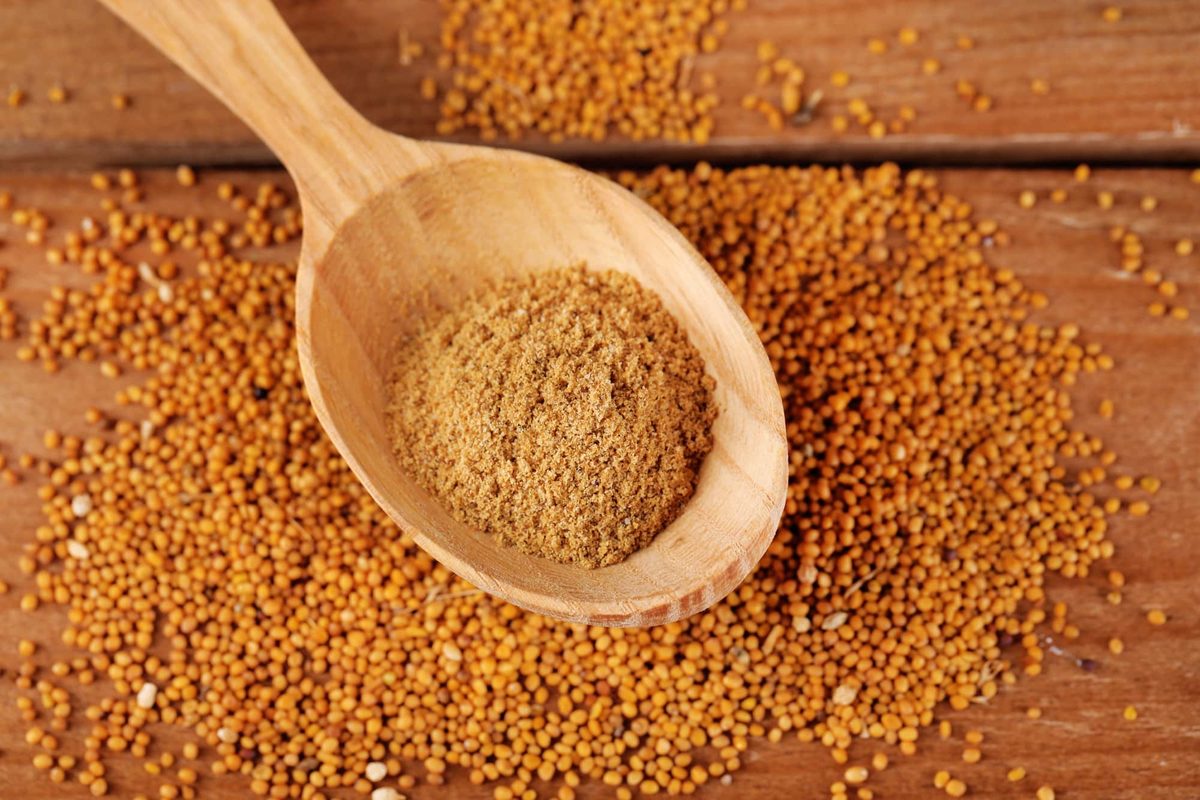
Mustard powder, also sold as dry mustard or ground mustard,1 is ground mustard seed, and in practice almost always yellow mustard seed.2 It is one of the most useful jars in a savory kitchen because it brings mustard flavor without the liquid, vinegar or salt of a prepared mustard. This page is about what to put it in. How it gets its heat, and how to keep that heat, is covered briefly below and in full on the mustard powder profile.
At a glance
| Use it in | Named example | Amount in that recipe |
|---|---|---|
| Macaroni and cheese | America’s Test Kitchen, classic baked, serves 6 to 83 | 1 1/2 teaspoons, with 1/4 teaspoon cayenne |
| Welsh rarebit | Food52 (Catherine Lamb), serves 4 to 64 | 1 teaspoon English mustard powder |
| Coleslaw dressing | Saveur, German coleslaw, makes 8 cups5 | 1 teaspoon, with 1/2 teaspoon celery seed |
| Rubs, marinades, roasted vegetables | McCormick’s suggestions1 | No amount given |
| Creole seasoning | USDA purchasing specification lists mustard as a minimum ingredient6 | Varies by blend |
| Homemade mustard | Colman method: powder mixed with water shortly before use7 | To the consistency you want |
Amounts are Attributed to those recipes. McCormick’s own caution applies to all of them: a small amount enhances a dish, but more can dominate and overpower other flavors.1
First, how the heat works
Dry mustard powder has little bite on its own. Its heat forms when water lets an enzyme in the seed, myrosinase, act on a sulfur compound to form isothiocyanates; in brown and black mustard the main one is allyl isothiocyanate.28 Yellow mustard, the usual powder, forms a pungent compound that is non-volatile and stable in acid.7 Mustard belongs to the same plant family as horseradish.9
What that means for using it:
- For full heat, wet it first. In the Colman method behind British mustard, the powder is mixed with water shortly before use and the flavor develops within about 10 minutes.7
- Use cool water, not hot. Water that is too hot deactivates the enzyme.2
- Water before vinegar. Strong acid such as vinegar stops the enzyme, so powder stirred straight into vinegar gives a milder result.2
- Cooking changes it. Katzer notes that heat quickly destroys isothiocyanates already formed in black and brown mustard, and suggests adding mustard late to cooked foods if you want some pungency.8 No source checked measures how much of yellow mustard powder’s bite survives a cheese sauce, so in cooked dishes treat it as a flavor note rather than a source of heat (our judgment).
Cheese sauces: mac and cheese and rarebit
This is mustard powder’s classic job. America’s Test Kitchen’s classic macaroni and cheese whisks 1 1/2 teaspoons of dry mustard and 1/4 teaspoon of cayenne into the butter with the flour before the milk and cheese go in.3 McCormick also suggests it for mac and cheese sauce.1 Catherine Lamb’s Welsh rarebit for Food52 whisks 1 teaspoon of English mustard powder and 1/2 teaspoon of cayenne into the roux, then adds stout, Worcestershire and sharp cheddar.4
Because powder adds no liquid, it suits a cheese sauce that you want to keep thick (our judgment). The same base works for potatoes au gratin, cheese soups and a grilled cheese spread, though no source here gives amounts for those. See spices for mac and cheese and spices for grilled cheese, and cayenne pepper uses for its usual partner.
Dressings, slaw and mayonnaise
- Vinaigrettes. Mustard contains emulsifiers, so it helps oil and vinegar hold together as well as adding flavor.7 McCormick suggests adding the powder to salad dressings.1
- Coleslaw. Saveur’s German coleslaw whisks 1 teaspoon of dry mustard and 1/2 teaspoon of celery seeds into 1/3 cup of vinegar, then sugar, then 1/2 cup of oil in a thin stream for 8 cups of cabbage and carrot.5 The powder goes straight into vinegar, which stops the heat-forming enzyme,2 so expect a mild mustard note rather than a sharp one (our reading).
- Mayonnaise. Yellow mustard’s uses include mayonnaise and salad dressings, according to Saskatchewan’s agriculture ministry.10 A pinch of powder in homemade mayonnaise adds flavor without thinning it (common practice).
- Dips. McCormick suggests mixing it with mayonnaise, sour cream or Greek yogurt for a dip.1
See celery seed uses for the other half of that slaw dressing.
Rubs, marinades and roasted vegetables
McCormick recommends ground mustard in rubs and marinades for pork, chicken, beef and seafood, as a dry rub for beef, and tossed with olive oil, salt and pepper on vegetables such as asparagus, carrots and potatoes before roasting.1 In these uses it adds a sharp, slightly bitter savor more than heat (our reading; McCormick describes the taste as sharp, hot and slightly bitter).1
It also turns up in Louisiana blends: USDA’s purchasing specification lists mustard among the minimum ingredients of Creole seasoning, with salt, paprika, garlic, cayenne, black pepper and lemon peel.6 See Creole seasoning.
Other places it fits, as our suggestions: meatloaf and burger mixes (see good spices for meatloaf and spices for hamburgers), and a brown sugar or honey glaze for ham, which McCormick includes among its ground mustard recipes.1 See spices for ham.
Deviled eggs and potato salad
McCormick lists deviled eggs and red potato salad among its ground mustard recipes.1 Mix the powder into the yolk filling with the mayonnaise, where the moisture lets its flavor develop (our Method). Dusting dry powder on top looks like paprika but tastes of little until it is wet (our reading of how the heat forms, above).
Homemade prepared mustard
The simplest mustard is powder and cool water. British mustard is mostly made by the Colman method: powder mixed with water shortly before use, ready in about 10 minutes.7 For a jarred mustard, mix the powder with water first and add vinegar once the heat has developed, since acid stops the enzyme (our Method, following Popular Science). Mustard made with cold water needs time to rest, and Popular Science suggests resting homemade mustard in the fridge for two to three days.2 Yellow mustard is the seed behind traditional American hot dog mustard.10 Some brands color their mustard bright yellow with turmeric.7 Beer, wine, honey or sugar are common additions (common practice).
For the differences between powder and jarred mustard, see mustard powder vs. prepared mustard.
Swapping it
If a recipe calls for dry mustard and you only have prepared mustard, NDSU Extension gives 1 tablespoon of prepared mustard for each teaspoon of dry mustard (Attributed).11 Reduce other liquid slightly to allow for it (our suggestion). More options are on mustard powder substitutes, and for grinding your own from seed see mustard powder vs. mustard seed.
Allergy note
Mustard is one of the 14 allergens that UK food businesses must declare.12 It is not one of the nine major food allergens under US law,13 so a US label may not flag it. Mention it when cooking for guests.
Not yet measured
- How much of yellow mustard powder’s pungency survives cooking in a sauce.
- A tested per-serving amount for rubs, marinades or dressings; the amounts above are single recipes.
- Whether “English” mustard powders differ in strength from other yellow powders.
Related
- Mustard powder and mustard seed uses
- Mustard powder substitutes
- Mustard powder vs. mustard seed and mustard powder vs. prepared mustard
- Yellow mustard seeds and horseradish
Footnotes
-
About Ground Mustard: Uses, Pairings and Substitutes, McCormick Kitchens, 2025. mccormick.com · Merchant ↩ ↩2 ↩3 ↩4 ↩5 ↩6 ↩7 ↩8 ↩9 ↩10
-
Sandra Gutierrez G., When the mustard shortage hits, make your own, Popular Science, 2022. popsci.com · Publication ↩ ↩2 ↩3 ↩4 ↩5 ↩6
-
Classic Macaroni and Cheese, Cook’s Illustrated, America’s Test Kitchen, 2012. americastestkitchen.com · Publication ↩ ↩2
-
Catherine Lamb, Welsh Rarebit, Food52, 2017. food52.com · Publication ↩ ↩2
-
German Coleslaw, Saveur, 2007. saveur.com · Publication ↩ ↩2
-
Commercial Item Description A-A-20001C, Spices and Spice Blends, USDA Agricultural Marketing Service, 2023. ams.usda.gov · Regulator ↩ ↩2
-
Gernot Katzer, White Mustard (Sinapis alba), Gernot Katzer’s Spice Pages. gernot-katzers-spice-pages.com · Reference work ↩ ↩2 ↩3 ↩4 ↩5 ↩6
-
Gernot Katzer, Mustard (Brassica nigra, B. juncea, Sinapis alba), Gernot Katzer’s Spice Pages. gernot-katzers-spice-pages.com · Reference work ↩ ↩2
-
Horseradish, Encyclopaedia Britannica. britannica.com · Reference work ↩
-
Mustard, Government of Saskatchewan, Ministry of Agriculture. saskatchewan.ca · Regulator ↩ ↩2
-
Julie Garden-Robinson, Ingredient Substitutions (FN198), NDSU Extension, 2018. ksre.ksu.edu · Reference work ↩
-
Allergen guidance for food businesses, Food Standards Agency. gov.uk · Regulator ↩
-
Food Allergies, U.S. Food and Drug Administration. fda.gov · Regulator ↩