Spices · Substitutes
Panch Phoran Substitutes: Rebuild It From the Seeds You Have
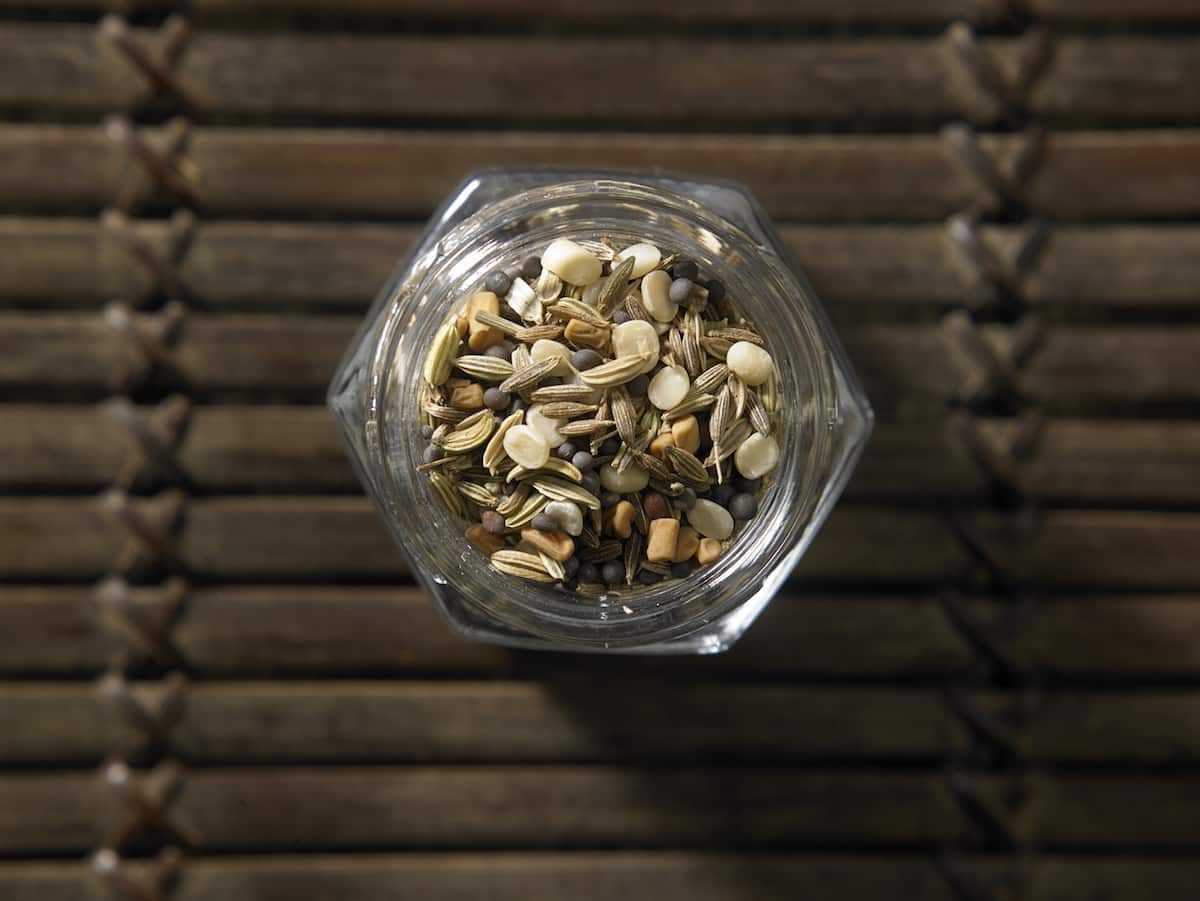
Panch phoran (also written panch phoron) is a mix of five whole seeds from eastern India and Bangladesh, and its name means “five spices,” used in tempering.12 Katzer writes that it is always fried in oil before use, and that Bengali cooks almost always use mustard oil.2 So in most recipes the blend’s job is to flavor hot fat with whole seeds at the start of cooking. That is why the best substitute is not another spice blend but a rebuilt panch phoran made from whichever of its seeds you have.
Quick answer
| What panch phoran is doing | Best substitute | Starting amount, per 1 part panch phoran | Treatment |
|---|---|---|---|
| Whole seeds fried in oil at the start (dals, vegetables, fish) | Your own mix of the five seeds, equal parts | 1 part | Attributed (proportions) |
| Same job, but one or two seeds are missing | Equal parts of the seeds you have, to the same total | 1 part | Method |
| Radhuni is the missing seed | Cumin, black mustard or celery seed in its place | 1 part of the mix | Method |
| Flavor in a dish where the seeds would not be fried whole | Curry powder, bloomed briefly | 1/2 part, then taste | Method |
The rest of the page explains each choice and what each seed brings.
How the ratios on this page are labeled
Every ratio carries one of four labels.
- Computed: based on a measurable physical relationship, with the source named.
- Attributed: a named source publishes this ratio. We quote it as theirs.
- Disputed: named sources give different answers to the same swap. We show each one and do not average them.
- Method: we found no published ratio. We give a direction and a cautious starting point, and say so.
The only published proportions we found are for the blend itself: equal parts of each seed. We found no published ratio for any ready-made substitute.
What the five seeds do
The sources agree on whole seeds in equal amounts but not on which five. Katzer gives the version most often printed as nigella, fenugreek, cumin, black mustard and fennel, and notes that in Bengal cooks use a local seed, radhuni, which elsewhere is replaced by black mustard.2 Bong Eats uses radhuni and leaves out cumin.1 Down To Earth says that in West Bengal radhuni replaces the mustard seeds.3
| Seed | What the source says | Source |
|---|---|---|
| Nigella | Aromatic and slightly bitter; a vaguely oregano-like scent when ground | Katzer2 |
| Fenugreek | Bitter and aromatic; sotolon gives its curry aroma | Katzer;4 PROSEA5 |
| Black mustard | Fried or toasted, no longer pungent but nutty and smoky | Katzer6 |
| Fennel | Anethole gives the anise fragrance and sweet taste | PROSEA7 |
| Cumin | Cuminaldehyde, 20 to 72% of the oil | PROSEA8 |
| Radhuni | An intense grassy taste the other spices lack | Down To Earth3 |
Each seed brings something different, so leaving one out changes the balance rather than just the strength. Fenugreek’s bitterness is the note most likely to dominate if you overdo it; that is our judgment, consistent with Katzer’s description of it as bitter.4
If panch phoran is whole seeds fried in oil
1. Make it yourself, in equal parts
Ratio (Attributed proportions): Katzer describes the blend as equal parts of the five seeds,2 and Bong Eats uses a tablespoon of each.1 Use the mix one for one in place of store-bought panch phoran. Bong Eats says to keep it in an airtight container.1
2. If a seed is missing, use equal parts of the rest
Ratio (Method): No source gives proportions for a four- or three-seed version. Keep the parts equal and keep the total the same. One tablespoon of five seeds is 3/5 teaspoon of each; with four seeds it is 3/4 teaspoon each, and with three it is 1 teaspoon each. That keeps the amount of seed in the oil the same but makes each remaining seed stronger, so if fenugreek is one of the three, consider holding it at 3/5 teaspoon and splitting the difference between the others. That last adjustment is our judgment.
Fennel, cumin and black or brown mustard seed are the easiest of the five to find in a general grocery store; that is our observation, not a sourced figure. For mustard, Katzer calls black and brown mustard botanically different but of equal use in the kitchen,6 and says Indian brown mustard is probably the type most commonly sold in the West.6
If fenugreek is the one you lack, Tasting Table suggests a mix of fennel and mustard seeds as a fenugreek substitute, one for one.9 Both are already in panch phoran, so in practice that means making the blend without fenugreek. It will be sweeter and less bitter.
3. If radhuni is the missing seed
Radhuni is specific to Bengali cooking,3 so outside Bengal this is the usual situation. Three stand-ins are documented:
- Cumin. Bong Eats says cumin seeds make an acceptable substitute if radhuni is unavailable.1
- Black mustard. Katzer says black mustard replaces radhuni outside Bengal.2
- Celery seed. Katzer calls celery seed a working substitute for radhuni in panch phoran.10 Down To Earth gives radhuni’s English name as wild celery.3
Ratio (Method): None of these sources gives an amount for the swap. Since every seed in the blend is used in equal parts,21 give the stand-in the same one part that radhuni would have had. Celery seed is strongly aromatic, so in our judgment use a little less of it if the dish is delicate.
If the seeds won’t be fried whole
Sometimes panch phoran goes into a dish late, or you are using it ground in a rub. Here a ground blend can work.
Curry powder
The USDA’s purchasing specification for curry powder lists turmeric, coriander, fenugreek, cinnamon, cumin, black pepper, ginger and cardamom as minimum ingredients,11 so it shares fenugreek and cumin with panch phoran. It also says curry powder must have a fragrant aroma and a warm, bitter taste.11 It has no nigella or fennel unless the brand adds them. The turmeric will color the dish yellow; US regulations treat turmeric as a color additive.12
Do not use it the way you would use whole panch phoran. America’s Test Kitchen warns that ground spices burn fairly quickly in hot fat, giving a scorched flavor.13 Add curry powder after the onions or other vegetables are in the pan, or stir it into a little oil over moderate heat for no more than the 30 seconds to several minutes that ATK gives for blooming.13
Ratio (Method): No published ratio. Curry powder brings several spices that panch phoran does not, so start with half the panch phoran amount and taste before adding more.
Berbere, only where chile heat suits the dish
Berbere is a chile-spice blend whose name means hot in Amharic, according to Saveur.14 Katzer lists fenugreek among the spices added to its chiles.15 So it shares one of panch phoran’s seeds, but chile is its main ingredient, and it will make the dish red and hot. Saveur’s recipe also includes dried onion flakes.14
Ratio (Method): No published ratio. If you use it, start with a quarter of the panch phoran amount, added with the other ground spices rather than to hot oil.
What isn’t known
- No published ratio exists for any ready-made substitute for panch phoran, or for any single seed in place of radhuni.
- No source we found says how much fenugreek a typical curry powder contains. The USDA specification lists ingredients, not proportions.11
- Oregano is sometimes suggested in place of nigella. Katzer notes that ground nigella smells vaguely of oregano,2 but we found no source that recommends the swap, and dried leaves do not behave like seeds in hot oil.
Related
- Panch phoran
- The seeds: nigella seeds, fenugreek, cumin, black mustard seeds, brown mustard seeds, fennel seed, celery seeds
- Seed swaps: nigella seeds substitute, fenugreek substitutes, black mustard seed substitutes, cumin substitutes, fennel seed substitutes
- Comparisons and fixes: fenugreek vs. fennel seed, fennel seeds vs. cumin seeds, too much fenugreek, too much cumin
- Ground blends: curry powder, berbere seasoning, Indian spices
Footnotes
-
“Panch phoron”, Bong Eats, 2017. bongeats.com · Publication ↩ ↩2 ↩3 ↩4 ↩5 ↩6
-
Gernot Katzer, “Nigella (Nigella sativa L.)”, Gernot Katzer’s Spice Pages. gernot-katzers-spice-pages.com · Reference work ↩ ↩2 ↩3 ↩4 ↩5 ↩6 ↩7 ↩8
-
Vibha Varshney, “The fifth element: Why radhuni needs to be mainstreamed”, Down To Earth, 2023. downtoearth.org.in · Publication ↩ ↩2 ↩3 ↩4
-
Gernot Katzer, “Fenugreek (Trigonella foenum-graecum L.)”, Gernot Katzer’s Spice Pages. gernot-katzers-spice-pages.com · Reference work ↩ ↩2
-
C.S. Tawan and N. Wulijarni-Soetjipto, Trigonella foenum-graecum, Plant Resources of South-East Asia (PROSEA). uses.plantnet-project.org · Reference work ↩
-
Gernot Katzer, “Mustard (Brassica nigra, B. juncea, Sinapis alba)”, Gernot Katzer’s Spice Pages. gernot-katzers-spice-pages.com · Reference work ↩ ↩2 ↩3
-
Purwaningsih, Harmida and M. Brink, Foeniculum vulgare, PROSEA. uses.plantnet-project.org · Reference work ↩
-
P.C.M. Jansen, Cuminum cyminum, PROSEA. uses.plantnet-project.org · Reference work ↩
-
Alice Rich, “11 Best Substitutes For Fenugreek”, Tasting Table, 2024. tastingtable.com · Publication ↩
-
Gernot Katzer, “Celery (Apium graveolens)”, Gernot Katzer’s Spice Pages. gernot-katzers-spice-pages.com · Reference work ↩
-
Commercial Item Description A-A-20001C, Spices and Spice Blends, USDA Agricultural Marketing Service, 2023. ams.usda.gov · Regulator ↩ ↩2 ↩3
-
21 CFR 73.600, Turmeric, US Code of Federal Regulations. ecfr.gov · Regulator ↩
-
How to Bloom Spices, America’s Test Kitchen, 2023. americastestkitchen.com · Publication ↩ ↩2
-
Ethiopian Spice Mix (Berbere), Saveur, 2008. saveur.com · Publication ↩ ↩2
-
Gernot Katzer, “Long Pepper (Piper longum, P. retrofractum)”, Gernot Katzer’s Spice Pages. gernot-katzers-spice-pages.com · Reference work ↩