Spice Substitutes · Substitutes
Nigella Seed (Kalonji) Substitutes, Ranked by the Job the Seeds Are Doing
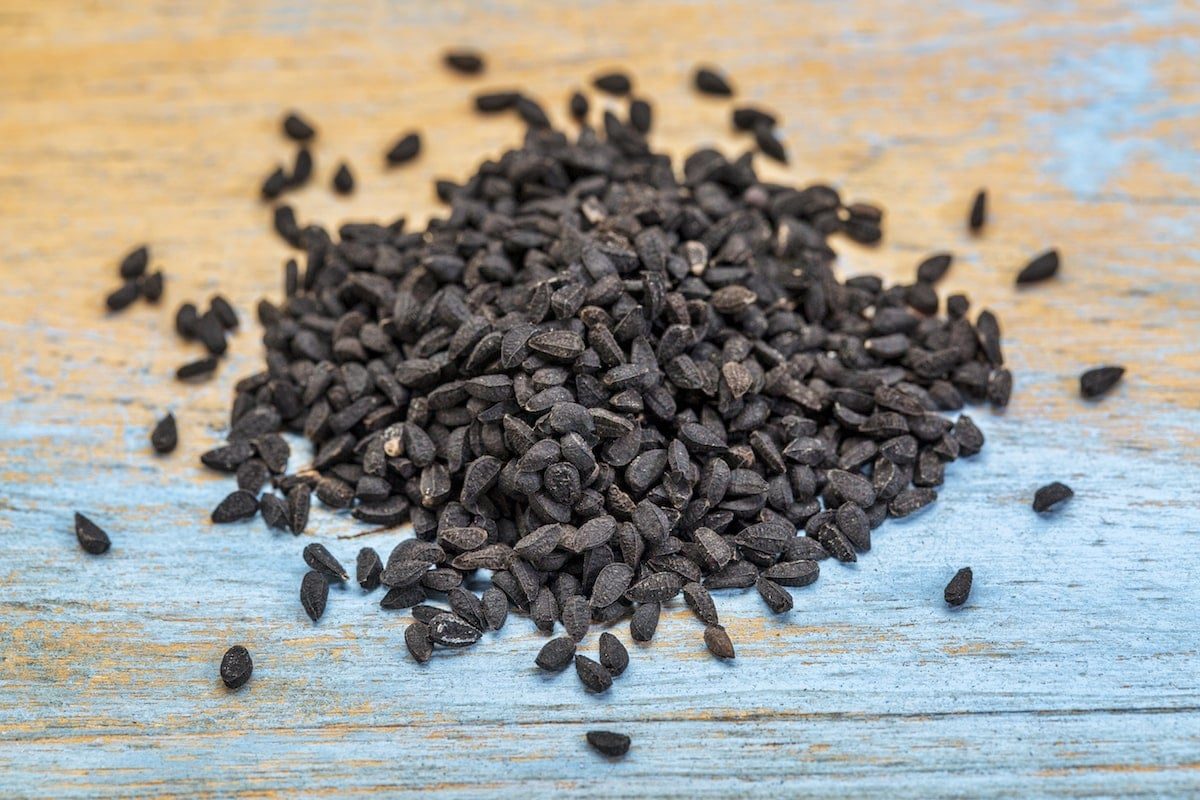
Nigella seeds (kalonji, sold in the US as charnushka) are the small black seeds of Nigella sativa, a member of the buttercup family.12 Whole, they have little smell. Ground or chewed, they develop a vaguely oregano-like scent, with an aromatic, slightly bitter taste.2 America’s Test Kitchen adds piney, menthol notes,3 and The Spice House places the flavor somewhere between cumin and thyme.4 No single spice matches that, and nigella is not closely related to any of the seeds it gets confused with.3 So pick a substitute for the job the seeds are doing: looking right on bread, giving aroma to a vegetable dish, or crackling in hot oil.
Quick answer
| What nigella is doing | Best substitute | Starting amount, per 1 part nigella | Treatment |
|---|---|---|---|
| Black speckles on naan, flatbread, rye bread or crackers | Black sesame seeds | 1 part | Method |
| Aroma in vegetable dishes, dals, pickles | Dried thyme or oregano, crumbled | 1/2 part, then taste | Method |
| Whole seeds sizzled in oil, or in panch phoran | Whole cumin seeds | 1/2 part, then taste | Method |
| A savory, slightly bitter seed in a rub or pickle | Celery seed | 1/4 part, then taste | Method |
How the ratios on this page are labeled
Every ratio carries one of four labels.
- Computed: based on a measurable physical relationship, with the source named.
- Attributed: a named source publishes this ratio. We quote it as theirs.
- Disputed: named sources give different answers to the same swap. We show each one and do not average them.
- Method: we found no published ratio. We give a direction and a cautious starting point, and say so.
We found no credible published ratio for replacing nigella with anything. Every amount on this page is a Method starting point: a direction and a cautious first measure, not a measured equivalence.
What you’re trying to replace
Nigella’s essential oil makes up about 0.5 percent of the seed on average, and up to 1.5 percent. Its main component is thymoquinone, up to 50 percent of the oil, alongside p-cymene at about 40 percent.2 None of the substitutes below is built on thymoquinone. Thyme and oregano oils are dominated by different compounds, thymol and carvacrol,56 and cumin’s main compound is cuminaldehyde.7 So each substitute matches a description of nigella’s flavor, not its chemistry. We found no study that explains why nigella smells faintly of oregano or thyme.
If nigella is decorating bread
On naan, Turkish breads, Jewish rye and crackers, nigella’s look matters as much as its flavor. Katzer notes that Turkish bread frequently shows the seeds’ characteristic black grains,2 and ATK says nigella seeds are added to breads and baked goods to give them a savory boost.3 The Spice House names Jewish rye and flatbreads as typical uses.4
Black sesame seeds
Katzer notes that nigella is sometimes confused with black sesame,2 which is the point here: from a distance, the look is close. Black sesame is not just white sesame with the hull left on. Seed color in sesame is a trait of the variety, ranging from white to brown to black,8 and the black color comes from a melanin-like pigment in the seed coat.9 Sesame generally has a slight bitterness,8 but its flavor is mild and nutty, nothing like nigella’s; that description is ours.
Ratio (Method): No published ratio. Use the same amount by volume, since the job is mostly visual. If you want some of nigella’s herbal edge too, add a pinch of dried thyme to the topping.
If nigella is giving aroma to a dish
Katzer says nigella spread from Iran to northern India, particularly Punjab and Bengal, where it is mostly used for vegetable dishes, eggplant and pumpkin among them.2 Here you want an aroma in the same family of descriptions: oregano, thyme, slightly bitter.
1. Dried thyme or oregano
Oregano is a mint-family herb (Lamiaceae),10 and thyme’s essential oil, like oregano’s, is led by thymol and carvacrol.56 Katzer’s description of ground nigella as oregano-like2 and The Spice House’s “hints of thyme”4 make them the closest aroma matches we can point to. They are leaves, not seeds, so you lose the small black seeds and their crunch.
Ratio (Method): No published ratio. Start with half as much crumbled dried herb as the recipe’s nigella, add it with the other spices, and taste. In our judgment, dried thyme is the gentler of the two; oregano can take over a dish quickly.
If nigella is crackling in hot oil
In Bengali panch phoran, Katzer writes, whole nigella, fenugreek, cumin, black mustard seed and fennel are combined in equal parts,2 and by common practice many dishes start by frying whole nigella in oil. You need a seed that can take the heat.
1. Whole cumin seeds
The Spice House’s “between cumin and thyme”4 puts cumin on the list, and cumin is already one of panch phoran’s five seeds.2 Its flavor is its own: cumin is a parsley-family seed whose oil is led by cuminaldehyde.7
Ratio (Method): No published ratio. Start with half as much cumin as nigella, since cumin’s flavor is more assertive than nigella’s in our judgment, and taste.
2. Panch phoran without the nigella
If the nigella is part of a panch phoran, the simplest fix is to make the blend with the other four seeds in equal parts. Ratio (Method): Leave the nigella out rather than adding extra of another seed; taste at the end and add a little more cumin only if the dish seems flat.
If nigella is a savory seed in a rub or pickle
Celery seed
Celery seed is the fruit of celery itself, Apium graveolens,11 not of a separate “smallage” plant. Katzer describes its aroma as similar to the leaves and root but much stronger, and the seeds as slightly bitter,12 and McCormick says its pungent, somewhat bitter flavor goes a long way.13 It shares nigella’s bitterness, not its aroma: celery’s characteristic odor comes from phthalides.11
Ratio (Method): No published ratio. Start with a quarter as much celery seed as nigella and taste. It will taste of celery.
What doesn’t work
- “Black cumin” and “black caraway.” Katzer notes that “black cumin” already names a different spice from Central Asia and northern India.2 ATK lists black cumin, black caraway, onion seed and black sesame as names or seeds nigella is confused with, and says it is not closely related to any of them.3 Check the botanical name before buying a jar as a stand-in.
- “Onion seed.” Nigella is sometimes called onion seed,3 but it is not related to onion.
What isn’t known
- No published ratio exists for replacing nigella with any spice; every amount here is a starting point.
- No study explains nigella’s oregano-like or thyme-like scent in terms of shared compounds with those herbs.
- Popular claims that nigella and celery seed have similar pungency, or that oregano is the closest flavor match, could not be traced to a source.
Related
- Nigella seeds, panch phoran and panch phoran substitutes
- Black sesame seeds, black vs. white sesame seeds and sesame seeds
- Thyme, oregano and oregano vs. thyme
- Cumin, cumin seeds vs. ground cumin and cumin substitutes
- Celery seeds and celery seed uses
Footnotes
-
Nigella sativa L., Plants of the World Online, Royal Botanic Gardens, Kew. powo.science.kew.org · Reference work ↩
-
Gernot Katzer, Nigella, Gernot Katzer’s Spice Pages. gernot-katzers-spice-pages.com · Reference work ↩ ↩2 ↩3 ↩4 ↩5 ↩6 ↩7 ↩8 ↩9 ↩10
-
How to Use Nigella Seeds, America’s Test Kitchen. americastestkitchen.com · Publication ↩ ↩2 ↩3 ↩4 ↩5
-
Charnushka Seeds, The Spice House. thespicehouse.com · Merchant ↩ ↩2 ↩3 ↩4
-
S.H. Widodo, Thymus vulgaris (PROSEA), Plant Resources of South-East Asia. uses.plantnet-project.org · Reference work ↩ ↩2
-
Lombrea et al., A Recent Insight Regarding the Phytochemistry and Bioactivity of Origanum vulgare L. Essential Oil, International Journal of Molecular Sciences, 2020. mdpi.com · Peer-reviewed ↩ ↩2
-
Cumin, Encyclopaedia Britannica. britannica.com · Reference work ↩ ↩2
-
E.A. Weiss and Q.D. de la Cruz, Sesamum orientale (PROSEA), Plant Resources of South-East Asia. uses.plantnet-project.org · Reference work ↩ ↩2
-
Dossou et al., The Dark Pigment in the Sesame Seed Coat, Frontiers in Nutrition, 2022. frontiersin.org · Peer-reviewed ↩
-
Anoushka Pant, Oregano, Encyclopaedia Britannica. britannica.com · Reference work ↩
-
Salehi et al., Apium Plants: Beyond Simple Food and Phytopharmacological Applications, Applied Sciences, 2019. mdpi.com · Peer-reviewed ↩ ↩2
-
Gernot Katzer, Celery, Gernot Katzer’s Spice Pages. gernot-katzers-spice-pages.com · Reference work ↩
-
McCormick Whole Celery Seed product page, McCormick. mccormick.com · Merchant ↩