Seasonings · Profile
Taco Seasoning: What’s in the Packet, Where It Comes From, and How to Use It
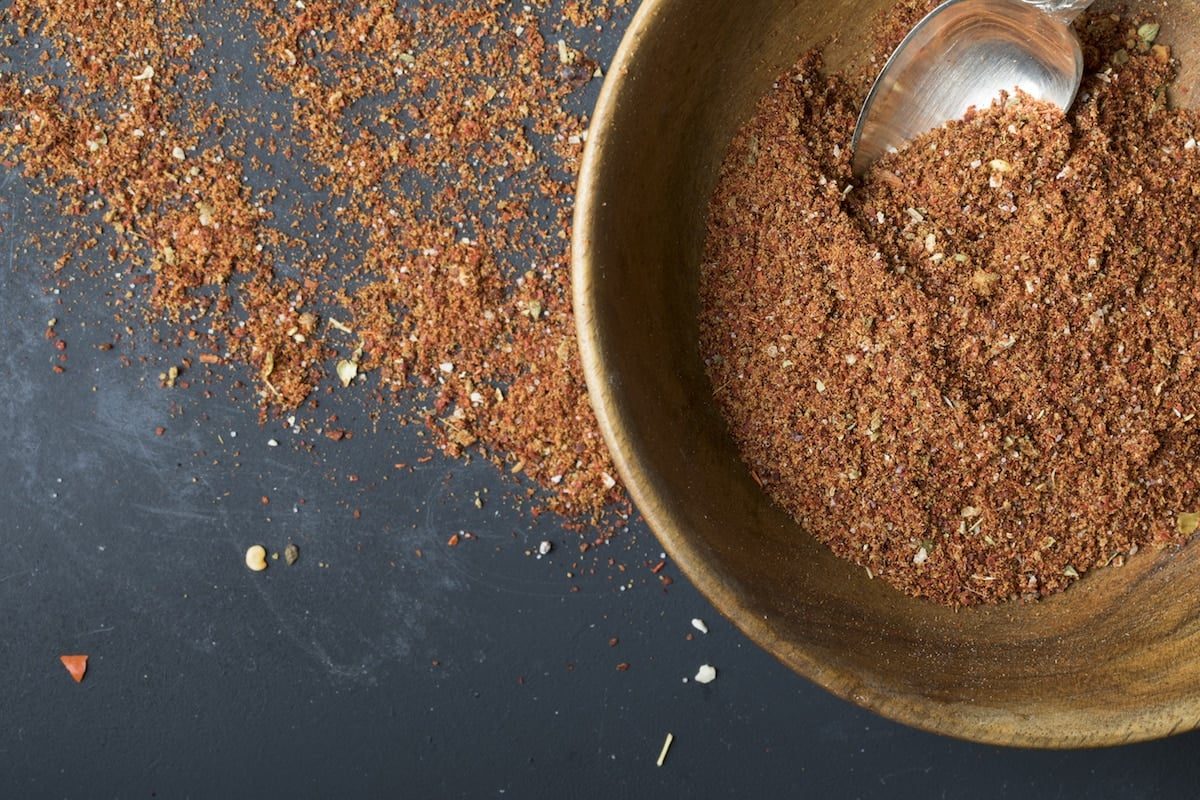
Taco seasoning is a ground blend for flavoring taco meat, usually built on chile pepper, other spices such as cumin and oregano, onion, garlic and salt. Packet mixes also contain a starch, which in some brands is the largest single ingredient. There is no standard recipe and no federal definition. This page covers what goes into the common mixes, where the taco and the packet come from, the compounds behind the flavor, and how to use, buy and store it.
At a glance
| What it is | A packaged or homemade spice blend for seasoning ground meat for tacos12 |
| Typical components | Chili pepper, other spices, onion, garlic, salt; packet mixes add corn starch and sometimes maltodextrin12 |
| Fixed recipe? | No. The USDA’s spice-blend purchasing specification defines chili powder and fajita seasoning but has no entry for taco seasoning3 |
| Main flavor drivers | Capsaicinoids from chile for heat; cuminaldehyde from cumin; carvacrol and thymol from oregano; salt456 |
| Salt per serving | 280 to 380 mg sodium per label serving in the two packets below12 |
| Typical use | One 1 oz packet per pound of ground meat, with 3/4 cup water12 |
| Forms sold | Single-use packets, larger shaker cans; also made at home |
Measured values
2 figures, sourced| Measure | Value | Scope | Source |
|---|---|---|---|
| Sodium Nutrient | 380 mg per 1 1/2 teaspoon serving | McCormick Original Taco Seasoning Mix packet, 1 oz, label (17% DV; 6 servings per packet)Company's own figures. | giantfoodstores.com |
| Sodium Nutrient | 280 mg per 2 teaspoon serving | Old El Paso Gluten Free Original Taco Seasoning Mix packet, 1 oz, label (12% DV; 5 servings per packet)Company's own figures. | giantfoodstores.com |
Each figure is quoted as its source states it, with the samples or standard it applies to. Where sources differ, both are shown; nothing is averaged. All measured values
What is in it
Two of the best-known packets, in the order the labels give:
| Blend | Ingredients, in order given | Serving | Sodium per serving | Source |
|---|---|---|---|---|
| McCormick Original Taco Seasoning Mix | Spices (including chili pepper, paprika, oregano), corn starch, salt, onion and garlic | 1 1/2 tsp; 6 per packet | 380 mg (17% DV) | 1 |
| Old El Paso Gluten Free Original Taco Seasoning Mix | Corn starch, chili pepper, maltodextrin, salt, spice, onion powder; 2% or less of vegetable oil, silicon dioxide (anticaking agent), natural flavor, modified corn starch | 2 tsp; 5 per packet | 280 mg (12% DV) | 2 |
The Old El Paso mix lists corn starch first; McCormick lists spices first and corn starch second.12 Neither label names cumin, though both list “spices” or “spice” without spelling out every one.12
Many cooks build taco seasoning on chili powder. The USDA’s purchasing specification for chili powder, written for federal food programs, lists ground chili pepper, cumin, oregano, salt and garlic powder as the minimum ingredients.3 For mixes built that way, see chili powder and spices for taco meat.
Where tacos and taco seasoning come from
The taco’s origins are unclear. Historian Jeffrey M. Pilcher, interviewed by Smithsonian Magazine in 2012, said “the origins of the taco are really unknown.” His own theory dates the word to 18th-century Mexican silver mines, where “taco” meant a small paper-wrapped charge of gunpowder used to blast ore.7 The first references in archives or dictionaries, he said, date from the end of the 19th century, and the earliest US mention he had seen was in a newspaper in 1905.7
On the hard shell, Pilcher said Mexican cookbooks were already describing how to make taco shells in the 1940s, and that the original patents for making them went to Mexican restaurateurs in that decade, not to Taco Bell founder Glen Bell.7 He also listed hamburger in place of offal among the changes in the American fast-food taco.7 When the first packaged taco seasoning went on sale is not documented in any source we found.
Cumin, which is on the federal chili powder minimum list,3 came to Mexico from abroad: AramcoWorld’s history of the spice says Spanish colonists and traders brought it.8
Flavor and the compounds behind it
Taco seasoning tastes earthy and warm, with chile heat that ranges from barely there in mild packets to noticeable in hot ones, a savory onion-garlic base and a herbal oregano note. That description is ours. The chemistry belongs to the individual ingredients:
| Ingredient | What it contributes | Source |
|---|---|---|
| Chili pepper, red pepper | Heat, from capsaicinoids | 5 |
| Paprika | Red color, mainly from capsanthin and capsorubin | 9 |
| Cumin | Cuminaldehyde, the most important constituent of the oil (20–72% across studies) | 4 |
| Oregano | Carvacrol and thymol, together about 78–85% of Origanum vulgare oil | 6 |
| Salt | Saltiness | 12 |
Neither label says which oregano it uses; the compound figures above are for Origanum vulgare. See Mexican oregano vs. oregano.
How taco seasoning is used
Both packet labels call for one packet, a pound of ground meat and 3/4 cup water; the McCormick directions say to stir in the seasoning mix and water.12 Beyond taco meat, cooks use it in taco soup, chili, burrito and nacho fillings, on roasted vegetables or fries, and as a dry rub for chicken or steak. That list is common practice, not a sourced finding. See good Mexican spices for chicken.
Buying and quality
- Read the first ingredient. In one of the two packets above it is corn starch, not a spice; in the other, spices come first.12
- Count the sodium per packet, not per serving. The packet directions use the whole packet for a pound of meat.12 At the labels’ figures, that is about 2,280 mg sodium in the McCormick packet (6 × 380 mg) and 1,400 mg in the Old El Paso packet (5 × 280 mg).12 FDA’s Daily Value for sodium is less than 2,300 mg a day.10
- Homemade gives control. Mixing your own lets you set the salt and leave out the starch.
Storage
No regulator or standards body we found gives a shelf life for taco seasoning. Keep opened packets folded and sealed, and jars closed, away from heat and light. A blend that has lost its smell has faded; that test is common practice, not a measured figure.
Safety
- Sodium. See Buying above: one packet can carry close to a full day’s Daily Value.110
- Lead in spices. A New York City health department review of 1,496 spice samples from 41 countries, collected from 2008 to 2017, found detectable lead in more than half and above 2 parts per million in more than 30%, with higher average levels in spices bought abroad.11 The abstract does not break results out by blend.
- Mycotoxins in chile spices. The EU sets maximum levels for ochratoxin A and aflatoxins in dried Capsicum spices, including chili powder and paprika.12
Health claims
Claims that taco seasoning helps prevent diabetes, heart disease or cancer could not be traced to any study of the blend. This page makes no health claim for it.
Substitutes and comparisons
- Taco seasoning substitutes
- Fajita vs. taco seasoning (see also fajita seasoning)
- Spices for taco meat
- Chili powder and paprika vs. chili powder
The individual ingredients: cumin, oregano, Mexican oregano, paprika, cayenne pepper, chipotle powder, garlic powder and onion powder.
Footnotes
-
McCormick Original Taco Seasoning Mix, ingredients, nutrition label and directions, via Giant Food Stores product listing. giantfoodstores.com · Merchant ↩ ↩2 ↩3 ↩4 ↩5 ↩6 ↩7 ↩8 ↩9 ↩10 ↩11 ↩12 ↩13
-
Old El Paso Gluten Free Original Taco Seasoning Mix, ingredients, nutrition label and directions, via Giant Food Stores product listing. giantfoodstores.com · Merchant ↩ ↩2 ↩3 ↩4 ↩5 ↩6 ↩7 ↩8 ↩9 ↩10 ↩11 ↩12
-
Commercial Item Description A-A-20001C, Spices and Spice Blends, USDA Agricultural Marketing Service, 2023. ams.usda.gov · Regulator ↩ ↩2 ↩3
-
P.C.M. Jansen, Cuminum cyminum, Plant Resources of South-East Asia (PROSEA). uses.plantnet-project.org · Reference work ↩ ↩2
-
Bosland and Walker, “Measuring Chile Pepper Heat”, New Mexico State University, 2010. pubs.nmsu.edu · Reference work ↩ ↩2
-
Lombrea et al., “A Recent Insight Regarding the Phytochemistry and Bioactivity of Origanum vulgare L. Essential Oil”, International Journal of Molecular Sciences, 2020. mdpi.com · Peer-reviewed ↩ ↩2
-
Katy June Friesen, “Where Did the Taco Come From?”, Smithsonian Magazine, 2012. smithsonianmag.com · Publication ↩ ↩2 ↩3 ↩4
-
Jeff Koehler, “Spice Migrations: Cumin”, AramcoWorld, 2021. aramcoworld.com · Publication ↩
-
“Paprika extract”, Chemical and Technical Assessment, FAO/WHO JECFA, 2008 (rev. 2013). fao.org · Regulator ↩
-
“Sodium in Your Diet”, U.S. Food and Drug Administration. fda.gov · Regulator ↩ ↩2
-
Hore et al., “A Spoonful of Lead”, Journal of Public Health Management and Practice, 2019. scholars.mssm.edu · Peer-reviewed ↩
-
Commission Regulation (EU) 2023/915 on maximum levels for certain contaminants in food. eur-lex.europa.eu · Regulator ↩