Cooking · Dish guide
The Best Spices for Chili: What Each One Does, and How the Styles Differ
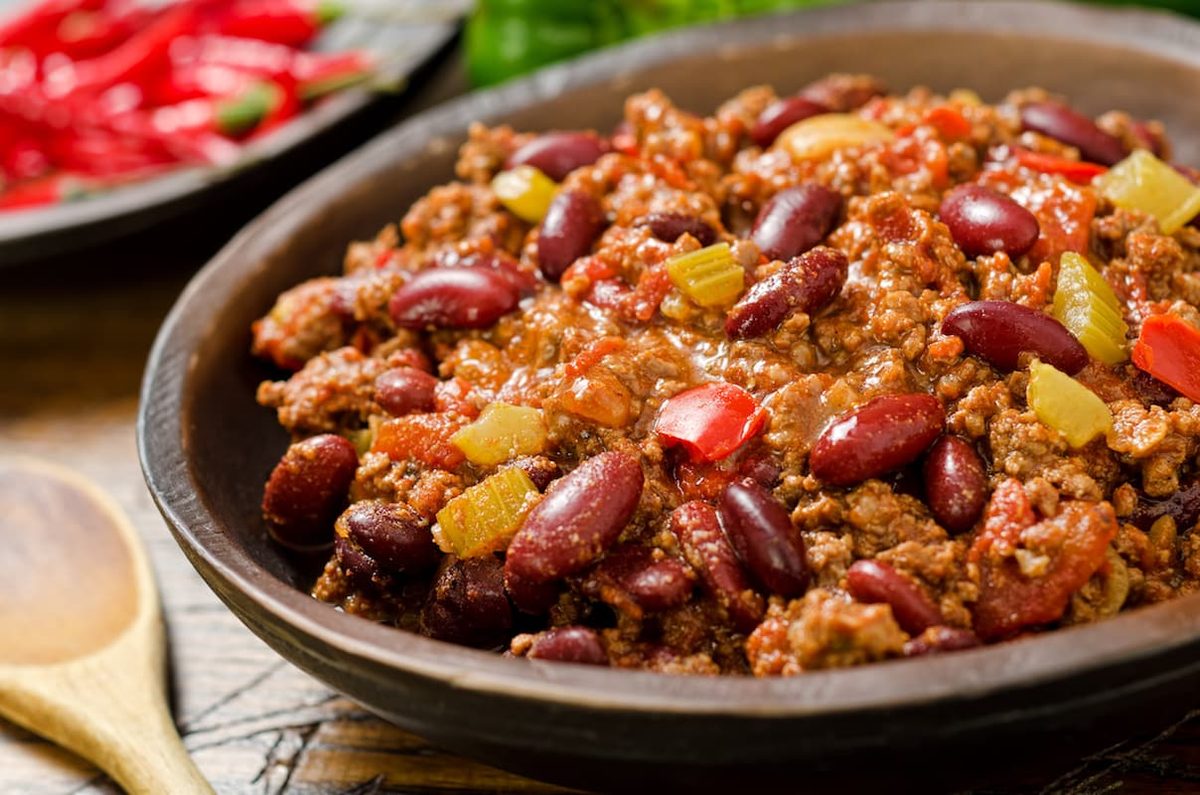
Chili con carne is, by its name, “chili with meat.”1 Most recipes cited here lean on chile, usually dried, for most of their flavor, color and heat, then build around it with a small set of spices: cumin, oregano and garlic in nearly all of them, and a few more that mark out a regional style. This page covers what each spice does in the pot, which spices define the main styles, and when to add them. Quantities appear only where a named recipe gives them, and they are credited to that recipe.
At a glance
| Spice | Job in the pot | Where it’s essential |
|---|---|---|
| Dried chile (ancho, pasilla, guajillo, New Mexico) or chili powder | Base flavor, color, body, some heat | Every style |
| Hot chile (cayenne, chile de árbol) | Extra heat | Texas red, many home recipes |
| Cumin | Earthy, warm depth | Texas red, most bean chilis, white chili |
| Oregano (often Mexican oregano) | Herbal top note | Most styles |
| Garlic or garlic powder | Savory backbone | Every style |
| Coriander, black pepper, paprika, cocoa | Depth and roundness | Some Texas recipes |
| Cinnamon, allspice, cloves, nutmeg | Sweet, warm spice | Cincinnati chili |
Chili powder versus ground chile
“Chili powder” on a supermarket shelf is a blend, not pure ground chile. The USDA’s purchasing specification for chili powder says it should include ground chili pepper, cumin, oregano, salt and garlic powder, and lists it separately from plain ground red pepper and paprika.2 The same specification sets a pungency range of 900 to 2,000 Scoville units for chili powder bought under it,2 which tells you the blend is meant to be mild; that figure covers federal purchases only, not every brand on the shelf. Saveur describes the blend in similar terms: dried chiles, usually ancho, with oregano, cumin, garlic and sometimes salt.3
Because a blend fixes the ratio for you, it is the simplest way to season chili. Building your own from single spices lets you push whichever element you want. Single-chile powders such as ancho, pasilla and guajillo give you chile without the cumin and oregano. For how blended chili powder differs from paprika, see paprika vs. chili powder; if you have none, see chili powder substitutes.
The core spices and what each one does
Dried chile: base flavor, color and heat
Chile is the defining ingredient. In blended chili powder it is usually ancho.3 The Chile Pepper Institute at New Mexico State University describes anchos as dark, wrinkled and reddish-brown to black, with mild heat of 1,000 to 2,000 Scoville heat units and sweet, smoky, dried-fruit flavors.4 That range is the Institute’s general figure for the pepper type, not a measurement of any particular lot or powder.
Both whole-pod recipes cited here combine chiles: one sweet and fruity for body, one sharper or hotter for lift. Texas Monthly’s recipe pairs ancho with pasilla,5 and a Saveur chili con carne uses guajillo with small, hot chiles de árbol.6 In the Texas Monthly recipe, hot chile is a small supporting addition: ½ teaspoon of cayenne against 19 dried pods.5
If you want a hotter pot, PepperScale points out that most chili powders are not very hot, so adding enough blend for a big jump in heat also piles in its other spices.7 It suggests cayenne instead, which it rates at 30,000 to 50,000 Scoville heat units, or chipotles in adobo, which it rates at 2,500 to 8,000 and says to start with one or two.7 Those ranges are PepperScale’s, not measurements.
Cumin: earthy warmth
The USDA specification for commercially packed chili requires a “well-blended chili powder/cumin flavor and aroma,”8 which puts cumin alongside chile as part of the expected taste of the dish, at least for federal purchasing. Cumin’s aroma comes from its volatile oil; a review in the International Journal of Seed Spices gives the seeds’ volatile oil content as 3 to 4%, with cuminaldehyde as a primary active principle.9
In our kitchen judgment, cumin is easy to overdo, and its earthiness can turn bitter and dominant. If that happens, see too much cumin. The Texas Monthly recipe toasts whole seeds and grinds them just before use;5 for how whole and pre-ground compare, see cumin seeds vs. ground cumin.
Oregano: the herbal top note
Oregano is the one herb in the USDA chili powder list,2 and it gives the pot a green, slightly bitter lift over the deep chile and cumin. Many Southwestern and Texas recipes call specifically for Mexican oregano, including the Texas Monthly chili5 and NMSU Extension’s red chile sauce.10 Mexican oregano is a different plant from the oregano most cooks know: Kew’s Plants of the World Online files Lippia graveolens in the genus Lippia, treating the name as a synonym of Lippia origanoides.11 For how the two taste and swap, see Mexican oregano vs. oregano.
Garlic: savory backbone
Garlic appears in nearly every recipe on this page, from Gebhardt’s early chili con carne (“a few buttons of chopped garlic”)12 to 15 cloves in the Texas Monthly pot.5 In our judgment, fresh garlic gives more pungency, while garlic powder dissolves evenly into a sauce and blends easily into a homemade spice mix. Both work; see garlic powder vs. garlic.
Depth: coriander, black pepper, paprika, cocoa
Some recipes add a layer of supporting spices. The Texas Monthly recipe, adapted from Terry Thompson-Anderson’s Texas on the Table, uses toasted ground coriander, sweet Hungarian paprika, freshly ground black pepper and 2 teaspoons of unsweetened cocoa alongside its chiles and cumin.5 In our judgment, none of these is required for chili to taste like chili; they round out the chile and add body.
Regional and stylistic variants
Texas red (chili con carne)
Texas made chili its official state dish in 1977, by House Concurrent Resolution No. 18 of the 65th Legislature.13 The dish is closely tied to San Antonio, where the “chili queens” sold it from open-air stalls in the downtown plazas.145 Texas Monthly notes the state’s “near universal, almost hysterical aversion” to beans in it.5
Defining spices: dried chiles (or chili powder), cumin, oregano, garlic.
| Recipe | Chile | Other spices | Meat |
|---|---|---|---|
| Texas Monthly (after Thompson-Anderson)5 | 12 ancho, 7 pasilla | 2½ tbsp cumin seed, 1 tbsp coriander seed, 1½ tbsp Mexican oregano, 1½ tbsp sweet Hungarian paprika, ½ tsp cayenne, 2 tsp black pepper, 2 tsp cocoa | 6 lb beef chuck |
| Saveur, Chili Con Carne6 | 6 guajillo, 6 chiles de árbol | 1 tbsp dried oregano, 1 tbsp ground cumin, salt and pepper | 1 lb beef shoulder, 1 lb pork shoulder |
| Gebhardt company booklet (undated)12 | 3 tbsp Gebhardt’s Eagle Chili Powder | garlic, onion, salt | 2 lb beef |
All three are the named sources’ own recipes, not a house standard. The booklet’s ratio of 3 tablespoons of chili powder to 2 pounds of beef is a useful historical reference point for a powder-based pot.
Cincinnati chili
Cincinnati chili is a different dish: a thin, finely ground meat sauce served over spaghetti, ordered by “ways” (two-way is chili and noodles, three-way adds cheese, four-way adds onions or beans, five-way has everything).15 Cincinnati Magazine credits Athanas (“Tom”) and Ivan (“John”) Kiradjieff, who opened the Empress Chili Parlor on October 24, 1922.15 Historian Paul Tenkotte writes that the brothers’ recipe used spices like cloves, cinnamon and nutmeg, resembling some Macedonian lamb stews but made with beef.16
Defining spices: cinnamon, allspice, cloves, nutmeg, on top of chili powder and cumin. Saveur’s version uses, for 1½ lb ground beef, 2 tbsp chili powder, 1½ tsp ground cinnamon and ½ tsp each of oregano, allspice, celery seed, cloves, cumin and nutmeg, plus a bay leaf.17 Chocolate is often named as the “secret ingredient”; Cincinnati Magazine calls that belief inaccurate.15
New Mexico red and green chile
In the New Mexico sources cited here, “red” and “green” mean chile sauces built on New Mexico chiles rather than a Texas-style bowl of chili, and the seasoning is spare: the chile carries the dish. NMSU Extension’s red chile enchilada sauce uses chile purée, garlic (optional), salt and ½ teaspoon of crushed dried Mexican oregano (optional) per cup of purée; a second NMSU version from powder lists cumin and Mexican oregano as optional, with no amounts.10 New Mexico Magazine’s beginner recipes season red chile sauce (½ cup chile powder) with only garlic and salt, and green chile sauce (1 cup roasted, peeled green chile) with garlic, onion and salt.18
Defining spice: New Mexico chile, red (dried) or green (roasted). Garlic always; Mexican oregano and cumin optional and light. The magazine’s advice for choosing a red powder is to stir a teaspoon into a cup of hot water and taste it.18
White chicken chili
White chili swaps red chile and beef for chicken, white beans and mild green chiles, so cumin and oregano do more of the work. Iowa State University Extension’s White Chili uses 1 tsp ground cumin, ½ tsp dried oregano and 1 tsp garlic powder with two 4-oz cans of diced green chiles.19 A University of Tennessee Extension (Bedford County) recipe uses 2 tsp cumin, 2 tsp Mexican oregano and ½ tsp ground red pepper with one 4-oz can of green chiles.20
Defining spices: green chile, cumin, oregano, garlic; optional cayenne for heat.
When to add each spice
No source gives a single rule for timing, so this is method, drawn from how the recipes above handle it:
- Dried chile pods: toast in a dry pan, then grind (Texas Monthly)5 or soak and purée (NMSU).10 Either way, they go in early and simmer with the meat.
- Chile powder and ground spices: cook briefly in fat before the liquid goes in. NMSU blooms red chile powder in hot oil “until fragrant” and then cooks optional cumin and oregano for 1 minute before adding water or stock;10 Saveur’s chili con carne cooks its oregano and cumin with the flour for about 2 minutes.6 Keeping the heat moderate is common practice, since ground spices can scorch.
- Whole cumin and coriander seed: toast whole, then grind, before they go in (Texas Monthly).5
- Oregano late (optional): NMSU’s enchilada sauce adds the oregano after the sauce has simmered 10 minutes, then simmers 5 to 7 minutes more.10 Cooks add some oregano late to keep more of its herbal note; that is common practice, not a measured effect.
- Salt and pepper: at the end, to taste.
- Adjusting: taste after the long simmer; heat and cumin can be added then in small amounts, but are hard to take out.
Who invented chili powder?
Chili powder is often credited to William Gebhardt of New Braunfels, Texas. The evidence supports an earlier date for a rival, and it supports more than one date for Gebhardt.
- DeWitt Clinton Pendery, a Fort Worth grocer, was marketing a chili blend called Chiltomaline in local newspapers by 1890, according to D Magazine;21 Saveur dates his seasoning powder to 1890, adding that it failed to catch on, and Barry Popik gives about 1890.322 His family claims he invented chili powder.21
- William Gebhardt opened a café in New Braunfels in 1892 and imported ancho chiles from Mexico, grinding them repeatedly in a meat grinder.23 The year he started selling powder varies by source: 1894 (New Braunfels Herald-Zeitung),24 or 1896, when he registered the Eagle Brand trademark and opened a San Antonio factory (UTSA Libraries, Saveur, Hagley).23325 He first sold it as “Tampico Dust.”2425
- The earliest dated advertisement Popik found is for “Gebhardt’s Chili Powder” in the Laredo Daily Times of 20 October 1897.22
So the claim that Gebhardt sold the first commercial chili powder is disputed: the sources that mention Pendery put his blend several years earlier, while chili historian Joe Cooper credited Gebhardt.21 What went into Gebhardt’s original blend is also thinly documented. A 2019 Herald-Zeitung article says he ground chiles with cumin seed, oregano and black pepper;24 the UTSA collection description names only ancho,23 and Gebhardt’s own booklet says only that the chile was blended with spices “used in every Mexican household.”12 The idea that oregano was in the first chili powder rests on that 2019 account.
One federal footnote: canned or packaged product labeled “chili con carne” in the US must contain at least 40 percent meat.26
Related
Footnotes
-
Chili con carne, Merriam-Webster. merriam-webster.com · Reference work ↩
-
Commercial Item Description A-A-20001C, Spices and Spice Blends, USDA AMS, 2023. ams.usda.gov · Regulator ↩ ↩2 ↩3
-
Chili Powder, Saveur, 2009. saveur.com · Publication ↩ ↩2 ↩3 ↩4
-
Ancho recipe card, Chile Pepper Institute, New Mexico State University. cpi.nmsu.edu · Reference work ↩
-
The Only Texas Chili Recipe You’ll Ever Need, Courtney Bond, Texas Monthly, 2015. texasmonthly.com · Publication ↩ ↩2 ↩3 ↩4 ↩5 ↩6 ↩7 ↩8 ↩9 ↩10 ↩11
-
Chili Con Carne, Saveur, 2012. saveur.com · Publication ↩ ↩2 ↩3
-
Matt Bray, How To Make Your Chili Spicier, PepperScale. pepperscale.com · Publication · PepperScale is also owned by Matt Bray, the editor of this site. ↩ ↩2
-
Commercial Item Description A-A-20273A, Chili With or Without Beans, and Vegetarian Chili, USDA AMS, 2017. ams2.prod.usda.gov · Regulator ↩
-
Meena et al., Cumin: a review, International Journal of Seed Spices. epubs.icar.org.in · Peer-reviewed ↩
-
Preserving Red Chile, NMSU Cooperative Extension Service, Bernalillo County. bernalilloextension.nmsu.edu · Reference work ↩ ↩2 ↩3 ↩4 ↩5
-
Lippia graveolens Kunth, Plants of the World Online, Royal Botanic Gardens, Kew. powo.science.kew.org · Reference work ↩
-
Gebhardt’s Mexican cookbook and advertising booklet, Gebhardt Chili Powder Company, undated. somebits.com · Merchant ↩ ↩2 ↩3
-
Texas State Dish: Chili, State Symbols USA. statesymbolsusa.org · Reference work ↩
-
Where Chili Comes From, Saveur, 2007. saveur.com · Publication ↩
-
17 Curious Facts About Cincinnati Chili, Cincinnati Magazine. cincinnatimagazine.com · Publication ↩ ↩2 ↩3
-
Our Rich History: Cincinnati chili, Paul A. Tenkotte, Northern Kentucky Tribune, 2024. nkytribune.com · Publication ↩
-
Cincinnati Chili, Saveur Editors, Saveur. saveur.com · Publication ↩
-
Essential Recipes: Red and Green Chile Sauce, Kate Nelson, New Mexico Magazine, 2020. newmexicomagazine.org · Publication ↩ ↩2
-
White Chili, Spend Smart Eat Smart, Iowa State University Extension and Outreach. spendsmart.extension.iastate.edu · Reference work ↩
-
White Chicken Chili, University of Tennessee Extension, Bedford County. bedford.tennessee.edu · Reference work ↩
-
The Man Who Invented Chili Powder, Kathy Wise, D Magazine, 2018. dmagazine.com · Publication ↩ ↩2 ↩3
-
Chili Powder, Barry Popik, The Big Apple. barrypopik.com · Reference work ↩ ↩2
-
Mexican Foods Company Collection (Gebhardt), UTSA Libraries Special Collections. lib.utsa.edu · Reference work ↩ ↩2 ↩3
-
Chili powder has its roots in New Braunfels, Lindsey Carnett, New Braunfels Herald-Zeitung, 2019. herald-zeitung.com · Publication ↩ ↩2 ↩3
-
These early Tex-Mex recipes come from “Mexican Cookery for American Homes”, Hagley Museum and Library, 2023. hagley.org · Reference work ↩ ↩2
-
9 CFR 319.300, Chili con carne, eCFR. ecfr.gov · Regulator ↩