Cooking · Dish guide
Good Spices for Hamburgers: What to Mix In, What to Sprinkle On, and When to Salt
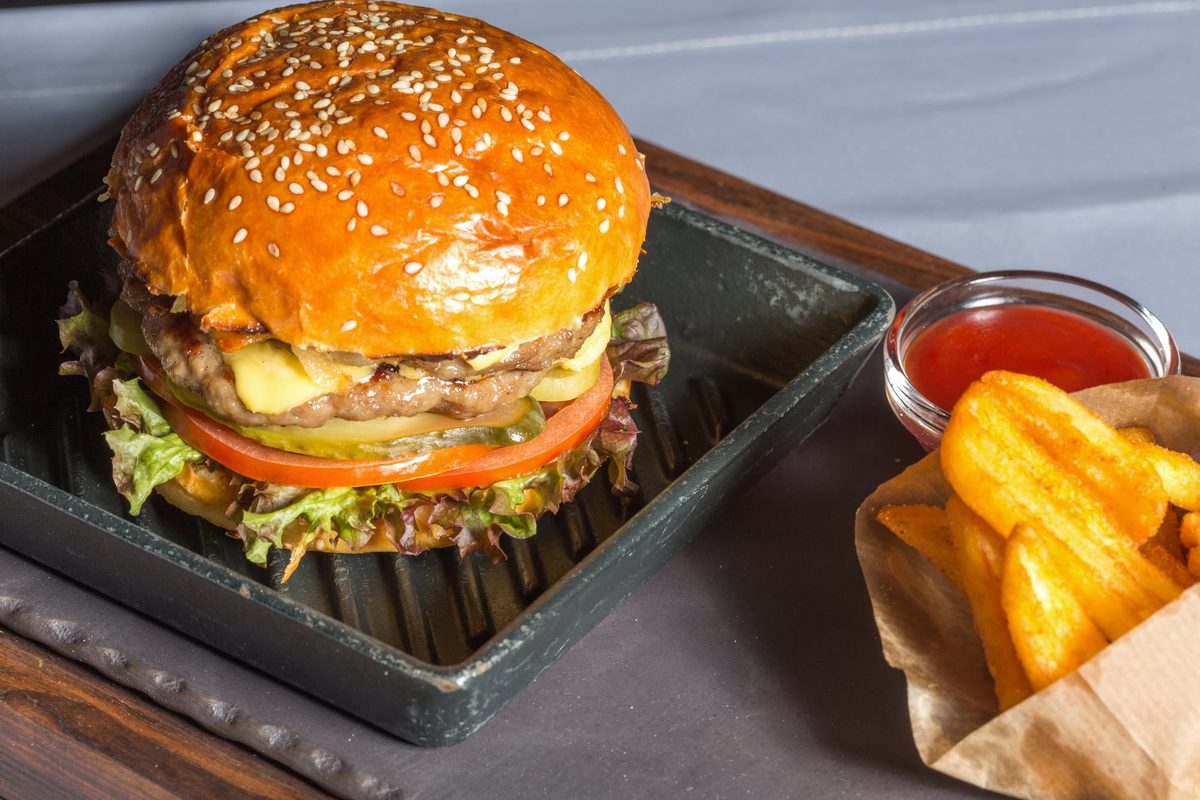
Ground beef already has plenty of flavor, so a burger needs only a few seasonings: salt, black pepper, garlic and onion powder, and often a splash of Worcestershire sauce. The two questions that matter more than the spice list are when to add the salt and how to tell when the burger is done. Quantities below come from named recipes or labels; where none exists, the amount is labeled as a starting point.
At a glance
| Seasoning | Mix in or sprinkle on? | Notes |
|---|---|---|
| Salt | On the outside, right before cooking | Mixed in early, it makes burgers springy and sausage-like1 |
| Black pepper | Either | Grind just before use2 |
| Garlic powder | Either | 1/2 tsp per pound in a University of Idaho recipe3 |
| Onion powder | Either | Adds onion flavor with almost no water45 |
| Worcestershire sauce | Mix in | 1/2 tsp per pound in the same recipe3 |
| Montreal steak seasoning | Sprinkle on | Salt-based; replaces plain salt6 |
| Rosemary, basil | Mix in | Optional herb note; rosemary in the Idaho Greek burger3 |
| Taco seasoning | Mix in | A whole packet per pound in the Idaho Mexican burger3 |
Salt: on the outside, at the last minute
America’s Test Kitchen seasoned burger meat three ways: salt worked in before shaping, salt on the surface 30 minutes ahead, and salt on the surface right before cooking.1 The longer the meat sat with salt, the firmer and springier the burgers were; the batch with salt mixed in was so dense and snappy it resembled sausage.1 ATK explains that salt makes the meat protein myosin more soluble so it forms a gel, which cooks up springy.1 Only the patties salted at the last minute were uniformly tender and juicy, so its advice is to salt burgers right before cooking.1
That also applies to salty blends such as seasoned salt, garlic salt or Montreal steak seasoning: put them on the outside just before the patties hit the heat (Method, following ATK’s salt finding). The salt-free powders below can be mixed in.
Black pepper
Kew calls black pepper one of the earliest known and most widely used spices in the world.7 ATK’s advice is to grind peppercorns just before using them.2 A coarse grind pressed onto the outside of the patty gives a peppery crust; that is kitchen practice. See cracked vs. ground black pepper.
Garlic powder and onion powder
Powders blend evenly into ground meat without the pieces or juice of fresh aromatics, which is why they are the usual choice for burgers (kitchen judgment). A University of Idaho burger recipe uses 1/2 teaspoon garlic powder per pound of ground beef.3 ATK found that garlic powder straight from the jar has not developed its full flavor and recommends hydrating it in a little water first;8 stirring it into the Worcestershire before mixing does the same job (Method).
Onion powder is almost dry: USDA lists 5.39 g of water per 100 g, against 89.1 g in raw onion.45 Grated fresh onion works too, but it adds liquid and loosens the mix. No source gives an onion powder amount for burgers; 1/2 teaspoon per pound, matching the garlic powder, is a reasonable starting point (Method). See onion powder vs. onion and garlic powder vs. garlic.
Worcestershire sauce
Britannica says Worcestershire sauce in its original form included tamarind, soy, garlic, onions, anchovies and spices.9 In a burger it reads as a tangy, savory background note (our description). The University of Idaho’s Greek burger uses 1/2 teaspoon per pound.3 A common claim says Worcestershire keeps burgers from drying out. At half a teaspoon per pound it adds very little liquid, and we found no test showing an effect on juiciness. For a dry form, see Worcestershire powder.
Montreal steak seasoning
Montreal steak spice began as the smoked meat spice at Schwartz’s in Montreal, which a cook there started sprinkling on steaks.10 Sources list different ingredients. McCormick’s Grill Mates label names coarse salt, spices including black pepper and red pepper, garlic, onion, sunflower oil, natural flavor and paprika extractives.6 CBC News lists coriander seed, mustard seed, peppercorns, dried garlic and onion, paprika and salt,10 and Atlas Obscura names coriander and dill alongside pepper and garlic.11 McCormick’s label does not name dill or coriander.6
McCormick’s directions call for 1 tablespoon per pound of beef before grilling, and say the blend is for steaks, burgers and pork.6 Each 1/4-teaspoon serving carries 250 mg of sodium,6 so treat it as the salt, and given ATK’s finding, sprinkle it on the outside just before cooking rather than kneading it in.1 See best spices for steak.
Herbs and other blends
- Rosemary. The University of Idaho’s Greek burger uses 1 teaspoon of fresh or dried rosemary per pound, with garlic powder, Worcestershire and feta.3 See rosemary uses.
- Basil. Not a usual burger seasoning, but fresh basil works in a beef patty or on top. The LSU AgCenter counts basil among the delicate herbs that lose flavor with long cooking,12 so a quick-cooking burger suits it. See cooking with basil.
- Taco seasoning. The Idaho Mexican burger mixes a whole packet into a pound of beef.3 One McCormick packet carries about 2,280 mg of sodium (six servings of 380 mg),13 so add no other salt. See taco seasoning.
- Smoked salt and seasoned salt. See smoked sea salt uses and seasoned salt.
Doneness: 160°F, and don’t trust the color
Federal guidance is to cook ground meat to 160°F.14 FSIS says to measure it with a food thermometer, because research has shown that color and texture are not reliable signs of doneness.15 The University of Idaho’s recipe card says to insert the thermometer into the side of the patty.3 Ground poultry burgers need 165°F.14
Related
- Good spices for meatloaf and good spices for meatballs
- Spices for taco meat
- BBQ spices
- Garlic salt and onion salt
- The master list of herbs and spices
Footnotes
-
“When to Salt Burgers”, America’s Test Kitchen. americastestkitchen.com · Publication ↩ ↩2 ↩3 ↩4 ↩5 ↩6
-
“Savory Spices”, America’s Test Kitchen. americastestkitchen.com · Publication ↩ ↩2
-
Greek Burger and Mexican Burger recipe card, University of Idaho. webpages.uidaho.edu · Reference work ↩ ↩2 ↩3 ↩4 ↩5 ↩6 ↩7 ↩8 ↩9
-
“Spices, onion powder”, FDC ID 171327, USDA FoodData Central. fdc.nal.usda.gov · Regulator ↩ ↩2
-
“Onions, raw”, FDC ID 170000, USDA FoodData Central. fdc.nal.usda.gov · Regulator ↩ ↩2
-
McCormick Grill Mates Montreal Steak Seasoning, ingredients and directions, via ShopRite product listing. shoprite.com · Merchant ↩ ↩2 ↩3 ↩4 ↩5
-
“Piper nigrum L.”, Plants of the World Online, Royal Botanic Gardens, Kew. powo.science.kew.org · Reference work ↩
-
Carolyn Grillo, “For Great Garlic Bread, Hydrate Your Garlic Powder First”, America’s Test Kitchen, 2021. americastestkitchen.com · Publication ↩
-
Michael Raffael, “Worcestershire sauce”, Encyclopaedia Britannica. britannica.com · Reference work ↩
-
Elias Abboud, “‘Tis the seasoning: What’s behind Montreal steak spice”, CBC News, 2019. cbc.ca · Publication ↩ ↩2
-
Anne Ewbank, “Montreal Steak Spice”, Atlas Obscura. atlasobscura.com · Publication ↩
-
“Flavorful Herbs”, LSU AgCenter. lsuagcenter.com · Reference work ↩
-
McCormick Original Taco Seasoning Mix, nutrition label, via Giant Food Stores product listing. giantfoodstores.com · Merchant ↩
-
“Cook to a Safe Minimum Internal Temperature”, FoodSafety.gov, U.S. Department of Health and Human Services. foodsafety.gov · Regulator ↩ ↩2
-
“Color of Cooked Ground Beef as It Relates to Doneness”, USDA Food Safety and Inspection Service. fsis.usda.gov · Regulator ↩