Spice Substitutes · Substitutes
Szechuan Pepper Substitutes: What Can Replace the Numbing Tingle, and What Can’t
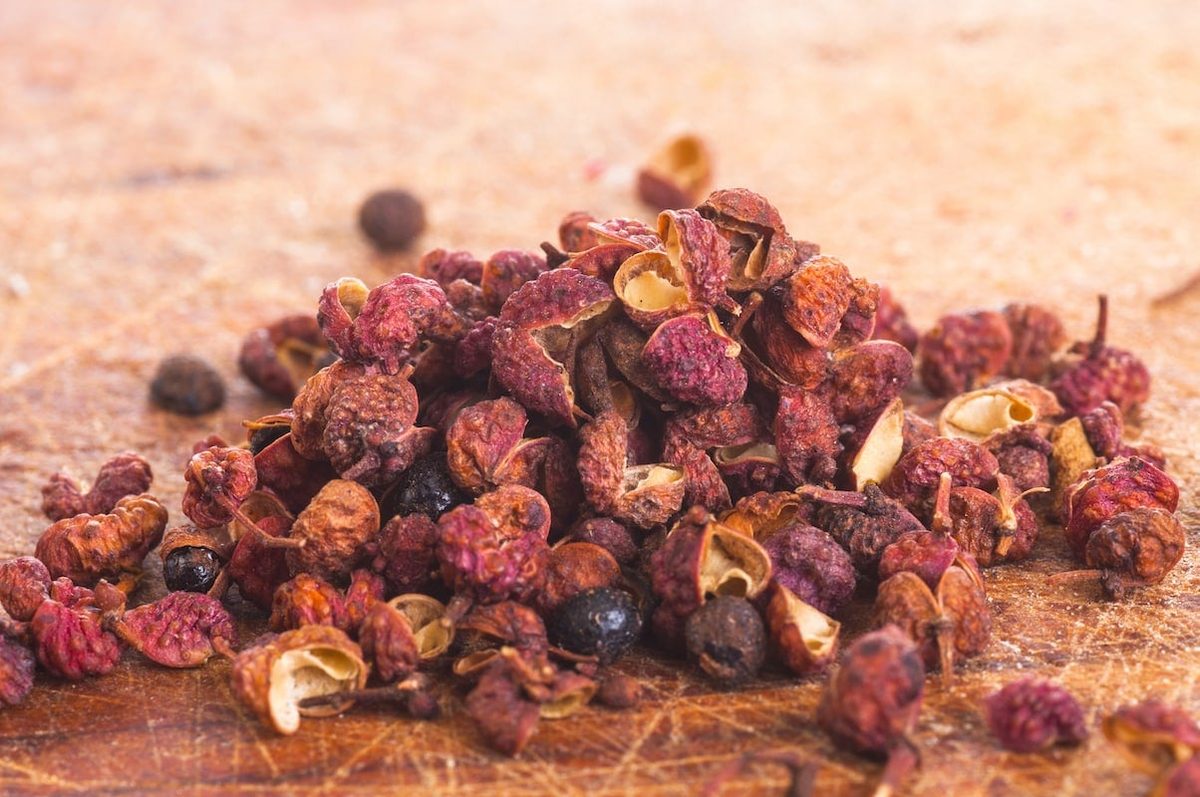
Szechuan pepper (also spelled Sichuan pepper) is not a peppercorn. It is the dried, papery fruit husk of several species of prickly ash (Zanthoxylum), in the rue and citrus family;1 one main species, Z. bungeanum, is native from the Himalaya to China.2 Gernot Katzer describes its aroma as “lemon-like, with more or less pronounced warm and woodsy overtones,”3 and its bite as one that slowly produces “a strangly numbing, almost anaesthetic feeling on the tongue.”3 In Sichuan cooking that numbing (ma) is paired with chile heat (la); Katzer says the two kinds of hotness “very well complement each other.”3 The Woks of Life’s kung pao chicken uses ½ teaspoon of Sichuan peppercorn powder,4 and Britannica lists Szechuan pepper as one of the five spices in Chinese five-spice powder.5
So a substitute has two jobs: the numbing tingle and the citrusy, woody aroma. Only spices from the same genus, plus one Australian berry, do the first.
Quick answer
| What Szechuan pepper is doing | Best substitute | Starting amount, per 1 part Szechuan pepper | Treatment |
|---|---|---|---|
| The numbing tingle (ma la dishes such as kung pao chicken) | Japanese sansho | 1 part in a blend; 1 part on its own, then add | Attributed in a blend; Method on its own |
| The tingle, when red peppercorns are sold out | Green Sichuan peppercorns | 3/4 part, then taste | Method |
| The tingle, with no Zanthoxylum at all | Tasmanian pepperberry | A pinch, then taste | Method |
| Citrusy, woody aroma (five-spice, spiced salt) | Black pepper plus ground coriander seed | 1/2 part each | Method |
| Peppery warmth only | Black or Tellicherry pepper, or grains of paradise | 1/2 part, then taste | Method |
How the ratios on this page are labeled
Every ratio carries one of four labels.
- Computed: based on a measurable physical relationship, with the source named.
- Attributed: a named source publishes this ratio. We quote it as theirs.
- Disputed: named sources give different answers to the same swap. We show each one and do not average them.
- Method: we found no published ratio. We give a direction and a cautious starting point, and say so.
The only Attributed figure is a blend recipe that lists sansho and Sichuan pepper as alternatives. We found no credible published ratio for replacing Szechuan pepper on its own.
Why the tingle is hard to replace
The numbing comes from a specific group of compounds. Katzer says most Zanthoxylum species produce pungent alkamides, chiefly the sanshools,3 and a 2017 systematic review of Z. bungeanum identifies hydroxy-α-sanshool as the compound “most responsible for the unique tingling sensation.”6 Researchers at University College London, who had volunteers match the tingling to a vibrating stimulus, describe it as the equivalent of about 50 light taps per second.7 Black pepper, grains of paradise and chile are hot in other ways and do not produce it. Only the substitutes in the next section tingle.
If you need the numbing tingle
1. Japanese sansho
Sansho (Z. piperitum) is the closest substitute: the same genus, the same kind of tingling compounds.3 Katzer describes Korean chopi, the same species as sansho, as “very similar to Chinese jiao,”3 and The Spice House says the two “both provide a slight tingle and numbness sensation on the tongue.”8
It falls short in strength. Just One Cookbook says the Chinese pepper “has a punchy and strong flavor” while the Japanese pepper “is more delicate,”9 and describes sansho as having a “strong citrus flavor.”9 Expect a brighter, gentler result.
Ratio (Attributed, in a blend): The Daring Gourmet’s shichimi togarashi recipe lists “1 teaspoon sanshō or sichuan peppercorns,”10 using either at the same amount.
Ratio (Method, on its own): No published ratio was found for straight swaps. Start with the same amount of sansho, taste after cooking, and add more if the tingle is too faint. See sansho pepper.
2. Green Sichuan peppercorns
If you can find Sichuan pepper but not the red kind, The Woks of Life suggests looking for the green variety, and says green peppercorns “will usually offer a stronger numbing sensation.”11
Ratio (Method): No published ratio was found. Because the numbing is described as stronger, start with about three quarters as much and taste.
3. Timur and other Zanthoxylum peppers
Katzer names Z. armatum, the source of Nepal’s timur, among the species used for Sichuan pepper in China.3 Its aroma differs: Katzer says it “reminds more of rose and cassia than to lemon,” and that the Nepali spice is significantly more pungent than the Chinese ones.3 See timut pepper.
Ratio (Method): No published ratio was found. Start with half as much and taste.
4. Tasmanian pepperberry
Tasmanian pepper (Tasmannia lanceolata) is unrelated to Szechuan pepper; it is native from southeastern New South Wales to Tasmania.12 It is the one non-Zanthoxylum spice here that numbs. Katzer writes that the berries taste sweet for a second, then give an “intensive pungency which again does not last very long,”13 followed by “a strange sensation of numbness, similar to water pepper and Sichuan pepper.”13 The pungent compound is polygodial,13 not a sanshool, so the effect is similar rather than the same. Katzer says it is used for typical Australian food such as emu burgers and kangaroo steaks.13
Ratio (Method): No published ratio was found. Its pungency is described as intense,13 so start with a pinch of ground berries, taste, and build up.
If you need the aroma
When Szechuan pepper is one spice among several, as in five-spice powder,5 or in the salt-and-pepper condiment Katzer describes, where coarse salt and dried Sichuan pepper “are toasted together until some smoke evolves,”3 its citrusy, woody aroma matters more than the tingle.
1. Black pepper plus coriander seed
Katzer lists geraniol, linalool, cineol and citronellal in the essential oil of Chinese Sichuan pepper.3 Coriander seed shares one of them: its essential oil is 60 to 80 percent linalool.14 Black pepper adds bite, from piperine.15 Together they cover some of the aroma and some of the warmth, but not the tingle. Use ground coriander seed, not fresh cilantro leaves.
Ratio (Method): No published ratio was found. In our judgment, start with half as much black pepper and half as much ground coriander as the Szechuan pepper called for, then taste.
2. Tellicherry pepper
Tellicherry is the former name of Thalassery, a port in Kerala that the British established in 1683 for the pepper and cardamom trade.16 Today the name marks a grade of black pepper: McCormick Science Institute describes grades and varieties of pepper identified by their geographic origin,17 and Pure Indian Foods, which sells it, describes “a citrus-forward brightness that comes through even in cooked dishes.”18 That is a merchant’s description of its own product; we found no comparative study. It is still black pepper, with piperine’s bite and no tingle.15 See Tellicherry pepper.
Ratio (Method): No published ratio was found. Start with half as much, freshly ground, and add coriander (above) if you want more citrus.
If you need peppery warmth only
Grains of paradise
Grains of paradise are the pungent seeds of Aframomum melegueta, a reedlike plant in the ginger family (Zingiberaceae),19 native from West Africa to Angola.20 Katzer lists alligator pepper among their English names,21 describes the taste as “Spicy, hot and warm, a little bitter,”21 and says their hotness is “not as strong as in pepper, but more subtle.”21 Historically, Katzer notes, they were “a common substitute for black pepper” in Europe.21 They do not numb. See grains of paradise.
Ratio (Method): No published ratio was found. Start with half as much, freshly ground, and taste. Use it only where warmth matters more than tingle.
What isn’t known
- No published study compares the tingling strength of Szechuan pepper with sansho, green Sichuan pepper, timur or Tasmanian pepper. Every starting amount above is a judgment.
- Tasmanian pepper is often said to taste of juniper and fennel and to be wild-harvested only in Tasmania. Katzer makes no such comparison and says the plant also grows in Victoria and New South Wales.13
- It is sometimes said that Tellicherry peppercorns are left longer on the vine, or that the name is used regardless of origin. No source reviewed here supports either.
Related
- Szechuan pepper, sansho pepper and sansho pepper substitutes
- Timut pepper, Tellicherry pepper and Tellicherry pepper substitutes
- Grains of paradise, alligator pepper, black pepper, coriander
- Shichimi togarashi, too much pepper?
Footnotes
-
Petruzzello, Sichuan pepper, Encyclopaedia Britannica. britannica.com · Reference work ↩
-
Zanthoxylum bungeanum Maxim., Plants of the World Online, Royal Botanic Gardens, Kew. powo.science.kew.org · Reference work ↩
-
Sichuan pepper (Zanthoxylum species), Gernot Katzer’s Spice Pages. gernot-katzers-spice-pages.com · Reference work ↩ ↩2 ↩3 ↩4 ↩5 ↩6 ↩7 ↩8 ↩9 ↩10
-
Judy, Kung Pao Chicken, The Woks of Life, 2023. thewoksoflife.com · Publication ↩
-
Hill, Five-spice powder, Encyclopaedia Britannica. britannica.com · Reference work ↩ ↩2
-
Zhang et al., Zanthoxylum bungeanum Maxim. (Rutaceae): A Systematic Review, International Journal of Molecular Sciences, 2017. mdpi.com · Peer-reviewed ↩
-
Tingling sensation caused by Asian spice could help patients with chronic pain, University College London, 2013. ucl.ac.uk · Publication ↩
-
Sansho Japanese Pepper, The Spice House. thespicehouse.com · Merchant ↩
-
Chen, Sansho Pepper, Just One Cookbook, 2024. justonecookbook.com · Publication ↩ ↩2
-
Killebrew, Shichimi Togarashi (Japanese 7 Spice Blend), The Daring Gourmet. daringgourmet.com · Publication ↩
-
Sichuan Peppercorns, The Woks of Life, 2022. thewoksoflife.com · Publication ↩
-
Tasmannia lanceolata (Poir.) A.C.Sm., Plants of the World Online, Royal Botanic Gardens, Kew. powo.science.kew.org · Reference work ↩
-
Tasmanian Pepper (Tasmannia lanceolata), Gernot Katzer’s Spice Pages. gernot-katzers-spice-pages.com · Reference work ↩ ↩2 ↩3 ↩4 ↩5 ↩6
-
Al-Khayri et al., Essential Oil from Coriandrum sativum, Molecules, 2023. mdpi.com · Peer-reviewed ↩
-
Black pepper, Encyclopaedia Britannica. britannica.com · Reference work ↩ ↩2
-
Thalassery, Encyclopaedia Britannica. britannica.com · Reference work ↩
-
Black Pepper, McCormick Science Institute. mccormickscienceinstitute.com · Merchant ↩
-
Tellicherry Special Extra Bold Peppercorns, Pure Indian Foods. pureindianfoods.com · Merchant ↩
-
Grains of paradise, Encyclopaedia Britannica. britannica.com · Reference work ↩
-
Aframomum melegueta K.Schum., Plants of the World Online, Royal Botanic Gardens, Kew. powo.science.kew.org · Reference work ↩
-
Grains of Paradise (Aframomum melegueta), Gernot Katzer’s Spice Pages. gernot-katzers-spice-pages.com · Reference work ↩ ↩2 ↩3 ↩4