Spice Substitutes · Substitutes
Tellicherry Pepper Substitutes: Why Any Good Black Peppercorn Comes First
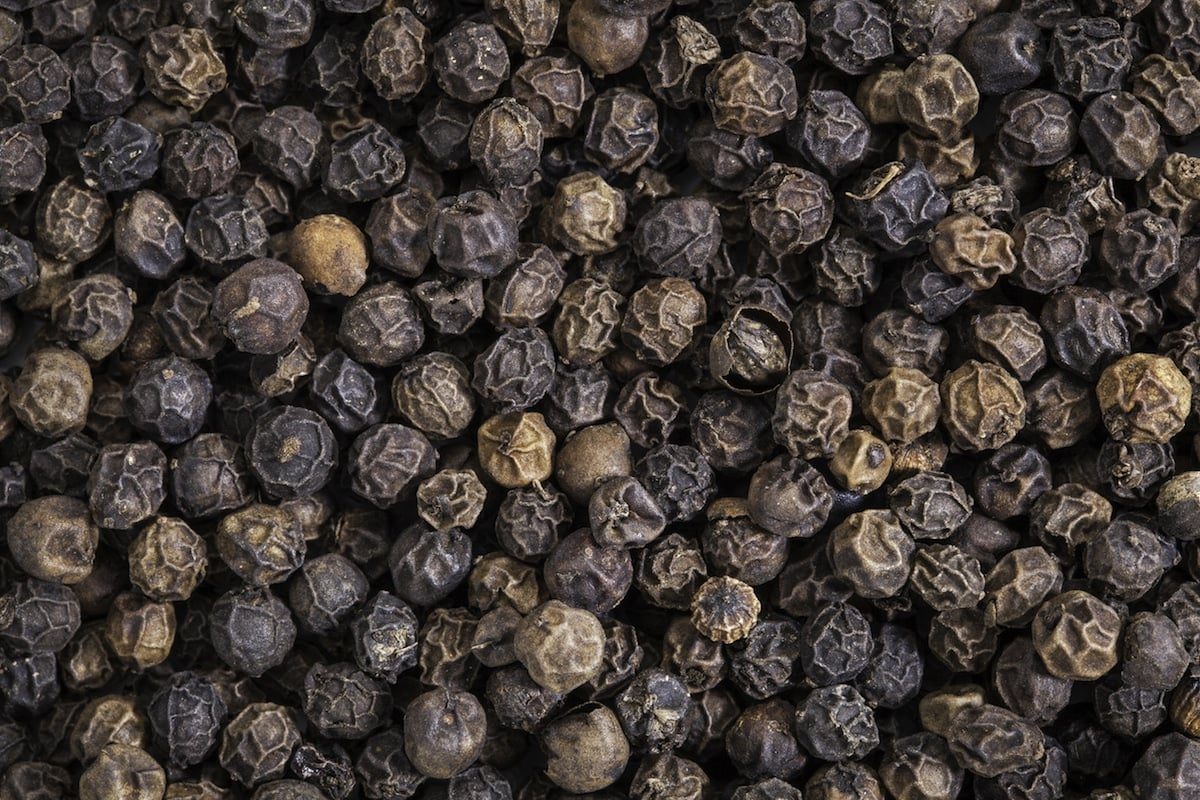
Tellicherry pepper is black pepper, Piper nigrum. The name comes from Tellicherry, the former name of Thalassery, a port in northern Kerala on India’s Malabar Coast.1 McCormick Science Institute describes Tellicherry as one of the grades or varieties of pepper identified by geographic origin, and calls it “widely considered to be the highest quality and most flavorful variety of black pepper,” which is an opinion, not a measurement.2 So the best substitute is simply other black pepper, and the questions are which kind and how much.
Quick answer
| What Tellicherry pepper is doing | Best substitute | Starting amount, per 1 part Tellicherry | Treatment |
|---|---|---|---|
| Freshly ground over food, for aroma and bite | Other whole black peppercorns, freshly ground | 1 part | Method |
| A recipe measures whole Tellicherry peppercorns; you have ground pepper | Ground black pepper | 1 tsp whole = 1 1/2 tsp ground (volume only) | Computed |
| A recipe measures ground Tellicherry | Ground black pepper | 1 part, then taste | Method |
| Heat only, pepper flavor not needed | Cayenne | 1/4 part | Attributed |
| Seasoning a pale sauce or soup | Ground white pepper | 1 part | Attributed |
The rest of the page explains each choice.
How the ratios on this page are labeled
Every ratio carries one of four labels.
- Computed: based on a measurable physical relationship, with the source named.
- Attributed: a named source publishes this ratio. We quote it as theirs.
- Disputed: named sources give different answers to the same swap. We show each one and do not average them.
- Method: we found no published ratio. We give a direction and a cautious starting point, and say so.
The two Attributed ratios are Better Homes & Gardens’ figures for replacing black pepper in general; Tellicherry is black pepper, so they apply, but nobody has published a figure for Tellicherry specifically.
What you are replacing
Tellicherry is a trade name for an origin and a size, not a separate plant:
- Size. Katzer names Malabar and Tellicherry as the most important Indian grades and says Tellicherry corns are larger than typical black peppercorns.3 Pure Indian Foods sells its pepper as TGSEB, “Tellicherry Garbled Special Extra Bold,” and defines Special Extra Bold as a minimum diameter of 4.75 mm.4 That is one seller’s definition.
- Origin. McCormick Science Institute says Tellicherry pepper is from India,2 and Pure Indian Foods gives its own lot as single origin, Malabar Coast, Kerala.4
- No international grade. The Codex standard for black pepper sets three grades by bulk density, light berries, volatile oil, piperine and other measures, and does not mention Tellicherry.5
Inside the berry, the chemistry is black pepper’s. Britannica says pepper’s characteristic flavor comes principally from piperine,6 which PROSEA puts at 4.9 to 7.7 percent of black pepper.7 Katzer describes black pepper’s aroma as dominated by monoterpene hydrocarbons.3 We found no study comparing the piperine or aroma of Tellicherry-grade berries with smaller ones, so any difference in flavor is a matter of reputation and the lot in your jar.
If the pepper is freshly ground over food
This is the job Tellicherry is bought for: whole berries in a grinder, ground over steak, eggs, pasta or salad at the end.
1. Other whole black peppercorns
Any good whole black pepper, freshly ground, is the closest substitute, because it is the same spice. For something close to Tellicherry’s grade, look for a stated origin and a grade code on the label. AramcoWorld quotes spice writers who ask for Malabar grades by name, such as Malabar Garbled No. 1 and Malabar Garbled Extra Bold.8 Other origin-named peppers, such as Lampong or Kampot, are alternatives with their own reputations.
Ratio (Method): We found no published ratio between grades. Use the same amount and adjust to taste. Larger berries may grind differently from small ones in a cheap mill; that is kitchen judgment.
If the recipe measures whole peppercorns and you have ground pepper
Ratio (Computed): McCormick’s conversion is 1 teaspoon of peppercorns to 1 1/2 teaspoons of ground pepper.9 This is a volume figure: ground pepper takes up more room than the whole berries it came from. It says nothing about potency. A jar of pepper ground long ago may taste weaker than pepper ground fresh, in our judgment, so taste before adding the full amount.
If the recipe measures ground Tellicherry pepper
Ratio (Method): No published ratio was found. Use the same amount of ground black pepper, ideally ground fresh from whole peppercorns, and taste. The two are the same spice; the difference is in the lot and its freshness, not in a known conversion.
Add pepper near the end of cooking where you can. In a 1992 study of spices boiled in curry for 15 to 30 minutes, 50 to 60 percent of the piperine was lost.10
If you need heat, not pepper flavor
Cayenne
Cayenne replaces the heat but none of black pepper’s aroma, and it turns a dish red rather than speckling it; that description is ours. In a 2005 study on human heat receptors grown in cultured cells, piperine acted on the same receptor (TRPV1) that capsaicin from chiles activates, but was the less potent of the two.11 That is a laboratory measure, not a taste test.
Ratio (Attributed): Better Homes & Gardens says 1/8 teaspoon of cayenne can replace 1/2 teaspoon of black pepper,12 a quarter of the amount.
If the dish is pale
White pepper
White pepper comes from the same plant; Codex defines it as pepper made from dried berries with the pericarp removed.5 Katzer notes that it is often suggested for cream-based sauces where black pepper could spoil the color, and that black peppercorns are more aromatic than white ones.3 It will replace the bite better than the aroma.
Ratio (Attributed): Better Homes & Gardens gives 1/2 teaspoon of ground white pepper for 1/2 teaspoon of black pepper.12
Substitutes that work less well
| Substitute | Why it falls short |
|---|---|
| Ground ginger | Its pungency comes from gingerols and related compounds, not piperine.13 It adds warmth and its own flavor, not pepper’s. Use it only where ginger already belongs in the dish. |
What isn’t known
- No study compares Tellicherry-grade pepper with smaller black peppercorns for piperine or aroma.
- The official sieve sizes for India’s Tellicherry grades are set by rules we could not open; the 4.75 mm figure is one seller’s.
- It is sometimes said that Tellicherry berries owe their flavor to staying on the vine longer. We found no source for this.
- It is also sometimes said that most Tellicherry pepper is grown in Vietnam. The sources we found describe Tellicherry as Indian pepper.24 Vietnam is the largest producer of black pepper in general: McCormick Science Institute lists it first among 2022’s top producers.2
Related
- Tellicherry pepper and Tellicherry pepper vs. black pepper
- Black pepper, black pepper substitutes, Malabar pepper, Lampong pepper, Kampot pepper
- White peppercorns, white pepper substitutes, cracked vs. ground black pepper
- Cayenne pepper, black pepper vs. cayenne, ginger, too much pepper
Footnotes
-
“Thalassery”, Encyclopaedia Britannica. britannica.com · Reference work ↩
-
“Black Pepper”, McCormick Science Institute. mccormickscienceinstitute.com · Merchant ↩ ↩2 ↩3 ↩4
-
Gernot Katzer, “Black Pepper (Piper nigrum L.)”, Gernot Katzer’s Spice Pages. gernot-katzers-spice-pages.com · Reference work ↩ ↩2 ↩3
-
Tellicherry Special Extra Bold Peppercorns, product page, Pure Indian Foods. pureindianfoods.com · Merchant ↩ ↩2 ↩3
-
Standard for Black, White and Green Peppers, CXS 326-2017, Codex Alimentarius. fao.org · Standard ↩ ↩2
-
“Black pepper”, Encyclopaedia Britannica. britannica.com · Reference work ↩
-
Piper nigrum, Plant Resources of South-East Asia (PROSEA). uses.plantnet-project.org · Reference work ↩
-
Jeff Koehler, “Spice Migrations: Pepper”, AramcoWorld, 2021. aramcoworld.com · Publication ↩
-
How to Grind Your Own Spices, McCormick, 2025. mccormick.com · Merchant ↩
-
Srinivasan, Sambaiah and Chandrasekhara, “Loss of active principles of common spices during domestic cooking”, Food Chemistry, 1992. agris.fao.org · Peer-reviewed ↩
-
McNamara, Randall and Gunthorpe, “Effects of piperine, the pungent component of black pepper, at the human vanilloid receptor (TRPV1)”, British Journal of Pharmacology, 2005. pmc.ncbi.nlm.nih.gov · Peer-reviewed ↩
-
100 Emergency Ingredient Substitutions, Better Homes & Gardens. static.onecms.io · Publication ↩ ↩2
-
Sutarno, Hadad and Brink, Zingiber officinale, Plant Resources of South-East Asia (PROSEA). uses.plantnet-project.org · Reference work ↩