Spice Comparisons · Comparison
Bay Leaves vs. Basil: Two Unrelated Herbs That Do Opposite Jobs
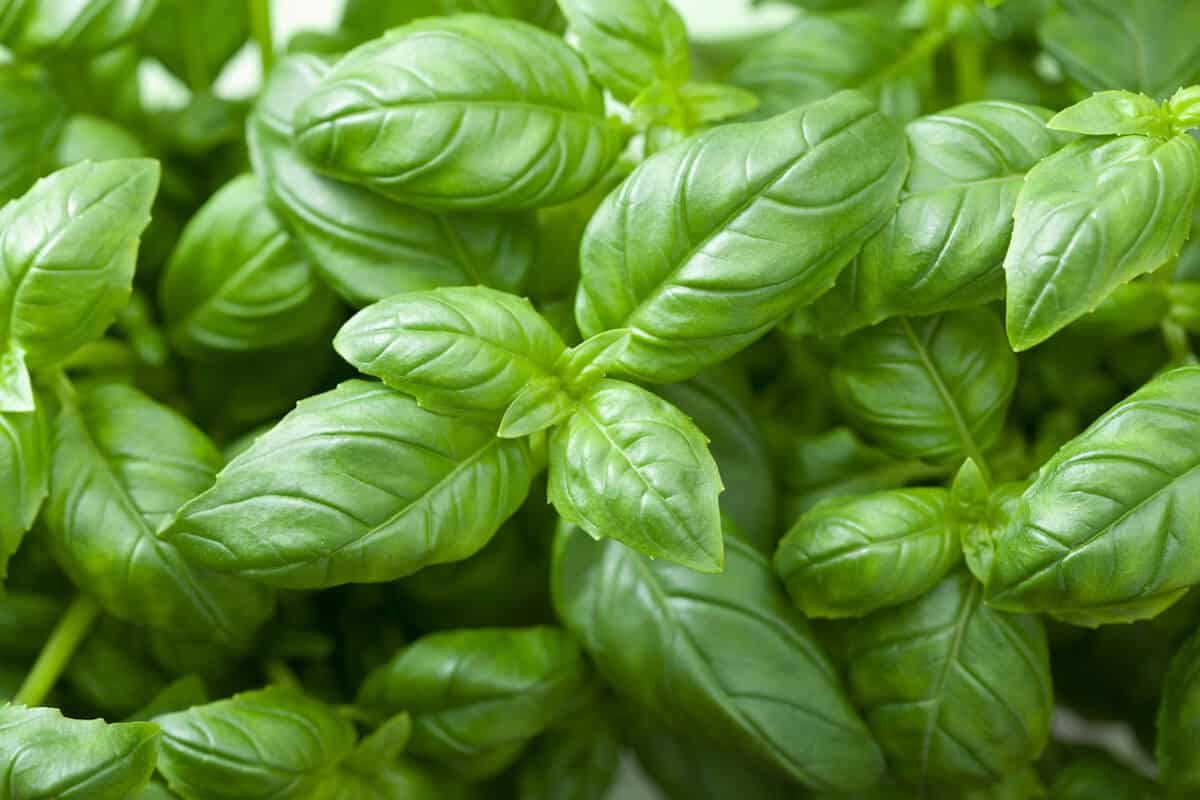
Bay leaves and basil are not related and do not do the same job. Bay is the tough, dried leaf of the bay laurel tree, put into a pot whole to give a long-simmered liquid a quiet herbal background and taken out before serving.12 Basil is a tender herb in the mint family, at its best fresh and added at the end or not cooked at all.34 The University of Delaware’s extension service even puts them in different strength classes: bay among the strong or dominant flavors, basil among the medium ones.5
Side by side
| Bay leaves | Basil | |
|---|---|---|
| Species | Laurus nobilis (bay laurel)1 | Ocimum basilicum (sweet basil)36 |
| Family | Lauraceae (laurel family)1 | Lamiaceae (mint family)3 |
| Plant | Tree1 | Annual or subshrub, extremely frost-sensitive36 |
| Native range | Mediterranean1 | Tropical and subtropical Asia to northern Australia3 |
| Part used | Leaves, usually dried7 | Leaves, fresh or dried6 |
| The leaf | Leathery, narrowly elliptic to ovate, 5 to 10 cm long, glossy dark green above8 | Glossy, oval, smooth or slightly toothed edges that typically cup slightly6 |
| Leading aroma compounds | 1,8-Cineole, sabinene, linalool (one Italian sample)7 | Methyl chavicol (estragole) and linalool, in proportions that vary by type96 |
| Strength class | Strong or dominant5 | Medium5 |
| Flavor | Very subtle on its own (López-Alt); herbal, bitter and slightly piney (Atlas Obscura)210 | Sweet and green, with a peppery, faintly anise-like edge (editorial) |
| Forms sold | Whole dried leaves, crushed, ground | Fresh, dried, ground dried |
| Typical uses | Stocks, soups, braises, beans; the French bouquet garni; garam masala1112 | Pizza, pasta and pesto in Italy; omelets and soups in France; Thai cooking9 |
| Safety | Whole leaves are a physical hazard if swallowed (see below)1314 | Estragole, assessed by EU and German regulators (see below)1516 |
For more on each herb, see the bay leaves and basil profiles.
The difference in the oil
Both herbs owe their aroma to a volatile leaf oil, but the oils are built differently. The figures below come from separate studies, so they show which compounds lead, not a like-for-like measurement.
| Sample (scope) | Main compounds, % of oil | Source |
|---|---|---|
| Bay leaf oil, leaves gathered at Montecorice, southern Italy, February 2016 | 1,8-Cineole 31.9, sabinene 12.2, linalool 10.2 | Caputo et al. 20177 |
| Bay leaf oil, other studies compared in the same review | 1,8-Cineole 44.97 (Turkey), 56.0 (Tunisia), 58.59 (Cyprus), 52.43 (Morocco), 34.62 (Algeria) | Caputo et al. 20177 |
| “French basil” oil distilled in the Philippines | Methyl chavicol 53.3, linalool 22.0, eugenol 1.4 | PROSEA9 |
| Sweet basil oil, range in the EU assessment | Estragole 20 to 43 | EU Scientific Committee on Food15 |
The two oils share linalool, but bay is led by 1,8-cineole and basil by estragole (another name for methyl chavicol).79 PROSEA describes French-type basil oil as sweet-spicy, slightly green and fresh.9 That is a different direction from bay’s herbal, slightly piney character.10
Differences that change the dish
When each goes in. Bay needs time in liquid; that is common practice, and it is why bay suits stocks and braises. America’s Test Kitchen found that hardy dried herbs such as thyme, rosemary and sage held up reasonably well in dishes with fairly long cooking times (more than 20 minutes) and a good amount of liquid,17 the same conditions bay is used in. Basil works the other way. LSU AgCenter groups it with the delicate herbs best added a minute or two before cooking ends, because long heat costs flavor and aroma.4 For long-simmered dishes generally, the University of Delaware suggests adding herbs in the last 45 minutes, or part at the start and the rest later.5
Whether it stays in. Basil is eaten. Bay is not: whole leaves stay tough, and López-Alt compares the texture to a fish bone.2 There is also a safety reason, covered below.
Fresh versus dried. Bay is almost always used dried. Basil is the opposite: America’s Test Kitchen lists basil among the herbs to use fresh rather than dried.18 Dried basil still has a place in cooked tomato sauces, but not in pesto or as a garnish; that is our judgment.
Together. The two can share a pot, bay simmering in a tomato sauce from the start and basil going in at the end. That is common practice rather than a sourced pairing.
Can one stand in for the other?
Not well, and no source we found recommends either swap.
- Basil for bay. The reviewed substitutes for bay are dried thyme first and dried oregano second. The Spice House and Tasting Table both give 1/4 teaspoon of dried thyme per bay leaf (Attributed), and The Spice House gives the same for dried Greek oregano.1920 Basil is a poor fit for bay’s long simmer because it is a delicate herb meant to go in late.4 If dried basil is all you have, the honest Method answer is to leave the bay out: López-Alt considers bay optional in most dishes.2 See bay leaf substitutes.
- Bay for basil. Bay cannot replace basil anywhere basil is the point: pesto, a raw garnish, a tomato salad. In a long-simmered sauce, one bay leaf adds its own background note but not basil’s sweetness. No ratio exists for this swap; we would not make it.
Safety
Bay. Bay leaves are not poisonous; Atlas Obscura calls that belief a misconception.10 The hazard is physical. Doctors have reported two cases of bay leaves lodged in the esophagus,13 and one in which a 2 cm piece of bay leaf penetrated the bowel wall; the authors note that the leaves are rigid, can have sharp points and edges, and stay intact.14 These are case reports, which show the risk exists, not how common it is. Count the leaves in and count them out.
Basil. In 2001 the EU Scientific Committee on Food concluded that estragole, the leading compound in many basil oils, is genotoxic and carcinogenic, based mainly on studies in mice, and could not set a safe exposure limit.15 In 2022 Germany’s BfR said the risk from estragole and related compounds in food cannot yet be conclusively assessed and made no consumption recommendation for consumers.16 Neither body tells people to stop eating basil.
What isn’t known
- No study compares the oils of bay and basil measured the same way; the figures above come from separate studies.
- No source we found describes how bay’s flavor changes between fresh and dried leaves.
- No published ratio exists for swapping bay and basil in either direction.
Related
- Bay leaves and basil profiles
- Bay leaf substitutes
- Curry leaves vs. bay leaves and crushed vs. whole bay leaves
- Basil vs. oregano, basil vs. mint and basil vs. Thai basil
- Cooking with bay leaves, cooking with basil and basil uses
- Too much bay leaf and too much basil
Footnotes
-
Laurus nobilis L., Plants of the World Online, Royal Botanic Gardens, Kew. powo.science.kew.org · Reference work ↩ ↩2 ↩3 ↩4 ↩5
-
David Leite with J. Kenji López-Alt, “Bay leaves are an optional ingredient, ‘but things are definitely better with them’”, The Splendid Table, 2014. splendidtable.org · Publication ↩ ↩2 ↩3 ↩4
-
Ocimum basilicum L., Plants of the World Online, Royal Botanic Gardens, Kew. powo.science.kew.org · Reference work ↩ ↩2 ↩3 ↩4 ↩5
-
“Flavorful Herbs”, LSU AgCenter. lsuagcenter.com · Reference work ↩ ↩2 ↩3
-
“Using Herbs and Spices”, University of Delaware Cooperative Extension, 2025. udel.edu · Reference work ↩ ↩2 ↩3 ↩4
-
“Basil”, Encyclopaedia Britannica, 2026. britannica.com · Reference work ↩ ↩2 ↩3 ↩4 ↩5
-
Caputo et al., “Laurus nobilis: Composition of Essential Oil and Its Biological Activities”, Molecules, 2017. mdpi.com · Peer-reviewed ↩ ↩2 ↩3 ↩4 ↩5
-
Laurus nobilis, Landscape Plants, Oregon State University. landscapeplants.oregonstate.edu · Reference work ↩
-
N.O. Aguilar, Pham Truong Thi Tho and L.P.A. Oyen, Ocimum basilicum, Plant Resources of South-East Asia (PROSEA). uses.plantnet-project.org · Reference work ↩ ↩2 ↩3 ↩4 ↩5
-
Andrew Coletti, “What Is a Bay Leaf, Exactly?”, Atlas Obscura, 2023. atlasobscura.com · Publication ↩ ↩2 ↩3
-
“Bouquet garni”, Encyclopaedia Britannica. britannica.com · Reference work ↩
-
“How to make garam masala”, Great British Chefs, 2025. greatbritishchefs.com · Publication ↩
-
Ahmed and McCormick, “Bay-leaf: an unusual oesophageal foreign body”, J Laryngol Otol, 1993. cambridge.org · Peer-reviewed ↩ ↩2
-
Bell and Mustard, “Bay leaf perforation of Meckel’s diverticulum”, Can J Surg, 1997. canjsurg.ca · Peer-reviewed ↩ ↩2
-
Opinion of the Scientific Committee on Food on Estragole, European Commission, 2001. food.ec.europa.eu · Regulator ↩ ↩2 ↩3
-
“Alkenylbenzenes in food: how large is the health risk?”, BfR Communication No. 22/2022. bfr.bund.de · Regulator ↩ ↩2
-
“Science: Substituting Dried Herbs for Fresh”, America’s Test Kitchen. americastestkitchen.com · Publication ↩
-
Danielle Lapierre, “When You Should Actually Use Dried Herbs (and Which Ones to Avoid)”, America’s Test Kitchen, 2022. americastestkitchen.com · Publication ↩
-
“Bay Leaf Substitute”, The Spice House, 2021. thespicehouse.com · Merchant ↩
-
Cassie Womack, “If You’re Out Of Bay Leaves, Use Dried Thyme”, Tasting Table, 2024. tastingtable.com · Publication ↩