Seasonings · Profile
Baharat Seasoning: What Goes Into It, Regional Versions and Uses
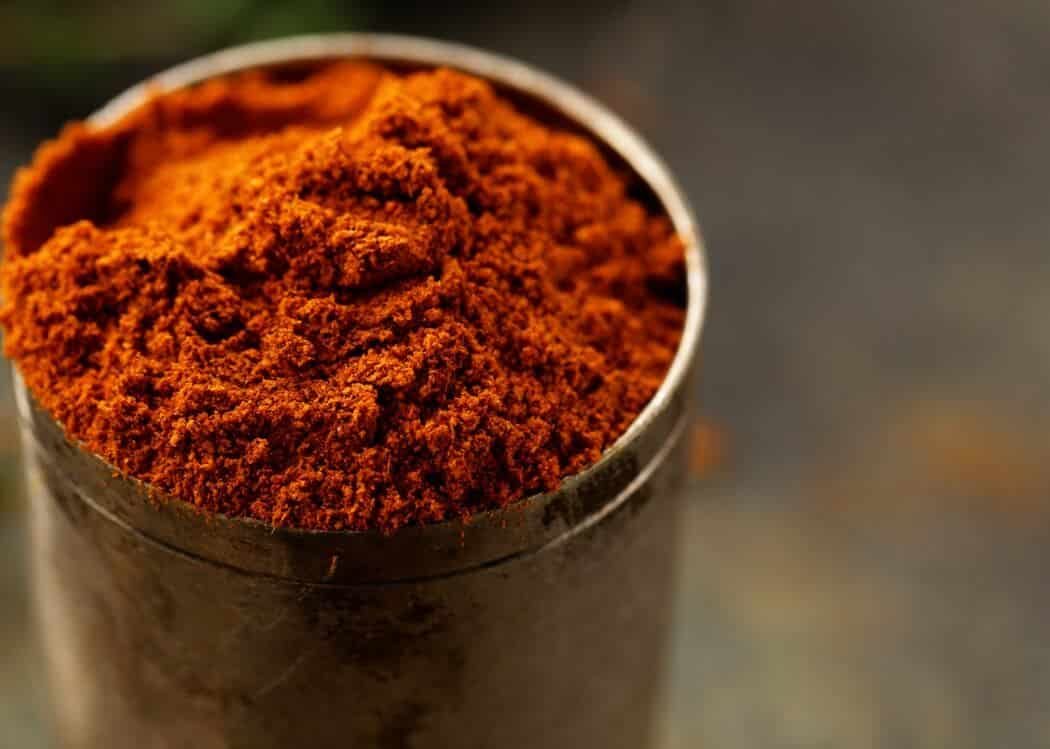
Baharat is a ground spice blend used from the Persian Gulf to the eastern Mediterranean, built on black pepper with warm spices such as cumin, coriander, cinnamon, cloves, cardamom, nutmeg and allspice. The name simply means “spices.”12 There is no fixed recipe: the Gulf version can be fiery with chile, the eastern Mediterranean one can be little more than black pepper and allspice, and Turkish cooks use a related mix with dried mint.13
At a glance
| What it is | A ground blend of pungent and sweet spices; no fixed recipe14 |
| Name | Arabic for “spices”; an archaic plural of bahar, spice12 |
| Regions | Gulf countries; the eastern Mediterranean; a related Turkish mix13 |
| Common components | Black pepper, cumin, coriander, cinnamon, nutmeg; often cloves, cardamom, allspice; sometimes paprika or chile2456 |
| Heat | Ranges from mild to fiery depending on chile124 |
| Main uses | Lamb and mutton, kebabs, stews, machboos; as a rub for meat and fish1745 |
| Keeps | Up to 3 months (RecipeTin Eats); up to a year (University of Nebraska–Lincoln Extension)46 |
The name
Katzer explains that baharat is an archaic Arabic plural of bahar, “spice,” so the name means something like “the spices.”1 Ottolenghi, RecipeTin Eats and Darina Allen all give the same meaning.245 The same root turns up in the Turkish word for allspice, yenibahar, literally “new spice.”8
What is in it
These five published recipes and one merchant label show the range:
| Ingredient | Ottolenghi (label) | RecipeTin Eats (Lebanese 7-spice style) | Darina Allen | UNL Extension | Saveur, Turkish baharat karisimi |
|---|---|---|---|---|---|
| Black pepper | yes | 1 1/2 tsp | 2 tsp | 2 tbsp peppercorns | 1 tsp |
| Cumin | yes | 3/4 tsp | 1 1/2 tbsp | 2 tbsp seeds | 1/2 tsp |
| Coriander | yes | 2 1/4 tsp | 2 tsp | 2 tbsp seeds | none |
| Cinnamon | yes | 1 tbsp | 1 tbsp | 2 tsp | 1/2 tsp |
| Nutmeg | yes | 3/8 tsp | 2 tsp | 1/2 tsp | 1/2 tsp |
| Cloves | yes | 3/8 tsp | none | 2 tsp whole | none |
| Cardamom | yes | none | 1 tsp | 2 tsp seeds | none |
| Allspice | yes | 1 tbsp | 1 tsp | none | none |
| Paprika or chile | paprika, chilli, cayenne | none | none | 2 tbsp paprika | none |
| Other | none | none | none | none | Dried mint, winter savory, pickling spice |
Sources: Ottolenghi,2 RecipeTin Eats,4 Darina Allen,5 UNL Extension,6 Saveur.3
Katzer describes the Gulf form as a combination of pungent spices (black pepper, chiles and paprika) with aromatic ones (nutmeg, cloves, cinnamon and cardamom) plus cumin and coriander, and the eastern Mediterranean form as a simpler mix of mainly black pepper and allspice.1 RecipeTin Eats, writing in the Lebanese “7 spice” style, says the blend varies from region to region and from family to family.4
Turkish baharat
Saveur says seasoning mixtures of this kind are common in kitchens throughout Turkey; its version adds dried mint and winter savory to cinnamon, nutmeg, cumin and black pepper, plus a spoonful of pickling spice.3 That makes it more herbal than the Arab blends above, not just the same blend with mint.
Flavor and the compounds behind it
Baharat tastes warm and peppery, with clove and allspice giving a sweet, almost medicinal note and cumin an earthy base. Where paprika or chile is in the mix, it is red, fuller and hotter. That description is ours. Its chemistry is the chemistry of the individual spices:
| Spice | Key compound | What has been measured | Source |
|---|---|---|---|
| Black pepper | Piperine | The primary pungent alkaloid (not an essential oil) | 9 |
| Coriander seed | Linalool | 60–80% of the seed oil (review) | 10 |
| Cumin | Cuminaldehyde | 20–72% of the oil (range in the literature) | 11 |
| Cinnamon (Ceylon) | Cinnamaldehyde | About 49.9–62.8% of bark oil (systematic review) | 12 |
| Allspice | Eugenol | 50–80% of the berry oil | 13 |
| Clove | Eugenol | About 85–92% of clove oil (review) | 14 |
| Cardamom | 1,8-cineole | 0.24–30.62% of the oil across samples in one 2025 study | 15 |
Allspice and cloves share eugenol as the main component of their oils.1314 No published aroma analysis of a baharat blend was reviewed for this page.
How baharat is used
- Lamb and mutton. Katzer says baharat is mainly used for mutton dishes.1 Saveur pairs its Turkish mix with marinated grilled lamb skewers.3
- Kebabs, kofta and stews. Darina Allen uses it to spice Middle Eastern kebabs and stews.5 RecipeTin Eats uses it in kofta, arayes and meatballs, as a rub for chicken, lamb chops or fish before pan-frying or barbecuing, and on vegetables before roasting.4
- Machboos. Katzer notes that baharat is often used to give the dish machboos a slight piquancy.7
- Everyday seasoning. Ottolenghi calls baharat an aromatic, everyday spice and compares its role in the Middle East to garam masala’s in India.2 UNL Extension suggests it for meat, fish, soups, rice, beans and vegetables.6
Technique
Katzer says baharat is usually fried briefly in oil or clarified butter to bring out its fragrance.1 The same oil can then be used to baste meat or vegetables; that is a cook’s suggestion rather than a sourced practice.
Buying and quality
There is no standard for baharat, so the label decides what you get. Check whether paprika or chile is listed (it changes the heat and color a lot), whether allspice is present, and whether salt has been added. UNL Extension toasts whole peppercorns, cumin, coriander, cloves and cardamom before grinding.6
Storage
RecipeTin Eats says its blend keeps up to 3 months in an airtight jar in a cool, dry place.4 Saveur gives up to 3 months for its Turkish mix, away from direct sunlight.3 UNL Extension gives up to a year in an airtight container in a cool, dark place.6 These are each publisher’s guidance, not measured shelf lives. The University of California Cooperative Extension lists air, light, moisture and heat as the factors that speed flavor and color loss in spices.16
Safety
Mycotoxins in chile-containing blends. Where baharat contains paprika, chile or cayenne, EU law caps ochratoxin A in dried Capsicum products at 20 µg/kg, aflatoxin B1 at 5.0 µg/kg and total aflatoxins at 10.0 µg/kg.17
Lead in spices. A New York City health department review of 1,496 spice samples from 41 countries, collected 2008 to 2017, found detectable lead in more than half; spices bought abroad had higher average levels.18 The abstract does not report results by blend.
Health claims
No regulator or systematic review we found supports health claims for baharat as a blend, and this page makes none. Claims that it improves digestion, lowers blood pressure or protects vision through its vitamin A could not be traced to any credible source.
Substitutes and related pages
For stand-ins, see baharat substitutes. Related blends: ras el hanout, hawaij, advieh, za’atar and garam masala.
The individual spices: black pepper, cumin, coriander, cinnamon, nutmeg, cloves, cardamom, allspice, paprika and mint. Comparisons: cloves vs. cinnamon, allspice vs. cloves and allspice vs. black pepper. If a dish has too much of one note, see too much cumin, too much allspice or too much cinnamon. For more blends, see the list of herbs and spices.
Footnotes
-
Gernot Katzer, “Paprika (Capsicum annuum)”, Gernot Katzer’s Spice Pages. gernot-katzers-spice-pages.com · Reference work ↩ ↩2 ↩3 ↩4 ↩5 ↩6 ↩7 ↩8 ↩9 ↩10 ↩11
-
“Baharat”, Ottolenghi (product page). ottolenghi.co.uk · Merchant ↩ ↩2 ↩3 ↩4 ↩5 ↩6 ↩7
-
“Turkish Herb and Spice Mix (Baharat Karisimi)”, Saveur, 2007. saveur.com · Publication ↩ ↩2 ↩3 ↩4 ↩5 ↩6
-
Nagi Maehashi, “Baharat”, RecipeTin Eats, 2026. recipetineats.com · Publication ↩ ↩2 ↩3 ↩4 ↩5 ↩6 ↩7 ↩8 ↩9 ↩10
-
Darina Allen, “Baharat Spice Blend”, Irish Examiner. irishexaminer.com · Publication ↩ ↩2 ↩3 ↩4 ↩5
-
“Baharat (Mezcla de Especias del Medio Oriente)”, University of Nebraska–Lincoln Extension. food.unl.edu · Reference work ↩ ↩2 ↩3 ↩4 ↩5 ↩6
-
Gernot Katzer, “Damask Rose (Rosa damascena)”, Gernot Katzer’s Spice Pages. gernot-katzers-spice-pages.com · Reference work ↩ ↩2
-
Gernot Katzer, “Allspice (Pimenta dioica)”, Gernot Katzer’s Spice Pages. gernot-katzers-spice-pages.com · Reference work ↩
-
McNamara, Randall and Gunthorpe, “Effects of piperine at the human vanilloid receptor (TRPV1)”, British Journal of Pharmacology, 2005. pmc.ncbi.nlm.nih.gov · Peer-reviewed ↩
-
Al-Khayri et al., “Essential Oil from Coriandrum sativum: A Review”, Molecules, 2023. mdpi.com · Peer-reviewed ↩
-
P.C.M. Jansen, Cuminum cyminum, Plant Resources of South-East Asia (PROSEA). uses.plantnet-project.org · Reference work ↩
-
Ranasinghe et al., “Medicinal properties of ‘true’ cinnamon: a systematic review”, BMC Complementary and Alternative Medicine, 2013. link.springer.com · Peer-reviewed ↩
-
D. Sulistiarini, Pimenta dioica, Plant Resources of South-East Asia (PROSEA). uses.plantnet-project.org · Reference work ↩ ↩2
-
Batiha et al., “Syzygium aromaticum L. (Myrtaceae)”, Biomolecules, 2020. mdpi.com · Peer-reviewed ↩ ↩2
-
Blažeković et al., “Content and Chemical Composition of Essential Oil from Cardamom”, Croatica Chemica Acta, 2025. hrcak.srce.hr · Peer-reviewed ↩
-
Add a Little Spice to Your Life! Part II, University of California Cooperative Extension. ucanr.edu · Reference work ↩
-
Commission Regulation (EU) 2023/915, EUR-Lex. eur-lex.europa.eu · Regulator ↩
-
Hore et al., “A Spoonful of Lead”, Journal of Public Health Management and Practice, 2019. scholars.mssm.edu · Peer-reviewed ↩